
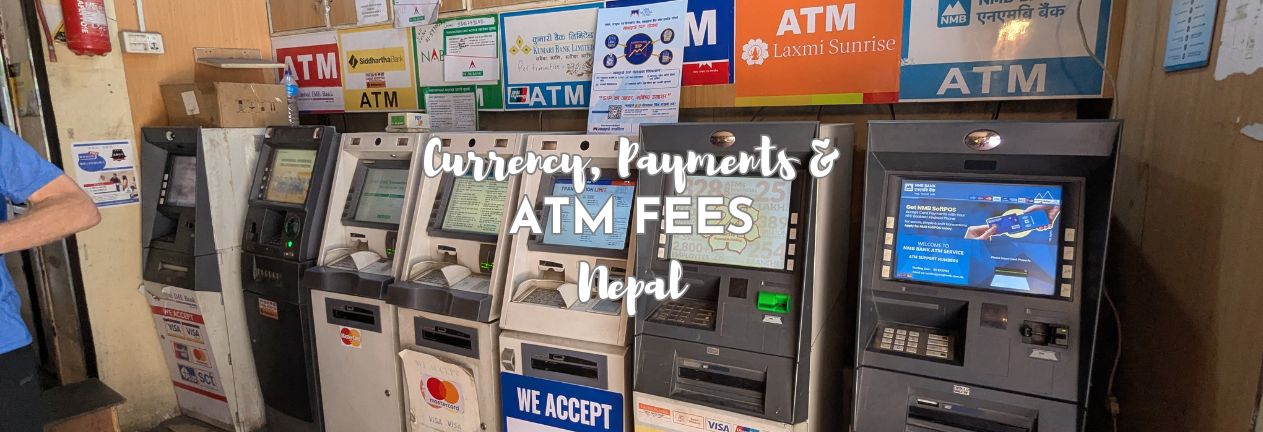
Many people, like us, visit Nepal on a longer trip and need to plan how to pay for it. Oh, I don’t mean whether you’ve got the money in the bank, I mean how to get the money to the providers of service that you’re using. Whether that’s a trekking company in Nepal, a guide in Chitwan National Park, a bus that you need to take, or simply a hotel or hostel room you need to pay for. Cards are a lot more accepted than they were when we first visited 11 years ago, but cash still goes a long way here. This is my guide to currency, payments, and ATM fees in Nepal.
THIS POST MAY CONTAIN COMPENSATED AND AFFILIATE LINKS MORE INFORMATION IN OUR DISCLAIMER
Cards are accepted in parts of Kathmandu and Pokhara. You’ll even find some tea houses in the Annapurna region where you can pay with a Wise account, but step into one of the knock-off trekking gear stores in Thamel, or try to get a taxi from Tribhuvan International Airport to the city, and you’ll be reaching for cash. And by cash, I mean Nepali Rupees. In this guide, I’ll cover what currency you can use in Nepal, how to make payments, what hidden fees you might find, and all the ways you can reduce the bank fees that might hit you when paying for things. In this guide, I’ll walk you through exactly how money works in Nepal in 2026—how to access cash, what fees to expect, whether cards are worth using, and how to avoid paying more than you need to.
PRACTICAL TRAVEL TIPS
- 🛡️ Considering travel insurance for your trip? World Nomads offers coverage for more than 150 adventure activities as well as emergency medical, lost luggage, trip cancellation and more.
- 💵 Read about cash, currency, payments and ATM Fees in Nepal here.
- 🔌 Always be charging – best plug adapter for Nepal.
- 📶 Get online EASILY & cheaply – One eSim for the world. Data never expires
Nepal Currency at a Glance
- Currency: Nepalese Rupee (NPR)
- Cash: Essential for most day-to-day spending
- Cards: Accepted in cities, limited elsewhere
- ATMs: Widely available but ALWAYS charge fees
What is the Currency in Nepal?
The currency used in Nepal is the Nepalese Rupee (NPR). It’s considered a closed currency, which means that it can’t be easily bought or sold outside of the country. That’s not to say that you can’t buy them outside the country, just that it’s more difficult.
NPR’s are generally notes, although there are 1 and 2 rupee coins, they’re rarely used. There are 100 paisa in a rupee, but this is mainly historic, and you won’t see these either.
Using ATMs in Nepal
ATMs are easy to find in Kathmandu and Pokhara, and you’ll also find a few in places like Sauraha near Chitwan National Park. They generally work with international cards, but there are a few things to keep in mind.
Withdrawal limits are lower than in many other countries, often between 20,000 and 40,000 NPR per transaction. That means you may need to make multiple withdrawals if you need more cash. There is always a withdrawal fee, and there are also limits on how many withdrawals you can make in a day.
ATM Fees in Nepal
ATM fees are the biggest downside of using cash machines in Nepal.
You’ll typically be charged:
- A local bank fee per withdrawal. This is primarily what I’m writing about, as you can avoid the next two points.
- A fee from your own bank. (Fees from your own bank applied when you withdraw from foreign ATMs can be avoided by getting a different ATM card. The best options vary by your home country, but the best worldwide option is Wise.)
- A possible currency conversion fee. Currency conversion fees are sometimes applied by foreign ATMs, and they’re to be avoided at all costs. They are desperately bad rates, and the ATM provider is the only one who wins in this game
Back to that local bank fee in Nepal – because the local fee is charged per transaction, making multiple smaller withdrawals can quickly become expensive. If you’re using ATMs, it ALWAYS makes sense to take out the maximum amount each time.
ATM Fees by Bank in Nepal
ATM fees are charged at every machine in Nepal, and limits and reliability vary quite a bit depending on the bank. Here’s what you can expect based on usage in 2026. If you have other experiences, then let me know in the comments, and I’ll update this as a resource for everyone.
| Provider | Typical Withdrawal Limit | Observed Fees | Notes | Date |
| Nabil Bank | Max 35,000 NPR | 660–850 NPR | 660 was the fee in Kathmandu, 850 was the fee in Sauraha. | April 2026 |
| Kumari Bank | Max 40,000 NPR | 850 NPR | Higher withdrawal limit, higher fee, | April 2026 |
| Siddhartha Bank | Foreign cards not accepted | Foreign cards not accepted | Foreign cards not accepted | April 2026 |
| Prabhu Bank | 25,000 NPR | 625 NPR | April 2026 | |
| Global IMEI Bank | 20,000 NPR | 600 NPR | Lower withdrawal limit | April 2026 |
| NIC Asia | Foreign cards not accepted | Foreign cards not accepted— | Did not work with foreign cards | April 2026 |
| Machhapuchchhre Bank | 35,000 NPR | 650 NPR | April 2026 | |
| NMB Bank | 35,000 NPR | 660 NPR | April 2026 | |
| Standard Chartered | 20,000 NPR | 600 NPR | April 2026 |
Paying by Card in Nepal
Cards are accepted in Nepal, but not everywhere, and it’s also very common for places to add a surcharge for card payments, often between 3% and 5%. This makes paying by card less attractive, even when it is an option. American Express is rarely accepted.
In Kathmandu and Pokhara, you’ll find that many hotels, bigger restaurants, and tour operators accept Visa and Mastercard. However, smaller businesses, cafés, taxis, and local shops are usually cash only.
Our hotel in Kathmandu – the Sapana Garden (which I recommend and which we stayed at several times) accepted cash (“any currency”) or card, but cards came with a 3% fee. Our hotel in Chitwan, the gloriously located Jungle Wildlife Camp, did NOT charge a fee for using a card.
Paying by Wise or Bank Account in Nepal
You’ll find that when you’re spending larger sums of money, like paying for a trek or tour, for instance, then your provider is likely to offer the opportunity to “pay by Wise” or “pay by bank”. Technically, they’re the same, as Wise is a bank, but if your provider has set up a Wise account then there are no fees usually to pay in this way. Check it out, and ask!
Paying with Cash in Nepal
In practice, you’ll end up using a mix, but with a strong emphasis on cash. In cities, you can use cards in larger establishments, but you’ll still need cash for everyday spending. In Chitwan and smaller towns, cash is more important. Once you’re trekking, it’s essentially cash only. The safest approach is to always have enough cash on you, even if you plan to use your card where possible.
The biggest note that you’ll see in Nepal is the 1000 NPR note. It is usually what’s dispensed from the ATMS, and 40 of them pack quite a wedge in your wallet!
QR Code Payments in Nepal
QR code payments are becoming more common in Nepal, especially in cities like Kathmandu and Pokhara, but they’re not something most international travelers will be able to use.
You’ll see QR codes everywhere, from cafés and restaurants to small shops and even taxis. These are usually linked to local mobile payment systems, such as Fonepay and NEPALPAY, or bank-based apps. Locals simply scan the code and pay instantly from their phone. If you’re a visitor that uses these, then you can scan these QR code and pay using local mobile banking apps, digital wallets (eSewa, Khalti), or international apps like Alipay+ and Indian UPI for seamless, cashless transactions.
However, mostly the QR codes are are generally tied to Nepali bank accounts or local phone numbers. That means if you’re visiting Nepal as a short-term traveler, you won’t be able to set them up easily, and in most cases, you won’t be able to use them at all.
In practical terms, QR payments don’t replace cash or cards for many visitors and they’re really only practical for visitors
- From China/Southeast Asia: Use Alipay, AlipayHK, GCash, KakaoPay, Tinaba, Touch ‘n Go, or TrueMoney via Alipay+.
- From India: Use the UPI app to scan Fonepay QR codes at participating merchants.
So while Nepal is clearly moving towards more digital payments, for now your best options remain the same: carry cash, use your card where it makes sense, and treat QR codes as something you’ll see often, but probably won’t use.
Paying While Trekking in Nepal
If you’re trekking in Nepal, you’ll need to plan your cash carefully. There are no ATMs on trekking routes, and cards are not accepted, although some tea houses may have access to a Wise or Paypal account and will allow you to pay in that way. That replies on having WiFI (and some teahouses have WiFi) or a cell phone signal. Read my guide to the best SIM card for Nepal here. xxxx
However, in general assume that when you are trekking, everything, from accommodation to food to even charging your devices in some places, is paid in cash. This means you need bring enough or withdraw, or exchange enough money before leaving Kathmandu or Pokhara.
Money Exchange in Nepal
Money exchange is straightforward in Nepal, especially in tourist areas. It’s the first thing you see when you exit the airport, the exchange office. And there are exchange offices everywhere. Rates are generally competitive and usually better than what you’ll effectively get through ATM withdrawals once fees are included.
But I get it – because this is the situation that we’re in as well, its just NOT possible to bring all the cash you need for a longer trip. It’s not safe in the vast majority of countries, to carry 3 months or more worth of cash around with you. So using ATMs to withdraw cash in Nepal is for many, including us, a necessity and finding the ATMs in Nepal with the lowest fees is a necessity.
Practical Tips for Managing Money in Nepal
- Bring foreign currency to exchange if you can
- Max withdrawals at ATMs to reduce fees
- Always carry smaller notes, people have change in the cities, but not when you get out and account.
- Don’t rely entirely on cards
- Have a backup card in case one doesn’t work
FAQs on Money in Nepal
There are a few common questions that come up when planning how to handle money in Nepal. If you’re got more, drop them in the comments, and I’ll answer them here for everyone to see.
Can You Use USD in Nepal?
Yes. Certainly in Kathmandu and Pokhara, you can use US Dollars to pay for things. Foreign currency is prized and you’ll get a good deal for your dollars. Don’t expect to pay in USD in a small restaurant, though; keep it to major hotel expenses, paying for a trek, a tour, or big transport expenses.
At the airport you can certainly use foreign currency (USD and EUR for sure) to pay for a prepaid SIM card and a prepaid taxi at the booth in Kathmandu airport. You can read my guide on going from Kathmandu’s airport to Thamel here. xxxx
Should You Bring Cash to Nepal?
Yes, and more than you might expect. Because ATM fees are charged at almost every machine, and withdrawal limits are relatively low, relying entirely on ATMs can become expensive. Bringing foreign currency and exchanging it locally is often better value.
The most useful currencies to bring are:
- USD
- GBP
- EUR
- AUD
- CAD
These are widely accepted by exchange offices in Nepal, particularly in Kathmandu and Pokhara. You don’t need to bring all your money in cash, but having a reasonable amount to exchange when you arrive can save you both time and ATM fees in Nepal.
Are ATMs Safe in Nepal?
Yes, generally ATMs are safe in Nepal. In tourist areas they tend to be in groups, so you’ll see 6 or 7 of them all from different banks all in the same location.
Does Visa or Mastercard work better in Nepal ATMs?
Visa tends to work more regularly in ATMs in Nepal, but we also never had any problems with Mastercard debit cards here either.
Are ATM fees in Nepal a set amount of a percentage of the amount withdrawn?
ATM fees in Nepal are a set amount and NOT a percentage of the amount withdrawn.
Can you use cards in Nepal?
Yes you can use cards in Nepal. It’s easy to book buses on sites like 12goAsia and use cards (like we did when going from Kathmandu to Chitwan), or for paying for hotels.
How Much Cash Should You Carry in Nepal?
This depends on your itinerary, but you should always carry enough for a few days’ expenses, especially outside major cities. If you’re trekking then expect to carry all the cash you need (and a backup) until you get back to either Kathmandu or Pokhara.
What Happens If ATMs Don’t Work in Nepal?
It happens occasionally. This is why it’s important to have some backup cash (in whatever currency), carry more than one card and use ATMs when you can, rather than waiting until you urgently need money. It’s also always a good idea to have access to a Paypal account or a Wise account. Even if your tea house owner, or transport or tour provider doesn’t accept it (and they usually will), then you’ll always find someone who can accommodate you.
Final Words on ATMs, Currency and Payments in Nepal
Money in Nepal isn’t complicated, but it does require a bit of planning. Cash is still king, ATM fees are unavoidable, and relying entirely on cards isn’t realistic. Bring some foreign currency, use ATMs sensibly, and you’ll avoid most of the common frustrations.
ASocialNomad is a participant in the Amazon Services LLC Associates Program, an affiliate advertising program designed to provide a means for sites to earn advertising fees by advertising and linking to amazon.com, amazon.co.uk, and amazon.ca. Amazon and the Amazon logo are trademarks of Amazon.com, Inc. or its affiliates. As an Amazon Associate, I earn from qualifying purchases.


One thought on “Currency, Payments, and ATM Fees in Nepal in 2026”
Great article, very informative content. Özellikle insightful approach hoşuma gitti.