
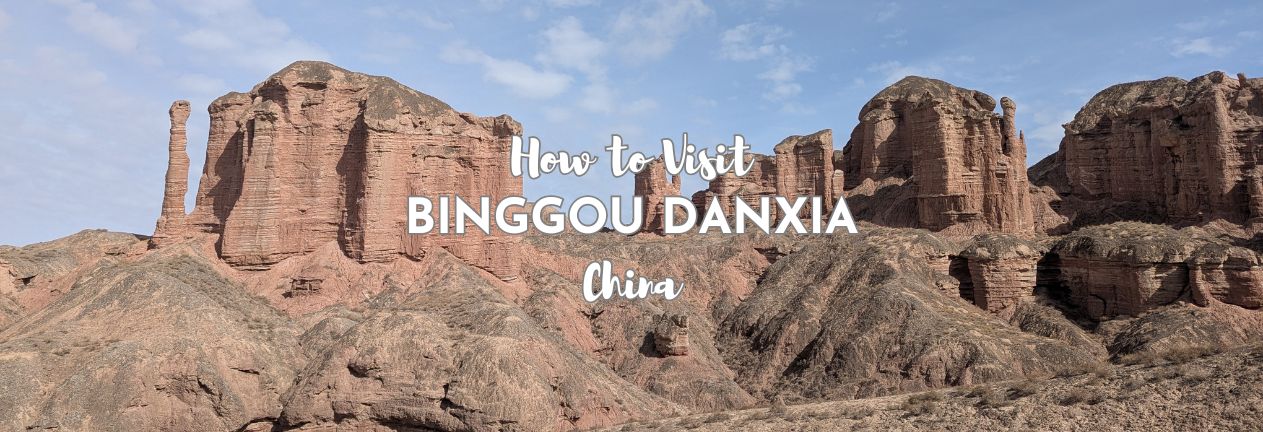
Binggou Danxia is one of the most extraordinary landscapes in China, yet surprisingly few international travelers have heard of it. It is located near Zhangye in Gansu Province, and this vast area of towering red rock formations, narrow valleys, natural stone pillars, and jagged cliffs feels more like another planet than somewhere you can visit in northwest China. While many people have seen photos of the nearby “Rainbow Mountains” of Zhangye Danxia, Binggou Danxia is completely different. Instead of colorful striped hills, you’ll find dramatic rock formations shaped by millions of years of wind and erosion, with viewpoints that look out across an almost unreal desert landscape. This is my guide on how to visit Binggou Danxia, Zhangye.
THIS POST MAY CONTAIN COMPENSATED AND AFFILIATE LINKS MORE INFORMATION IN OUR DISCLAIMER
The name “Binggou” (冰沟) is usually translated as either “Ice Valley” or “Ice Groove,” although there’s nothing icy about the landscape today. Instead, this part of Gansu is dry, dusty, and often intensely hot in summer, with huge open skies and variously colored, but mainly deep red, rock formations stretching into the distance. Visiting Binggou Danxia is relatively straightforward once you reach Zhangye, but there are a few practical things worth knowing before you go, especially if you’re traveling independently in China. Once you arrive in the geopark, you’ll buy your ticket and then be transported by the shuttle buses to the stops for the viewpoints, from where you walk around a pre-determined route and return to a bus stop to hop on to the next viewpoint stop. In this guide, I’ll cover exactly how to visit Binggou Danxia, how it differs from the more famous Rainbow Mountains, how much time you need, and what to expect when you arrive.
CHINA TRAVEL RESOURCES
STAY CONNECTED
WhatsApp with tour guides, get online easily and quickly.
Buy an eSim
HOTELS
Reserve a room here
Best city hotel? Need a laundry service? The best choice of hotels & places to stay.
TOURS & TRIPS
Most excursion choices, small groups, beach resort days passes, free cancellation, local guides.
Check options here.
TRAINS IN CHINA
Book now
Book trains in China easily, quickly and get the seats and berths you need.
PRACTICAL TRAVEL TIPS
- 🛡️ Get Travel Insurance: Civitatis includes medical expenses, repatriation, theft, luggage delays. No deductibles or upfront payments. Get a quote here.
- 🛏️ Breakfast Included? Laundry? Private bath? Book a Room.
- 🔌 Be ready for the plug, socket & power situation.
- 📶 Get online EASILY & cheaply – Get a China eSIM
- 🚄 Book trains in China – quickly easily. Use Trip.com
What Is Binggou Danxia?
Binggou Danxia is part of the wider Zhangye UNESCO Global Geopark in Gansu Province, northwest China. The landscape here has been shaped over millions of years by tectonic activity, wind, and erosion, creating huge red sandstone formations that rise dramatically from the desert floor. Unlike the nearby Colorful Danxia Scenic Area, which is famous for its striped rainbow hills, Binggou Danxia is known for its towering rock pillars, cliffs, canyons, and unusual stone formations.
You can read my guide to visiting “Colorful Danxia” here.
And I’ve also written about whether you visit one or both of these sites here.
The word “Danxia” refers to a type of geological landform made up of red sandstone and mineral deposits, while “Binggou” is commonly translated as “Ice Gully”, “Ice Ditch,” or on some of the signage here at Binggou Danxia, “Ice Groove.” Bing means ice, and Gou means gully/ditch/etc.
Some of the formations here have nicknames based on what they resemble, from castles and temples to giant animals and stone forests. And you’ll need some imagination for understanding why some of the names have stuck… It’s all in the eye of the beholder, I guess…
Regardless, the landscape is just glorious. And it was EMPTY.
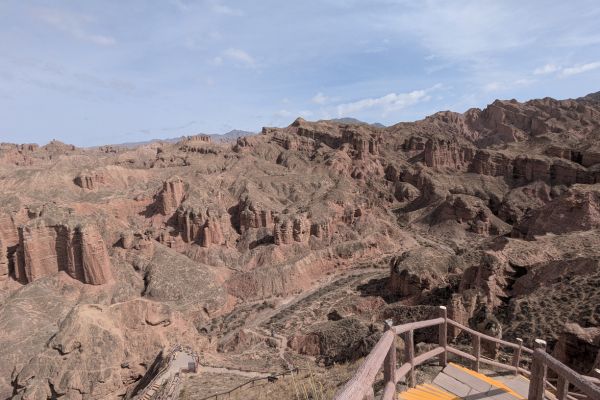
Although both Binggou Danxia and the more famous and popular “Rainbow Mountains” are part of the same UNESCO geopark, they feel completely different once you’re there. Binggou is quieter, more rugged, and much more dramatic in terms of rock formations. It also involves more walking and climbing than the Colorful Danxia area. And despite being part of the same UNESCO geopark, there is no combo ticket to save you money. They’re completely separate, despite being relatively close to each other.
Where is Binggou Danxia?
Binggou Danxia is located around 35 kilometers (22 miles) from Zhangye city in Gansu Province, northwest China. The site is within the Zhangye National Geopark, not far from the more famous Colorful Danxia Scenic Area, which is often called China’s Rainbow Mountains.
From Zhangye city, it usually takes around 45 minutes to 1 hour to reach Binggou Danxia by car, depending on traffic and where you start from. The local bus takes around 90 minutes. If you’re arriving by high-speed rail at Zhangye West Railway Station, expect the journey from the train station to take roughly the same amount of time to get here as from the city.
While most people who come to Zhangye only visit the Rainbow Mountains, some combine Binggou Danxia with the Colorful Danxia Scenic Area in a single day because the two entrances are relatively close together, although they are separate attractions with separate ticketing systems. However, many travelers skip Binggou Danxia altogether (which, to my mind, makes it all the more worth visiting!)
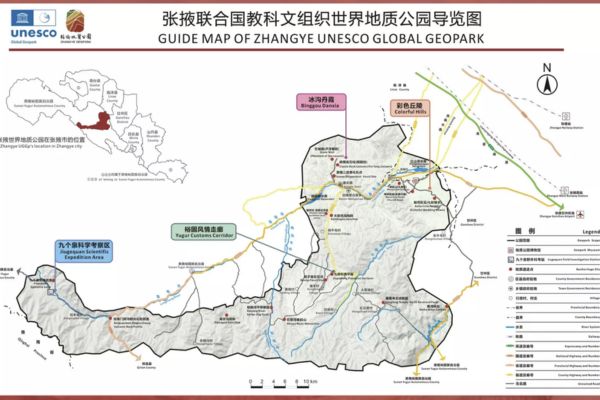
Map of Binggou Danxia and Zhangye Global Geo Park Area
While Binggou Danxia and the Colorful Danxia (Rainbow Mountains) are part of the same UNESCO Global Geo Park, they’re actually some distance apart. Here’s a map to show their locations.
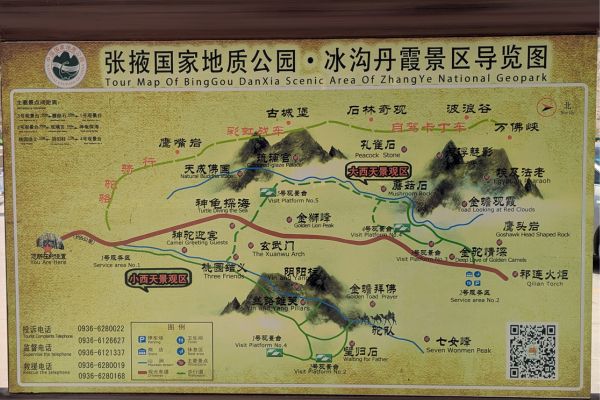
Map of Hiking Trails in Binggou Danxia
And if you’re looking to see what the hiking trails are like, then these are the trails that you’ll walk at Binggou Danxia.
Why Visit Binggou Danxia?
The biggest reason to visit Binggou Danxia is that the scenery feels genuinely surreal. The rock formations here are enormous, twisted into shapes that look almost man-made in places, and the scale of the landscape is difficult to appreciate until you’re actually standing among it. If you’ve visited some of the Utah National Parks in the United States, then it will remind you somewhat of those.
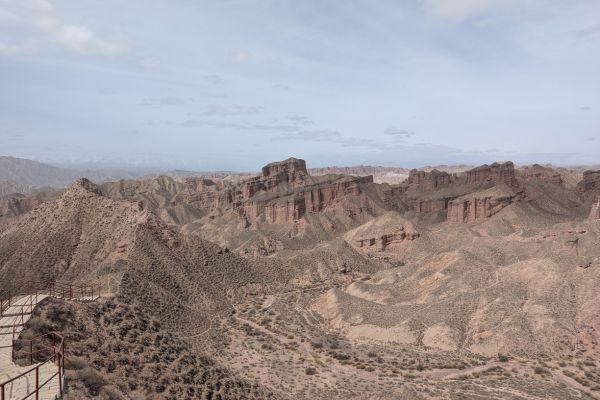
Compared to the nearby Rainbow Mountains, Binggou feels a lot less commercialized and is usually much quieter. While the colorful hills attract huge domestic tour groups, and the experience there is tailored to huge numbers, Binggou tends to attract travelers who are happier to walk between viewpoints, enjoy the landscapes, and prefer less crowded places.
If you enjoy unusual geology, dramatic landscapes, or places that still feel relatively undiscovered by international tourism, Binggou Danxia is absolutely worth adding to your western China itinerary.
How to Get to Binggou Danxia from Zhangye
Once you’ve arrived in Zhangye, it already feels like you’re completely off the beaten track. You are well off the mainstream for foreign visitors, and it’s a delight. And heading to Binggou Danxia is about to go more off track, so here’s how you can go from Zhangye to Binggou Danxia.
Take a Taxi or Didi from Zhangye to Binggou Danxia
The easiest way to visit Binggou Danxia independently is by taxi or Didi from Zhangye. Most drivers will understand “Binggou Danxia” written in Chinese characters, and many hotels can help arrange transport.
Some drivers will wait while you explore and then drive you back to Zhangye, although it’s important to agree on a price and timing in advance. Having a translation app helps enormously if you don’t speak Chinese, but using WeChat to communicate is generally accepted as the norm now. Just send a message and the app does all the translation. Of course, for this, you need local data, and the best way to get this is to have an eSIM. The eSIM from Trip.com is generally considered to be the best; you can get it here. (There are two options, a 3Gb a day one – after which you still get data, but it’s super slow, and a 10Gb a day one. Both options allow you to hotspot and share the connection. In our recent trip to China, we hit 3Gb only one day, and we were out ALL day and a lot of the night that day. This is the eSIM we bought.
Join a Tour from Zhangye to Binggou Danxia
Many domestic tours combine Binggou Danxia and the Rainbow Mountains into a single day trip from Zhangye. This is the simplest option if you don’t want to deal with transport logistics. You’ll find that they’re relatively small groups here, this far west, and you might even end up going just in a car by yourself!
Tours are particularly useful if you want to visit for sunset, as transport options can otherwise be limited very early or late in the day.
Public Transport to Binggou Danxia
Buses to Binggou Danxia leave Zhangye from the West Bus Station. “Xi” or 西 generally means West in Chinese. The West Bus Station in Zhangye is also known as the Xiguan Bus Station. The Zhangye West Bus Station is about 3 kilometers (1.86 miles) from Zhangye West Train Station.
Here’s a link to the location on Amap (as you will likely know by now, Google Maps and Maps.me are generally useless in China, you should use Amap instead.
Buses leave the Zhangye West Bus Station for Binggou Danxia at 07:30, 07:45, 08:00, 08:40, 09:15, and 10:30. The trip takes around 90 minutes.
The bus goes to the North Gate of Colorful Danxia (aka the Rainbow Mountains) first before continuing to Binggou Danxia. The last return bus is usually around 18:00 – 18:30, but when you buy a ticket, the staff will advise you of the last timed bus for the day, so that you don’t miss it.
You can buy a single (15 CNY or a return ticket 30 CNY) and can pay cash, Alipay, or WePay.
Visit Information for Binggou Danxia
Now that you’ve got here to Binggou Danxia, here’s what to expect.
Entrance Fees for Binggou Danxia
There are two elements to the entrance fees at Binggou Danxia: a price to enter the scenic area and a price for the mandatory shuttle bus inside the area. There are two different routes you can take; the main route (spending around 2 hours in the geo park) costs as follows.
- Adult entry fee = 40 CNY
- Shuttle bus = 20 CNY
The secondary route that you can take transfers from the shuttle bus to a bright yellow truck and takes you up a dried riverbed, with a much shorter walk.
We spent just over 2 hours here. And that’s about what most travelers allocate. You’re dependent on the shuttle buses going between the viewpoints, although you could also walk; it’s likely not much fun, as there’s no shade and it’s just up the road. We walked through all the areas that it was possible to walk on the route.
Opening Hours for Binggou Danxia
Summer hours are generally 06:00 until 20:30, and winter hours from 08:30 until 17:30. Your timing for visiting will be driven by the transport you use from Zhangye, how early you want to get up, and if you also want to visit the Rainbow Mountains (or any other nearby attraction) on the same day.
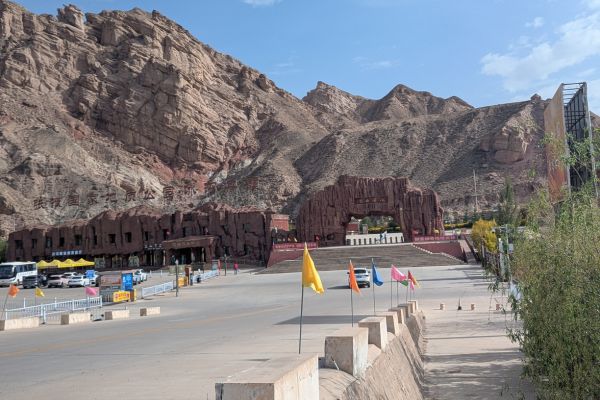
What to Expect When Visiting Binggou Danxia
Once you’ve bought your tickets (you will need your passports to buy the tickets), and tickets can be paid for with cash, Alipay, or WePay, you’ll go through the electronic gates to the rear of the ticket office and find the shuttle bus waiting area.
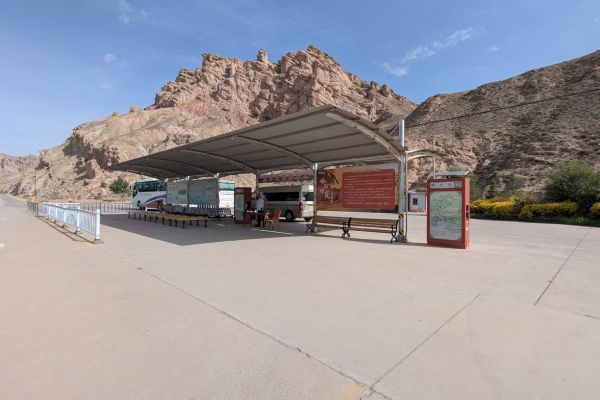
And it’s from here, inside the scenic area, that these shuttle buses transport you between the main viewing sections. There’s no particular timetable for the buses, but there are staff with radios at each of the stops, so you won’t be waiting too long for buses.
There are three bus stop points inside the scenic area, and there are toilets (and shade) at each of them. The first stop that the bus makes is to drop off folks who are taking the yellow DUKW (amphibious vehicle) looking cars, to the “Ancient Castle route”. This, as you can see from the map below, mostly drives past a short number of views, and has a short (100-meter or so) walk at the end.
So I’m ignoring this as a bus stop, because you only get off here if you are taking this tour.
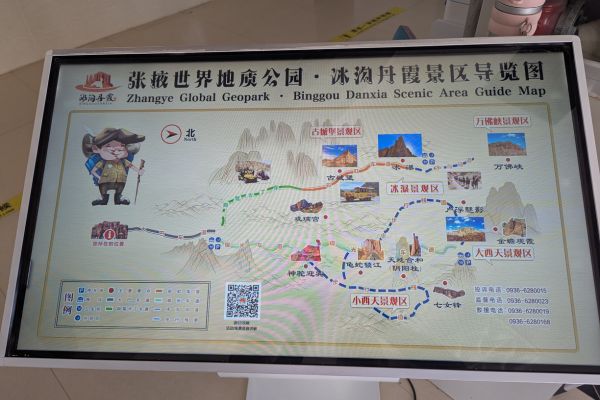
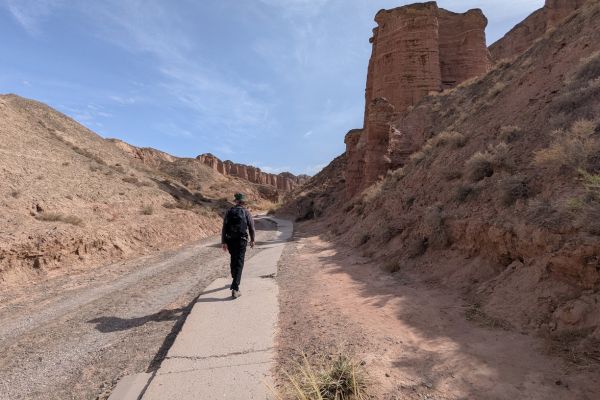
From the bus stops that you will be taking, you walk along wooden and concrete “boardwalks”, up steps, and to viewing platforms that overlook the rock formations. Some of the stairways are quite steep, and there’s little, if any, shade, so wear decent shoes, bring a hat, and water.
The main thing is that you can’t get lost. There is a VERY prescribed route that you’ll take, some of it is circular, some you will be backtracking on yourself, and at the second bus stop, you have a choice as to whether you want to go back to the stop or continue and meet the bus further down the road.
The shuttle buses at Binggou Danxia
The buses are comfortable with good air conditioning. There is a seat belt for each seat and curtains if the light is too bright. Each of the buses has a video rolling about the Danxia landform. The spoken language is Chinese, but there are also subtitles in Chinese and English.
And it’s worth watching, there’s some interesting information displayed, and some great shots of the park.
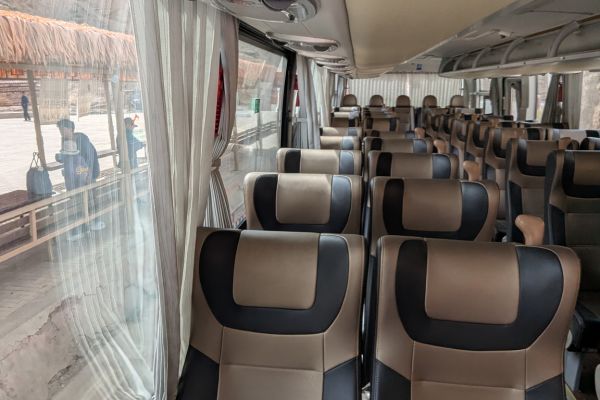
Here’s what you’ll see
What to see at the first bus stop and viewpoints in Binggou Danxia
At the first bus stop, the trail starts easily. Flat, and then with a slight upward slope, and you’ll get to see the first of the named rocky outcrops.
You only have to check out the photo to see how few people there were on this day in mid-May when we explored Binggou Danxia.
The Camel Welcomes Guests
These rocks have been eroding for 36 million years and have evolved to become this camel-headed shape. Camel? Or sheep? Not sure, but definitely animalish.
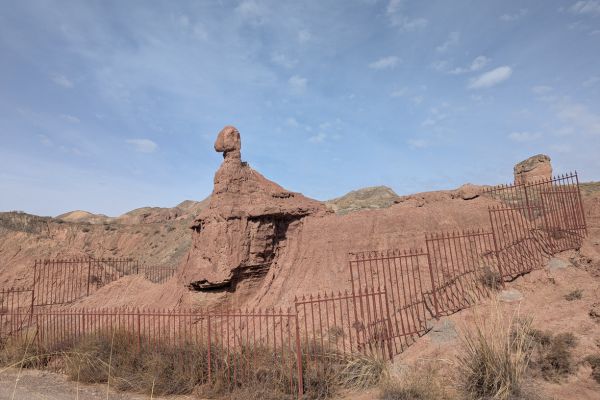
There are signposts all the way along the trail, which is very easy to follow. The signposts give details as to the specific rock formation that you’re going to see, and then there are detailed boards that describe the formations in more detail.
The Classic Rock Columns (the Sworn Brothers)
Helpfully, the information boards also contain a good-quality color photo of the rock formation that you’re looking at. You know, in case you’re not an expert at figuring out what “the Sworn Brothers” might actually be.
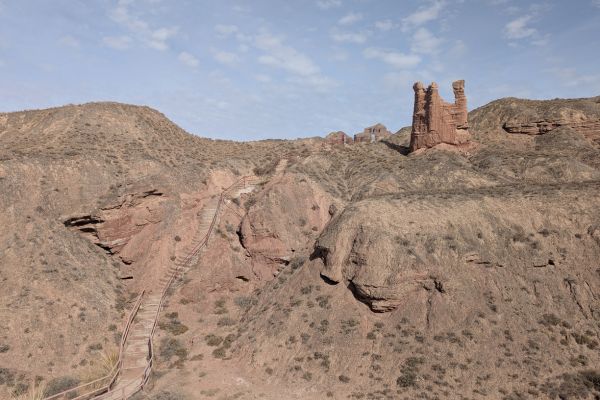
There are some areas that are closed off, like the steps up towards “the Sworn Brothers”, but I think these look better from a distance anyway.
The Stone Wall (Xuanwu Gate)
The enormous castle –shaped landform measures around 80 meters in length by 50 meters in height.
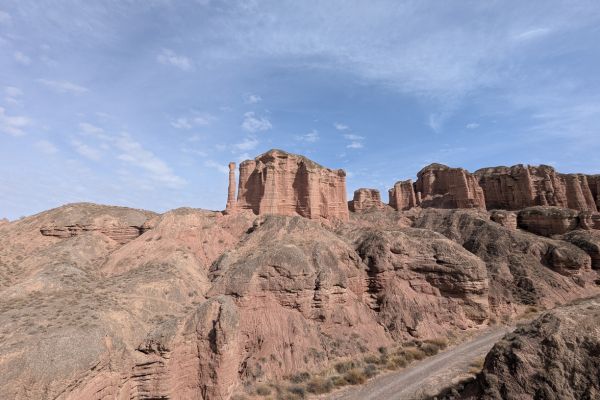
There’s even WiFi out here as well (and our China Mobile eSIM, bought from Trip.com, worked perfectly as well. We’ve had a great signal throughout virtually all of the trip, with only minor issues on GPS updates when on China’s bullet trains.
The Classic Rock Column (Mushroom Rock)
This column is around 45 meters high and contains layers of clay. Erosion from water and the climate has led to the formation of these mushroom-shaped features.
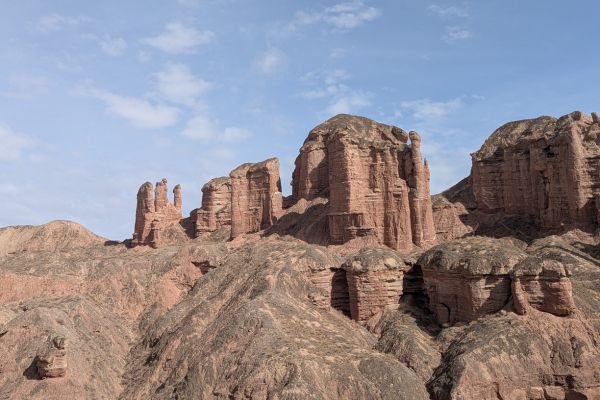
You’ll get to a crossroads at this point, and it doesn’t matter which way you go, as you’ll end up back here, but you do have to go up. There are lots of ups here, but the views are definitely worth it.
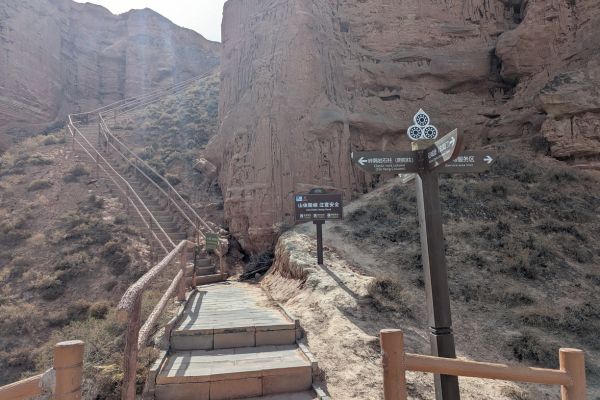
Once you’re up at the top, the rest of the trail is easy to see.
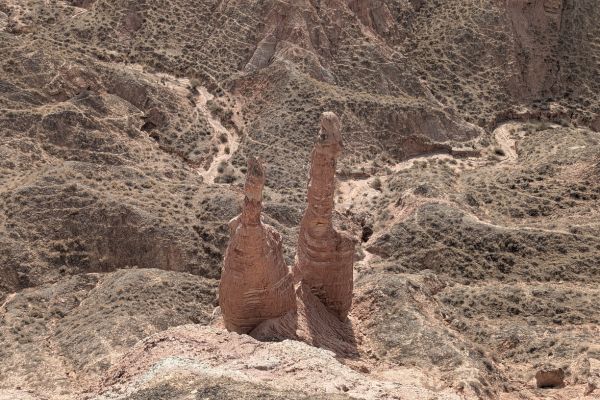
The Classic Rock Columns (Waiting for Return)
These two adjacent columns formed through the erosion of a stone castle (like the Stone Wall we saw previously). They’re named in homage of Zhangye’s position on the ancient Silk Road, where young men headed off, either for business or by joining the armed forces, and are to represent the wives and children of those young men waiting for their return.
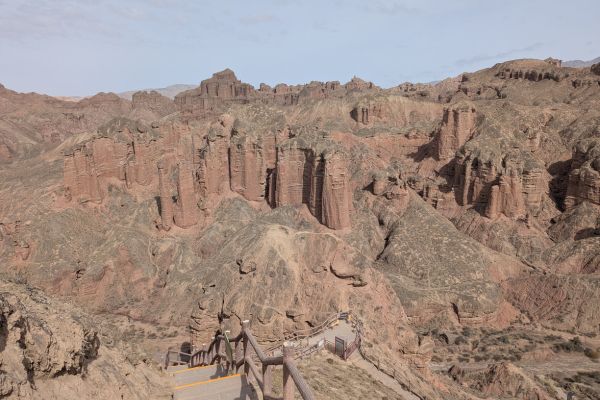
The Stone Peak (Seven Maidens)
This is another cluster of tightly packed columns that have weathered from a stone castle. The weathering has been along vertical joints. It seems to represent 7 standing maidens.
The Classic Rock Columns (Ying Yang Column)
There’s been erosion, collapse, and weathering on this formation. It’s called Ying and Yang because one column is upright and the other is softer and rounder – representing natural balance and social harmony.
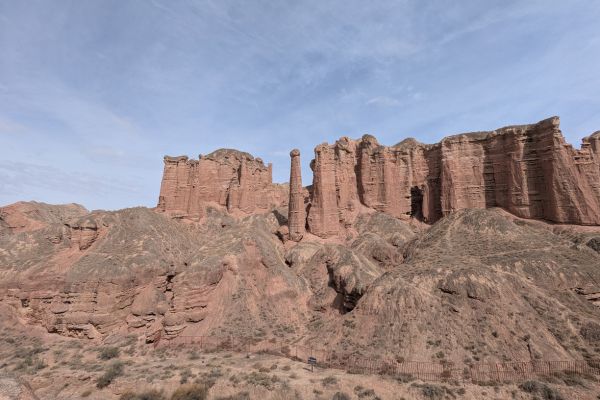
When you’re done, just head back down the trail to the bus stop area. It is clearly signposted as to where to stand and wait for your bus to the next stop.
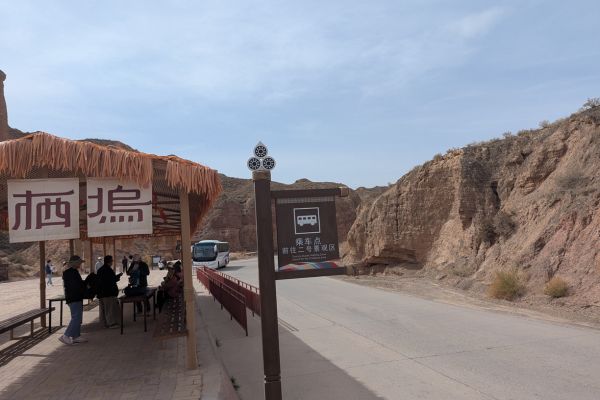
What to see at the second bus stop and viewpoints in Binggou Danxia
This is the second bus stop, and again, you can’t get lost. If you hesitate, one of the members of staff will shoo you in the right direction, which, of course, is up.
There are toilets here, as well as at the first stop as well. They’re clean.
Pictographic Rock (Gold Camel in Love)
Apparently, this represents two crouching camels (I couldn’t see this, but maybe you can…)
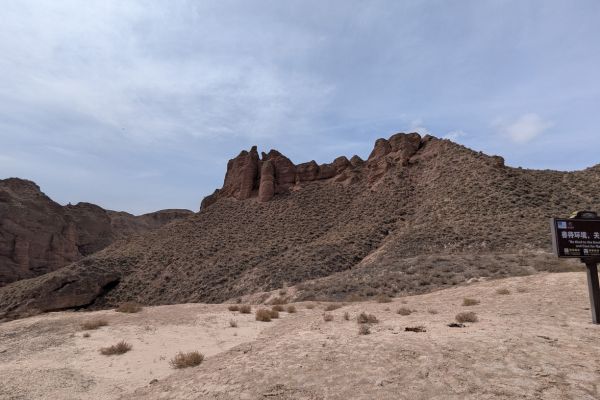
Pictographic Rock (Liqian Legacy)
This represents a strong man with a moustache. Apparently.
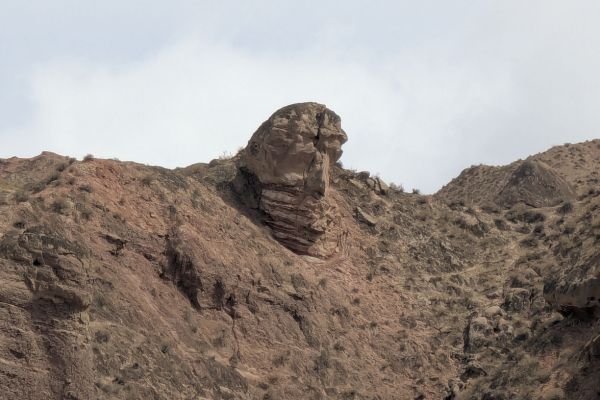
Classic Column (Qilian Torch)
This rock formation resembles a burning torch and is named for the mountains that are located on the border of Gansu Province. The word Qilian is from the Xiongnu language and means Heaven.
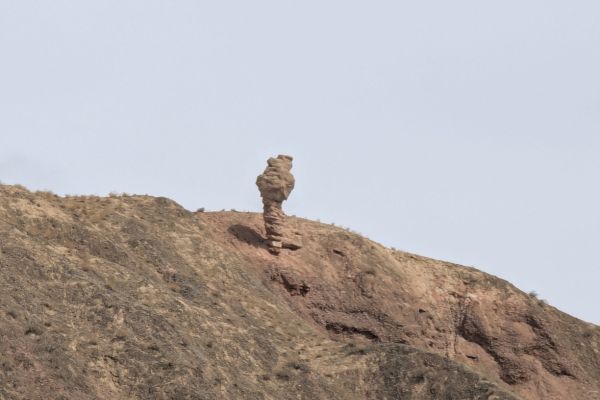
Pictographic Rock (Eagle’s Head)
Measuring 30 meters in length and 20 meters high, long-term erosion and weathering have shaped this to look (kind of) like an eagle’s head.
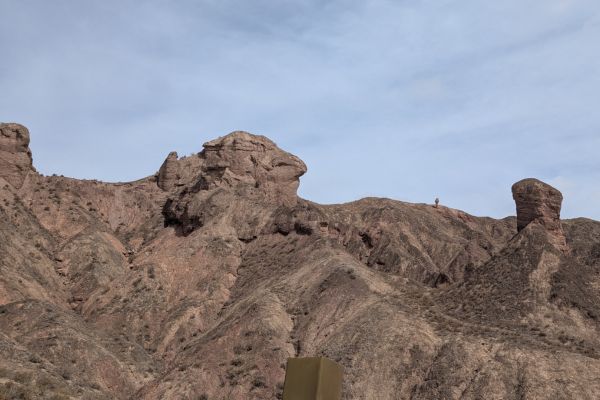
Pictographic Rock (Gold Toad Viewing Red Clouds)
This one requires a lot of imagination to see the toad that’s been created from the eroding rocks.
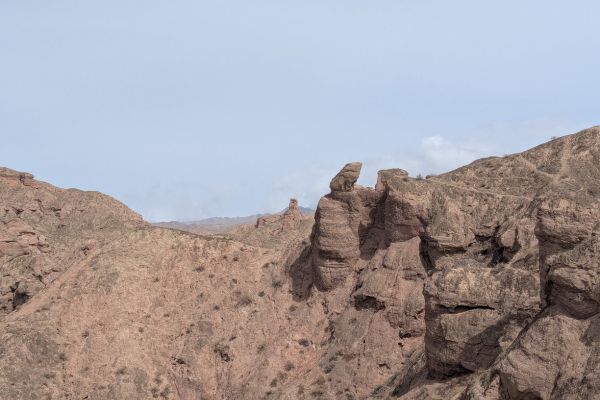
Stone Wall (Phantom of the Louvre)
The weathering of this rock formation has caused both convex and concave walls and is named after the Louvre Palace.
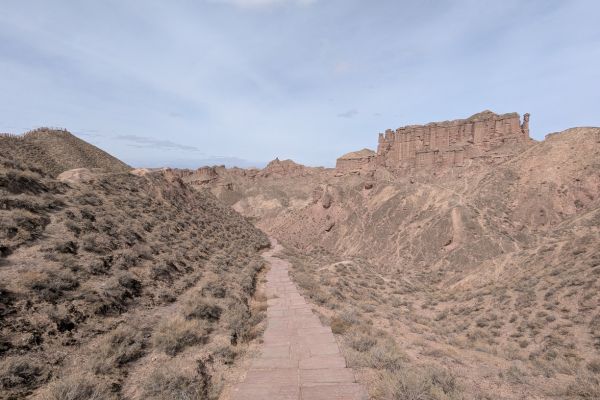
Pictographic Rock (Egyptian Pharaoh)
I *think* that this might refer to the headdress and clothing worn by the Pharaohs, but nope. Not seeing this one either.
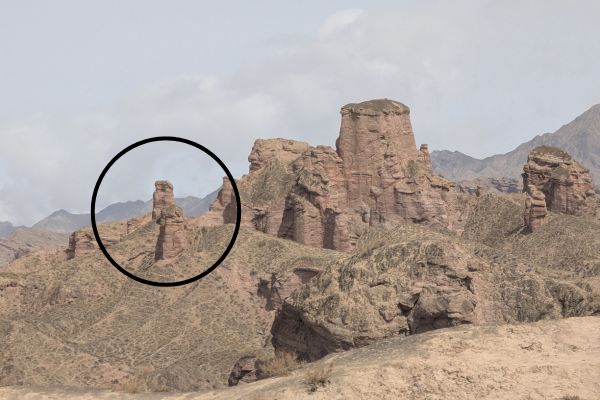
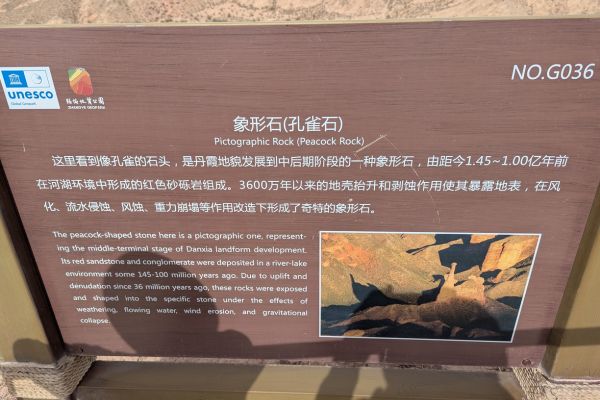
Pictographic Rock (Peacock Rock)
You definitely need to have the right light, and a good imagination to see some of these…so I just included the photo of the photo…
Stone Wall (Beer House)
It’s named after one of the formations, looking like the top of a bottle of beer, and another looking like the lower part of the bottle. I did, however, ponder for quite some time, which part of this was the house for the beer….
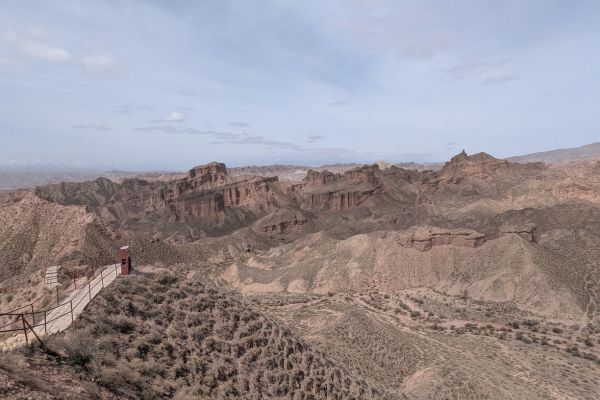
At this point, you can either turn around and return to bus stop 2, where you left the bus more recently. (everyone else who was on the shuttle bus with us –about 15 people) did this. We didn’t.
The trail continued. And we followed it. It runs in a loop, and while there is nothing specific to see, it was downhill all the way, rather than back up and down again to bus stop 2.
It leads to a bus stop on the side of the road, and the bus heading downhill back to the Tourist Center, where you bought your tickets, will pick you up on the way.
And that’s it. That is Binggou Danxia. You can read more about its UNESCO GeoPark admittance here.
The Best Time to Visit Binggou Danxia
Spring and autumn are generally the best times to visit Binggou Danxia. Temperatures are more manageable, skies are often clear, and the lighting conditions are excellent for photography. We visited in mid-May, and the temperature was perfect for us. We hiked in long trousers and with lightweight T-shirts and fleeces.
Summer can be extremely hot during the middle of the day, and there is little natural (or manmade) shade anywhere in the park. Winter visits are possible, although temperatures can drop sharply and strong winds are common.
Practical Tips for Visiting Binggou Danxia
- Visit early or late in the day for the best lighting and fewer crowds
- Bring a hat (it’s windy, so be sure not to lose it!), sunglasses, and a good pair of shoes
- Bring a camera, but drones are prohibited at Binggou Danxia.
- Bring water, especially during summer
- Make sure you have an eSIM for data, WeChat for communication, and Alipay to make it easy to buy your tickets.
- You might want to carry some cash as backup, but we’ve only had a single instance where digital payments didn’t work (and I suspect that was because we didn’t have much of a cell phone data signal at the time)
- Expect ZERO English signage
- Avoid visiting during major Chinese public holidays if possible, as domestic tourism numbers increase dramatically
Where to Stay for Visiting Binggou Danxia
There are several hotels near the Colorful Danxia (Rainbow Mountains) area, including a yurt camp by the west entrance gate. You can check out the options here.
Stay in Zhangye City to visit Binggou Danxia.
Most travelers stay in Zhangye itself. It has easy access to the train station or airport, and you have a wider selection of places to eat, as well as being based more centrally to visit other sites in the area. (like the Mati Temple, and the Pingshan Grand Canyon.)
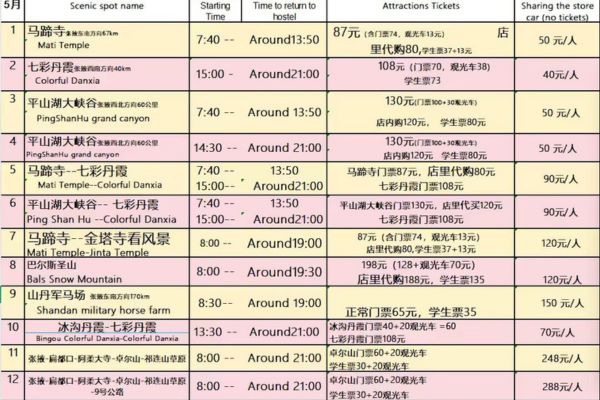
The folks at the Silk Road Travelers Hostel are fabulous, and I do recommend them and the hostel as a place to stay. They can arrange either shared or private transport to Binggou Danxia, the Rainbow Mountains, and a variety of other spots to visit. They also have some great recommendations of where to eat (and what) in Zhangye. Check out their room availability here.
The current list of tours (and shared vehicle prices) that the Silk Road Travelers Hostel in Zhangye offers is in the photo below.
Stay near the Danxia Scenic Areas and Geopark
There are also hotels and guesthouses closer to the Danxia scenic areas themselves. These are useful if you specifically want to photograph sunrise or sunset without traveling back and forth from Zhangye city. The most popular place we’ve found is the KaoShan Tent (Yurt) Camp, just 6 minutes walk from the West Entrance Gate of the Colorful Danxia. There are no other facilities here, but they do provide breakfast and have dinner options too.
UNESCO World Heritage Sites in China
If you like visiting UNESCO World Heritage Sites, then our guides to these Chinese World Heritage sites will be useful
- Binggou Danxia – the Zhangye UNESCO Global GeoPark
- China’s Rainbow Mountains – the Colorful Danxia
- How to Visit Huanglong National Park [the Yellowstone of China]
- Discover Xian’s Terracotta Army
- How to Visit The Great Wall of China – [Independent Public Transit Route]
- The Forbidden City of Beijing
- The Historic Center of Macau
- Jiuzhaigou National Park
- Huangshan National Park and Sacred Mountain
- Wulingyuan and the Zhangjiajie National Park
- The Sichuan Giant Panda Sanctuaries
- Tiger Leaping Gorge
FAQs on Visiting Binggou Danxia
Here are the questions we had before visiting Binggou Danxia ourselves, along with the ones we’ve since answered for other travelers planning the trip too.
Is Binggou Danxia a UNESCO World Heritage Site?
No. Binggou Danxia is part of the Zhangye UNESCO Global Geopark; it is not a UNESCO World Heritage Site.
Is Binggou Danxia the Same as the Rainbow Mountains?
No. Binggou Danxia and the Rainbow Mountains are different scenic areas within the same geopark. You need different tickets to enter, there is no combined ticket.
Can You Visit Binggou Danxia and the Rainbow Mountains in One Day?
Yes. It is easy to do this if you arrange a car or taxi to take you. You might struggle to make both sites on the public bus unless you rush around.
How long does it take to visit Binggou Danxia?
We took a leisurely 2 hours to visit Binggou Danxia. You don’t need any longer, unless you’re taking WAY more photos and unless you have to line up a lot for the bus.
Is Binggou Danxia Worth Visiting?
Absolutely. We preferred it to the Rainbow Mountains because it was quieter and much more natural, with fewer (i.e., hardly any) of the commercial distractions that the Rainbow Mountains have to cater to the vast numbers of visitors that they receive.
Do You Need a Guide for Binggou Danxia?
No, a guide is not necessary, although tours can make your transport easier.
Is Binggou Danxia Crowded?
Not usually, no. It receives many fewer visitors than the Colorful Danxia Scenic Area (aka the Rainbow Mountains), particularly outside Chinese public holidays.
Can Foreigners Visit Binggou Danxia Independently?
Yes, foreigners can visit independently without any special permits. It is easy, especially if you stay in Zhangye and arrange transport locally.
The main challenge as an independent traveler is transport and language rather than the site itself. Once you arrive, the park is easy enough to navigate thanks to boardwalks, shuttle buses, and clear visitor routes.
CHINA TRAVEL RESOURCES
STAY CONNECTED
WhatsApp with tour guides, get online easily and quickly.
Buy an eSim
HOTELS
Reserve a room here
Best city hotel? Need a laundry service? The best choice of hotels & places to stay.
TOURS & TRIPS
Most excursion choices, small groups, beach resort days passes, free cancellation, local guides.
Check options here.
TRAINS IN CHINA
Book now
Book trains in China easily, quickly and get the seats and berths you need.
Final Words on Visiting Binggou Danxia in Zhangye
When we started planning this route around Western China, Binggou Danxia wasn’t anywhere near the list. The Rainbow Mountains were – as we’d seen the spectacular mountains in Peru. But it seemed like such a waste to come here to Zhangye and not visit Binggou Danxia. And we are so glad we did. While the Rainbow Mountains tend to get most of the attention online, I actually think Binggou Danxia is the more memorable experience. It feels wilder, quieter, and more dramatic. You get to experience the UNESCO geopark without having to compete with the commercial aspects, selfie stick wielding groups, and flag-waving tour groups. It’s worth it. Put it on your list.
ASocialNomad is a participant in the Amazon Services LLC Associates Program, an affiliate advertising program designed to provide a means for sites to earn advertising fees by advertising and linking to amazon.com, amazon.co.uk, and amazon.ca. Amazon and the Amazon logo are trademarks of Amazon.com, Inc. or its affiliates. As an Amazon Associate, I earn from qualifying purchases.

