
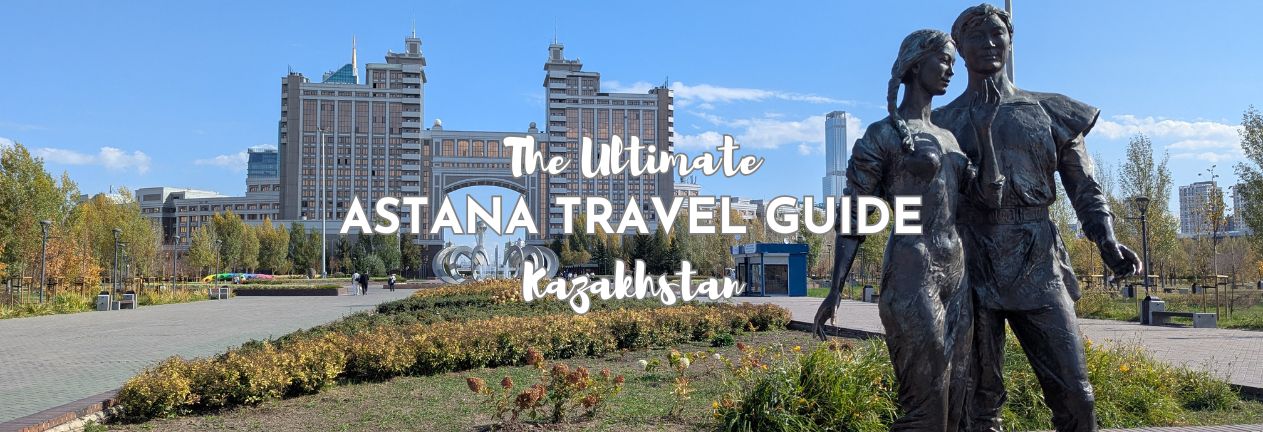
Astana is a very different kind of city to Almaty, purpose-built, futuristic, and unmistakably a capital. It’s not somewhere you’ll end up by accident. The architecture alone is worth the trip: glass pyramids, a giant tent, and a tower shaped like a mythical tree, all built within a couple of decades on what used to be open steppe. It’s definitely not the Kazakh (or even Central Asian) base you’ll keep returning to the way Almaty is; to come here is a deliberate, self-contained trip that makes its case in a day or two. Here’s our travel guide to Astana.
THIS POST MAY CONTAIN COMPENSATED AND AFFILIATE LINKS MORE INFORMATION IN OUR DISCLAIMER
If you’re putting together an Astana travel plan of your own, here’s what this one covers: how to get to Astana, where to base yourself, how long to spend in Astana, the top things to do, a map to help you get between them, where to eat and drink, a couple of day trips worth adding on, and answers to the questions we get asked most about visiting.
How to Get to Astana
We arrived at the old train station after an overnight train from Almaty, and it’s a darned good way to make the trip. You can see my full guide to getting from Almaty to Astana for the full breakdown of train versus flight. From this station (Astana 1), also seen on maps as Nur Sultan 1 (a throwback to the once-upon-a-time name of the city), a Yandex to your hotel is straightforward; drop your bags and you’re straight out exploring. If you’re arriving into Nurly Zhol, the big new fancy train station that’s more like an airport, then the new metro is now open. Flying is, however, the much faster option if you’re short on time, and both 12Go.asia and the airlines directly are worth checking for train and flight prices before you book.
We arrived on a gloriously sunny (and T-shirt warm) day, and we walked everywhere we could. We sat in the sun and had fabulous Georgian food and then suffered the following day as the temperature dropped significantly, it rained (sideways), and then we also messed up, trying to visit museums on a Monday. Spoiler. You can’t. They’re closed. Ah well. Next time.
Astana was a key component of our 10 days Kazakhstan itinerary, you can see how the route worked out here.
Where to Stay to Explore Astana
Astana is vast, and accommodation is spread right across the city rather than clustered in one obvious district. The best approach is staying close to whatever you actually want to see rather than trying to find a single ‘center,’ since the city doesn’t really have one in the way Almaty does. Personally? Stay near Baiterek; there’s lots to see around there.
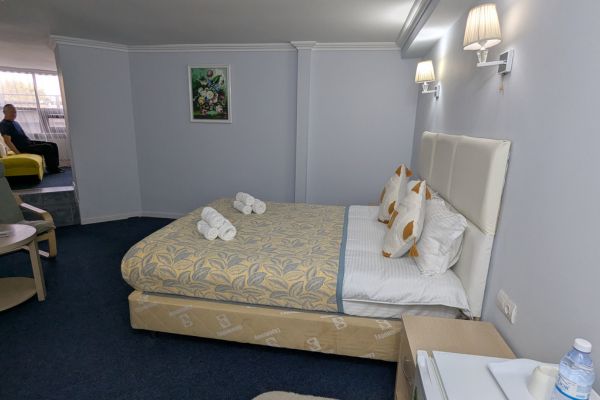
We stayed near the Baiterek Tower, at the Baiterek Premium, and would recommend it. We had a decent room, good facilities, and breakfast included, all within easy walking distance of the majority of the sights we wanted to see.
How Long to Visit Astana for
Two days is enough to explore Astana, and if you time your overnight trains in and out well, you can even make do with a single night in the city itself. Add another day if you want to head out to Burabay National Park or one of the other day trips below. Astana has a good bus system, and Yandex works well here too. We had one gorgeous weather day and one desperately cold, wet one back to back, so we walked EVERYWHERE the first day and switched to Yandex for the second.
A little history of Astana
The name Astana is pronounced uh·sta·nuh. And while it’s the second largest city in the country (after Almaty), it somehow feels a lot bigger. Streets are wider, buildings are bigger, everything is just, well, bigger. It’s been the capital since 1997 (more on that shortly). Astana means “Capital” in Kazakh.
But this isn’t the only name Astana has had. It was originally called Aqmoly, when it was formed in 1830. Since then it’s gone through several name changes. It went through Akmolinsk, Tselinograd, and Aqmola before it became Astana in 1998, a year after being declared the capital.
But we’re not done yet. 2019 saw it being renamed “Nur Sultan”, after the first President, Nursultan Nazarbayev, but it was renamed Astana in 2022.
Apparently the devotional cult associated with Nursultan Nazarbayev faded somewhat.
The capital was moved from Almaty to the name-changing Astana to “improve national security,” since Almaty was deemed too close to the borders with other countries. (I mean, note how quickly we were able to cross the border.) Astana works in that respect. It’s close to precisely nothing. Well, aside from the ex-Soviet gulags that were created up here during Stalin’s time…
Anyways. I’m digressing…
The Top Things to Do in Astana
Astana: Capital of Kazakhstan: It’s enormous. We’d arrived in glorious sunshine and yomped around the city. There’s a giant tent, a glass pyramid, and a stunning range of different-shaped buildings on Astana’s skyline. The architecture is all over the place. Literally and figuratively. It feels like it’s miles between everything. Here’s what’s worth your time in Kazakhstan’s capital city.
I haven’t detailed addresses, because to be fair you’re not going to use them. If you’re using Yandex, you’ll find the location by map. If you’re walking around, then you’ll use map directions, so I’ve added them to the map that you’ll find further on in this post. And yes, the walking directions work fine in Google Maps, even though Yandex is my preferred choice for Kazakhstan.
Ascend the Baiterek Tower
This is Astana’s most recognizable landmark. It’s a 97-meter (318-foot) tower topped with a golden sphere, built around the Kazakh legend of the mythical bird Samruk laying a golden egg in the branches of the tree of life.
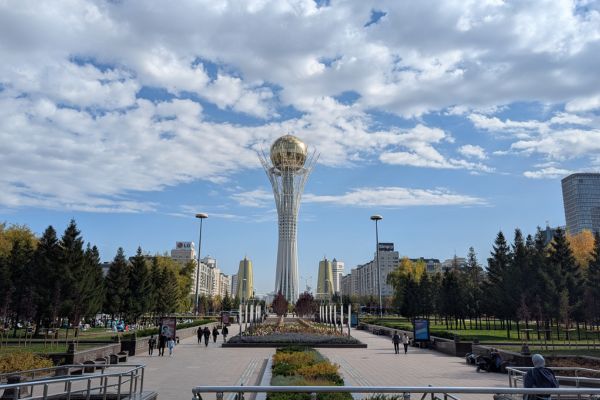
The observation deck at the top gives you the best overview of the city in one go, and lets you orient yourself. You’ll notice I say ascend; that’s because you can’t take the stairs. You need to take the paid elevator to the top; there are no stairs to the top that you can use. And the top is worth it. Not just for the view, but to put your hand in the (gold) handprint of the first president, Nur Sultan, whom the city was briefly renamed for.
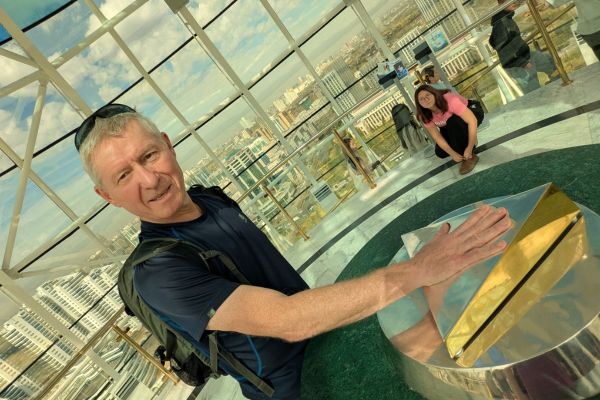
How long to spend at Baiterek Tower: 45 to 60 minutes.
Baiterek Tower Entry: the observation deck ticket (for the elevator) costs 2,500 KZT.
The Khan Shatyr
This is a shopping mall and entertainment center, designed by British architect Norman Foster, and it’s basically a tent. A 150-meter (492-foot) tent that creates 140,000 square meters (about 1.5 million square feet) of pure, unadulterated capitalism.
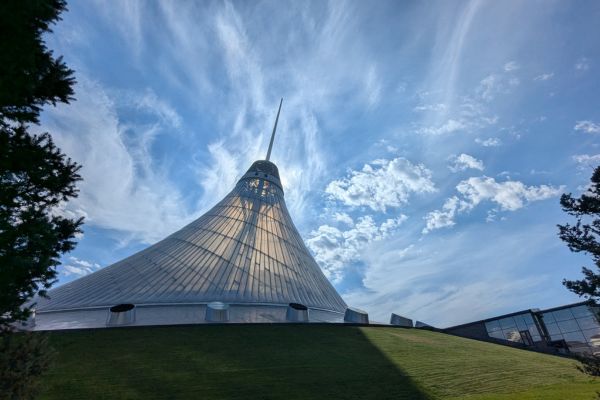
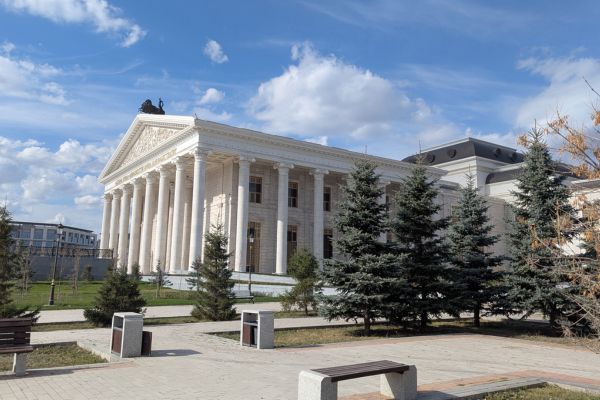
It opened officially on the 70th birthday of Mr Number 1 President, and presidents from Tajikistan, Russia, Belarus, and elsewhere turned up for the party. It’s listed in the Guinness World Records as the world’s “tallest tensile structure” (aka tent). There’s a leisure center at the top with a real fake beach that allegedly has sand shipped in from the Maldives or Dubai, depending on whom you believe. We can’t check it. It was closed for renovations when we were there, so we moved on. To the Opera House. Also encircled by construction. So enjoy a photo from a distance.
We managed to get to one museum here. Just one. And that’s the military history museum.
Military Historical Museum
It covers Kazakhstan’s military history from the Soviet era through independence, a fairly niche stop worth it if military history is genuinely your thing. And it’s definitely ours. We were one of 6 people there. The four others were a film crew. There’s lots of stuff here. Not much signage that makes sense, but lots of stuff.
The best is either outside (tanks, guns and boats) and an amazing car –the GAZ 14-05 “Chaika” – that was built to allow generals to be seen and to salute each other at parades.
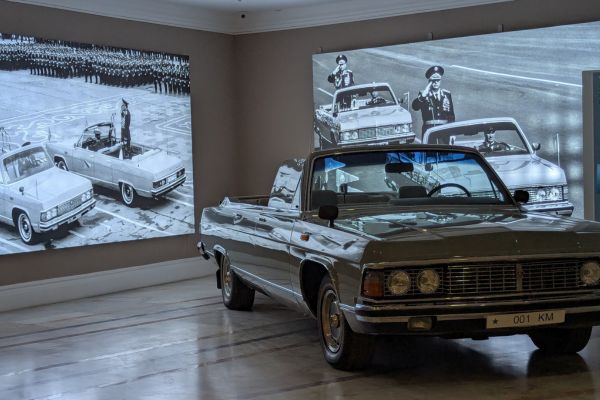
About 100 of them were built each year between 1977 and 1988, but the blueprints were ordered destroyed by Gorbachev in his campaign to fight privilege under perestroika.
How long to spend at Military Historical Museum: 60-90 minutes.
Military Historical Museum Entry: 500 KZT
I mentioned it turned cold. And wet. The wind changed direction. It went from about 24 during the day to about 3. And wet. That’ll be the wind from Siberia then. So we continued walking…
Atyrau Bridge
This pedestrian bridge across the Ishim River has distinctive arched supports, connecting the left and right banks.
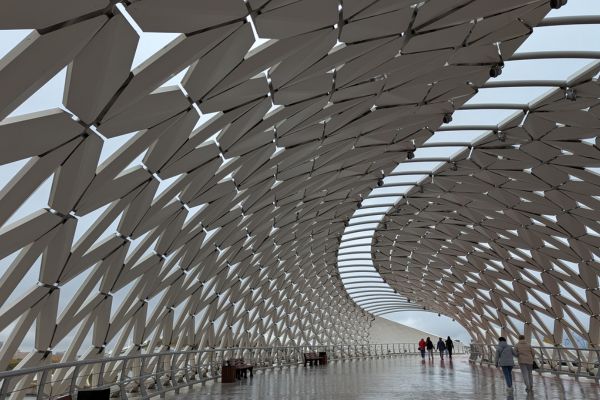
It’s a nice spot to cross on foot rather than by taxi; it would have been nicer if the weather had been nicer. So we walked across after visiting the Military Museum and heading on to our next stop, the State Flag of the Republic of Kazakhstan, which is, to be fair, just a big flag pole, but on the way to our next stop, the capital circus.
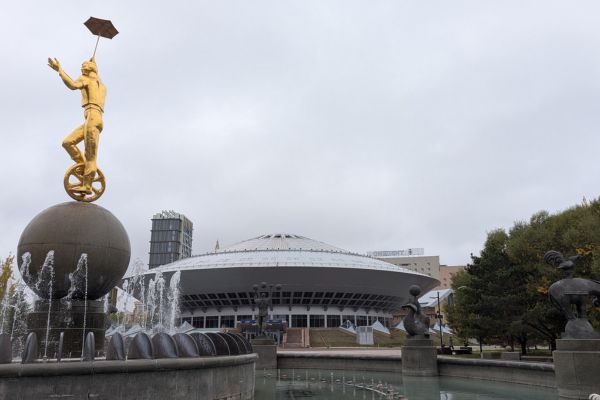
Capital Circus
Astana’s circus building hosts acrobatics and performance shows. But it’s like all the circus buildings we’ve seen across Central Asia: lots of promise, nothing ever open, but really quite a stunning building. The first circus building we saw was in Moldova, when we were en route from Chisinau to Old Orhei.
The Hazrat Sultan Mosque
This is one of Central Asia’s largest mosques, near Independence Square, with room for up to 10,000 worshippers. Construction started in 2009, and it opened in July 2012, and it held the title of Central Asia’s largest mosque for years afterward. The dome alone is the biggest in Kazakhstan, 51 meters high with a base 28.1 meters across, and four 77-meter minarets mark each corner. Inside, classical Islamic architecture meets traditional Kazakh ornamentation, all carved stone and pattern rather than plain white walls. It holds 5,000 worshippers on a normal day, and up to 10,000 during major holidays.
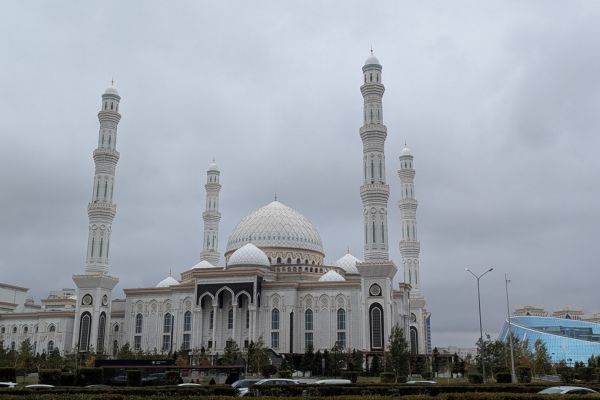
Visitors are welcome outside prayer times; dress modestly and expect to remove your shoes. Women should carry a headscarf for entering.
How to get to Hazrat Sultan Mosque: near Independence Square.
How long to spend at Hazrat Sultan Mosque: 30 to 45 minutes.
Kazakh Eli Monument
This tall column topped with the Samruk bird is set in Independence Square among landscaped grounds and fountains, built to symbolize the strength and unity of independent Kazakhstan. It’s a pleasant spot for a wander rather than a single must-see object. And you’ll likely pass it on your way elsewhere.
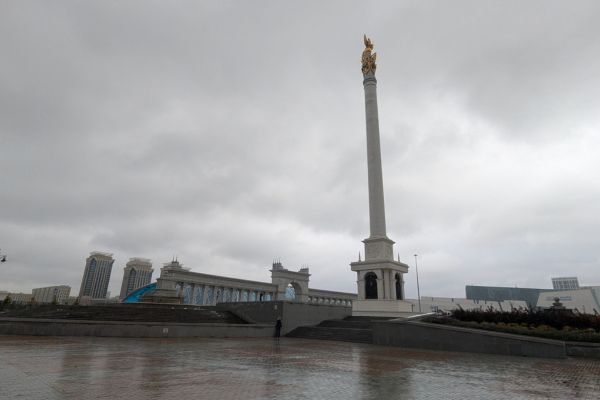
The column itself stands 91 meters tall, a deliberate nod to 1991, the year Kazakhstan declared independence. It went up in 2011 for the 20th anniversary of that independence, and the four bronze bas-reliefs around its base each tell part of the story: the first president and the people, courage, creation, and the future.
If you’re wandering around in this area of Astana, then your likely next stop after the mosque is the National Museum. Or the Palace of Peace and Reconciliation.
The Palace of Peace and Reconciliation (the Pyramid)
Another Norman Foster building, a glass pyramid built to host the Congress of Leaders of World and Traditional Religions. The exterior alone is worth the detour, and if there’s an event on when you visit, apparently the interior is worth the extra time too.
Norman Foster and his firm designed it, built between 2004 and 2006, and opened that September. It exists as a permanent home for the Congress of Leaders of World and Traditional Religions, a summit that brings around 200 delegates from the world’s major faiths together every three years in a circular chamber right at the apex of the pyramid.
We didn’t get close. So here’s a stock photo for you with the mosque in the background.
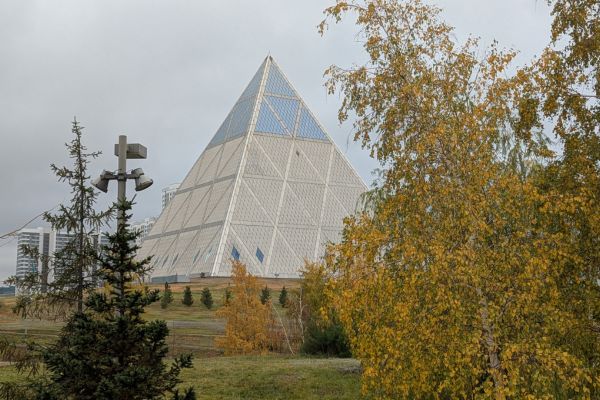
We got no further than about a block away before a legion of police told us to “wait, wait.” Someone important was in town, and THEY were visiting the places we wanted to go. No one told us this directly, but the sniper we spotted in the park as we tried to “go around the roadblock” made it pretty clear. So we gave up on that type of culture, aka the Pyramid and the National Museum.
The National Museum of the Republic of Kazakhstan
The country’s flagship history museum, and the best single stop for context on everything else in this guide, from Scythian gold artifacts to the more recent history of independence. I’ve taken that from their website. We didn’t get there, because first of all, on our first attempt, the current president was in town and it was all closed down.
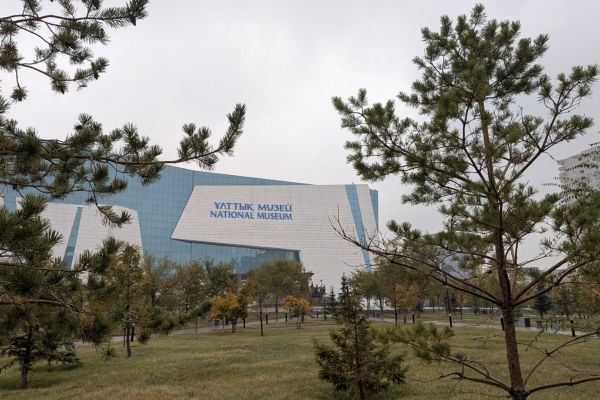
And it was here in Astana that we made a rookie mistake. We’d saved a day for museums. A Monday. Museums in Kazakhstan are closed on Mondays. So we ended up coffee shop hopping between bitterly cold yomps around the city, killing time, before we headed to the train station – a different one this time, the new station of Nurly Zhol, for the night train that will take us south to Shymkent.
How to get to National Museum of the Republic of Kazakhstan: central left bank, closed Mondays.< DON’T MAKE OUR MISTAKE
How long to spend at National Museum of the Republic of Kazakhstan: 2 to 3 hours.
- National Museum of the Republic of Kazakhstan Entry Price: 1,000KZT.
Ak Orda Presidential Palace
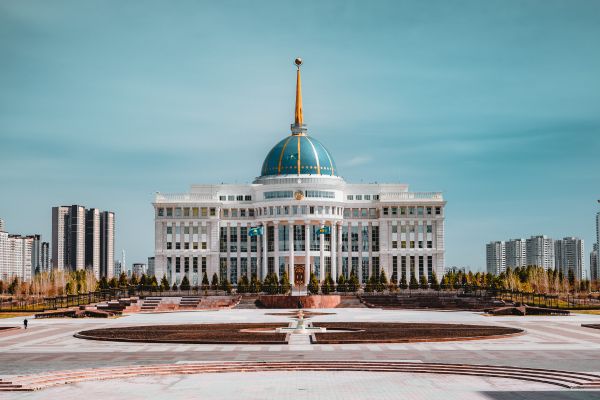
The official residence of Kazakhstan’s president, a white marble building with a sky-blue dome and golden spire. You can’t go inside, but it’s worth viewing from outside as one of the left bank’s defining buildings.
Explore Architecture in Astana
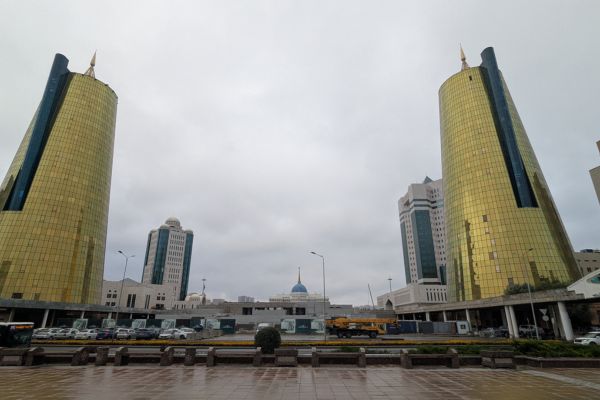
You can’t help when you’re walking – or driving – around Astana: the “over the top architecture. Some of the most incredible buildings. Are just office buildings. Or government buildings or apartments. And they all have their local nicknames; probably the most famous are the Astana Beer Cans. Which are residential buildings.
Go Wine Tasting in Astana
Not every stop in Astana needs to be a monument. This is where we ended up when Kazakhstan’s President’s visit to the capital with a fellow president in tow meant that one half of the city was closed down.
Arba Wine is a proper wine shop and tasting spot, a good way to spend an hour somewhere relaxed between sightseeing, and worth knowing about even if you’d rather buy a bottle to take back to your hotel than sit and taste.
It was here that we met Murad. And did an entire wine tasting session on Google Translate. Humor and all. Wine making in Kazakhstan dates back 2,500-2,700 years. The Soviets invested a lot here, planting up to 500 different grape varieties – and Kazakhstan produced a lot of grapes and wine between 1950 and 1985. In 1985 came prohibition on the orders of Gorbachev, as he tried to reduce alcoholism in the USSR. It lasted until 1988. Sales were restricted, production was reduced/stopped, vines were cut down and dug up. Luckily, says Murad with a wink, the Kazakh spirit made sure some were saved… In 2006, Arba Wines started to reconstruct the wine industry. Luckily, says Murad, the owner was the ex- Government finance minister…
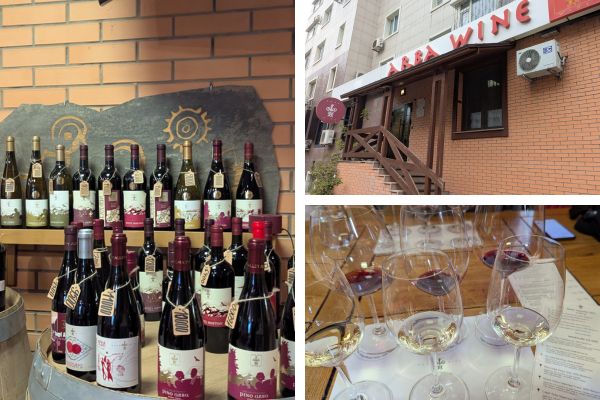
The wine is actually rather nice. They brought in vines from Europe and Georgia, grafted what they’d saved, and now, he says, “it’s Kazakh again”. There’s Rkatsiteli, Chardonnay and Riesling on the white side of things. The tasting notes describe the Riesling as having “delicate aromas of green ripening fruits, elegant petroleum and pleasant acidity”. The Pinot Noir and Cabernet Franc are better than the Saperavi. They’re good enough to buy bottles to enjoy later on our travels. And way, way, way, better than the Uzbek wine we’ll taste later in the trip.
How to get to Arba Wine: Syganak Street, central Astana.
How long to spend at Arba Wine: 30 minutes to an hour.
Arba Wine Entry: free to browse, tastings priced separately.
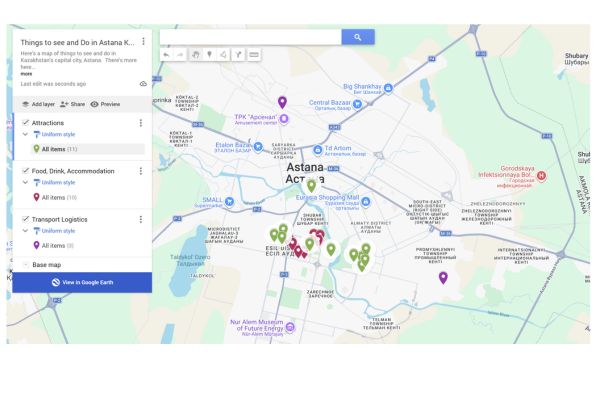
Map of Things to Do in Astana
Here’s a map to help you get between everything on this list, since Astana is a lot more spread out than it first looks.
Where to Eat and Drink in Astana
As the capital, Astana’s food scene is genuinely international; you’ll find everything from traditional Kazakh cooking to Georgian food and craft beer bars, often within the same few blocks. There are details of a few in this section, but I’ve also marked on the map the locations that we ate and drank in Astana. The fact that they’re on the map means that I recommend them. There’s more on food and drink in Kazakhstan in my guide here.
Sandyq
On the day the President closed down the city, we treated ourselves to lunch at Sandyq. It’s described as an upscale Kazakh restaurant. And here in the capital there are several options for upscale Kazakh. And I have to admit it’s really rather nice, and they take our day packs and dusty hiking shoes rather well. There’s a Sandyq in several other Kazakh cities, but we waited for Astana. There’s their house salad, with a glorious pomegranate dressing and horse meat. Katama bread – rather like Kerala Paratha. Roasted Bone marrow, which doesn’t really taste of anything, but I’m glad we’ve tried it.
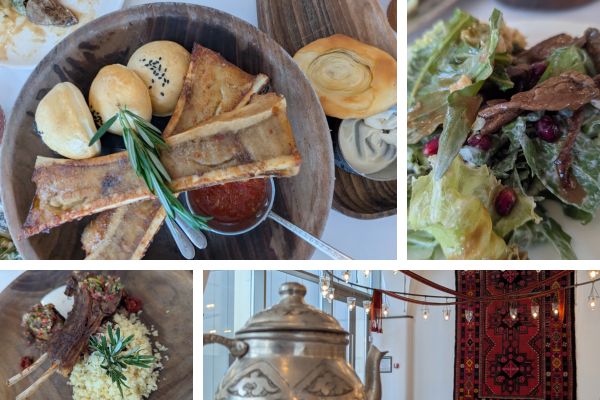
The puffy borzaki breads with it are a delight. And then slow-roasted lamb. We’ve tried the national dish of Beshbarmak previously and wanted to try something else. It’s all washed down with a pot of tea, served in the most fabulous teapot and warmer. We also opt for roasted vegetables, desperate for some vitamins. The taste is great, the portion (of veg) tiny.
There are branches of Sandyq around the country, including Shymkent and Almaty. And I’ve marked the Astana location on the map.
Georgian: Gruzin Kuzin, Daredzhani, and Пхали&Хинкали
Georgian food turns up all over Astana, and any of these three are worth trying if you want khachapuri and khinkali between the Kazakh-focused meals above. Daredzhani is fabulous, especially on a sunny day. I’ve marked it on the map, and you should read my guide to Georgian food, for what to expect.
Kul’tura Diktuyet
A good option for a more contemporary meal out, a change of pace from the traditional Kazakh spots above.
Coffee Boom
A reliable local coffee chain with good food options too, useful for a quick breakfast or a working coffee stop between sights.
More Bars and Pubs in Astana
If you’re after a night out beyond the restaurants above, Astana has plenty of bars and pubs worth knowing about: Makhabbat Bar, Uide, Uly Dala Brewery, Winners Pub, Underground Sport Bar, Golpas, Legends Pub, ResPUBlika Pub, Vzlyotny Bar, Huff’n Puff, Vtoroy Bar, and so on. I’ve marked them on the map
Day Trips from Astana
Astana doesn’t have the same day-trip concept that Almaty does, but there are a couple of tours worth considering if you’ve got a spare day. A day tour to Burabay National Park covers Kazakhstan’s answer to Switzerland, lakes and pine forests a few hours north of the city, with lunch and pickup included. Alternatively, a combined Karaganda camel ride and Karlag Museum tour pairs an unusual wildlife stop with one of the more sobering Soviet-era history sites in the country.
If you’re interested in picking up on the stories from the Museum of Political Repression that we visited in Shymkent, then this is just outside the city as well.
FAQs on Visiting Astana
The questions we get asked most about visiting Astana.
How Many Days Do You Need in Astana?
Two days cover the highlights well, or even one night if you time your overnight trains carefully. Add a third day for Burabay or another day trip.
Is Astana Walkable?
The left-bank monument district is walkable in good weather, but Astana overall is vast and spread out. The bus system is good, and Yandex works well when the weather doesn’t cooperate.
What’s the Best Area to Stay in?
Near the Baiterek Tower puts you within walking distance of most of the left-bank sights in this guide, which is where we based ourselves. We stayed at the Baiterek Premium, and I’d recommend it.
Is Astana Expensive?
It’s comparable to Almaty for food and transport, and generally affordable by Western European standards.
Do I Need a Car to Explore Astana Itself?
No. Walking, buses, and Yandex cover the city well, though Astana’s size means you’ll rely on Yandex more here than in Almaty.
Is Astana Worth Visiting, or Is It Just a Stopover Between Almaty and Elsewhere?
It’s worth visiting in its own right. The architecture alone makes it unlike anywhere else in Kazakhstan, not just a functional stop between other places. And yeah, it’s not really a stopover kind of city; you need to make a plan to come here.
PRACTICAL TRAVEL TIPS
- 🛡️ Get Travel Insurance: Civitatis includes medical expenses, repatriation, theft, luggage delays. No deductibles or upfront payments. Get a quote here.
- 🛏️ Sea view? Laundry? Private bath? Book a Room.
- 🔌 Be ready for the plug, socket & power situation.
- 📶 Get online EASILY & cheaply – One eSim for the world. Data never expires
Final Words on Visiting Astana
Astana won’t feel like anywhere else you’ve been in Kazakhstan, and that’s really the point of visiting. It’s a planned, purpose-built capital, and once you stop expecting it to feel like Almaty, the glass pyramids and giant tents start to make sense on their own terms. Give it two days, stay near the Baiterek, and you’ll leave with a completely different picture of the country than the one Almaty gives you.
ASocialNomad is a participant in the Amazon Services LLC Associates Program, an affiliate advertising program designed to provide a means for sites to earn advertising fees by advertising and linking to amazon.com, amazon.co.uk, and amazon.ca. Amazon and the Amazon logo are trademarks of Amazon.com, Inc. or its affiliates. As an Amazon Associate, I earn from qualifying purchases.

