

Visiting Myanmar without stopping off in Yangon, or Rangoon as it was formerly known, would be unthinkable. As well as the crumbling colonial heritage, the old capital of Myanmar houses the incredible Shwedagon pagoda and a diverse ethnic mix. This is what to see and do in Yangon, Myanmar. We first traveled to Yangon back in 2015, and things have changed a whole lot since then. However, we have a good friend who now lives there, so this 2026 updated content is from him.
THIS POST MAY CONTAIN COMPENSATED AND AFFILIATE LINKS MORE INFORMATION IN OUR DISCLAIMER
The updates to this content – about places to visit and things to see come from Steve Rohan, who lives and works in Myanmar today. His glorious site, Myanmar-Travels, is full of current information about exploring the country. So don’t miss it!
Back in 2015, when we traveled to Yangon, the old capital city of Myanmar, we headed there from Myanmar’s “new” capital city, Naypyidaw. It was a long, old trip. Our train broke down on the way. Literally. It divided into two pieces. And not by design. And so it was just about midnight when our train arrived in Yangon, where we found the Beautyland II Hotel. It was our most expensive, smallest, dampest, and most miserable room in Myanmar. The benefits were that it was close to the Railway Station and most of the things that we wanted to see in Yangon. After a damp, “cosy” night, we headed off on our colonial wanderings around the old capital city.
Now, new for 2026, here’s an updated version of what to see in Yangon, courtesy of Steve.
10 Things to See in Yangon
Yangon, or Rangoon as it was previously known, was the capital of Myanmar, prior to the new city of Naypyidaw being built and announced as the capital. Yangon was and is an interesting mixing pot of cultures. The Chinese and Indian immigrant culture is clear here. There’s a Chinatown, where most visitors will go to eat BBQ and drink cheaper beer.
Yangon was established and laid out by us Brits in the 1850s. It’s easy to navigate, and the center is easy enough to walk around. There is even a reminder of home in the combination of weather that Myanmar threw at us. One minute it’s 32 degrees, the next we are drowning in the monsoon rains, even though it’s the end of the rainy season.
Many things have changed in Yangon since 2015, but some remain the same. Here’s what not to miss.
1. Visit the Sule Pagoda in Yangon
The Sule Pagoda stands out as a landmark of Yangon, or at least a roundabout, where it’s hard to take a decent photo because of the sheer volume of traffic. Similar to Charing Cross in London, all distances to other parts of Myanmar are measured from here. When we visited, due to a major budget restriction, we simply circumnavigated the exterior (the foreign visitor charge put us off). In 2026, it costs 10,000 MMK to enter.

After we circumnavigated the Sule Pagoda, we took our 18 months of South East Asian traffic negotiation experience and launched ourselves off and across the roundabout, weaving through Burmese traffic, escaping with our lives and limbs intact.Each country seems to have unwritten rules about how to navigate busy roads as a pedestrian. Vietnam motorbike riders are supreme and will miss you easily. Indian drivers or riders of anything will aim for you, mainly because they’re looking elsewhere, and you’re just a convenient thing to bump off. Here in Myanmar, it’s almost like they’re out to get you.
Being here at the Sule Pagoda is somewhat poignant. We visited in the run-up to the 2015 elections, which proved to be historic for the country. The Pagoda has been a rallying point for pro-democracy activists in 1998 and 2007. It was during the “Saffron Revolution” in 2007 that the military opened up on unarmed protesters, killing 9 people.
Still, now you’ve seen the Sule Pagoda, there’s no time to waste. Let’s carry on.
2. See Yangon’s Maha Bandula Garden
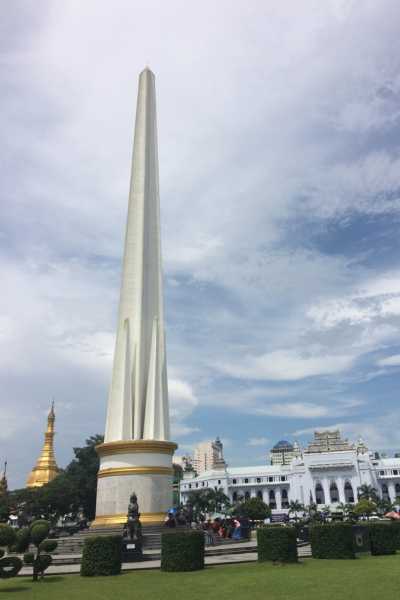
Moving on from Sule, we find the open square that is Maha Bandula It’s still a peaceful place, apart from all the tourists seeking the peaceful garden still touted by Lonely Planet. The square is named after the leader of the Burmese forces during the First Anglo-Burmese War. It houses the Independence Monument commemorating the independence of 1948. Today, more than ever, I feel the need to remind myself, though, that there’s a huge difference between independence and freedom.
3. See the light blue City Hall in Yangon
It’s quite lovely around here. If you squint a little and use some romanticised imagination. The City Hall must have been glorious in its day. It was built in 1924. It has a light blue coloring and dragons suspended over the main entrance. They flank a peacock. If you can see through the traffic to get a photo!

4. Visit the Supreme Court in Yangon
The Supreme Court building is beautiful, even now. It reminds me of the court building in Mumbai, India. It’s equally gorgeous, but even Mumbai isn’t crumbling like this. Mumbai’s court building is still used and maintained. Many of the colonial buildings here are crumbling quickly now, and if you continue walking around Yangon, you’ll see more of them.
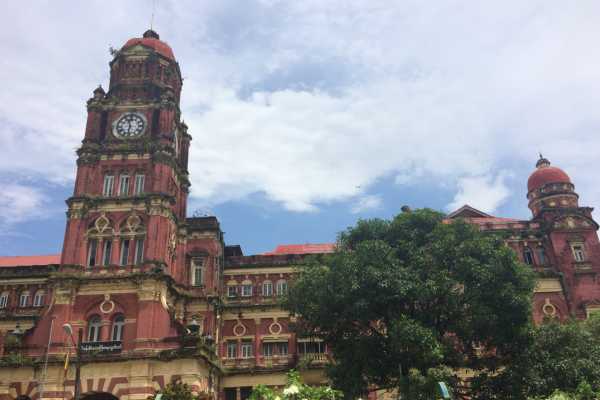
You’ll find one of the Sarkie Brothers’ hotels. The more impressive examples are Raffles in Singapore and the E&O in Georgetown, Penang. Here it’s the Strand Hotel. Unlike the Supreme Court, this building has been restored, most recently in 1989. But to within an inch of its life without retaining the ambience. But this is just looking from the outside. Perhaps, if you venture inside, like some of her famous guests, Rudyard Kipling, Somerset Maugham, and Lord Mountbatten, it is a little different.
5. See the Secretariat Building in Yangon
The biggest and most impressive colonial building that we find is the Secretariat. On our visit, it was all blocked off and almost disintegrating before our eyes. However, in 2018 it was completely renovated and now houses a cultural centre and some of the city’s more chic cafes and restaurants (oh, and a KFC). It covers some 37,000 square metres of floor space and is the former seat of British power in Myanmar. It’s here where General Aung San and six cabinet ministers were assassinated on 19 July 1947.

If his name is familiar, then it’s because he’s the father of “The Lady”, or “Daw” (Auntie), Aung San Suu Kyi. The leader of the National League for Democracy after their success in the 2015 election. (We visited about a month before the 2015 election, and visiting at a time of political upheaval is both good and bad; it prompts you to read up on the history and to understand much more about the region. William Topich and Keith Letitich’s “History of Myanmar” is an excellent and easy-to-read history, and I couldn’t put it down as we rode the rails throughout the country. The BBC’s election coverage and country information were also superb.
Obviously, much has changed in the last decade – and your best place to start reading about what’s happened is Wikipedia.
6. Shop at the Bogyoke Market in Yangon
I mentioned earlier that on this trip we’d become a bit “Templed-Out” and, like the temple situation, I think we’re Asian marketed out too. The Bogyoke market was for us, just another market selling more of the same stuff. However, Steve, as a local, tells us that if you’re looking to purchase some of the precious stones that are mined in Myanmar (jade, ruby, and sapphire), then this is the place to come. There is even a lab across the street at Junction City Mall, where you can get the stones tested and obtain the relevant permits so you can take them away with you legally. It’s also a great place to pick up uniquely Burmese handicrafts such as the longyi and colourful Pathein Umbrellas.

You can also see the Thanaka bark (and indeed branches) for sale, in case you need any to protect your skin from the sun.

7. See Yangon’s Holy Trinity Cathedral
Sadly, in 2015, the Holy Trinity Cathedral was closed. It no longer is, and the history is mind-boggling for the connections it has. Its foundation stone was laid in 1886 by Lord Dufferin, the Viceroy of India. His name first came to our notice on our first days in India, as we journeyed on the ferry from Fort Kochi to Ernakulam, past Dufferin Point. That all these folks travelled this part of the world more than 100 years ago is staggering. I feel more than a little inadequate in my travels!

8. Don’t Miss Yangon’s Shwedagon Pagoda
The absolute highlight of Yangon is the Shwedagon Pagoda, a copy of which we saw in Naypyidaw. It’s a little outside of the centre, so it’s best to take a taxi out to it. The light is best around sunset; heading there mid-afternoon is a good time.
Yangon didn’t let us down. This is one of the most glorious temples we’ve visited. It doesn’t, however, match the sense of peace I found in the Golden Temple at Amritsar, in the Punjab, India. There are far too many pilgrims and tourists wandering around for that, but it’s absolutely stunning.

The temple apparently enshrines eight strands of hair from the Buddha, Gautama, and relics from his predecessors. It is Myanmar’s holiest shrine and the symbol of national identity.
Even with all these people here, it is beautiful. It’s the oldest stupa in Myanmar, dating back to 588 BC. It’s been added to by subsequent Burmese rulers. It’s been looted by the Portuguese and the Brits and damaged by an earthquake.
The assassinated General Aung San addressed a mass meeting here in 1946, demanding independence from Britain. His daughter, Aung San Suu Kyi, spoke here in 1988, and marches during the 2007 Saffron Revolution also focused here.
The stupa is 99 metres tall. It’s gilded by 22,000 gold bars.

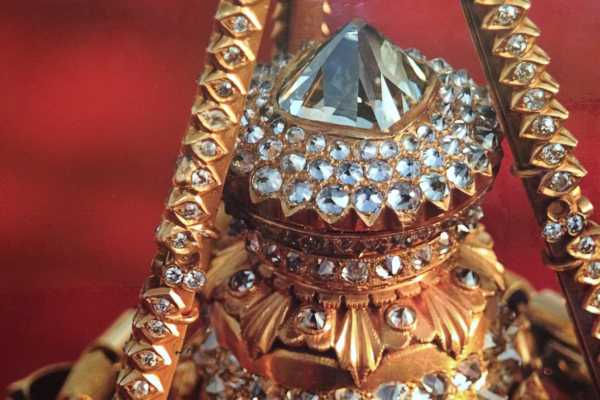
There are three octagonal terraces, 64 mini stupas, and it’s crowned by a “hti” – an umbrella or crown. The crown is set with more than 5400 diamonds, 2300 rubies, and golden bells. It’s topped with a 76-carat diamond that catches the first and last rays of the sun. Close-up photos of the hti are shown in a small photographic exhibition.
At the base of the stupa are the principal shrines of the four Buddhas Gautama, Kakusandha, Konagamana, and Kassapa. As we circle the base, we find the “planetary” posts. They represent the days of the week and the associated heavenly body and animal. Wednesday gets two posts. Here in Myanmar, astrology is taken incredibly seriously. The ruling General of Myanmar, who moved the capital to Naypyidaw, supposedly did so on the say-so of his astrologer.
There are shrines galore here.
From the solid jade Buddha from the Chinese Merited Association – made from a 324kg piece of jade from Kachin State, Northern Myanmar, to the Sun-Moon Buddha.

There’s a memorial to the student leaders of the 1920 revolt here. Also, a copy of the Buddha’s Tooth relic that’s held in the Temple of the Tooth, which we visited in Kandy, Sri Lanka.
We find many pilgrims at the “wish-fulfilling place” or the auspicious ground where folks pray to have their wishes granted. And there’s also a shrine to the place in which the 8 hairs of the Buddha were said to be washed.

My scepticism sadly rises at all these places where donations are given for what seem like surreal reasons.
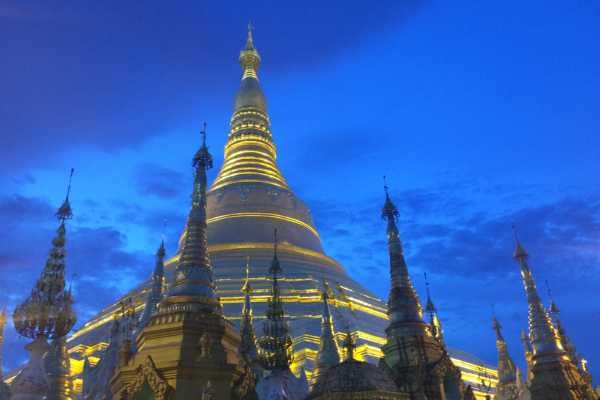
There is no denying the beauty of this place and the reverence that the Burmese people place upon it. It’s a fitting end to our visit to Yangon.

9. Take the Ferry boat over the River to the Dala Township
The boats that traverse the river from Mandalay to Bagan might not be running in 2026, but you can travel on a river here, and one of the most fun things to do in Yangon is to take the short ferry ride across the river to Dala Township on the opposite bank.
The ferry runs daily from 07:00 to 19:00 and takes just 15 minutes to cross, and offers excellent views of the city. The new Myanmar-Korea Friendship Bridge was also completed in February 2026.
But be warned, once you cross the river and leave the relative normality of Yangon behind, you enter another world of isolated villages and dense jungle. Dala is noticeably poorer than Yangon, so it’s inadvisable to be there after dark; however, during the day it’s a great place to explore via tuk-tuk or bicycle.
10. Take a Day Trip to Hlawga National Park
Hlawga National Park is a large protected area just 20 miles north of central Yangon and offers an excellent escape from the hustle and bustle of street markets and noisy traffic. The park includes miles of trail, including a picturesque boardwalk around a large lake, and deeper, jungle treks.
Kayaking and paddleboarding sessions are available year-round, and there are lots of pleasant picnic sites, as well as a small cafe/restaurant overlooking the lake. The park is a nesting site for migratory birds, and you’ll not fail to see some interesting wildlife from the cheeky macaques to deer, horned cattle, and, if you’re lucky (or unlucky depending on your sensitivities), the mighty Burmese python.
Travel Tips for Exploring Myanmar
- Get Travel Insurance: Civitatis includes medical expenses, repatriation, theft, luggage delays. No deductibles or upfront payments. Get a quote here.
- Download and install a VPN BEFORE you travel to Myanmar > discount coupon here
- Book Ferries, and Buses in Myanmar with12goAsia
- Book accommodation in Myanmar with Agoda or Booking
We left Yangon by train (yes, even after our experiences getting here), buying tickets at the train ticket office and heading to Mawlamyine. We left Mawlamyine to go to Sukhothai in Thailand. Our trip there was to visit this end of the Thai-Burma death railway. (it’s worth it). Of course, if you want to read more about what Myanmar is like in 2026, then check out Steve’s site, Myanmar-Travels.
Final Words on 10 Things to See and Do in Yangon
Yangon’s crumbling history is a delight to see and experience. The golden pagodas and colonial buildings are stunning, and the history feels just a fingertip away. It’s a glorious place to see. A lot has changed here in the decade since we visited, but those places that make Yangon special remain.
ASocialNomad is a participant in the Amazon Services LLC Associates Program, an affiliate advertising program designed to provide a means for sites to earn advertising fees by advertising and linking to amazon.com, amazon.co.uk, and amazon.ca. Amazon and the Amazon logo are trademarks of Amazon.com, Inc. or its affiliates. As an Amazon Associate, I earn from qualifying purchases.

