
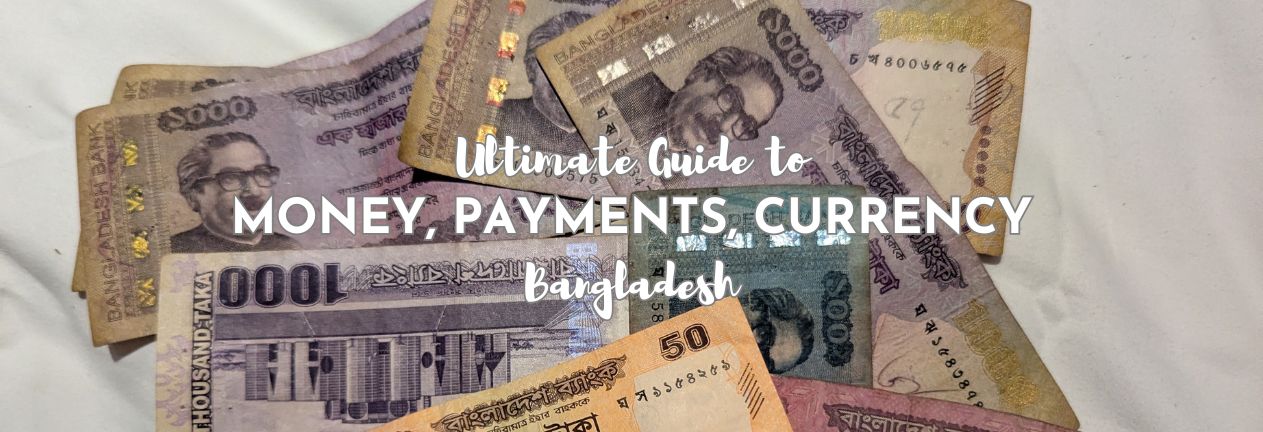
Money and the currency in Bangladesh are simple once you understand them. This is definitely not a tap-and-go destination, although many hotels and restaurants will accept cards. Cash is still king; you’ll quickly find that you need local currency for day-to-day travel, especially if you are traveling and staying in lower budget places, then cash is going to be required. My guide to the currency of Bangladesh and how to make payments covers what to expect, when you can use online payments and cards, and when you will definitely need cash.
THIS POST MAY CONTAIN COMPENSATED AND AFFILIATE LINKS MORE INFORMATION IN OUR DISCLAIMER
In this guide, I’ll walk you through exactly how money works in Bangladesh, from details of the currency to use, whether ATMs are reliable, to how easy it is to pay by card, and how much cash you’ll actually need. I’ll cover currency exchanges, online payments, and a key tip that will make your travels in Bangladesh a heck of a lot easier.
PRACTICAL TRAVEL TIPS
- 🛡️ Get Travel Insurance: Civitatis includes medical expenses, repatriation, theft, luggage delays. No deductibles or upfront payments. Get a quote here.
- 🛏️ Inhouse Resto? Laundry? Private bath? Book a Room.
- 🔌 Be ready for the plug, socket & power situation.
- 📶 Get online EASILY & cheaply – One eSim for the world. Data never expires
At a Glance – Payments & Currency in Bangladesh
- Currency: Bangladeshi Taka (BDT)
- Cash vs card: Cash is essential
- ATMs: Widely available in cities, less so in rural areas – read my guide to ATM fees in Bangladesh here. xxxx
- Cards: Accepted in hotels and some restaurants
- Best approach: Use cards when you can, ATMs for cash + carry backup foreign currency
Payments & Currency in Bangladesh?
The currency in Bangladesh is the Bangladeshi Taka (BDT). You’ll be dealing with notes rather than coins, and prices are quoted in Taka. As a rough guide, Bangladesh is a relatively low-cost destination, but you’ll still need to think in larger numbers due to the exchange rate. So you’ll be paying thousands for hotel rooms, for instance, when the hotel is around US$30 a night. Want to know where to stay in Dhaka? My guide is here.
Cash vs Card in Bangladesh
Bangladesh is still very much a cash-based economy. You’ll need cash for local transport, small restaurants and street food, markets and small stores (buying water and snacks, for instance. You’ll also need cash for entrance fees to attractions, like Dhaka’s Lalbagh Fort, for instance. If you take a day trip of Dhaka, then entrance fees are usually included.
Cards are widely accepted in places that surprised me, like the Panshi restaurant in Sylhet, but you shouldn’t rely on them for everyday spending.
ATMs in Bangladesh
ATMs are available in major cities like Dhaka, Sylhet, and Chittagong, and they’re generally the easiest way to get local currency. Read my guide to ATM fees xxxx to see which bank to use for your ATM withdrawals in Bangladesh. Be aware that some have low withdrawal limits and high fees.
Exchanging Money in Bangladesh
You can exchange money at the airport exchange counters (there are lots, and the exchange rate was decent), banks, and authorized exchange offices. You’ll need your passport to exchange money.
Exchange Rates and the Bangladeshi Taka
On 8 May 2024, the central bank placed the taka in a crawling peg to the US dollar. This is a way of keeping a currency pegged to another – and it’s usually the US dollar, but allowing frequent and small adjustments. The peg set on May 8, 2024, was 117 takas per US dollar.
Paying for Hotels, Tours & Transport
Generally speaking, all the hotels that you’ll find on booking.com or agoda.com will accept cards for payment. However, many of the budget range hotels don’t appear on these platforms, and you’ll find they have Facebook pages, and you’ll connect with them through Messenger or WhatsApp. They’ll likely want you to make deposits using bKash, and then pay the remainder in cash on arrival.
If you book a tour online with Viator, you can pay with a card. Your tour guide will expect a tip (in cash). If you’re using an agent, as we did with Ontu from Barishal, for tours and transport, then you’ll need to make payment either via bank transfer (which can take several days) or bKash (usually takes 5 minutes).
Transport in Bangladesh is a different story. You can make some (think few, very few) bookings for trains and buses using 12goAsia (see what your options are here), but check the time frames involved; they are much longer than you think for getting a ticket to you, and you can use a card for this. While online booking for trains is available to Bangladeshi’s with an ID number through the Bangladesh trains website, it’s not available to you. Some buses (again, it’s a few out of the massive number here in Bangladesh) can be booked online via 12goAsia. Despite all the information, you CANNOT use foreign cards to book buses trains or planes on Shohoz. It just does NOT work on browser or their app. And their customer services doesn’t respond either. (their train booking also requires registration on the Bangladesh train website as well as on Shohoz, and you can’t do that as a foreigner).
Many of the bus companies have their own website, but you really don’t want to subject yourself to that. They rarely, if at all offer online booking, some don’t have schedules, their main reason for existence appears to be to give you a phone number to ring.
Transport around cities, using the ride-hailing apps Uber and Pathao, is paid for using cash only. Technically, Uber accepts credit and debit cards for payment attached to your account, but most drivers won’t accept a ride if they see its being paid by a card. Rickshaws, CNGs (that’s a Bangladeshi tuk tuk), and taxis are all cash only, too.
Mobile Payments in Bangladesh (bKash, Nagad, etc.)
Mobile payment systems like bKash and Nagad are widely used by locals. They’re basically an e-wallet. You can make payments to bKash using a Wise account, and it works really well and quickly (the money transfers in about 5 minutes. There is, however, no way of RECEIVING money from a bKash account, so it’s a one-way transaction.
Bangladeshi Taka – Notes, Coins & What You’ll Actually Use
The currency in Bangladesh is the Bangladeshi Taka (BDT), and it’s what you’ll use for everything day to day. The taka came into being on March 4, 1972, following the independence of Bangladesh.
The word “taka” comes from the Sanskrit word “tanka,” meaning silver coin, and in Bangla, taka generally means any type of money.
Banknotes in Bangladesh
In practice, you’ll mostly be dealing with notes rather than coins.
The commonly used banknotes are:
- 2 taka – not common at all, but on here to make the list
- 10 taka
- 20 taka
- 50 taka
- 100 taka
- 200 taka
- 500 taka
- 1,000 taka
You’ll use 50, 100, and 500 taka notes the most for everyday spending. Smaller notes are essential for transport, tips, and small purchases, while 1,000 taka notes are common for hotels and larger payments. This is a country where no one ever has any change. So using a 1,000 taka note to pay for things and getting changes is something you’ll do constantly. Using it in a restaurant? Don’t expect to get as much change as you planned, as you should remember to tip. My guide to tipping in Bangladesh is here. xxxx
What’s on Bangladeshi Banknotes?
Most Bangladeshi banknotes feature Sheikh Mujibur Rahman, who is considered the founding father of the country. You’ll see his portrait on many of the notes, aside from those issued in 2025. Following the fall of the Awami League in the July 2024 Revolution (read more about it here), Sheikh Mujib’s portrait was removed.
On the reverse sides, you’ll find a mix of:
- National landmarks
- Historic sites
- Cultural imagery
- Natural scenes
While the currency is still young, being introduced in 1972, there have been 11 series of issuances of the notes, the most recent in February 2026. After the July Revolution of 2024, it was decided to remove Sheikh Mujibur Rahman from all the notes and replace him with graffiti from the July Revolution; these notes are slowly being issued. (There’s more on this graffiti in my guide to Dhaka here.
Coins in Bangladesh
Coins do exist, but you’ll rarely use them. Denominations include 1, 2, and 5 taka coins; we’ve only seen one 5 taka coin and one 1 taka coin during our stay.
FAQs on currency and payments in Bangladesh
Here are all the questions that we had about currency in Bangladesh, and the answers we’ve found.
What is the official currency of Bangladesh?
Bangladesh’s official currency is the Bangladeshi Taka. It is abbreviated as BDT, and the “৳” symbol is used to identify it.
Can I get Bangladeshi Taka abroad?
Yes. The Taka is NOT a closed currency, so you can obtain taka before you arrive in the country.
What Currency Should You Bring to Bangladesh?
It’s always worth bringing a stash of foreign currency. If you’re aiming to use the Bangladesh Visa on Arrival, for instance (I wrote about it here), then you can pay in 17 different major currencies. Or you can use a card. And yes, the card machine works.
The easiest currencies to exchange in Bangladesh are:
- US Dollars (USD)
- British Pounds (GBP)
- Euros (EUR)
U.S. dollars are usually the most widely accepted and easiest to exchange. We changed US$100 at the airport. It was a decent exchange rate and not far off what xe.com were stating as the exchange rate. There’s more on this and arriving at Dhaka Airport in my guide here.
Should You Bring Cash to Bangladesh?
Yes. It’s a good idea to bring some backup cash to Bangladesh. There are ATMs at the airport, but in case they don’t work or run out, having cash so you can get to your hotel is a good idea. Of course, if you’re using a transfer, then it’s not necessary. My guide to going to Dhaka Airport to the city is here. I would recommend a little cash, as your driver will expect a tip, and you can pre-book a transfer here.
What is bKash, and how do you use it as a foreign visitor in Bangladesh?
bKash is a mobile financial service, a digital wallet, that allows users to deposit, send, receive, and pay money via a phone app or SMS short code. It’s like a bank account on a phone (and it does NOT need a smartphone. Most of the phones we’ve seen people with here are NOT smartphones, so the SMS short code use is essential. It allows users to recharge mobiles, pay utility bills, make payments, and receive payments.
You, as a visitor, CANNOT get a bKash account (it, like the Bangladesh Railways system, requires a valid Bangladeshi National ID). You, as a visitor, CAN make payments to bKash accounts (and it’s very, very quick); it’s extremely easy to use from the Wise account online. It makes transfers much quicker than standard bank transfers, so you can pay deposits and for tours to your recipients’ bKash account.
You CANNOT receive money BACK from a bKash account.
How Much Cash Do You Actually Need in Bangladesh?
This depends on your travel style, but as a general rule, budget travelers will use mostly cash for hotels, rickshaws, and CNGs. If you’re buying bus tickets on the fly, then these, even for intercity, tend to be cash purchases. Train tickets purchased at the train station are cash-only purchases. You can buy an eSIM or SIM card at the airport (my guide on the best SIM/eSIM for Bangladesh is here) and pay with either card or cash. We paid by card, and it all worked easily.
There’s a good network of ATMs in the cities, and you can check out my guide to ATM fees for Bangladesh here. Xxxx
If you’re a mid-range traveler – I’d put us in this category, then you’ll want a mix of cash and cards. We’ve paid for our hotels mainly on cards, aside from in Cox’s Bazaar, where we had to partly pay with bKash and then pay the remainder in cash.
Our train tickets, bought online via our contact Ontu of Trip2Bangladesh. You can contact Ontu on WhatsApp here (+880 1784-399339) or [email protected]. Tell him Sarah & Nigel sent you. We paid for by bank transfer or bKash, the same as the tours he provided for us. We paid for all rickshaws, CNGs, Ubers, and Pathao’s with cash.
There are very few online tour bookings that you can make in Bangladesh. Viator is the primary option, and you can see what they have available here.
If you’re traveling at the high end, then pre-book your transport and transfers, booking and paying online with Viator or Welcome Pickups. You can also contact Ontu for bookings for tours and train tickets. And use cash for rickshaws and transport around cities. You’ll need cash for tips. Bangladesh is definitely a tipping society, for foreigners certainly, and you can read my guide to tipping in Bangladesh here. xxxx
Practical Tips for Managing Money in Bangladesh
While you can pay for more than I thought was possible on a card in Bangladesh, there’s a lot that you need cash for, so
- Withdraw cash in cities where ATMs are reliable
- You’ll get 1,000 taka notes out of the ATM.
- Break these into smaller denominations as soon as you can. You want 200’s, 100’s, 50’s, 20s, and 10s if possible.
BANGLADESH TRAVEL RESOURCES
STAY CONNECTED
WhatsApp with tour guides, get online easily and quickly.
Buy an eSim
HOTELS
Reserve a room here
Best city hotel? Need a laundry service? The best choice of hotels & places to stay.
TOURS & TRIPS
Most excursion choices, small groups, beach resort days passes, free cancellation, local guides.
Check options here.
AIRPORT TRANSFERS
Book now
Best choice of vehicles, English speaking drivers, 24 hour service.
Final Words on Money in Bangladesh
Managing money in Bangladesh isn’t complicated. The currency exchanges work well at the airport, and Google tends to be accurate for its locations in Dhaka. ATMs too. They work well; if a restaurant or hotel accepts cards, then the card machines tend to work. You will need cash, though, for tips, for transport around cities, and for paying for some tours if you book with locals and at hotels. If you arrive with the right expectations, use ATMs sensibly, and keep enough cash on hand, you’ll have no issues paying your way as you travel.
ASocialNomad is a participant in the Amazon Services LLC Associates Program, an affiliate advertising program designed to provide a means for sites to earn advertising fees by advertising and linking to amazon.com, amazon.co.uk, and amazon.ca. Amazon and the Amazon logo are trademarks of Amazon.com, Inc. or its affiliates. As an Amazon Associate, I earn from qualifying purchases.

