

We’ve visited the temples of Angkor twice now. We’ve visited Angkor Wat independently, and we’ve also explored Angkor Wat on a 2 day tour. We’ve seen sunrise here, and we’ve seen sunset at Angkor. While we learned a lot on our first visit, traveling independently, hiring our own tuk-tuks, and finding a guide at the entrance, our experience the second time was much deeper and informed. This is not a difficult place to visit, it can (and will) be busy. Millions of people visit Angkor every year. So our Angkor Wat guide looks at how to try and avoid crowds, making sure you don’t miss the highlights, and ensuring that you’re in the right frame of mind when you do get there. It’s easy in the sweltering heat of Cambodia to get exhausted and fed up. But Angkor is worth it. Ready?
THIS POST MAY CONTAIN COMPENSATED AND AFFILIATE LINKS MORE INFORMATION IN OUR DISCLAIMER
TOP WAY TO VISIT

Angkor Wat 2-Day Tour with Sunrise
Discover the temples of Angkor, representing 600 years of Khmer civilization. Learn about one of Asia’s greatest kingdoms from your historian guide and see major temples including sunrise & sunset.
Head out for a wonderful and informative time – but book early.
In 2024, a one day ticket costs US$37, a 3 day ticket US$62 and it is US$72 for 7 days. A few years ago on our first visit here, we bought the one day ticket, we toured independently, and at the end of the day, we agreed we needed more time. It took us some time to get back here, but we did and on our second visit, we opted for the 3 day ticket and also a 2 day guided tour which explained so much that we had entirely missed on our first visit.
PRACTICAL TRAVEL TIPS
- 🛡️ Get Travel Insurance: Civitatis includes medical expenses, repatriation, theft, luggage delays. No deductibles or upfront payments. Get a quote here.
- 🛏️ Sea view? Laundry? Private bath? Book a Room.
- 🔌 Be ready for the plug, socket & power situation.
- 📶 Get online EASILY & cheaply – One eSim for the world. Data never expires
The Best Way to See Angkor Wat
The best way to explore Angkor Wat and Angkor Complex is going to depend on how interested you are. You can pick up a tuk-tuk from your hotel that will rush you around to the main places to take a photograph if that’s what you’re interested in. You can get a guide at the entrance. You can rent a bicycle and spend an entire week here, or longer if you want. So you’ve got to decide what your interest level is.
If you’re coming here because you want a visit that educates, entertains, and gets you to the key parts of the Angkor Complex, then I recommend this specific tour from Journey Cambodia. It’s a small group tour. Our guide was one of the best that we’ve had in 10 years of traveling. I’ll explain what we saw, how our guide enhanced the visit, and also what our experiences were in visiting the first time when we picked up a guide at the entrance for an hour only as I go through this article.
Let’s start with an explanation of what you’re seeing around here.
What is Angkor Wat?
Angkor Wat is a Hindu-Buddhist complex of temples in Cambodia. More correctly termed the Angkor Wat Archeological Complex, Angkor Wat is the temple complex, that is located within the ancient Khmer city of Angkor. However, the term Angkor Wat is generally used to describe a single temple, the temple complex, and also the area around and near both of them.
The area in question covers 1,626,000 square meters or 402 acres, but in the past, the nature of Khmer building and settlement meant that it was low density and dispersed, so there’s an area of at least 1,000 square kilometers (390 square miles) that extends beyond the major temples covered in this guide to Angkor Wat. This area encompassed roads, canals, and general infrastructure. The area covered by Angkor Wat’s UNESCO World Heritage listing extends to 400 square kilometers (154 square miles)

The area that you’ll visit at Angkor, the complex of Angkor Wat is the largest religious monument in the world. The city was the capital city of the Khmer Empire, which ruled from the 9th to the 15th century. At its peak, the ancient city used to be home to more than a million people. The empire fell in 1351 to Ayutthaya (our guide to Ayutthaya is here) and was sacked in 1431. When Angkor started to decline the royal court was moved to Phnom Penh, Cambodia’s current capital city (our guide to Phnom Penh is here)
Your ticket to Angkor Wat gives you access to the temples, and the Archeological Complex of Angkor Wat, which was inscribed on the UNESCO World Heritage list in 1992.
What’s at the Angkor Temple Complex?
You will find the remains of different capitals of the Khmer Empire from the 9th to the 15th centuries, including all the major temples of Angkor and also moats, forests, and canals. Some villages are still inhabited, and they do sit within the wider temple complex. There are agricultural areas and rice cultivation. But you likely won’t want to or need to see all of that.
The major temples that you’ll want to see are
- The famous famous Temple of Angkor Wat
- Angkor Thom
- Bayon Temple
- Ta Prohm
- Preah Khan
- Banteay Kdei
What to See at the Angkor Wat Temple complex
Regardless of whether you visit the Angkor complex independently or on a tour, there are some key temples and areas that you’ll want to see. I’ll go through these in order of importance to the general visitor.
The Temple of Angkor Wat
This is the famous temple that you see in the first photo in this article. It’s what you see on all the promotional materials for Angkor Wat.
This is the centerpiece of the Archaeological complex. If you see just one temple at Angkor it should be this one. This is also the temple to see sunrise at Angkor.
Angkor Wat is the earthly representation of heaven. Each of the Cambodian kings strove to outdo each other by building temples. No one lived in these temples, they were simply for worship. The culmination of the temple building was Angkor Wat – it’s the world’s largest religious building. The temples in this area (the old capital of Angkor) were built during the period 802AD to 1432.
This is the temple that you’ll want to see at sunrise (we saw it at sunrise on this specific tour with Journey Cambodia – the tour was great, but the sunrise was not so much).
The first time I saw Angkor Wat, I wasn’t that impressed. We’d arrived around 09:00 and it was seriously hot (yes already) humid and crowded. Perhaps it was the heat. Perhaps it was that there were a fair few people, but my first impression wasn’t jaw-dropping. It was more a little “Oh, that’s it then”.
This wasn’t a Great Wall of China moment.
It became more impressive as we got closer.

The construction really is quite incredible, considering when it was built. It’s amazing how the temple lines up perfectly along compass lines, oriented perfectly to the west. The temple of Angkor measures a perfect square kilometer and has three terraces, which are capped by five lotus-shaped towers. The temple is surrounded by a moat and an exterior wall. The wall measures 1.3 kilometers by 1.5 kilometers.
The towers are typical Khmer architecture and they represent Mount Meru, the home of the gods in Hinduism. The Angkor people were Hindu until the end of the 12th century when they transitioned to Buddhism.
Unlike the other temples, Angkor Wat was never abandoned to the jungle after the city was sacked by the Ayutthayans and abandoned to the jungle from the early 15th century. It was mentioned by several visiting Europeans. Antonio da Madalena, a Portuguese friar was here in 1586, there were Japanese settlements here in the 17th century and Angkor was shown to Europeans who visited.
Even then it was a working monastery and temple.
However, it was the French we have to thank for “re-discovering” Angkor – in the 1860s. Although the Portuguese had also first “discovered” it in 1614. To cut a long story short about different explorers discovering Angkor, the first foreign tourists arrived in 1907.
And then, again, it was the French who began a long restoration process – from 1907 to 1970 the forest was cleared, drains were installed and work was undertaken to protect the buildings from water damage. This stopped in 1970 because of the Cambodian Civil War and the Khmer Rouge (read more about that in our guide to the Killing Fields of Phnom Penh here).
And, getting back to Angkor Wat.
As well as what I’ve mentioned above, Angkor is famous for sunrise and for its apsaras – that’s heavenly nymphs to you and me.

There are more than 3,000 here, sporting 37 different hairstyles and very shiny breasts. That’s from centuries of visitors trying to rub some good luck onto themselves. Or that’s the myth anyway.
If you’re going to visit Angkor Wat independently, then I recommend buying a specific guidebook about the temples, rather than just a chapter in a Rough Guide or Lonely Planet. I’d recommend
Moon Angkor Wat, or
The Pocket Siem Reap and the Temples of Angkor.
They haven’t been updated in recent years, but you know, to be fair, the temples haven’t had many updates since 1431 either…
Ta Prohm
The second most popular temple to visit at Angkor is Ta Prohm. Yes. This is the Tomb Raider temple. It’s time to embrace your inner Lara Croft. Yes, Ta Prohm is also known as the Angelina Jolie temple.
Much greener and less manicured than Angkor Wat, Ta Prohm is in an almost arrested state of decay.
Tumbledown blocks seem to be held sometimes almost by magic. Incredibly Ta Prohm was built without mortar and the tree roots curl impossibly in, under, and around buildings.

Your mind imagines them growing, reaching out, and including you in this macabre tableau of decay. They are giant snakes, not solid immovable trunks. They’re very much alive and they’re coming to get you. Moss covers almost everything.

It was Jayavarman VII – the first Khmer king who was devoted to Buddhism – who started the expansion program in Angkor in 1186. Ta Prohm (which stands for Ancestor Brahma) was one of the first temples constructed in this plan. Over the 37 years of his reign, Jayavarman is generally credited with introducing a welfare state for the Khmer people and constructing buildings that included hospitals and rest houses as well as temples. Bayon Temple and Angkor Thom also date from this period.
Ta Prohm was known as the monastery of the king or Rajavihara and the temple was built in honor of Jayavarman’s family, with various areas of the temple dedicated to his mother, father, elder brother, and guru.
When the Khmer Empire fell in the 15th century, Ta Prohm was abandoned. Even when the French began to restore the Angkor Wat temple it was decided that Ta Prohm would be left in an arrested state of decay. It was felt that Ta Prohm was the temple that had best become at one with the jungle, but not yet part of it. The restoration that has occurred has been primarily to prevent any further decay but also to minimize the effect of visiting tourists on the temple.
As you visit, right from the start, there’s an incredible atmosphere. Each time we visited there were lots of people here and yes it was hot. But somehow there’s still the feeling that the jungle is in control.
And it is possible to get away from the crowds. To find a quiet corner. To take a photograph with no people in it. And yes, even a moment of silence or two.
Angkor Thom and the Bayon Temple
Angkor Thom is the name of (another) ancient city within the area of Angkor, in which there are a series of temples, the most famous of which is the Bayon Temple. Angkor Thom was also built by Jayavarman and it was both his capital and the longest enduring of the Khmer capitals.
The city of Angkor Thom covers an area of 9 square kilometers (3.5 square miles), and at its center is the Bayon Temple. The name Angkor Thom means “Big” or “Great” City” (Angkor means city, and Thom means big). Angkor Thom was the Khmer capital when the area was sacked by the Ayutthaya kingdom, and that’s when the capital moved to Phnom Penh.
The walls around the city are 8 meters (26 feet) high and both the walls and the moat that surrounds them are 3 kilometers (1.8 miles) long. You’ll find a gate to Angkor Thom at each of the cardinal points – north, south, east, and west. There is a further gate, a fifth one, called the Victory Gate, which is 500 meters (1640 feet) north of Angkor Thom’s east gate.
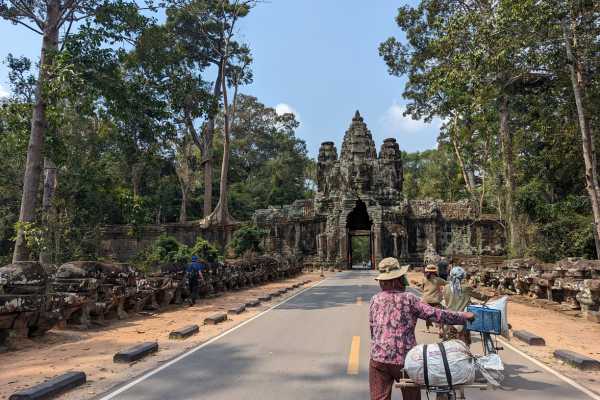
At the center of the ancient city is the Bayon Temple, which was the city, or state temple of Angkor Thom. Interpretively, Bayon is Mount Meru, and the city and the moat are the oceans and mountains that surround Bayon.
You’ll definitely want to visit here for a number of reasons. The first is the causeway and bridge across to the south gate.
The South Gate Deities of Angkor Thom aka the Churning of the Sea of Milk
You will most likely enter Angkor Thom via the South Gate. If you don’t, make sure you leave by it, as this causeway is spectacular. Although it looks like a bridge it’s technically a causeway as the water doesn’t flow underneath it.
As you approach the south gate of Angkor Thom you’ll see what looks like a bridge. And if you look closely you’ll see carved images on the walls on either side. These are Hindu images representing a Hindu myth, the Churning of the Sea of Milk. And the images are different on either side of the pathway.
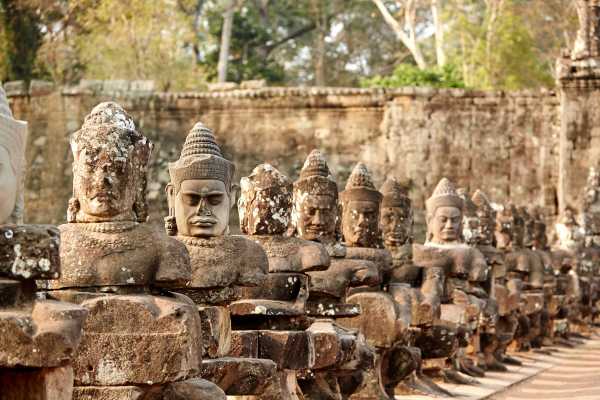
As you approach the south gate, on one side of the causeway (which does look like a bridge) you’ll see 54 devas (or guardian deities) which are pulling the head of a naga or mythical serpent. On the other side, there are 54 asuras (demon gods) which are pushing the tail of the serpent. In this Hindu creation myth, the whipping motion of the body of the serpent churned the ocean and recreated the cosmos. Those apsaras that you saw at Angkor Wat? They were the first beings to emerge from this sea of creation.
Angkor Thom’s Terrace of Elephants.
Inside the walled city of Angkor Thom is another spectacular place to visit – a 350 meter (1150 feet) long viewing platform named “the Terrace of Elephants”. Stories vary as to what this was used for – it may have been where the King viewed his victorious returning army. It may also have been the base where public complaints were listened to by the King.

The elephants are carved in bas relief and there are also carvings of life-sized garudas (a bird-like deity with the body of a human and the wings and beak of a bird) and lions.
Bayon Temple
Bayon Temple is the temple in the center of Angkor Thom. It was also built by Jayavarman VII. The Bayon Temple has 54 gothic towers that display more than 200 stone faces and these faces and the more than 11,000 figures display a combination of what everyday life was like here in the 12th century as well as historical tales of the time.

Bayon is known as the temple of the faces. But it’s most well-known among visitors for its great views of the surrounding jungle and for this reason alone, it is ALWAYS busy. It looks glorious in the early morning or late afternoon sun,
The temple was originally built for Buddhist worship, but it was later renovated as a Hindu Temple.
Pre Rup Hindu Temple
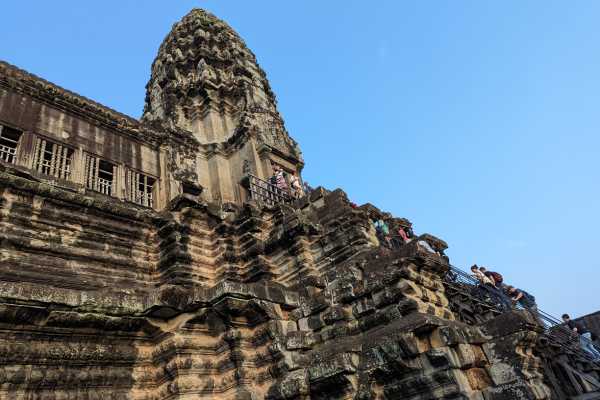
This 10th century Hindu Temple means “turn the body” – the name comes from a common Cambodian belief that there were funerals conducted here, with the ashes of the deceased rotated in different directions throughout the ceremony. The temple was dedicated to the Hindu God Shiva and is on an artificial island in one of the reservoirs of Angkor.

There’s a lot of red brick used in the construction and it looks lovely in early or late light.
You’ll notice the three spires of Pre Rup – and it’s kind of like a miniature Angkor Wat.
Preah Khan
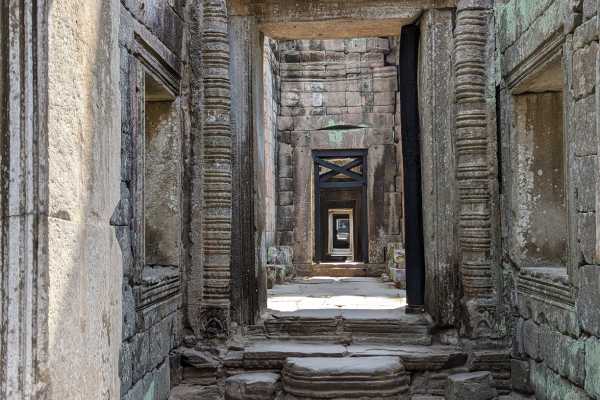
To the northeast of Angkor Thom is the temple that Jayavarman VII built to honor his father, Preah Khan. It’s very similar to Ta Prohm, with a state of arrested decay, although you can wander right inside some of the terraces and it does feel rather like some of them might fall on you!
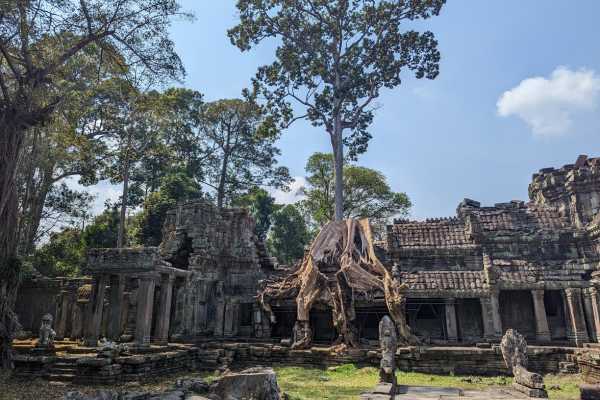
The site of Preah Khan is the location of the battle that Jayavarman VII had with the Chams in 1191. He was victorious. The name Preah Khan translates to “Holy Sword”
Banteay Srei
Another 10th century temple, this has to be my favourite of the temples at Angkor. It’s quite a distance away from the main temples, some 25 kilometers (16 miles), but you’ll usually find fewer people here (yay!). You’ll probably only get to Banteay Srei if you take a 2 day tour, like this one that we took.
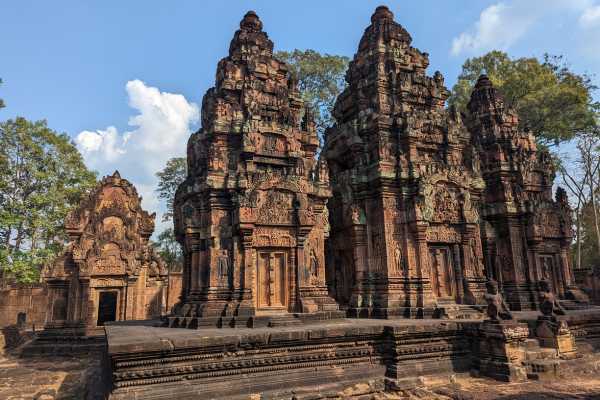
The detail and carving are spectacular. While tourists have been visiting Angkor since the French rediscovered the temples in the 1900s, Banteay Srei has only been open to the public since the Khmer Rouge left the area in the 1990s.
Banteay Srei is carved mostly from hard red sandstone, which can be carved like wood, and compared to the other temples, this is a tiny temple. The lintels and pediments (the triangle bit at the top of a doorway) are gloriously and ornately carved.
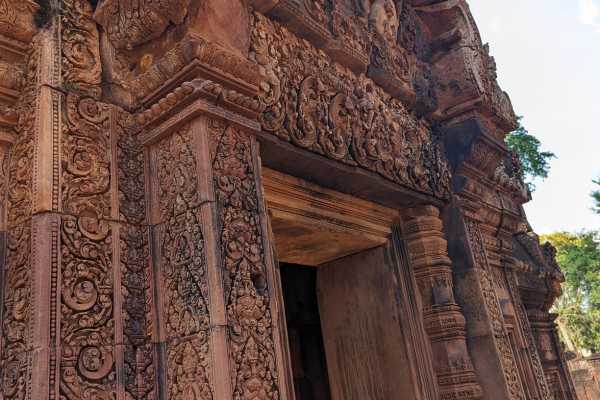
This temple is unusual as it was built not by the rulers, but by a couple of courtiers and its name translates as “Citadel of the Women”, or sometimes “Citadel of Beauty”. And it is a beauty.
Phnom Bakheng.
If you’re planning on seeing Angkor Wat at sunset, then the best place to see a sunset is Phnom Bakheng. Some tours, like this one, include stopping at Phnom Bakheng in your tour. On our first visit here, our tuk-tuk drivers didn’t include staying this late, but we paid them extra to stay while we watched the sunset and rode back in the dark. You’ll want to pre-arrange a ride back to Siem Reap if you want to see the sunset here, as you’re unlikely to find a driver just waiting around for a fare.
Phnom Bakheng is the oldest temple in the Archaeological Complex, built in the 9th century, it has symbols from both Hinduism and Buddhism and again represents Mount Meru. You’ll leave your transport at the bottom of the hill and need to walk up the wooded, paved slope, to get to the temple.
Numbers are limited now to around 300 people, to protect the structure AND the visitors.
Seeing Angkor Wat at Sunrise
The best place to see Angkor Wat at Sunrise is the “Reflecting Pool” in front of Angkor Wat. And despite all those photos on Instagram and other social media sites, you won’t have it to yourself. The Angkor Wat complex opens at 05:00. The time of sunrise at Angkor Wat varies from 05:30 to 06:30 depending on the time of year that you visit.
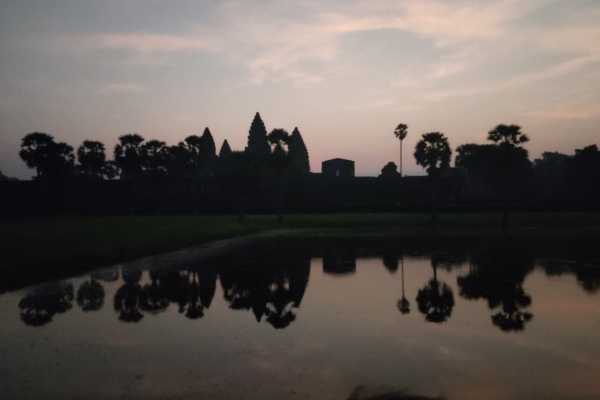
If you’re taking a tour that includes sunrise then you’ll get there in plenty of time. If you’re traveling independently, then you’ll need to leave your hotel in Siem Reap around 04:45, but you can check the sunrise times for Angkor Wat here. Note that you’ll see the sunrise times for the city of Siem Reap, which is the closest city to the complex. Our guide of what to do and where to stay in Siem Reap is here.

Seeing Angkor Wat at Sunset
The most popular place to see sunset at Angkor Wat is Phnom Bakheng. It is inside the Angkor Complex, so you do need your ticket to enter here. If you’re touring independently, then you’ll need to have transport arranged to go back to Siem Reap. It will be dark when you leave, and there’s a mass exodus from the park after sunset. It’s not a pleasant bicycle ride at this time.
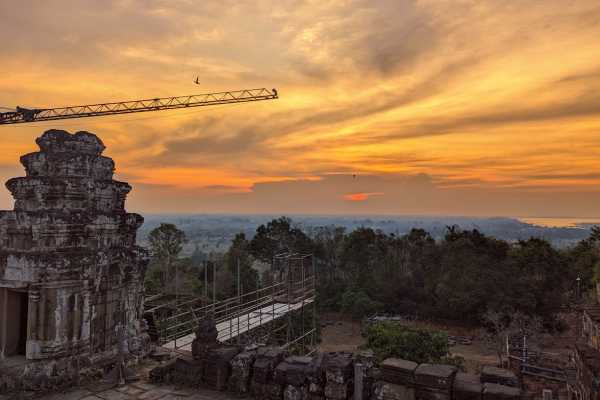
There is a limit to the number of people who are allowed onto the temple platform, so you’ll want to get here about 30 minutes before sunset if not earlier. If you’re taking a tour, then check if this is included. If not, then you can have your guide arrange transport back and just pay cash for the ride back to Siem Reap. It’s usually a one-off cash payment of about US$4 per person.
FAQ about Visiting Angkor Wat
Here are the questions that we get asked about visiting Angkor Wat – don’t forget if you have a question about how to explore Angkor Wat you can send us an email, or ask in the comments below and we’ll answer for everyone else to see.
What is the Angkor Wat entrance fee?
You can buy different tickets to visit Angkor Wat. You can buy online (here) or buy a ticket at the entrance to the Archeological Park. You’ll need to decide how many days you want to visit.
- A one day Angkor Wat ticket is US$37
- A three day Angkor Wat ticket is US$62
- A 7 day pass to Angkor Wat costs US$72
You can buy with cash OR cards at the ticket office now.
What does Angkor Wat mean?
The name Angkor is derived from nokor (នគរ), a Khmer word meaning “kingdom” which in turn derived from Sanskrit nagara (नगर), meaning “city”.[3]
When is the best time to visit Angkor Wat?
It’s best to visit Angkor Wat in the dry season, which is between November and March.
How do I buy tickets for Angkor Wat?
You can ONLY buy tickets for Angkor Wat either at the entrance gate or online at the official site here.
How big is Angkor Wat?
The Angkor Wat complex measures 1,626,000 square meters, or 402 acres. The specific Angkor Wat Temple measures 215 x 187 meters (705 x 614 feet), but the moat around it is 5 kilometers (3 miles) long and the outer wall around this specific temple is 3.6 kilometers (2.2 miles) long.
Is one day enough to visit Angkor Wat?
If a day is all you’ve got, then it’s enough to visit Angkor Wat. Don’t NOT visit because you can only spare a day. I recommend two days to visit Angkor Wat. Make them long days – and see Angkor at sunrise AND sunset.
How many days do you need to visit Angkor Wat?
I think two days is a good amount of time to visit Angkor Wat. You can buy a three day ticket, which means that if you bump into too many people, or the weather is bad, or you just can’t deal with the heat of the jungle, you can come back for a 3rd day.
What to wear in Angkor Wat?
There’s a specific dress code at Angkor Wat. This entire complex is a religious monument, one of the most important in the world. You need to wear clothes that cover your shoulders and knees. Although there is shade between a lot of the temples, when you actually are exploring the temples, there isn’t much shade. So bring a sunhat. Or an umbrella, which is my favorite way of avoiding the sun in Asia. (and yes it comes in handy for downpours too).
And you’ll need decent walking shoes, you’re going to be covering a lot of ground. Even if you’re taking a guided tour that provides transport between the relevant temples.
Is Angkor Wat open 7 days a week?
Yes. Angkor Wat is open 7 days a week. It’s open 365 days a year, including all national holidays. Opening hours depend on the temple. Most Angkor Wat temples are open from 07:30 until 17:00, but several are open for sunrise and sunset.
Which Angkor Wat Temples are open for sunrise?
Angkor Wat, Srah Srang, Pre Rup, and Phnom Pahkeng temples are open for sunrise (which means 05:00)
Which Angkor Wat Temples are open for sunset?
The Pre Rup and Phnom Bakheng temples are open for sunset, which means until 19:00
Angkor Wat Map of Temples
You can see the full map of Angkor Wat temples here.

Travel Tips for Exploring Cambodia
- Get Travel Insurance: Civitatis includes medical expenses, repatriation, theft, luggage delays. No deductibles or upfront payments. Get a quote here.
- Get online immediately with an eSIM – one SIM for the whole world, data never expires.
- Download and install a VPN BEFORE you travel to Cambodia > discount coupon here
- Arriving by air? Book your airport transfer with Welcome Pickups here.
- Book the best Cambodia tours and guides on Get Your Guide
- Read about getting around Cambodia in our guide to Cambodian Transport
- Book Buses in Cambodia with 12goAsia
- Book accommodation in Cambodia with Booking
Final Words in Our Angkor Wat Guide
The temple complex at Angkor Wat is spectacular. It is vast and full of history. A visit here is incomparable. And we’ve seen a lot of temples in our time. So whether you come to Angkor Wat for one day or longer, whether you take a tour, or whether you visit independently, just come. And explore. It’s a stunning place to visit.
ASocialNomad is a participant in the Amazon Services LLC Associates Program, an affiliate advertising program designed to provide a means for sites to earn advertising fees by advertising and linking to amazon.com, amazon.co.uk, and amazon.ca. Amazon and the Amazon logo are trademarks of Amazon.com, Inc. or its affiliates. As an Amazon Associate, I earn from qualifying purchases.

