

Huangshan, aka the Yellow Mountain, is one of China’s most famous natural attractions and one of the country’s best hiking destinations. It’s known for granite peaks, ancient pine trees, dramatic rock formations, and the famous Sea of Clouds, and has inspired Chinese artists and poets for centuries. It’s a popular mountain, with millions of visitors each year, but despite all those people, it still offers some of the most spectacular mountain scenery in China. Whether you’re planning a challenging hike up thousands of stone steps, taking a cable car to the summit, or spending a night on the mountain to see the sunrise, visiting Huangshan is a fabulous Chinese experience you won’t forget. In this guide, I’ll cover everything you need to know about hiking Huangshan Mountain, including routes, difficulty levels, maps, transportation, accommodation, viewpoints, and practical tips to help you plan your visit.
THIS POST MAY CONTAIN COMPENSATED AND AFFILIATE LINKS MORE INFORMATION IN OUR DISCLAIMER
PRACTICAL TRAVEL TIPS
- 🛡️ Get Travel Insurance: Civitatis includes medical expenses, repatriation, theft, luggage delays. No deductibles or upfront payments. Get a quote here.
- 🛏️ Breakfast Included? Laundry? Private bath? Book a Room.
- 🔌 Be ready for the plug, socket & power situation.
- 📶 Get online EASILY & cheaply – Get a China eSIM
- 🚄 Book trains in China – quickly easily. Use Trip.com
When we visited Huangshan, we hiked and took the cable car. Our hike was a long climb up seemingly endless stone staircases (but don’t worry, the down is harder), incredible mountain views, and a memorable hiking experience. And those steps? There are more than 60,000 of them at Huangshan, so you’ll have plenty of chances to experience them!
EASIEST WAY TO VISIT

Buy Huangshan Skip the Line Tickets
Buy skip the line tickets for Huangshan. Include the cable car too if you want to, you’ll avoid having to line up for tickets. This is a quick and easy way to get a head start on the mountain.
Why You Should Visit Huangshan
Huangshan Mountain is one of the most iconic landscapes in China and is worthy of being added to your China itinerary. It is a unique combination of natural beauty and cultural significance.
What Makes Huangshan Special
Huangshan is instantly recognizable. The jagged granite peaks, twisted pine trees growing from impossible angles, and layers of mist drifting between the mountains create scenery that looks more like a traditional Chinese painting than a real place. In fact, many classic Chinese landscape paintings are believed to have been influenced by the scenery found here. Today, Huangshan is a UNESCO World Heritage Site and one of the most visited scenic areas in China.
There is a vast network of trails, stairways, viewpoints, and mountain paths, and while most visitors use the cable cars, hiking the mountain is an experience that I wouldn’t swap.
Not as easy to get to either. To get here, after our sojourn to Nanjing, we’d had to take an afternoon train south to Huangshan. The train station is not actually near the mountain Huangshan, but in the town of Tunxi (but it’s called Huangshan).
Huangshan’s Four Wonders
Huangshan is famous for what are known as the Four Wonders of Huangshan Mountain. They are natural features and the main reason people travel from across China (and the world) to visit the mountain.
The Peculiarly Shaped Pines at Huangshan Mountain
The pine trees of Huangshan are probably the mountain’s most recognizable feature. They grow directly from cracks in the granite cliffs, and many of these trees have survived for hundreds of years despite the harsh conditions. Their unusual shapes have become symbols of Huangshan.
Fantastic Rock Formations at Huangshan Mountain
Across Huangshan Mountain, you’ll find countless rock formations that have been given imaginative names based on their appearance. Some require a good deal of imagination to see the creature or person behind them (very much like how I struggled at Binggou Danxia in Gansu province recently), but some of them have legends attached to them, which adds to the attraction of Huangshan.
Sea of Clouds at Huangshan Mountain
This is the primary reason we came to Huangshan Mountain. The Sea of Clouds. When conditions are right, thick clouds fill the valleys below the peaks, creating the impression that the mountains are floating above a white ocean. Sunrise (and we came for sunrise) is often the best time to witness this phenomenon, although you’re likely to be disappointed by the clouds not behaving.
Hot Springs at Huangshan Mountain
The hot springs at Huangshan have been famous for more than a thousand years. Located near the base of the mountain, if hot springs are your thing, then they provide a relaxing way to unwind after a day of hiking.
Klook.comWhy is Huangshan known as the Yellow Mountain?
You’ll quickly notice that many guidebooks and travel websites use both “Huangshan” and “Yellow Mountain.” Interchangeably. That’s because they’re exactly the same place.
Huangshan and Yellow Mountain Explained
The name Huangshan translates directly to “Yellow Mountain.” While visitors often refer to it as Yellow Mountain, you’ll usually see it written as Huangshan in China, on train tickets, maps, hotels, and tourist information.
The mountain wasn’t always known by this name. Originally, it was called Yishan, or Black Mountain. During the Tang Dynasty (618 to 907), the mountain was renamed Huangshan in honor of the legendary Yellow Emperor, a mythical ruler who is said to have made magic here. Today, Huangshan Mountain is one of China’s most famous scenic areas and a UNESCO World Heritage Site. Whether you see it described as Huangshan, Mount Huangshan, Yellow Mountain, or the Yellow Mountains of China, all of these names refer to the same spectacular mountain range in Anhui Province.
Is Huangshan the Same as Huashan?
No, Huangshan and Huashan are completely different mountains, although many travelers confuse the two because of their similar names.
Huangshan, or Yellow Mountain, is located in Anhui Province and is famous for its granite peaks, pine trees, Sea of Clouds, and extensive hiking trails.
Huashan is located near Xi’an in Shaanxi Province and is known for its dramatic cliffside paths, narrow walkways, and reputation as one of China’s most challenging mountains. My guide to hiking Huashan is here. (and it’s well worth it and very different from Huangshan).
Where is Huangshan?
Understanding exactly where Huangshan is located will help you to see how it fits into a wider China itinerary. Thanks to China’s extensive high-speed rail network, Huangshan is much easier to reach than it ever used to be. (Our first visit in 2014 involved a lot of trains and buses!).
Huangshan’s Location in Anhui Province
Huangshan Mountain is located in southern Anhui Province in eastern China and is part of the Huangshan Scenic Area.
Most visitors stay in the town of Tangkou, which sits at the southern entrance to the Huangshan Scenic Area. Tangkou serves as the main gateway to the mountain and is where you’ll find hotels, restaurants, ticket offices, and transportation connections. The other options for accommodation are in the mountains (and there are a few options) and the town of Tunxi, which is sometimes also known, confusingly, as Huangshan.
The nearest major train station is Huangshan North Railway Station, which is on the high-speed rail network.
How Far is Huangshan from Shanghai?
Huangshan is approximately 430 kilometers (267 miles) from Shanghai. The easiest way to travel between Shanghai and Huangshan is by high-speed train. Direct trains typically take between 2.5 and 3.5 hours, depending on the service, making Huangshan a popular long weekend destination from Shanghai. You can check the timetable and book trains to Huangshan here with Trip.com
How Far is Huangshan from Hangzhou?
Huangshan is approximately 250 kilometers (155 miles) from Hangzhou. High-speed trains connect the two destinations in around 1.5 to 2 hours, making Huangshan one of the easiest side trips from Hangzhou. Because of the short travel time, it’s entirely possible to travel from Hangzhou to Huangshan in the morning and begin exploring the mountain the same day. You can book a train to Huangshan here.
How to Get to Huangshan
Getting to Huangshan is surprisingly easy thanks to China’s excellent transportation network. Most visitors today arrive by high-speed train, although buses and domestic flights are also available. Once you reach the area, you’ll need to continue to Tangkou, the main gateway town for Huangshan Mountain. The alternative access is Tunxi, aka Huangshan City.
How to Get to Huangshan By High-Speed Train
For most travelers, the high-speed train is the best way to reach Huangshan. Trains connect Huangshan North Railway Station with major cities including Shanghai, Hangzhou, Beijing, Nanjing, and Hefei.
We arrived in Huangshan on the train from Xi’an. (read about Xi’an here)
The train is comfortable, reliable, and often faster than flying once airport transfers and security checks are taken into account. If you’re traveling the Huangshan from Shanghai or Hangzhou to Huangshan, the high-speed train is almost certainly your best option. When booking tickets, look for services terminating at Huangshan North Railway Station rather than Huangshan City, unless you’re planning on staying in Huangshan City (aka Tunxi).
Check train timetables and book a ticket to Huangshan here.
How to Get to Huangshan By Bus
Long-distance buses operate from several cities throughout eastern China. While buses are generally cheaper than trains, journeys can be significantly longer and less comfortable. We used several buses in our visits to China, the most memorable of which was the bus from Hekou to Yuanyang, which you can read about here.
How to Get to Huangshan By Domestic Flight
The nearest airport is Huangshan Tunxi International Airport. Domestic flights connect Huangshan with several major Chinese cities. Flying can be useful if you’re coming from southern or western China, although we always prefer the train. From the airport, you’ll need onward transportation to either Huangshan City (Tunxi) or Tangkou. Using the ride-hailing app, Didi is usually the best (and cheapest) option, unless you’re taking a city bus.
Getting from Huangshan North Station to Tangkou
If you’ve taken a fast train and arrived at Huangshan North Railway Station, you’ll still need to travel to Tangkou, the town at the base of Huangshan Mountain. Luckily, there are regular shuttle buses running between the station and Tangkou, with the journey taking approximately 50 minutes. Alternatively, use Didi to get to your hotel in Tangkou.
If you’re planning to hike Huangshan early the following morning, I recommend staying in Tangkou the night before. This gives you easy access to the park entrance and avoids an early morning transfer from Huangshan City.
Before You Hike Huangshan
A little preparation goes a long way when visiting Huangshan Mountain. So here’s all you need to know about entrance fees, opening hours, cable cars, what to pack, and the best time to visit. It’ll also help you decide whether staying on the mountain overnight is something that you want to consider.
Klook.comEntrance Fees and Tickets for Huangshan
You will need to purchase an entrance ticket to access the Huangshan Scenic Area. Then there are separate fees that apply for the various cable cars, which are optional but can save a considerable amount of climbing. We compromised and took one cable car up, and then hiked, stayed overnight on the mountain, and then hiked back down.
You can buy tickets from Trip.com (and they tend to be cheapest), or you can also buy from Getyourguide.com or Klook.
Ticket prices vary depending on the season. It’s more expensive between March and November as this is peak season. Tickets for the Huangshan entrance range from 150 to 190 CNY. The cable car tickets also differ depending on which cable car and season, and range from 65 to 100 CNY.
It’s always best to buy tickets in advance. During peak holiday periods such as Chinese National Day and major public holidays, tickets can sell out quickly, and booking is recommended. If you’re planning to hike up and take a cable car down, or vice versa, you’ll need to purchase both an entrance ticket and the relevant cable car ticket.
Do NOT forget to take your passport EVERYWHERE with you in China – yes, the original, not a copy – as you will need it to get into the Scenic Area and to verify your ticket.
Opening Hours of Huangshan Mountain
Opening hours vary slightly throughout the year, but Huangshan Scenic Area generally opens early in the morning and remains accessible until the evening.
- March 5 until November 30: Monday to Friday 07:00 – 17:10
- March 5 until November 30: Saturday and Sunday 06:30 – 17:40
- December 1 until March 4: 08:00 – 16:40
Cable Cars also operate the same seasonal hours as above. However, the West Sea Valley Cable Car is open from 08:00 to 17:00 and closed from December to March.
If you are staying on the mountain, then you do NOT need to buy a ticket for your second (or third) day; your ticket is valid so long as you don’t leave the mountain.
If you want to see sunrise on the mountain at Huangshan (like we did), then you should stay overnight in one of the mountain hotels, as you’ll then have time to get to the viewpoints before dawn without having to hike up in the dark.
Klook.comWhat to Pack for Hiking Huangshan Mountain
Even if you’re only planning a day hike, it’s important to come prepared. The mountain weather can change quickly, and you’ll be climbing thousands of stone steps throughout the day.
I recommend bringing:
- Comfortable hiking shoes with good grip
- A reusable water bottle
- Snacks for the trail
- A lightweight rain jacket
- Sunscreen
- A hat
- A portable power bank
- Extra layers during cooler months
When we visited, the stair climbing was far more demanding than we expected. Having plenty of water and comfortable footwear made a huge difference. But don’t worry, this is a Chinese mountain, there will ALWAYS be somewhere where you can buy water, souvenirs, and pretty much anything you need!
Best Time to Visit Huangshan
Huangshan can be visited throughout the year, with each season offering a different experience.
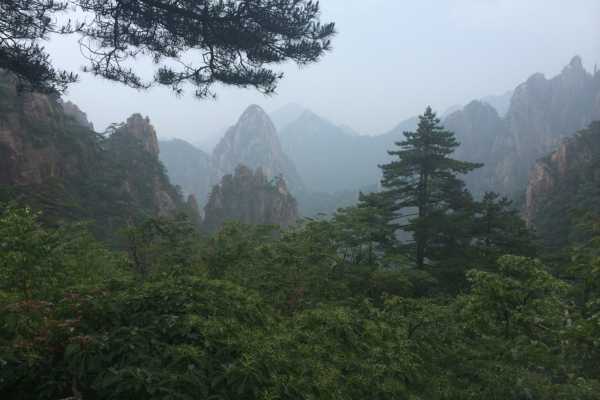
Spring brings fresh greenery, blooming flowers, and a higher chance of seeing the famous Sea of Clouds. Summer offers warmer temperatures but also attracts larger crowds. Our visit was in mid-July, and we got drenched. With monsoon-like rain. It wasn’t hot, put it that way!
Autumn is often considered one of the best times to visit, thanks to cooler temperatures, clear skies, and colorful foliage. Winter transforms Huangshan into a snowy wonderland, with ice-covered pine trees creating some of the mountain’s most spectacular scenery.
Huangshan Hiking Map and Route Options
One of the most common questions people ask is which route they should take up Huangshan Mountain. The good news is that there are several options depending on your fitness level, available time, and whether you want to hike the entire way or use one of the cable cars.
Huangshan Trail Map Overview
The Huangshan Scenic Area is vast, with numerous peaks, viewpoints, hotels, and walking trails spread across the mountain range. Today, most visitors enter from the south near Tangkou and either hike or take a cable car to the summit area before exploring the network of trails at the top.
The two main hiking routes are the Eastern Steps and the Western Steps. Both eventually connect to the central summit area, where many of Huangshan’s most famous viewpoints are located. We visited via the Eastern Steps.
If you’re visiting for the first time, carrying an offline map or downloading one to your phone before arriving can be helpful, although the major trails are generally well-signposted. This map (below) is a great one to give you an overview of the mountain and the trails.

The Eastern Steps Route at Huangshan Mountain
The Eastern Steps route is the most popular hiking route on Huangshan Mountain.
Starting near the Yungu Cable Car station, this route climbs steadily through forests and granite scenery before reaching the summit area. While still challenging, it is generally considered the easier of the two main hiking routes. And don’t worry, taking the cable car up still means that you’ll have plenty of hiking to do when you get to the top of the cable car station.
Many visitors choose to hike up via the Eastern Steps and descend by cable car, creating a good balance between experiencing the climb and saving their knees on the way down. Heading down the steps is a real workout for your calves, and we felt it for days afterwards.
The Eastern Steps route also provides easier access to several of Huangshan’s most famous viewpoints.
The Western Steps Route at Huangshan Mountain
The Western Steps route is longer and generally considered more demanding than the Eastern Steps.
This route passes through some spectacular scenery and offers a quieter experience compared to the busier eastern side of the mountain. However, it involves a substantial amount of stair climbing and can take considerably longer to complete. There tend to be fewer crowds on this route.
Cable Car Options for Huangshan Mountain
For those who prefer to reduce the amount of climbing required, Huangshan’s cable cars provide quicker access to different areas of the mountain. We used one cable car (the way up via the Yongu and the Eastern Steps) and hiked all the way back down.
Yungu Cable Car at Huangshan Mountain
The Yungu Cable Car serves the eastern side of Huangshan and is one of the most popular options for reaching the summit area. This is the route that we took. It’s popular. You will want to buy tickets before you get there, and it provides quick access to many of the mountain’s famous viewpoints and is frequently used by visitors following the Eastern Steps route.
Yuping Cable Car at Huangshan Mountain
The Yuping Cable Car serves the southern side of Huangshan and provides access to several major attractions, including the famous Greeting Pine. If you just want a quick and dirty visit, then this is a popular choice to maximize sightseeing time while minimizing the amount of climbing required.
Taiping Cable Car at Huangshan Mountain
The Taiping Cable Car operates on the northern side of the mountain and is well known for its impressive length and panoramic views. It’s used by fewer visitors and tends to be quieter.
Klook.comHow Difficult is the Huangshan Hike?
One of the most common questions people ask before visiting is whether Huangshan is difficult to hike. The answer depends on the route you choose and your fitness level, but there’s no doubt that hiking Huangshan Mountain is more physically demanding than most people expect it to be.
Fitness Level Required for Hiking Huangshan Mountain
You don’t need to be an experienced mountaineer to hike Huangshan, but a reasonable level of fitness will make the experience much more enjoyable. The trails are well-maintained and easy to follow, with no technical climbing required. This is a mountain of concrete trails. And steps.
But the sheer number of steps means it’s hard work. Especially coming back down them. However, if you’re comfortable walking for several hours and tackling sustained uphill sections, you should be able to complete most Huangshan hiking routes without any problems.
Stair Climbing and Elevation Gain
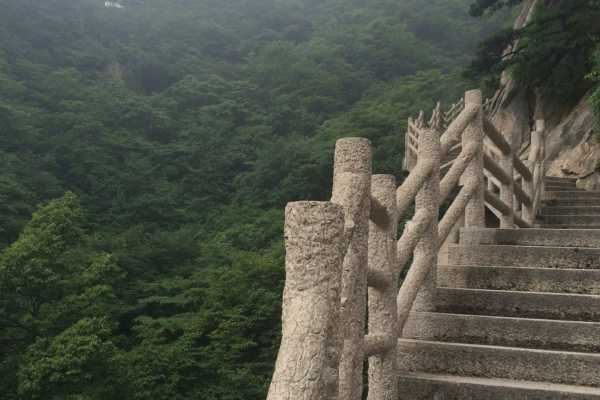
The biggest challenge on Huangshan Mountain isn’t rough terrain, it’s the endless staircases. And hiking on concrete is hard on your feet. There are more than 60,000 concrete and stone steps that connect the various trails, viewpoints, and peaks throughout the mountain. Some sections are steep, and there were times during our hike when it felt like every corner revealed yet another staircase climbing into the clouds.
The base of Huangshan is a miserly 200 – 800 meters (depending on where you start), and the top is 1864 meters. So it can be a challenging and significant elevation gain. And of course, you don’t just go straight up, there’s a bit of up, not much flat, some down, and the up again. And so on.
Our Huangshan Hiking Experience
When we were standing in a thunderstorm, with spectacular lightning, sheltering from the torrential rain that was threatening to go over the TOP of my shoes, it didn’t seem to be a good idea that we’d said “screw the weather” and continue with our planned trip to Huangshan, the Yellow Mountain.
We’d already conquered fears and Mount Huashan, and despite the calf-trembling pain of the few days after that, we’d gone back for more. This time, it wasn’t a sacred mountain, just another item on the Bucket List.
And it wasn’t particularly easy to get to either. After our sojourn to Nanjing, we’d had to take an afternoon train south to Huangshan. The train station is not actually near the mountain Huangshan, but in the town of Tunxi (but it’s called Huangshan). After a night in Tunxi, we spent an hour in a bus to get to Tangkou (also confusingly called Huangshan in some places), where we’d booked into a hotel that doesn’t exist anymore, but their map was amazing, so I’m keeping it in this blog post.
As we were staying on the mountain overnight, we’d set off a little later than expected, and our hosts suggested a route for us to walk and arranged to buy our bus tickets for an onward trip to Hangzhou once we’d returned. Minutes later, we were heading for the bus station and the 18 CNY tickets to take us to the Huangshan ticket office. This was going to be another of those not-cheap visits to a Chinese mountain.
When we first visited in 2014, it wasn’t possible to buy tickets in advance online. Now it’s essential. This is a very popular mountain these days.
Our shuttle bus took us to the East Steps base, where, in torrential rain, we bought our 230 CNY tickets (in 2014) – current ticket prices are here and the single cable car ticket, another 80 CNY. (Cable car tickets have barely changed in price; check them out here.
So, just after noon, we were zooming up a very misty, drizzle-bound Yellow Mountain on the Yongu cableway.
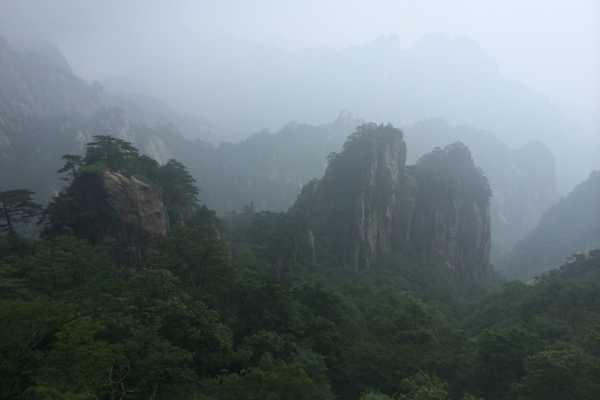
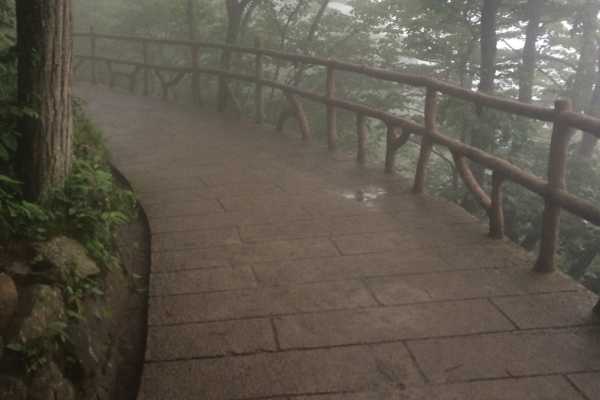
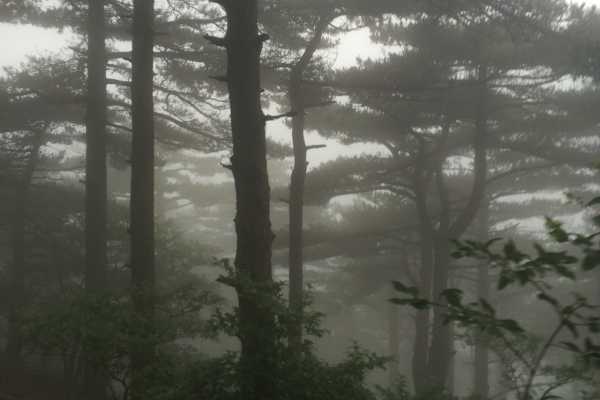
10 minutes into our foray onto the mountain, we were donning waterproofs. Then we were sheltering under the trees with 20 other Chinese tourists, considering the folly of our ways and listening to the hugely loud thunder cracks. But we were here, and we trudged on, contemplating the mist through the trees, and the grey outlook now below us. Similar to Huashan, there are no trails as such; it’s all concrete or stone paths, and there are steps upon steps upon steps.
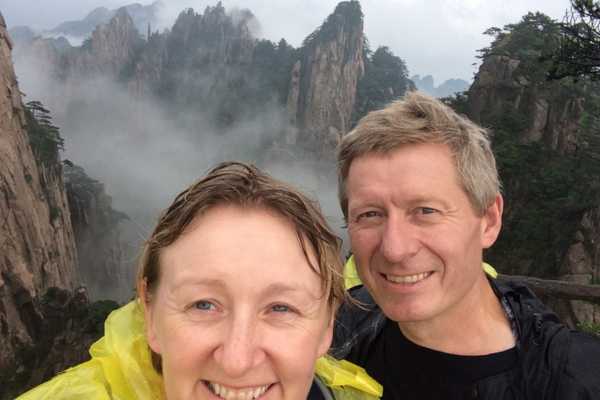
We’d made it to the poetically named “Beginning to Believe Peak” – named apparently, by a disbelieving tourist that there was anything worth looking at up here. We were wet, our feet were sodden, and we were contemplating the selfie that would contain just our faces, rain day hair, and a grey background, when all of a sudden the mists cleared.
Magical. We were there on Beginning to Believe Peak, suddenly believing. It wasn’t just us; we met a Chinese national, back from 30 years in the USA, who snapped a shot of us, as she said it mirrored the delight that she felt, too, beginning to believe.
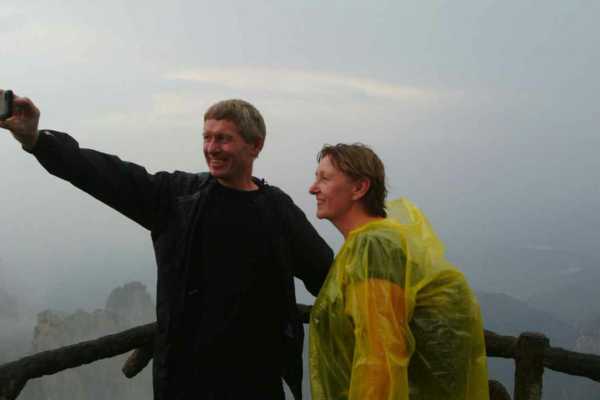
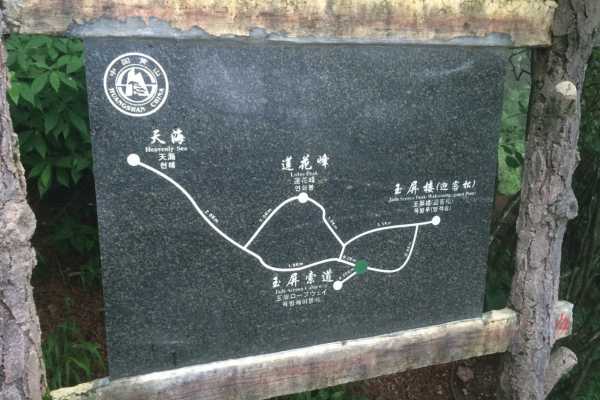
We were staying on the mountain to try and catch a sunrise, as, unlike Mt. Huashan, it’s not possible to walk up Huangshan in the dark. So your options for sunrises and sunsets are to stay on the mountain or stay on the mountain. There are quite a few places to stay. We’d chosen the cheapest, best located for a sunrise, the Behai (now Xihai hotel ), and headed there to check in and claim our beds before continuing our hike around the summit.
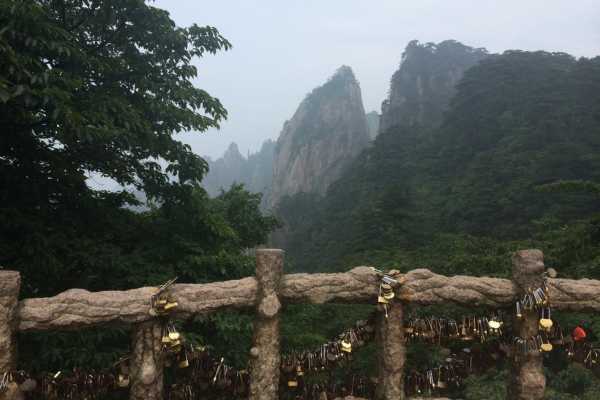
At the time, (they don’t have them anymore), this hotel had dorm beds, which even in 2014 cost us 240 CNY each. Separate male and female dorms. Double rooms started at 720 CNY, and we figured that we’d be getting up at 04:30 for the sunrise anyway. We ended up rooming next door to each other and without a keycard for the rooms, which have 6 bunk beds each.
As usual in cheaper Chinese beds, there was a wooden board involved and not a great deal of comfort. It was clean, though, with clean bedding, and there was a bathroom in each room – it had just been a regular room, with the twin beds replaced by three sets of bunks.
I ended up sharing with 2 sets of Chinese girls, who stayed in the room all afternoon and evening, glued to a very loud TV watching what I can only imagine was crap Chinese TV. I suspect the content wasn’t relevant, because there was even a program in American English broadcast. That was crap too, but they watched avidly until I made a point of turning the lights off….
I’ve written before about the noise that the Chinese make. They excelled themselves at the Behai. We were bedding down at around 22:00, with alarms set for 04:20, with a start planned for 04:30 (we’d come back for showers after the sunrise). Sunrise was scheduled to be 05:18, and still the noise continued in the corridors and in adjoining rooms. Doors banging. The usual shouting conversation is going on outside the door. Damn. Should have brought the earplugs up the mountain.
Looking for earplugs? My Loop Earplugs are one of the best travel kit investments I have ever made. Get yours here.
None of my fellow roomies snored. But two of them did start to get up at 03:30, but that’s ok, because I was wide awake by then. After all, clearly, some other groups were also getting up and had applied the “If I’m awake, then all the rest of you are going to be awake too” technique of justifying their early rise.
Food options on the mountain are not limited at all. They’re only limited by what you want to spend. It looked like a great full menu in the restaurant at the Behai, which also had one of the fastest in China wifi connections available in the public areas, but it was expensive. We figured that a main course each would have set us back around 150 CNY, so we headed outside, using the experience of Nigel’s roomie, who hailed from Marin County (how cool, a neighbor!).
Corn on the cob, a parcel of sticky rice, and two Chinese sausages (contents unknown) each for the bargain cost of 24 CNY. Beers were off the menu, being too expensive, but we’d lugged tea bags up the mountain and had a kettle in the dorms, so we were going to drink tea.
Klook.comSunrise on Huangshan
Stumbling out in the dark, we followed the crowds, up more steps, and as they headed to the designated “best place to watch the sunrise”, we peeled off to the right and found ourselves a wall over the cliff and claimed our spot.
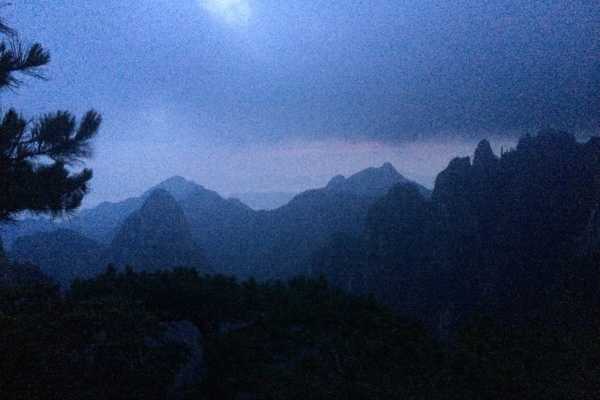
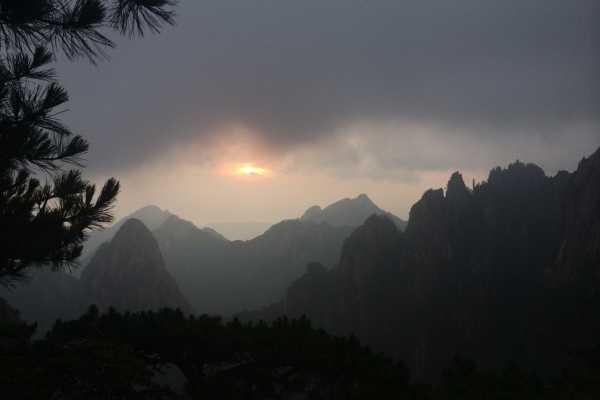
It was glorious. Watching the scene go from dark to dawn to the sun rising. Watching the mountains and trees slowly take form and the landscape change. It was worth the extra cost, the sleepless night, the irritation at the smokers in the cafe area where we sat to use the wifi, and the two annoying travelers, who insisted they knew everything, and then persisted in competing with Chinese noise levels and giving us the benefit of their ‘considerable experience’.
Walking down Huangshan
The weather didn’t get any better. In fact, the sunrise was the best part of the day – as the sun rose, the mist rolled in, and the drizzle started. The wind got up, and by mid-morning it was 40 miles an hour (64 km/h) at the top. We’d planned to walk around the peaks at the top, summit Lotus Peak and Celestial Mountain, but they were closed. Our calves thanked us immensely and agreed to walk down the mountain instead of taking the cable car down.
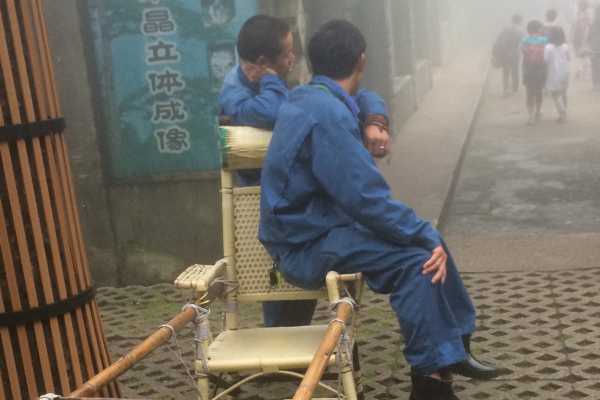
Even so, the walk down was 15 kilometers (9.3 miles) and took us four hours; we took the longer, more scenic route – known commonly as the Western Steps (as opposed to the Eastern Steps – which we’d bypassed a lot of by using the Yungu cableway). Easier than the descent from West Peak to the North Peak Cableway on Huashan, because the steps were much more uniform, but harder as the wind made it hairy, and the sheer number of steps was just overwhelming. We passed sedan chair offer after sedan chair offer, and we passed folks on their way up.
We peered at the Welcoming Pine through the fog and held on tight to handrails as we slipped down wet, treacherous steps.
We considered the small food, drink, and souvenir stalls on the way down. The price here was just the same as the prices at the top, but here, everything has to be carried in; there’s no cable car to ease the load.
Like we said on the Great Wall, anything we buy we have to carry, so thanks, but NO. Especially to the child-sized bamboo chair, which seemed to have no place 3 kilometers (1.9 miles) up a mountain.
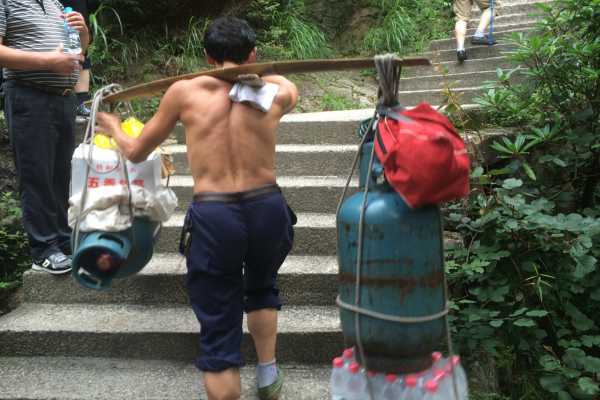
We passed porter after porter, some carrying what we calculated to be more than 148lbs (67 kilos) of weight. And looking at them (and their calf muscles), you’ve got to believe that was actually more than their own body weight! They carried rice, gas bottles, bottles of water, Coke, and vegetables.
We saw groups of tourists, blindly following their guide, who, like in an increasing number of places around the world, insist on using a speaker to broadcast their patter. Don’t come to the mountains for peace and quiet!
We walked through the forest at the bottom, listening to the high-pitched sound of insects and of something else, very loud and shrill – we moved on quickly.
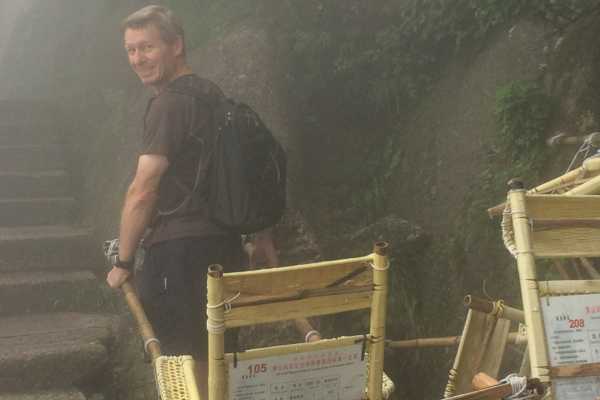
And we arrived at the bottom, paid our 18 CNY for the shuttle bus, although you can actually walk down the road as well if you so wish. Before long, we ended up back in Tankou.
Huangshan won’t be our last mountain in China, but it’s certainly memorable. I can still recall the delight on that mist clearing. I remember how incredible it was to see the landscape change as daylight broke.
Best Viewpoints on Huangshan
One of the best things about hiking Huangshan Mountain is that there is the potential for spectacular viewpoints around every corner, weather depending, of course. While there are dozens of scenic spots across the mountain, a handful stand out as must-see locations.
Bright Summit Peak
Bright Summit Peak, or Guangming Ding, is one of the highest and most famous points on Huangshan Mountain. It’s at an elevation of 1,860 meters (6,102 feet), and it offers panoramic views across the surrounding peaks and valleys. Because of its relatively open location, it’s also one of the most popular places to watch both sunrise and sunset. It’s pretty easy to get to, and most visitors to the central summit area will see it.
Flying Over Rock
Flying Over Rock is one of Huangshan’s most photographed natural features. It’s an enormous boulder which appears to balance precariously on top of a rocky outcrop, seemingly defying gravity.
Beginning-to-Believe Peak
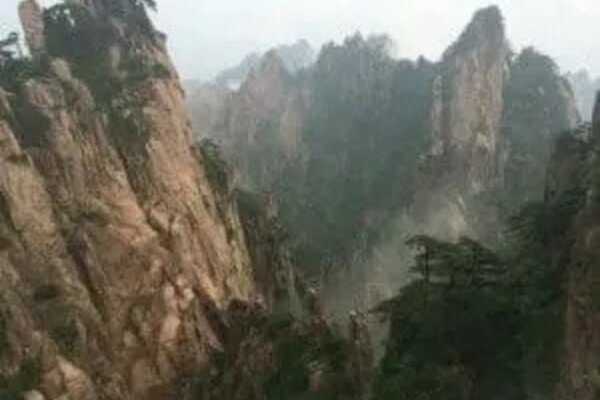
Beginning-to-Believe Peak is famous for its collection of ancient pine trees and sweeping mountain views. It’s my favorite viewpoint on Huangshan, because it was where we began to believe in the mountain. It’s the classic Huangshan landscape of granite peaks, twisted pines, and dramatic cliffs.
Lion Peak
Lion Peak is another of Huangshan’s most popular viewpoints and is particularly well known as a sunrise viewing location. It’s probably the most popular spot for seeing the Sea of Clouds.
Klook.comMy Recommended Huangshan Hiking Itinerary
How much time you spend on Huangshan Mountain will have a big impact on your experience. You can visit in one day, or stay overnight, so you can catch the sunset and sunrise.
Huangshan in One Day
If you’re short on time, it’s possible to visit Huangshan in a single day. You’ll want to start as early as possible, ideally arriving at the mountain entrance shortly after opening. Take a cable car to the summit area and spend the day exploring the network of trails and viewpoints.
Include the highlights such as Bright Summit Peak, Beginning-to-Believe Peak, Flying Over Rock, and the various scenic walkways that connect the central mountain area.
If you decide to hike up, or down, or both ways, then be prepared for a rather long day. Lots of people tend to choose to take the cable car one way and hike the other.
Huangshan in Two Days
On the first day, head up to the summit area, stopping at viewpoints and scenic spots along the route. Spend the afternoon exploring the trails before checking into one of the mountain hotels. Start your second day with sunrise, then find yourself some breakfast, and pick up the viewing points that you missed on the first day. Then either hike down or take the cable car.
Staying Overnight on the Mountain
Staying overnight on Huangshan Mountain can be the highlight of the trip. The biggest advantage is being able to watch sunrise and sunset without having to rush back down the mountain. Early morning is often when Huangshan is at its most beautiful, with soft light illuminating the peaks and clouds filling the valleys below.
Accommodation on the mountain is generally more expensive than staying in Tangkou, and rooms do book out quickly during peak travel periods, so book your accommodation well in advance, particularly during weekends and Chinese public holidays.
Where to Stay When Visiting Huangshan
Choosing where to stay can make a big difference to your Huangshan experience. Most visitors either stay in Tangkou at the base of the mountain or book a hotel on the mountain itself.
Staying in Tangkou
Tangkou is the main tourist town at the southern entrance to Huangshan Scenic Area and is where most visitors base themselves before or after their hike. It’s cheaper to stay here than it is on the mountain. Tangkou is also a convenient base if you’re planning to visit nearby attractions such as Hongcun or Xidi. This is a great option for staying in Tangkou.
Staying on the Mountain
If your goal is to watch sunrise or sunset on Huangshan, staying on the mountain is the best option. Several hotels are located within the summit area, but you will want to book early, as they get booked out quickly. Check out hotels near the summit area to book.
Practical Tips for Hiking Huangshan
Huangshan is one of the most accessible mountain destinations in China; it’s not a whole lot easier to get to and hike than it ever used to be.
Avoiding Crowds
Huangshan is one of China’s most popular tourist attractions, so crowds can be significant, particularly during weekends and public holidays. Do NOT travel during the Chinese National Day in October and other major holiday periods. Arrive early in the morning to get to the viewpoints before the largest tour groups arrive.
Staying overnight on the mountain can also provide opportunities to experience some of Huangshan’s most famous viewpoints when visitor numbers are much lower.
Food and Water on the Mountain
Food and drinks are available at various locations throughout Huangshan Scenic Area, including near some of the hotels and major viewpoints.
Toilets and Facilities
Toilets are available throughout much of the Huangshan Scenic Area, particularly near cable car stations, hotels, and major viewpoints. They’re generally well-maintained considering the mountain environment and the large number of visitors. You’ll also find shops, rest areas, and small food outlets in several locations across the mountain.
Weather Considerations
The weather can have a huge impact on your Huangshan experience. I mean, look at ours! Torrential rain, even in July. A lack of views, but to be fair, the rain and fog were atmospheric!
Frequently Asked Questions about Huangshan
If you’re planning a visit to Huangshan Mountain, these are some of the most common questions that we’ve answered about visiting Huangshan.
How difficult is the Huangshan hike?
Huangshan is a challenging hike, primarily because of the huge number of stone steps rather than the altitude or terrain. Be prepared for several hours of sustained climbing.
How long does it take to hike Huangshan?
This depends on your route and whether you use the cable cars. Most people spend between 6 and 10 hours exploring Huangshan during a day trip. If you’re hiking all the way to the summit and back down again, expect a full day of walking.
Can you hike Huangshan in one day?
Yes, Huangshan can be visited in a single day. An early start is essential if you want to hike and still have enough time to visit the major viewpoints. If your schedule allows, spending two days on the mountain provides a more relaxed experience and gives you the opportunity to see sunrise or sunset.
What is the best hiking route in Huangshan?
For most visitors, the Eastern Steps route offers the best balance of scenery, accessibility, and hiking challenge.
Is Huangshan worth visiting?
Absolutely. Huangshan is widely considered one of the most beautiful mountain destinations in China and is one of the country’s most iconic landscapes.
Why is Huangshan called Yellow Mountain?
The name Huangshan translates as “Yellow Mountain.” The mountain was renamed during the Tang Dynasty in honor of the legendary Yellow Emperor, an important figure in Chinese mythology. Today, Huangshan and Yellow Mountain refer to the same destination.
Do you need a map for hiking Huangshan?
The map that I’ve included in this blog post should be enough. A map can be helpful, especially if you’re planning a longer hiking route or staying overnight on the mountain. However, Huangshan’s main trails are generally well signposted, and most visitors have little difficulty finding the major viewpoints.
CHINA TRAVEL RESOURCES
STAY CONNECTED
WhatsApp with tour guides, get online easily and quickly.
Buy an eSim
HOTELS
Reserve a room here
Best city hotel? Need a laundry service? The best choice of hotels & places to stay.
TOURS & TRIPS
Most excursion choices, small groups, beach resort days passes, free cancellation, local guides.
Check options here.
TRAINS IN CHINA
Book now
Book trains in China easily, quickly and get the seats and berths you need.
Final Thoughts on Hiking Huangshan
This mountain has inspired artists, poets, and travelers for centuries. You don’t need to hike every one of the 60,000 steps here to enjoy the mountain. You don’t have to stay on the mountain and try to see sunrise (but you should). The granite peaks are dramatic, the pine trees are gloriously twisted, and the entire experience is well worth the visit.
ASocialNomad is a participant in the Amazon Services LLC Associates Program, an affiliate advertising program designed to provide a means for sites to earn advertising fees by advertising and linking to amazon.com, amazon.co.uk, and amazon.ca. Amazon and the Amazon logo are trademarks of Amazon.com, Inc. or its affiliates. As an Amazon Associate, I earn from qualifying purchases.


2 thoughts on “Hiking Huangshan (Yellow Mountain): Routes, Difficulty, Maps & Travel Guide”
How did you manage to book the bunk beds? Did you walk in, or did you book in advance? If booked in advance, could you share the website for booking? I’m having trouble finding any booking site specifically for bunks on top of Huangshan.
We just turned up on spec, but you can now book online with Trip.com – they’re generally the best site for online bookings in China – this is a good spot for sunrise/sunset and staying over. Not sure they still do bunks. (We ended up in bunks as that’s all that was available). Xihai Hotel Huangshan. good luck and let me know how you get on!