
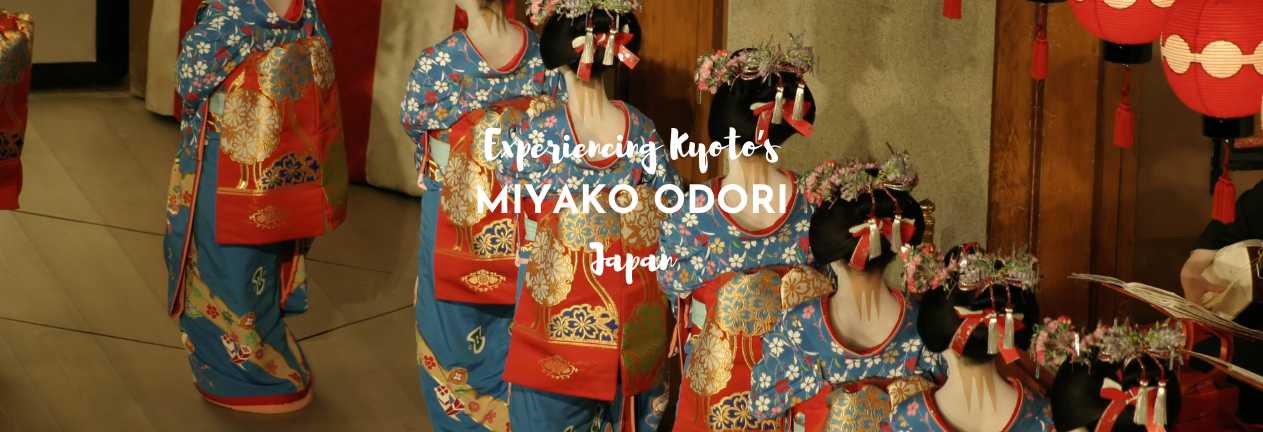
For the entire month of April, every year, Kyoto’s Gion Kaburenjo Theater turns itself over to the geiko and maiko and becomes the home of the annual Miyako Odori. Kyoto was once the capital of Japan and Miyako Odori translates literally to “Capital City Dances”. As it is peak cherry blossom season in Kyoto at this time the dances are also sometimes called the Cherry Blossom dances or even “the Kyoto dances”. Regardless of what you call them, if you are in Kyoto during this time and can attend, it’s a unique Japanese experience and well worth the time spent there. Here’s our experience of attending Kyoto’s Miyako Odori.
THIS POST MAY CONTAIN COMPENSATED AND AFFILIATE LINKS MORE INFORMATION IN OUR DISCLAIMER
Kyoto was Japan’s capital from 794 until 1868, and the name Kyōto literally translates as Capital City, but over the years it’s been called a variety of names, including Miyako “The Capital”, but it wasn’t until four years after Japan’s capital moved to Tokyo, in 1872, that the Miyako Odori dances started here in Kyoto as part of the Exhibition for the Promotion of Domestic Industry. The moving of the capital to Tokyo had caused an economic decline and this was part of the plan to revitalize the old city.
PRACTICAL TRAVEL TIPS
- 🛡️ Get Travel Insurance: Civitatis includes medical expenses, repatriation, theft, luggage delays. No deductibles or upfront payments. Get a quote here.
- 💰 Read about the Currency in Japan and ATM fees.
- 🔌 Check out Japan’s plug, socket & power situation.
- 📶 Get online EASILY & cheaply – One eSim for the world. Data never expires
The dances and performances of the Miyako Odori were a way of showcasing Kyoto’s traditional arts. In the original performance, the choreography was performed by Yachio Inoue III, who was the Kyomai Dance School Master. Today this role is still undertaken by the Kyomai Dance School, but it is under the instruction of Yachio Inoue V. She is listed as a Living National Treasure, one of only 116 in the country.
Kyoto is the heart of Japan’s world of geishas, the highly skilled entertainers who have trained for years in traditional Japanese arts to become the perfect entertainer. In Kyoto fully trained geisha are called “geiko” (it’s pronounced gay-ko). From the age of 15, young women train to become a geiko, and during this period they’re called maiko (pronounced myko), when they are fully trained they are known as geiko. Maiko are recognizable by their colorful kimono with long sleeves and extravagantly pinned hairstyles. Geiko wear plainer kimonos, plainer hair adornments, and shorter sleeves.
The expo in Kyoto in 1872 was the first time that Kyoto’s geisha had performed in public. In 1873 the performances moved to the Gion Kobu Kaburenjo Theatre and they have been there ever since. The theatre holds 900 people and the tickets usually sell out for each performance.

What is Miyako Odori?
There are many spring traditions in Japan, and the Miyako Odori is another of them that is unique to Kyoto. The year 2024 marks the 150th year of the performances. This is the time of sakura or Cherry Blossom which is particularly special in Kyoto. The Miyako Odori is a series of dance, song, and theatre performances by the geiko and maiko of the Gion quarter of Kyoto. There is accompanying music. Historically, the performances started by way of increasing tourist traffic to the city.
Japan’s geisha are world famous, but only usually perform at small private gatherings in teahouses in the Gion district of Kyoto
Each show lasts about an hour and consists of 8 different scenes, which detail the changing seasons in Japan. There are no breaks in the show, and scenery changes are seamless, there’s no raising and lowering of curtains.
The performance takes place on the stage at the front of the theatre, but the geiko, maiko, and musicians perform throughout the ground floor of the theater and walk around the raised areas to the sides of the theater too.

There are 3 Miyako Odori performances a day, every day during April – from April 1st to April 30th.
During the hour-long performance you get to see the geisha (geiko) and maiko demonstrate their training in theatre, music, and dance.
Each of the performances has 8 scenes, all of which display aspects of Japanese life throughout the seasons. You’ll see the seasons change with the different scenery displays – and there are stories and dramatizations, which will make little sense unless you buy the audio guide (which is excellent), and you’ll need one per person. There are usually around 60 geikos and maikos involved in the performance wearing stunningly embroidered kimonos.
The Miyako Odori opens with the “Miyako Odori wa yoiyasa!” chant.
The audio guides can be purchased just before you enter the auditorium. They come with one ear plug and no way to add a second plug. Audio guides for the Miyako Odori cost 700 Yen and you’ll need to pay cash.
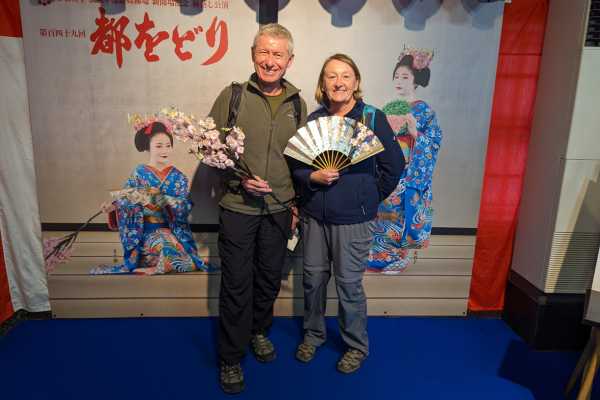
Performance show times for the Miyako Odori
There are 3 performances a day for the Miyako Odori – 12:30, 14:30 and 16:30.

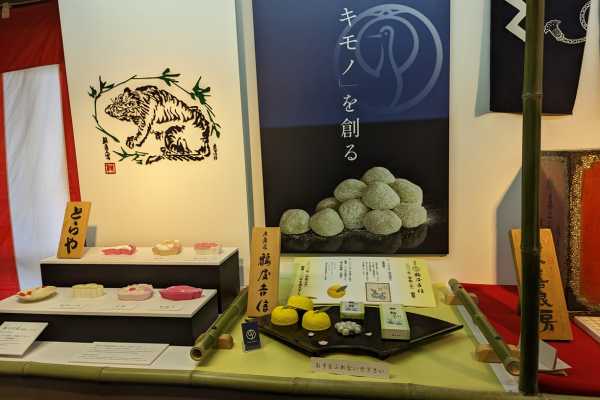
History displays of the Miyako Odori
There are stalls to purchase souvenirs and there are displays to see the costumes used in the shows, as well as mockups of what the sweets have been like in previous years. There is very little information in English, so it’s worth purchasing the brochure that is for sale.
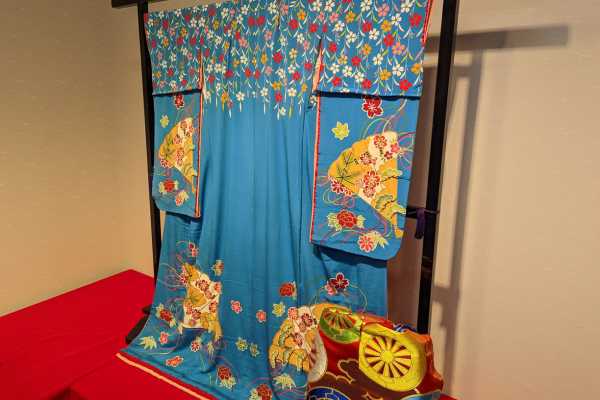
If you’ve bought tickets for the tea ceremony then you’ll also be able to access both the Japanese garden belonging to the theatre and also see the historic displays. The kimonos are stunning and they’re all handmade.
The Tea Ceremony at the Miyako Odori – Ryukrei-Shiki
If you purchase a premium seat you have the chance to also buy a ticket for the tea ceremony. Tea ceremony tickets cost an additional 1,000 Yen. If you purchase Miyako Odori tea ceremony tickets, then you need to arrive about 60 minutes before your performance time, as you’ll attend the tea ceremony before the show. The entrance to the tea ceremony closes 15 minutes before the show starts.
This isn’t a small private gathering that you’re attending, like this tea ceremony. At the Miyako Odori tea ceremony, all guests are seated on chairs at tables in rows, and the tea ceremony takes place on a small slightly raised platform. You’ll receive a small hand-painted plate with your manju on and the plate is yours to take home. They’re really rather lovely.

The tea ceremony is over very quickly, but that’s probably good as they have a lot of people to get through. You’ll first enter a seated waiting area, where there are lovely views out to the garden at the back of the theatre.
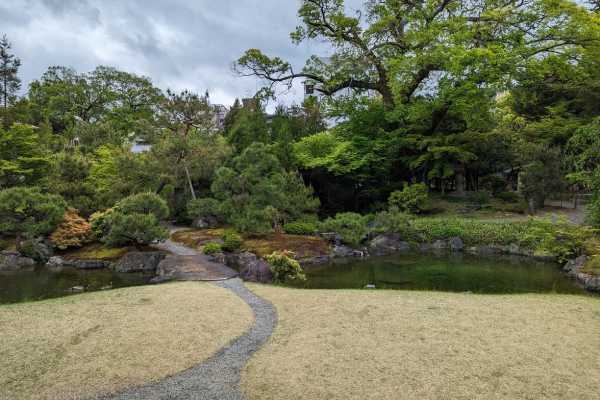
The tea ceremony is performed by a geiko, she makes powdered green tea and is assisted by a maiko. This is one of the arts in which they’re trained for years to perfect. If you’re on the front row of seats surrounding the platform then you may be the lucky person who gets to be served the tea prepared by the geiko. Everyone else is served by attendants who are wearing kimonos.

As you’re seated, you’ll be given your plate with a manju, a sweet bun filled with bean paste, and then your tea will be poured. The tea is very, very green. This isn’t the ceremony, that takes place on the small raised platform. The plates are hand-painted and lovely.
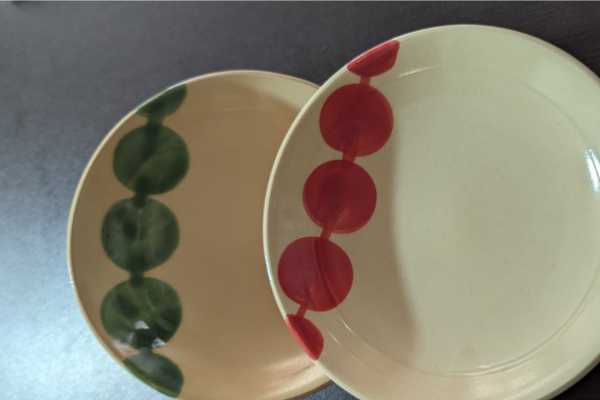
And well, the tea is poured. And as I said it’s over very quickly. There are no photos allowed inside the Miyako Odori while the performance is going on, so any of the photos are from the brochure and information leaflets.
Buying Tickets, Checking In & Getting to the Miyako Odori
There are 900 seats in the theatre for the Miyako Odori, however, this is a popular event with domestic visitors, and while you may be able to buy a ticket at the door on the day, you may not be lucky. We bought tickets online about 4 weeks in advance of the event.
You cannot make any changes to your ticket once you’ve purchased it.

How to Buy Tickets for Miyako Odori
You can buy tickets online for the Miyako Odori from the official site here. There are different types of tickets available, regular seats, premium seats, and premium seats with the tea ceremony included. We bought premium seats with the tea ceremony.
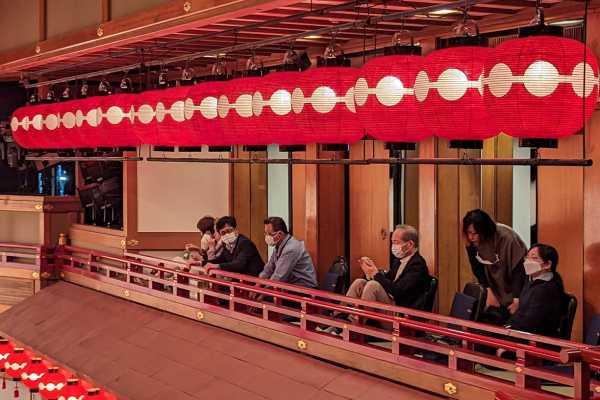
Premium Seats for the Miyako Odori are either on the same level as the performance or the first two rows of the balcony. There are also premium seats on the upper floor on tatami mats. We sat on the balcony, to get a bird’s eye view of what was happening.
You can download the floor plan for the Gion Kobu Kaburenjo Theatre for the Miyako Odori here.
The theatre reopened in 2023 after several years of renovations and is rather lovely
Checking in to the Miyako Odori
There are clear signposts for check-in (which is required to obtain your tickets for the show and the tea ceremony) and you are told where to go for the tea ceremony at the Gion Kobu Kaburenjo theatre, which we’d previously been to years ago when we went to the Gion Corner “show”.
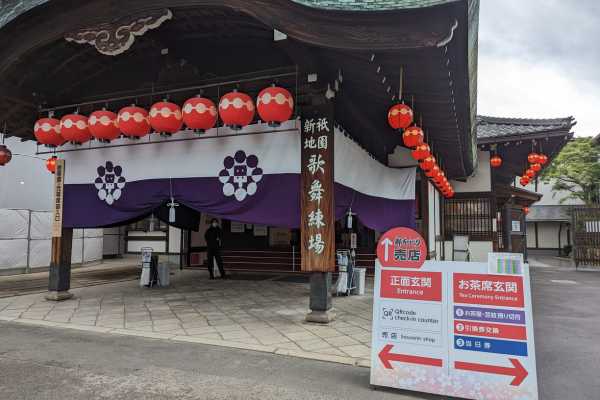
How to get to the Gion Kobu Kaburenjo Theatre
The theatre is in Gion, Kyoto, and is immediately outside Exit 6 of Keihan Railway’s Gion-Shijo Station. If you’re taking the Hankyu Railway then exit at Kawaramachi Station from Exit 1 and it’s just a 3-minute walk from there.
JAPAN TRAVEL RESOURCES
TRAIN TICKETS
Easiest way to buy train tickets, use Klook for Shinkansen Train Tickets, check timetables & reserve seats.
Book Train Tickets
HOTELS AND APARTMENTS
See choices here
Sea view rooms? Budget rooms? Need a washing machine? The best choice of hotels & apartments.
TOURS & ATTRACTIONS
Most excursion choices, small group tours, skip-line tickets, free cancellation and top local guides.
Top options here.
CAR RENTAL GUIDE
Read my Guide
The best choice of vehicles, automatics, large or small cars, child seats. Book early for more options.
Final Words on Experiencing the Miyako Odori
This truly is a very unique and very Japanese experience to experience. We were two of only about 6 Western visitors in the audience of 900 people. Although originally designed for foreign visitors, the Miyako Odori is very popular with domestic visitors too! If you’re in Kyoto during April and can get tickets, I really recommend coming along. And while the tea ceremony isn’t a small private gathering it is an interesting experience, especially combined with being able to see the garden and visit the historic displays and exhibition.
ASocialNomad is a participant in the Amazon Services LLC Associates Program, an affiliate advertising program designed to provide a means for sites to earn advertising fees by advertising and linking to amazon.com, amazon.co.uk, and amazon.ca. Amazon and the Amazon logo are trademarks of Amazon.com, Inc. or its affiliates. As an Amazon Associate, I earn from qualifying purchases.

