

If you’re looking for an easy day trip from either Islamabad or Lahore, Rohtas Fort should be high on your list. It’s one of Pakistan’s most impressive UNESCO World Heritage Sites and a place that can help you understand the scale and strategy of sixteenth-century Mughal military architecture. In this guide on how to visit Rohtas Fort, I’ll walk you through where it is, how to get there, and the best things to see once you’re inside the vast stone walls. The fort dominates the village of Rohtas, and while the walls are the main attraction, the interior gates, havelis, mosques, wells, and viewpoints are just as fascinating. You’re unlikely to come across other visitors in significant numbers here, especially if you visit mid-week; it feels wonderfully untouristy. It’s quiet, atmospheric, and huge. Read on for my guide on visiting Rohtas Fort.
THIS POST MAY CONTAIN COMPENSATED AND AFFILIATE LINKS MORE INFORMATION IN OUR DISCLAIMER
Before you arrive, it’s useful to have a clearer picture of what to expect. That’s what this guide to visiting Rohtas Fort is all about. I’ve got all the practical details you need, so you can plan the best route, understand which parts of the fort to visit, and avoid any surprises when you arrive. We struggled to put together a plan to visit Rohtas Fort because of a lack of up-to-date information, and the sheer size of the fort was somewhat overwhelming. Still, once you know how the gates connect, where the viewpoints are, and how to navigate the rough paths, it is a fabulous place to visit. Whether you travel independently, with a private driver, or as part of a tour, the trick is to give yourself enough time to explore without rushing.
PRACTICAL TRAVEL TIPS
- 🛡️ Get Travel Insurance: Civitatis includes medical expenses, repatriation, theft, luggage delays. No deductibles or upfront payments. Get a quote here.
- 🛏️ Sea view? Laundry? Private bath? Book a Room.
- 🔌 Be ready for the plug, socket & power situation.
- 📶 Get online EASILY & cheaply – One eSim for the world. Data never expires
Why Visit Rohtas Fort?
Rohtas Fort isn’t just another ruined fortress — it’s one of the finest examples of early Mughal defensive architecture anywhere in South Asia. The fort was built by Sher Shah Suri in the 1540s, after the Battle of Chaunsa in 1539. It was designed to control the region’s major trade and military routes, and to stop the advance of the Mughal Emperor Humayun, who, after his defeat, had fled to Iran. That means everything here was built on an epic scale: There are impressive towering gates, thick bastions, long defensive walls, and the remains of carefully engineered water systems. And all in the middle of it, the town of Rohtas – home to some 3,000 people, four schools, and 16 mosques.
EASIEST WAY TO VISIT
Visit Rohtas Fort on a Day Trip
You’ll travel in air conditioned comfort in a newer car, with an English speaking guide and see all the highlights of Rohtas Fort. Plus, add on a visit to Khewra Salt Mine too.
Sher Shah Suri was a Pathan general who rose to power serving in the Mughal Army. He was originally known as Farid Khan. There’s more on the man known as “the just King”, “the teacher of Kings”, and “the Great Honored Man” here.
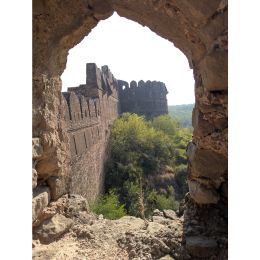
Back to Rohtas Fort. The entire complex covers more than 4 kilometers with walls that are 15-24 meters (50 to 80 feet) high and includes 68 bastion towers.
There’s been some renovation, but as the site was added to the UNESCO World Heritage list in 1997, it’s slow work. It feels somewhat untouched, crumbling slowly. It’s one of the best day trips from Islamabad or Lahore, but it’s also a fabulous stop en route from Islamabad to Lahore.
The name Rohtas Fort came after Sher Shah Suri had captured a fort called Rohtasgarh Fort in the Shahabad district from a Hindu Raja in 1539. It’s said that the site of Rohtas Fort resembles the landscapes around Rohtasgarh.
Where Is Rohtas Fort?
Rohtas Fort is located in the Punjab province of Pakistan, close to the small town of Dina and not far from the larger city of Jhelum. It sits on a ridge overlooking the Kahan River, giving it the defensive vantage points that made it so strategically important.
From Islamabad, Rohtas Fort is around 110 kilometres (68 miles) south, and the drive takes roughly 2 hours depending on traffic. From Lahore, it’s about 200 kilometres (124 miles) northwest, with a travel time of 3 to 3.5 hours. Both routes are straightforward, although you’ll leave the motorway near Dina and continue on smaller village roads for the last stretch.
How to Get to Rohtas Fort
You won’t find trips to Rohtas Fort easily bookable on the usual sites; the only place I’ve found to book a trip here is Viator (check it out here)
Take a Tour to Rohtas Fort
If you prefer everything handled for you, then booking a tour is the easiest option. This Rohtas Fort Tour from Lahore, which also includes the Khewra Salt Mine, is a full-day itinerary and a good way to combine two of Punjab’s major sites. It comes complete with an English-speaking guide, essential if you’re to understand more about what you’re seeing here in Rohtas. You can see what’s included here.
Take a Private Taxi to Rohtas Fort
While you can rent a car in Pakistan, the best is to hire a car and driver. Believe me, you’ll feel much better with someone else behind the wheel. It’s easy to arrange one from Islamabad or Lahore. Your hotel will be able to arrange one, or you can connect with car rental companies (in Pakistan, they offer the option for just a car, or a car and driver).
Expect to pay around 12,000–18,000 PKR for a return trip, depending on the vehicle type and negotiation. You can get some idea of pricing from Royal Taxis here.
We travelled with Royal Taxis and do not hesitate to recommend them. Their communication is great, and our driver, Ismail, was safe, competent, and very good. Out of the companies we contacted, Royal Taxis were the first to respond, not just to our initial query, but to subsequent questions. Some just didn’t reply at all, and others took 24 hours to respond to a simple question.
Our trip to Pakistan started in Islamabad, and our next stop was Lahore, so it made sense for us to make a stop at Rohtas as part of our travel. And it makes sense to make Rohtas part of a longer one-way transfer — for example, Islamabad → Rohtas → Khewra Salt Mine → Lahore, or the same route in reverse. For other ways to go between Islamabad and Lahore read my guide here.
It’s possible to visit both Rohtas Fort and Khewra Salt Mine in one day, but you’ll need to leave Islamabad or Lahore by 08:00, and you’ll be arriving in the other city around 12 hours later, traffic depending. You should read my guide to Khewra Salt Mine which details all you need to know.
If you want to break the journey into two days, the only accommodations in the area that accept foreign guests are Rohtas Resort (near the fort) and Green Pak Katas Raj (near Katas Raj Temple). This makes it easy to visit Rohtas one day and Khewra the next.
Connect with Rohtas Resort here – Imran is very responsive, and if you check out his Facebook page, he’s very used to hosting foreign guests.
Green Pak Hotel Katas Raj was disappointing for us, despite stating availability on the website – and we made a booking, we were only glad that the email telling us that they were closed for the season (early December) arrived before we’d driven all the way there!
We paid 45,000 PKR for a good-quality sedan car and a great driver from Royal Taxi for a two-day trip from Islamabad to Lahore, stopping at Rohtas Fort and Khewra Salt mines. We had planned to stop at the Katas Raj Hindu temple, but decided not to in the end and continued onwards to Lahore, arriving in Gulberg around 19:30. If this suits your route, then I recommend Royal Taxi and their drivers.
Take Public Transport to Rohtas Fort
Public transport is the slowest but cheapest way to get here. First, you’ll need to take a bus or train to Jhelum or Dina, both of which are well-connected. After that, there’s no public transport, so from either town, hire a rickshaw or a local taxi to take you the remaining distance to the fort.
Dina is 10 kilometers (6.2 miles) away, and Jhelum is 18 kilometers (11 miles) from Rohtas Fort.
The closest railway station is Dina, and trains from Lahore, Islamabad, Rawalpindi, and Karachi stop at both Jhelum and Dina.
Several bus services (Daewoo, Faisal Movers, Skyways) travel between Lahore, Islamabad, and Jhelum, but the closest bus stop is at Dina.
For a rickshaw from Dina to Rohtas Fort, expect to pay 600-800 PKR.
What to See at Rohtas Fort
Before you start exploring, here’s my strongest piece of advice: take a guide if you’re not on a tour. You can hire one right after paying the entrance fee — they will usually approach you. Prices are 1,000 PKR for one hour or 1,500 PKR for ninety minutes, and you can request a longer tour.
We’d originally contacted the Sustainable Tourism Foundation Pakistan (STFP), who allegedly provided tours of Rohtas Fort in conjunction with locals, but never, despite repeated modes of communication, got a response. The promoted WhatsApp was the wrong number, and we never got a reply from phones or emails.
So trust in Pakistani locals in Rohtas, and you’ll find a guide on the site. Mohammed was our guide on site, and this sprightly father of 6 is energetic, interesting, and informed.
The fort has walls which are 12 kilometers (7.45 miles) in circumference and began construction in 1543 (ish), taking some 7 years to complete, with more than 300,000 involved in its construction. There are 12 gates that make up the fort. Not all are intact today. I’ve detailed the most important ones to visit below.
With a fort this size, you might also want to hire a golf cart (it seats the driver plus 9-10 at a push) with a driver for around 2,000 PKR for about 60–90 minutes. This gets you between the main highlights without spending all your energy on the long, uneven paths. You’ll still do some walking and climbing, but it saves a lot of time.
The fort is on the UNESCO World Heritage list for a number of reasons, not least because it’s a blend of architectural and artistic traditions from Turkey, Persia, and India. Its building influenced the ongoing style of the Mughal Empire.
Humayun, whose tomb we saw in Delhi, India, some years ago, eventually captured the fort in 1555. When Attak Fort was built in 1583, Rohtas Fort lost its importance as a defensive tool.
The town inside the fort walls covers one-third of the area of the fort, and has been continuously inhabited since it was built, making it one of the few living forts in the world. Walls have crumbled over time, and, before the UNESCO World Heritage listing, blocks have been taken by locals for building.
The fort sustained some damage during the 2003 earthquake, and you can see some of the damage in the Shah Chan Wali Gate, as well as the structures put in place to hold the gate together.
There are two main areas of the fort, the main fort and Ander Kot, which is divided from the rest of the fort by a wall to segregate the residential area allocated to the ruling family and elites. If you’re here on a 1-2 hour visit, then most of what you’ll see is in the Ander Kot Area (the Sohail Gate is just outside). You can see this on the map below.

Khwas Khani Gate
One of the grandest gates in the fort, Khwas Khani Gate, was named after Sher Shah Suri’s trusted general. It served as the fort’s main entrance on the royal route from Lahore to Kabul, and it’s where we entered the fort. Our driver stopped here so we could explore, as it’s outside of the ticketed area, but it has some interesting features and great views. The intricate stonework here shows how seriously Rohtas took its defensive role — this gate was built to impress and intimidate.

This gate is a double gate, with an entrance on a bend; it’s the main access from the Grand Trunk Road (the main road from Islamabad). The inner side has 5 battlements, unique here at Rohtas.

You’ll also see what looks like a Star of David high up on the inside of the first gate. Somewhat weird in a fort that dates from Mughal times, but has Islamic influences, eh? It’s most likely a Seal of Solomon, which predates the Star of David. The Seal of Solomon or the Ring of Solomon was a legendary signet ring attributed to King Solomon. In Medieval Times, it was extremely popular as an Islamic symbol.

Shah Chan Wali Gate, aka the Shah Chandwali Gate
The gate is named after the light scattering sage who is buried beneath a Jojoba tree in front of the gate (possibly). Legends have it that the sage aided hugely in the construction of this gateway, but refused to accept payment in exchange. There are delightful views of the Man Singh Haveli from the walls of this gate.

Raja Man Singh Haveli
This is one of the few surviving residential structures, and it’s the highest point of the fort as well as the only palace. It was constructed later in the Mughal period. If it’s open when you visit, climb up for the best views (it was undergoing restoration when we visited and closed). The Haveli (a traditional mansion, or townhouse with architectural or historical significance comes from the Arabic hawali, which means partition or private space. It was named after the trusted Rajput General of Akbar, who died in 1614 A.D. Akbar, the Emperor who built Attak Fort in the 1580’s only stayed here at Rohtas one night. Rohtas wasn’t a popular fort with the Mughals on account of its plain style and lack of gardens. The Haveli is double-storey and made from bricks that have been plastered over.

Rani Mahal
The Queen’s Palace is a single-storey structure. It originally had four rooms, but there’s just one remaining today. The roof is a dome-shaped and carved to resemble a flower.
Phansi Ghat, aka the execution site
This part of Rohtas Fort was once used for executions, and there’s little of the structure left. It’s another high point of the fort, and there are great views from there. It was built primarily as an execution area for royal traitors. Our guide said that they were hung outside, and then the bodies dropped down inside. I can’t find any supporting evidence for this.
Shahi Mosque, aka the King’s Mosque
Dating to Sher Shah’s time, the Shahi Mosque is a beautiful example of early Mughal religious architecture. It’s still intact enough to imagine how it looked when soldiers and administrators gathered here for prayer. It’s not used by residents of Rohtas Fort, as they have 16 other mosques to use within the fort!

The mosque has three bays, each with an arched opening, and while the roof of each bay is domed, there are no domes on top; it’s simply a flat roof. The western wall of the mosque is attached to the exterior wall of the fort.

Kabuli Gate
This gate faces towards Kabul and was a heavily fortified northern access point. It’s a spectacular gate (although the Sohail Gate is pretty darned impressive too!), and it’s worth descending the steps for the view back up. You’ll find old guard rooms and battlements that make it clear how defensible this entrance needed to be. There are great views from here over the river and the lemon grove across from it. The river is considerably lower these days due to the building of the Mangla Dam (the 6th largest in the world) in 1967.
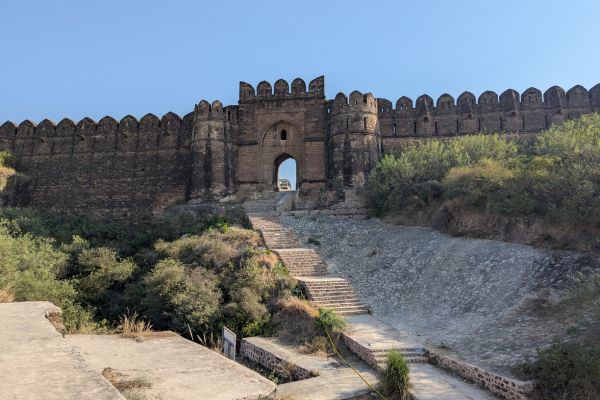
The Kabuli Gate is likely to have been built in two stages because there’s a stepwell outside the gate, and so a secondary outer gate also exists. There’s a large circular well, with rooms on the side, which may have been bathrooms for the Emperor’s family.

Sohail Gate
This is one of Rohtas Fort’s most spectacular gates; it almost looks like a fort on its own. There are two massive bastions, a high arch, and enough intricate detailing to make it the finest example of Rohtas’ military architecture. It must have been the main entrance to the fort, such is its magnificence.

Its name comes from Sohail Bukhari, a famous saint, who is buried in the southwest bastion. Either that or the Sohail Star. Or a favored commander of the time. Take your pick.
Sheshi Gate, aka Shish Gate, aka the Glass Gate
This gate gets its name from the glazed tiles that were used to decorate the outer arch. The tiles are set on a plaster base and create a reflection, hence the name. The tiles are the first known examples of this technique, which was later developed further in Lahore. There’s a carved inscription on the left of the gate, which details the fort’s construction date in Persian.
“In the Hijri year 948 (1541 AD) came the exalted. At that time constructed the great fort was constructed. The emperor is Sher, with life long. There is no match to his good fortune. It was completed by Shahu Sultan.”
Langar Khani Gate
The gate opens directly into the fort, and there’s not much of the structure left, but it was located near the kitchens and the communal eating area.
Talaqi Gate
The Talaqi, or sometimes Talaki, gate is linked to local legends involving illness and misfortune. It has a duplicate inscription to that of the Shish Gate. The word Talaqi means “Divorce”, but it can also mean condemned. Legend has it that the Prince Sabir Suri entered the gate and suffered a fatal attack of fever, which was seen as a bad omen, and the gate became known as the Talaqi Gate.
Kashmir Gate
Named as it faces the direction of Kashmir, this gate is on the northern side of the fort.
Step Wells aka Baoli
The fort has three baolis – aka step wells. The main one was used for supplying water for livestock and soldiers. The Royal Baoli is located by the Kabuli Gate, and is only for use by the Royal Family. and The Sar Gate Baoli, which was located by the gate of the same name, was probably used by those on guard at the walls.
The Museum at Rohtas Fort
The small museum inside the fort is currently closed for renovations with no confirmed reopening date. When it reopens, it will house archaeological finds, maps, and models of the fort. Possibly.
Practical Tips for Visiting Rohtas Fort
- Bring plenty of water — there are no reliable shops inside the fort.
- Bring food or ask your driver to stop somewhere on the way.
- A sun hat and sunglasses are essential; there’s very little shade.
- Wear sturdy walking shoes — the ground is rough, uneven, and involves climbing.
Entrance Fees for Rohtas Fort
- 500 PKR for foreigners
- 20 PKR for locals
(Guide and golf cart fees are separate.) A guide will cost 1,000 PKR for a one-hour visit. Golf carts and a driver cost 2,000 PKR for an hour.
Opening Hours of Rohtas Fort
08:00 – 17:00, daily.
Final Words on Visiting Rohtas Fort
Rohtas Fort is one of the easiest major heritage sites to visit from Islamabad or Lahore. There isn’t much remaining of the original constructs, aside from the massive walls, but you need to see it to understand the scale of the build. It’s a spectacular stop en route between Islamabad and Lahore. I do recommend having a guide to help explore (and the golf cart is a useful way to get around as well!)
ASocialNomad is a participant in the Amazon Services LLC Associates Program, an affiliate advertising program designed to provide a means for sites to earn advertising fees by advertising and linking to amazon.com, amazon.co.uk, and amazon.ca. Amazon and the Amazon logo are trademarks of Amazon.com, Inc. or its affiliates. As an Amazon Associate, I earn from qualifying purchases.

