
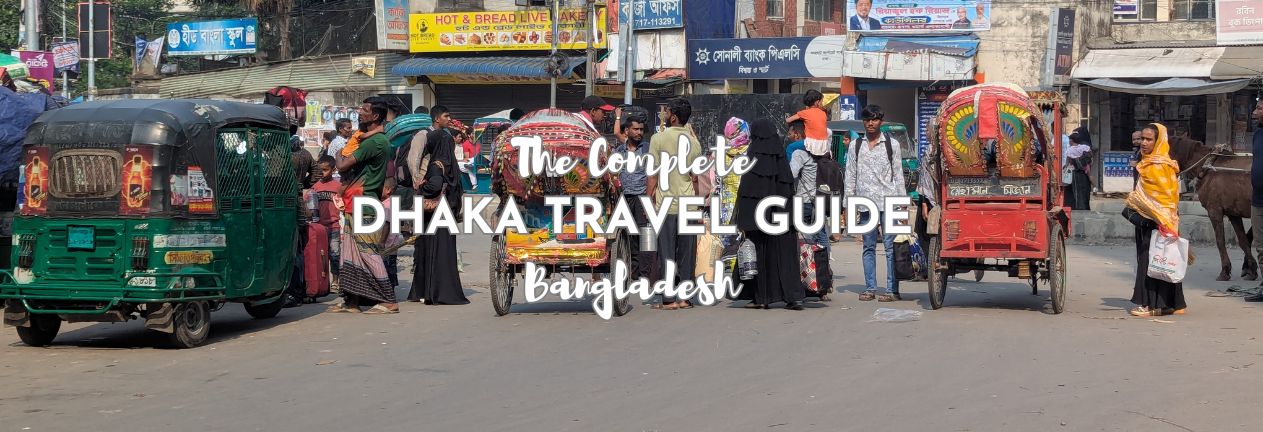
Dhaka isn’t an easy city to visit, although to be fair, we picked an excellent time to visit – just after Eid al-Fitr and in between National holidays, which meant that the city was relatively empty. In part, though, the city’s chaos and busyness make it so interesting to visit. There’s traffic, noise, crowds, and constant movement and noise. There’s also desperate poverty and disturbing levels of trash. This isn’t a city that’s tailor-made for Western tourists looking for an easy trip. Here’s my Dhaka travel guide with details on the best things to see and do in Bangladesh’s capital.
THIS POST MAY CONTAIN COMPENSATED AND AFFILIATE LINKS MORE INFORMATION IN OUR DISCLAIMER
If you just grit your teeth, dive in, and find somewhere great to stay to escape for a little peace and quiet, then Dhaka is a seriously interesting place to visit. There’s a fascinating history here that spans the 1947 partition of India, the formation of East Pakistan, the Bengali Language Movement, Operation Searchlight, and the Liberation War of 1971, leading to the country that is Bangladesh. Most recently, the student uprising of 2024 adds a fascinating, but equally violent chapter to Bangladesh’s history, which you can read about, but that only becomes real when you walk the streets and feel the energy.
PRACTICAL TRAVEL TIPS
- 🛡️ Get Travel Insurance: Civitatis includes medical expenses, repatriation, theft, luggage delays. No deductibles or upfront payments. Get a quote here.
- 🛏️ Inhouse Resto? Laundry? Private bath? Book a Room.
- 🔌 Be ready for the plug, socket & power situation.
- 📶 Get online EASILY & cheaply – One eSim for the world. Data never expires
In this guide to visiting Dhaka, I’ll walk you through the best things to do and see in Dhaka, along with practical tips to help you make the most of your time in Bangladesh’s capital.
Dhaka at a Glance
- Country: Bangladesh
- Population: Over 20 million in the wider metropolitan area
- Language: Bengali (English is spoken in hotels and some restaurants)
- Currency: Bangladeshi Taka (BDT)
- Time zone: Bangladesh Standard Time (GMT+6)
- Best time to visit: November to February (cooler and drier)
- Time needed: 1–2 days
Why Visit Dhaka?
I find it difficult to visit a country and not explore the capital city. Even when, in places like Myanmar’s almost ghost town of Napyidaw, there is little to see. And while Dhaka doesn’t provide any semblance of relaxed sightseeing, it’s worth your time to visit.
Dhaka is the most densely populated city in the world; the traffic noise, street life, and constant movement of people make it feel intense. You’ll want shorter days here, and a good place to stay (I recommend the Omni Residency in Banani); it’s otherwise exhausting.
And whether it’s the Mughal-era forts, colonial buildings, Indian, Pakistani, or more modern history you’re interested in, it is an intriguing place to visit. You can actually get right up close to the people, who are actually more fascinated by you than you are by them.
Bangladeshi’s love foreigners, is a phrase we’ve heard many times in our travels. And it’s true. Lots of people want a selfie; they all want to know “What country?” And “Your name?”. Few that you’ll come into contact with on the street will speak English, the language here is Bangla, and the 99% of westerners find it incomprehensible to read and understand, although smatterings of English words pop up, “internet” for instance. They’re friendly, not threatening. Street beggars and homeless children might break your heart, but if you’re firm, they’ll leave you alone. Ferry men and rickshaw pullers will stare and wave you in, but a wave of the hand will see them off.
Dhaka is, too, the main entry point for most visitors to Bangladesh, unless you’re overlanding from India, so it’s rare that you’ll visit the country without at least passing through the capital.
What to Expect in Dhaka
Dhaka feels somewhat intense when you first arrive. The traffic is constant, the streets are crowded, and there’s always something happening. You’re straight into it from the moment you leave the airport, and my guide to arriving at Dhaka Airport is here.
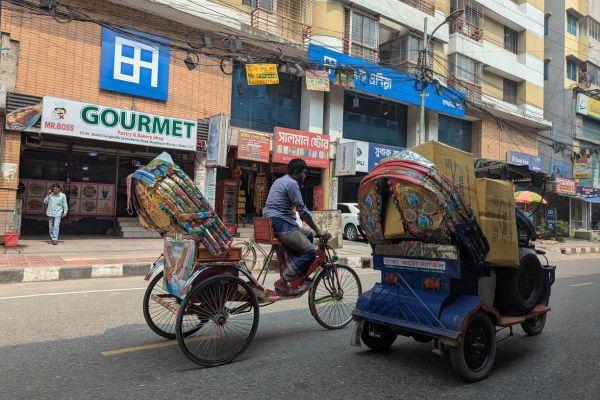
One of the biggest things to adjust to is the speed of getting around. Distances that look short on a map can take a long time to cover because of the congestion. The traffic can turn a short journey into something much slower than expected. Planning your day around travel time is essential. Rickshaws and CNGs (Bangladeshi tuk-tuks) can usually weave in and out of traffic more easily than cars, but really, sometimes an air-conditioned car to block out the noise is necessary.
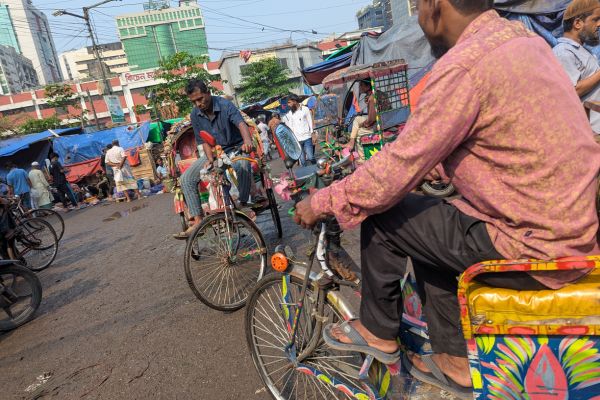
And the noise is another thing you’ll notice very, very quickly. Horns, engines, people, street activity, it’s all part of daily life here. No one seems to bat an eyelid. But if you’re used to quiet (like we are), then it’s incredibly wearing. It’s another reminder to get a good hotel with soundproofing.
At the same time, there are quieter places. You’ll find them in courtyards, like at Beauty Boarding, or inside mosques, around the university areas, or even just sitting inside an air-conditioned café.
Most importantly, Dhaka (and Bangladesh as a whole) just isn’t set up for tourists in the way many other cities are. You won’t find everything clearly signposted or neatly organized. If there are signposts, then they tend to be in Bangla. And I challenge you to read it. But it’s worth the effort, and the people are friendly and will help where they can.
You should read my guide to money, payments and the currency of Bangladesh before arriving.
Where to Stay in Dhaka
Where you stay in Dhaka makes a big difference to your experience. The city is large enormous. Traffic is always heavy (unless you arrive during Eid al-Fitr, as we did), and moving around can take much longer than you first anticipate. We were recommended, for instance, to allow 90 minutes to travel from Banani to Sadarghat (a distance of 12.4 kilometers (7.7 miles), so choosing the right area will save you a lot of hassle.
Most travelers choose to stay in Gulshan, Banani, or Baridhara. These are the more modern, international parts of the city, with better hotels, restaurants, and easier access to transport. One of the best tips for finding better districts anywhere is to look for decent hotel chains and see where they’re located – so the Sheraton, or Crowne Plaza, for instance. They’re also generally quieter and more comfortable, especially if it’s your first time in Dhaka. We stayed at the Omni Residency in Banani, and highly recommend it.
It was perfect, locaiton wise for us, meeting all our criteria and able to help us with a power charging problem – read about it here.
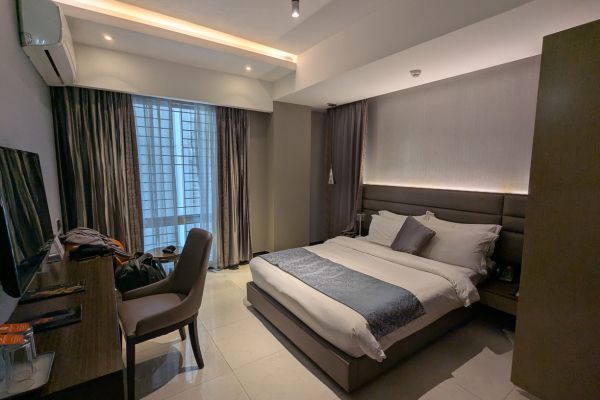
Staying in Old Dhaka is possible, but it’s much more intense. Aside from that, if you decide to stay at Dhaka’s oldest 5-star hotel, the Pan Pacific. It’s really close to Old Dhaka but is a haven of peace, tranquility, and luxury. Apart from that, Old Dhaka is busy, crowded, and not particularly convenient in terms of transport or accommodation standards. That said, if you want to be right in the middle of the action, it can be an interesting experience.
For most visitors, Gulshan or Banani is the best choice. You’ll have easier access to restaurants, transport, and services, and it gives you a more manageable base for exploring the city. My guide on areas of Dhaka in which to stay in Dhaka is here.
What to See and Do in Dhaka
Dhaka isn’t a city where you particularly tick off sights in a neat, orderly way. It’s busy, intense, and often overwhelming, but that’s also what makes it interesting. The best experiences of Dhaka come as much from wandering the streets and taking it all in as they do from visiting specific landmarks. That said, some key places are absolutely worth your time, especially if you want to understand the history, culture, and everyday life of the city.
Historic Sites & Landmarks of Dhaka
These are some of the key historical places to visit in Dhaka and are a good way to understand the city beyond the surface-level chaos. They’re relatively easy to group together, especially if you’re spending time in Old Dhaka, and give you a mix of Mughal, colonial, and more recent history.
Lalbagh Fort
Lalbagh Fort is one of the best-known historical sites in Dhaka and one of the easiest places to start. The name comes from the area in which it’s built, Lalbagh, and it means the red garden, although it was originally called Aurangabad. No, not THAT Aurangabad in India, but if you’re the top thing to do near Aurangabad, India, then it’s visit the Ajanta and Ellora caves, I wrote about it here.
Built in the 17th century during the Mughal period, and modelled on Delhi’s Red Fort and Fatehpur, it was originally started by Prince Muhammad Azam Shah. It was never fully completed, as the construction was overseen by the Governor of Bengal, Shaista Khan, whose daughter, Pari Bibi, died during the building of the fort. Construction was halted. Pari Bibi was buried inside the fort, and it’s her tomb that you see in most of the photos of the fort.
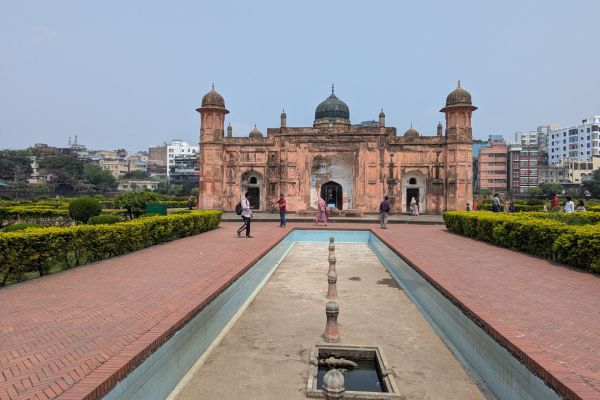
The grounds are lovely, and a haven of peace in the madness of the city, and although there’s not much left of the fort, Pari Bibi’s tomb and the remains of the governor’s house, as well as a mosque.
- Address of Lalbagh Fort: Lalbagh Rd, Dhaka
- Cost of visiting Lalbagh Fort: Locals 30 BDT, SAARC Countries 200 BDT, Other Foreigners 400 BDT
- Opening hours of Lalbagh Fort: 10:-00 – 13:00 and 13:30 -17:00 Tuesday-Thursday +Saturday, 10:00-12:30 and 15:00 – 17:00 Friday, closed on Sunday, 14:00 – 17:00 Mondays
- How long to spend at Lalbagh Fort: You can easily whip in, take photos, and get out again in 30 minutes if you’re pushed for time.
- How to get to Lalbagh Fort: Just grab a rickshaw or ride-hailing app from central Dhaka
- Map location of Lalbagh Fort: https://maps.app.goo.gl/uLFH8aAt5nBw4dsK7
Ahsan Manzil Museum (aka the Pink Palace)
Ahsan Manzil, known as the Pink Palace, is one of Dhaka’s most recognisable landmarks. Sitting on the banks of the Buriganga River in Old Dhaka, it was once the residence of the Nawabs of Dhaka. Today, it’s a museum, about its use, the Nawabs, and how they lived. It’s pretty dusty and old-fashioned when it comes to museums, but it’s worth visiting to check out the building itself. Don’t miss the “round room” and the dancing hall.
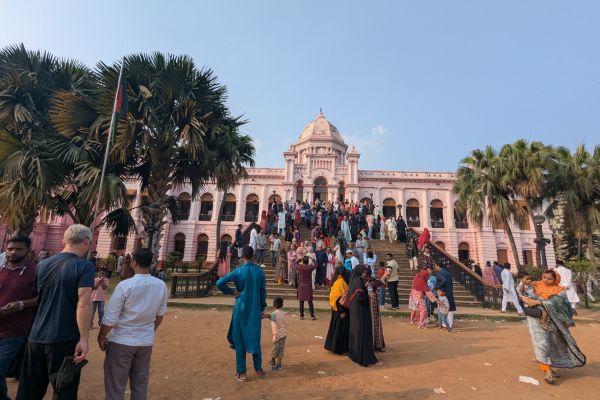
The All India Muslim League was formed here, and Lord Dufferin (he of Dufferin Point in Fort Kochi) was a regular visitor.
- Address of Ahsan Manzil: 2/3 Islampur Rd, Dhaka, Bangladesh
- Cost of visiting Ahsan Manzil: Locals 40 BDT, SAARC Country 300 BDT, Other foreigners 500 BDT
- Opening hours of Ahsan Manzil: Closed on Thursday and Sunday. 10:30 – 16:00 on all other days, open until 18:00 on Wednesday. Friday 15:00 – 18:30
- How long to spend at Ahsan Manzil: If you wander slowly through the entire museum, you won’t spend more than an hour here.
- How to get to Ahsan Manzil: It’s best to combine a visit with a trip to Sadarghat or Old Dhaka
- Map location of Ahsan Manzil: https://maps.app.goo.gl/bPkKS3eJtQcGJ6Hj8
Dhaka Old Central Jail
There used to be a Mughal-era fort here, but in 1788 it was “renovated” and turned into a jail. It housed more than 500 prisoners in 1888, and more recently became the jail for the whole of East Bengal. The jail has seen its fair share of criminals and political prisoners from every uprising and protest that Bangladesh has seen (apart from the most recent in 2024).
The jail is infamous as it’s here that four political leaders, A. H. M. Qamaruzzaman, Tajuddin Ahmad, Syed Nazrul Islam, and Captain Muhammad Mansur Ali were killed on 3 November 1975. It came on the eve of a counter coup led by the military following the assassination of Sheikh Mujibur Rahman, the founding president of Bangladesh.
The old central Jail in Dhaka was supposed to open as a museum in October 2025. It wasn’t open when we visited, but it has an interesting story and is a fascinating building.
- Address of Old Central Jail: 30/3, Umesh Nandakumar Dutta Rd, Dhaka 1211, Bangladesh
- How to get to Old Central Jail: Best visited as part of an Old Dhaka itinerary
- Map location of Old Central Jail: https://maps.app.goo.gl/bJ3N2ayBHXjVy9Dt9
Dhakeshwari Hindu Temple
Dhakeshwari Temple is the most important Hindu temple in Bangladesh, and surprisingly, it’s owned by the government, making Bangladesh the only muslim majority country in the world to have a national temple that is Hindu. The name of the temple, “Dhakeshwari,” means Dhaka’s temple. It was built originally in the 12th century.
- Address of Dhakeshwari Temple: Bakshi Bazar, Dhaka
- Cost of visiting Dhakeshwari Temple: Free
- Opening hours of Dhakeshwari Temple: Open daily
- How long to spend at Dhakeshwari Temple: 15-20 minutes
- How to get to Dhakeshwari Temple: Easily reached by rickshaw or ride-hailing app
- Map location of Dhakeshwari Temple: https://maps.app.goo.gl/j8fQiUrC4uerZb4W7
Star Mosque (Tara Masjid)
The Star Mosque, or Tara Masjid, is one of the most visually distinctive places to visit in Old Dhaka. From the outside, it looks fairly modest, but once you step inside, it’s completely different. The interior is covered in intricate mosaic work, with star patterns throughout, which is where the name comes from. It was built in the 19th century by Mirza Golam Pir, and you can find it on the 5 taka note.
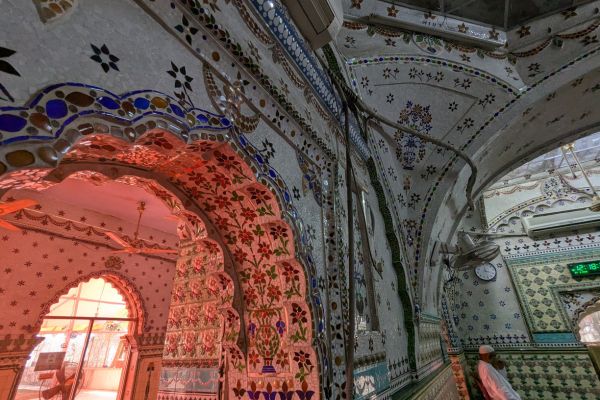
The stars weren’t added until 1926, when the mosque was renovated by a businessman called Ali Jan Bepari.
I was shocked when I entered. There was another couple there, western tourists, but the female visitor was in tight jeans and a short-sleeved t-shirt with no headscarf. It’s the first time that I’ve ever seen that in a mosque. Arfin, our guide, explained that Bangladesh is very forgiving of tourists and that it wasn’t a problem. Still, it made me feel (even as an atheist) quite uncomfortable.
- Address of Star Mosque: Abul Khairat Rd, Dhaka 1100, Bangladesh
- Cost of visiting Star Mosque: Free
- Opening hours of Star Mosque: Open daily, outside of prayer times
- How long to spend at Star Mosque: 20–30 minutes
- How to get to Star Mosque: Best visited while exploring Old Dhaka
- Map location of Star Mosque: https://maps.app.goo.gl/Nreq7qEyTivdQC6v8
Dhaka’s Armenian Church
There are few Armenians in Bangladesh today, but in the 17th century, there was a decent-sized community here. They came primarily for business, trading in leathers and jutes, and they tended to live in an area that became known as Armanitola.
And that’s where you’ll find the Armenian Church in Dhaka. There was a cemetery here before the church was completed in 1781, and the gravestones are inscribed with various scripts and languages.

Inside the church, it’s an oasis of calm and a simple design. There’s currently no specific permanent Armenian community here, but the church is used occasionally by the Church of Bangladesh and visiting priests. There’s more on opening times and the history of the church here.
- Address of Armenian Church: 4 Armenian Street, Armanitola Rd, Dhaka 1100, Bangladesh
- Cost of visiting the Armenian Church: Free, although there is a donation box
- Opening hours of Armenian Church: 09:00 – 17:00 every day; you may need to ask the caretaker to open the doors to the church.
- How long to spend at Armenian Church: 20–30 minutes
- Website: http://armenianchurchbangladesh.com/
- How to get to Armenian Church: Best visited while exploring Old Dhaka
- Map location of Armenian Church: https://maps.app.goo.gl/q4Q5PsxjqGBoZz9fA
Dhaka’s Museums & History
I never expect much from National Museums, unless they’ve been renovated and re-curated in the past few years, as many of them opened decades ago and belong to the museum school of thought that it’s enough to simply “put things on display with a label saying what they are”. Few detail the story, the personal histories, and information beyond the blindingly obvious. Sadly, Bangladesh’s National Museum is a little like that; however, the Liberation War Museum is a masterpiece.
National Museum of Bangladesh
The National Museum of Bangladesh is a good, not great, place to go to get a broad overview of the country’s history and culture. It covers everything from ancient history and archaeology to art, religion, and everyday life.
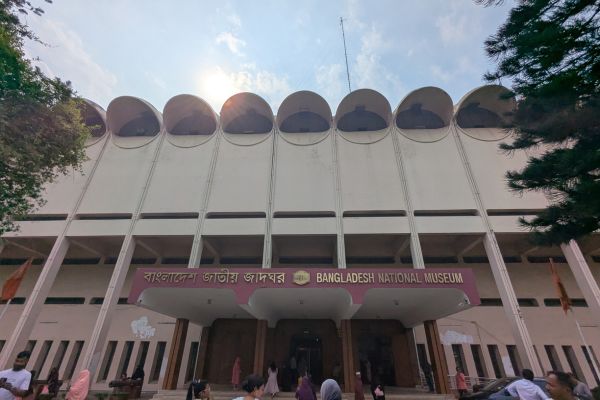
The map of Bangladesh that greets you in the first gallery (there are lots, set over three floors, but you can skip floor 3, it’s not really about Bangladesh) is useful, showing the scale and scope of the country. There are dioramas of life in various regions of Bangladesh, information on the development of the Bangla language (albeit only in Bangla), and a large section on the fight for Independence in Bangladesh. A good hour will see you through the main parts of the museum.
- Address of National Museum of Bangladesh: Shahbagh Rd, Dhaka 1000, Bangladesh
- Cost of visiting the National Museum of Bangladesh: Locals 40 BDT, SAARC country visitors 300 BDT, Other Foreigners 500 BDT
- Opening hours of National Museum of Bangladesh: Closed Thursdays, Friday 15:00 – 19:00, Saturday to Wednesday: 10:30 – 17:30
- How long to spend at the National Museum of Bangladesh: 1–2 hours
- How to get to the National Museum of Bangladesh: It’s easy to get here by rickshaw or ride-hailing app.
- Map location of National Museum of Bangladesh: https://maps.app.goo.gl/GjoApwjbTKmpFdvKA
The Liberation War Museum
The Liberation War Museum is one of the most important places to visit in Dhaka, and it is a superb museum. Its main focus might be on the events of 1971, when Bangladesh gained independence, but it also provides the background in what led up to Bangladesh’s liberation, and it’s a long, old story. There’s a fascinating section on the Partition of India in 1947, leading to the creation of West Pakistan and East Pakistan (Bangladesh), details on the Bengali language movement which began in 1952, and the various protests, movements, and violent episodes that culminated in the Pakistani Operation Searchlight, and of course, the independence of Bangladesh.
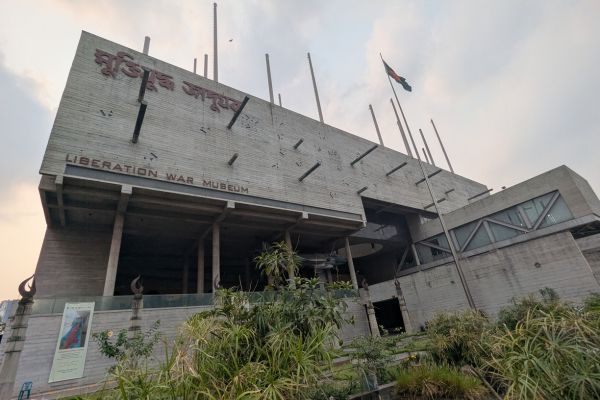
The museum is extremely well presented and more focused than the National Museum, which makes it easier to follow. Even if you don’t usually visit museums, this one is really worth your time.
- Address of Liberation War Museum: Civic Centre, Plot: F11/A & F11/B, Dhaka 1207, Bangladesh
- Cost of visiting Liberation War Museum: Locals 50 BDT, SAARC Countries 50 BDT, Other Foreigners 500 BDT
- Opening hours of Liberation War Museum: Monday to Saturday 10:00 -18:00, closed Sunday.
- How long to spend at Liberation War Museum: 90 minutes minimum
- Website: https://www.liberationwarmuseumbd.org/
- How to get to Liberation War Museum: Use a ride-hailing app, take a taxi, rickshaw, or CNG. It’s easy to get to
- Map location of Liberation War Museum: https://maps.app.goo.gl/Z6dFZkZ98QJNMkCG9
Dhaka University & Cultural Landmarks
Hear me out. It might seem a little bizarre to say visit the university area, but for Dhaka and Bangladesh, it’s really important. Many of the political changes that have come about in Bangladesh have started here, at Dhaka University. The 2024 uprising to oust Sheikh Hasina was led from here. It was here that real regime change was begun. It was also here, with the students, that the Bengali Language Movement began, and students were pivotal in the early Bengali nationalist movement. They organized resistance, played crucial roles, and thus became major targets during the 1971 Pakistani military crackdown.
The University area is a rather leafy area, and there are a few places that stand out to visit.
Curzon Hall – the Department of Chemistry, Dhaka University
This Raj-era building is a delight. It was originally designed to be a town hall and named after Lord Curzon, the Viceroy of India, who laid the foundation stone here in 1904. When Dhaka University was established in 1921, the buildings became the science faculty. It’s still used today in the same function. You can see the Mughal influences with a British tinge (probably the red brick part) in this lovely building.

The Central Shaheed Minar & the Language Movement
This national memorial in the University area of Dhaka is dedicated to the Bengali Language Movement activists who were killed during protests in 1952. Following the partition of India in 1947, what is now Bangladesh became part of Pakistan. The country was named East Pakistan to differentiate it from West Pakistan (current-day Pakistan). Power was retained in West Pakistan, and Karachi became the country’s first capital city (you can read about our travels in and around Karachi here). East Pakistan was so named to differentiate it from India’s state of West Bengal. However, East Pakistan was also known as Pakistani Bengal, and its citizens were known as Pakistani Bengalis.
The primary language spoken in East Pakistan was Bengali. The official language of Pakistan in its entirety was selected as Urdu in 1948, despite 65% of the population of Pakistan being Bengali speakers and living in East Pakistan. It was Governor-General Muhammad Ali Jinnah who declared that “Urdu and Urdu alone shall be the state language of Pakistan.” He aimed to unify Pakistan through Urdu. It’s estimated that around 7% of the population of Pakistan spoke Urdu as their first language.
Bengali was even removed from the list of approved subjects in schools, from currency and stamps, with extensive preparations being made to make Urdu the single official language of Pakistan.
And so, to cut a long story short, public outrage spread, and large numbers of Bengali students met at the University of Dhaka on 8 December 1947 to make a formal demand that Bengali be made an official language. And so began the Language Movement.
Roll forward to that 1948 declaration by Jinnah that Urdu be the official language, and tensions rose, discontent set in, so the Pakistani government outlawed public meetings and rallies. And so the students of Dhaka University began a protest on 21 February 1952. The police killed 7 people, including 4 students, Abdus Salam, Rafiq Uddin Ahmed, Abul Barkat, and Abdul Jabbar.
It wasn’t until 1956 that the Bengali language was granted official status in 1956.
There is a Shaheed Minar in many schools, but this is the central Shaheed Minar, commemorating those who died. Bangladesh celebrates and remembers Language Movement Day on 21st February each year, and on November 17th, 1999, UNESCO declared 21 February to be “International Mother Language Day”, recognizing the linguistic rights of people around the world.
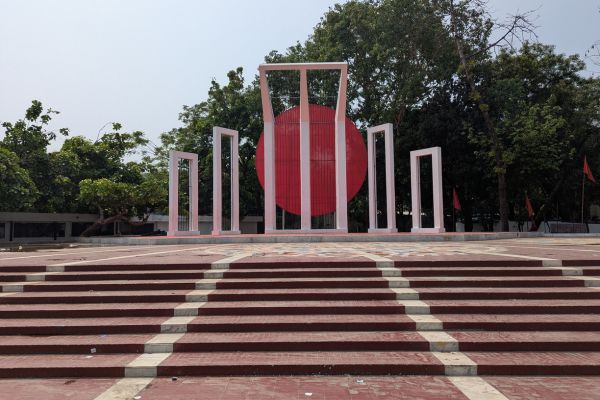
This Central Shaheed Minar has been demolished many times, most notably during Operation Searchlight (go to the Liberation War Museum to learn more about this) in 1971, but each time it’s been rebuilt. It was expanded in 1983.
- Address of Central Shaheed Minar: Near Dhaka Medical College Gate, Secretariat Road, Dhaka 1000, Bangladesh
- Cost of visiting Central Shaheed Minar: Free
- Opening hours of Central Shaheed Minar: Open 24 hours
- How long to spend at Central Shaheed Minar: 10-15 minutes
- Map location of Central Shaheed Minar: https://maps.app.goo.gl/HY7A7c1711GtQaeg6
The 2024 Murals of Protest
2024 was another turning point in the history of Bangladesh. Movements for political reform were, once again, led by the students of the country, who demanded systemic changes. The protests began as the “Quota Reform Movement” (you can read more about it here) and led to further, broader nationwide protests.
There were massive rallies in Dhaka and other cities, which quickly led to a mass uprising against the government, leading to Prime Minister Sheikh Hasina resigning and fleeing to India (where she still is). Estimates by the United Nations indicate that around 1,500 people were killed during the protests.
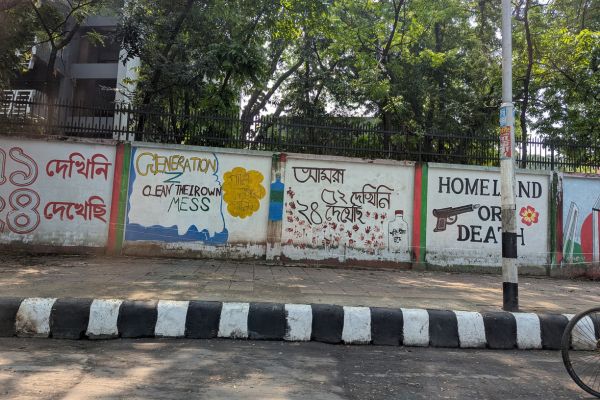
These protests were led by Gen Z, who documented on social media, who detailed the protests through murals, and you can see them on the walls around Dhaka University – and there are lots of them, in English as well as Bangla.
Bangladesh National Parliament Building (Jatiyo Sangsad Bhaban)
The National Parliament Building is one of the most striking pieces of architecture in Bangladesh and, honestly, one of the most impressive buildings you’ll see anywhere. It was designed by the American architect Louis Kahn; it’s a huge, geometric structure surrounded by water, and it feels completely different from the rest of Dhaka. Of course, it is set in its own grounds, and access, while possible, is strictly limited – I’ll explain how to visit, although we didn’t as our time in Dhaka covered the end of Eid al-Fitr and Independence Day, and so the building was completely closed.
The plans for the building began in 1959, yes, even while Bangladesh was East Pakistan, but it wasn’t until 1962 that Kahn was commissioned to design and build it. Construction halted in March 1971, following Bangladesh’s declaration of independence from Pakistan, but it was recommenced and completed in 1982. It cost US$32 million – twice the original estimate. There’s a great description of the architecture of the building here.
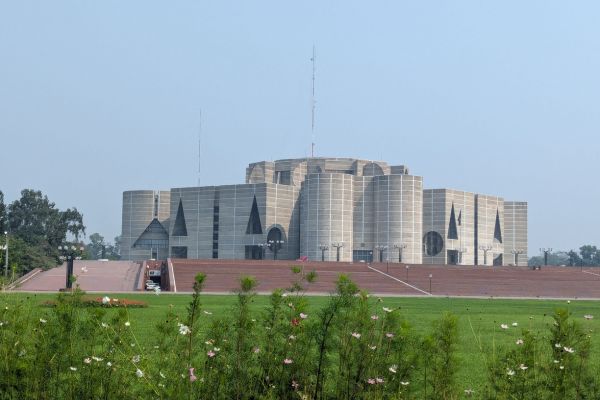
Access to the Parliament Building for foreign visitors may be limited at short notice, depending on the Parliamentary program and the security situation, but always requires prior booking, at least 24 hours in advance, usually more. It’s best arranged through a private tour guide, as locals can enter for free, but there is a fee for foreign visitors. Visiting times are from 11:00 to 16:00 on Sundays through Thursdays; the building is closed on all public holidays. You may be able to arrange a visit with as little as 24 hours’ notice, but your notification of approval will be by telephone. It’s best to complete this form at least 7 days in advance, but again, to understand the working of the Parliament, arrange with a guide.
- Address of Bangladesh National Parliament Building: Dhaka 1207, Bangladesh
- Cost of visiting the Bangladesh National Parliament Building: Free to view from outside, 500 BDT for foreign visitors.
- Opening hours of Bangladesh National Parliament Building: Exterior accessible during daylight hours, visits inside 11:00 – 16:00 Sunday through Thursday, closed on public holidays.
- How long to spend at the Bangladesh National Parliament Building: 45–60 minutes
- Website: https://www.parliament.gov.bd/contact/visit-to-parliament
- How to get to the Bangladesh National Parliament Building: Best reached by ride-hailing app due to the distance from central Dhaka
- Map location of Bangladesh National Parliament Building: https://maps.app.goo.gl/UxhZvWaBtgJb2TMv6
Old Dhaka
The area of Bangladesh’s capital known as Old Dhaka is where you’ll find narrow streets, squeezing between rickshaws, noise, and people going about their business. Chaos. But none of it feels threatening. Well, apart from the mud, if you’re here after a downpour like we were. There’s constant traffic, from trucks to CNGs to rickshaws, both man-powered and electric.
Some roads are paved, some are muddy. All are busy.
Old Dhaka Streets
Wandering the streets of Old Dhaka is an experience in itself. You don’t need a strict plan here, but having a few places bookmarked, if you’re planning on going it alone, will give you a vague route and things to see. Unlike some of the tourist sites, this is where people are going about their business, selling fruit and veg wholesale, dismantling animals for sale, weighing fish and seafood, loading trucks with watermelons, they’ll most likely ignore you.
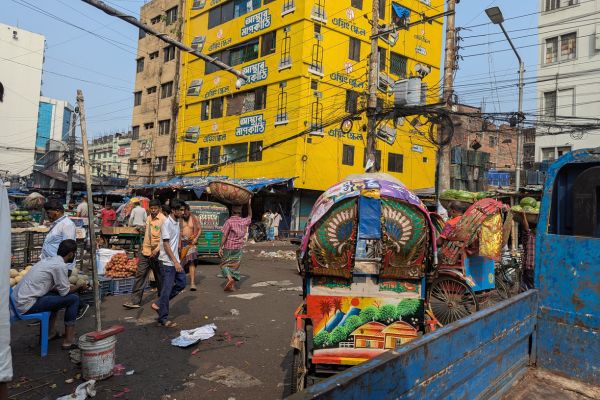
Markets tend to be open in the morning, and wholesale markets tend to operate from 02:00, but you’re best coming here during daylight hours, because, to be fair to the vendors, you’re likely to just get in their way. You can easily spend a couple of hours happily getting lost and found again. If you want to know where you’re going and what’s happening around you, then I do recommend taking a trip here as part of a guided tour; it’s well worth it to be straight to the heart of the action.
I’ve covered the markets below, but the first one of the havens in Old Dhaka is Beauty Boarding.
Beauty Boarding
When you enter the oasis that is Beauty Boarding, you’ll feel like you’re stepping back in time. And into a quiet spot. It’s a historic guesthouse and restaurant that has long been associated with writers, artists, and intellectuals.
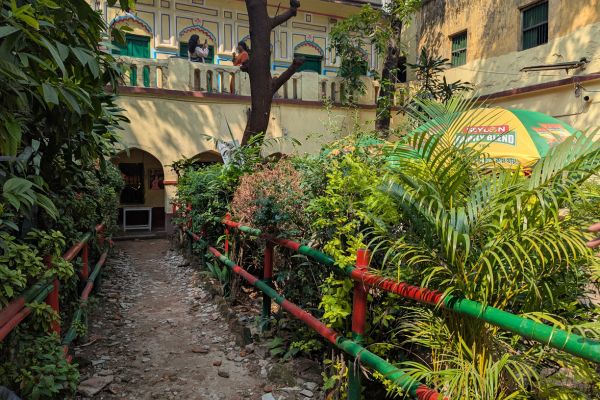
Before the 1947 Partition of India, this was the office of the daily newspaper, Shona Bangla, but they left by 1951 and moved to Kolkata, whereupon Nalini Mohon Saha opened a boarding house and restaurant and named it after his daughter, Beauty. There’s an artist in residence here now, and if you fancy cool painted sunglasses, metal beakers, or even hurricane lamps, this is the place to come. The shady courtyard is also a great place for a drink, a meal, or a toilet break, too. It’s not used as a boarding house anymore, but you can take some atmospheric photos in the courtyard and from the second floor.
- Address of Beauty Boarding: PC47+9GF, 1, Shris Das Lane, Bangla Bazar Rd, Dhaka, Bangladesh
- Map location of Beauty Boarding: https://maps.app.goo.gl/tySdquKPvS9ZVccd8
Dhaka’s River & Local Life
The river that flows through Dhaka is the Buriganga. It means Old Ganges in English, and its 29 kilometers (18 miles) are some of the most polluted waterways in the world. But this river is a huge part of life in Dhaka, and nowhere is that more obvious than at Sadarghat.
Sadarghat is one of the busiest river ports in the world, and it’s an experience you won’t forget. It’s loud, crowded, dirty, there’s trash everywhere, and everything is constantly moving. You can get a good sense for how the city works just by standing here and watching for a while.
Sadarghat Riverfront
Sadarghat is chaotic continually. Boats of all shapes and sizes arrive and depart constantly, people are loading goods, and there’s activity everywhere you look. There are small man-powered ferry boats available to take you across the other side of the river or on a jaunt up and down it. There are launches that will take you, perhaps from Dhaka to Barisal overnight, or any of the other places further south. There are ocean-going vessels steaming up and down the river. It’s not designed for visitors gawping at what’s going on.
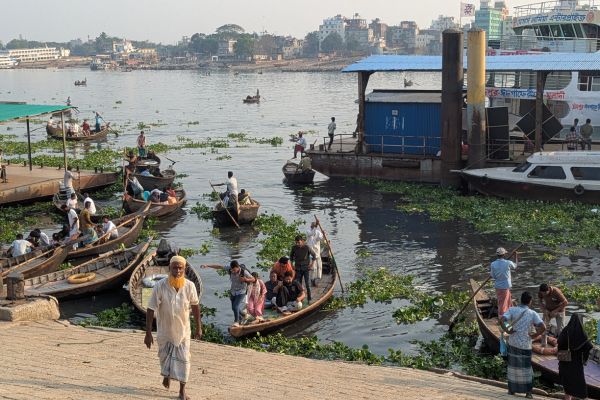
And gawp you will. If you want to get a sense for what it’s like here, then this BBC documentary brought a London, England Woolwich Car Ferry operator to Dhaka to learn the trade of a local ferryman. It was an eye-opening experience for him. Today, some 13+ years later, the water is blacker, the trash is thicker, and the ferrymen are more desperate for your money than they were then.
Locals will pay 10 BDT to cross the river. You’ll pay considerably more. You can cross the river to the shipbuilding and breaking yard, or head up or downriver. Expect to pay 500 BDT for an hour’s trip.
- Address of Sadarghat Riverfront: Sadarghat, Old Dhaka
- Cost of visiting Sadarghat Riverfront: Free, but take a ferry and negotiate.
- Opening hours of Sadarghat Riverfront: There are usually ferries going backwards and forwards across the river from 04:30 until 01:30
- How long to spend at Sadarghat Riverfront: 1–2 hours
- How to get to Sadarghat Riverfront: Best reached by rickshaw or ride-hailing app
- Map location of Sadarghat Riverfront: https://maps.app.goo.gl/qfe8UhnnaohhyuaH6
Ferry Ride across the River (Shipbuilding / Breaking Area)
One of the best things you can do at Sadarghat is take a short ferry ride across the river. If you’ve been looking at trying to visit the ship breaking yards north of Chittagong (spoiler, you can only do it from the water these days, on tours like this), then come here instead. It’s inexpensive, easy, and gives you a completely different perspective on the city and the manual approach that Bangladesh has to just about everything.
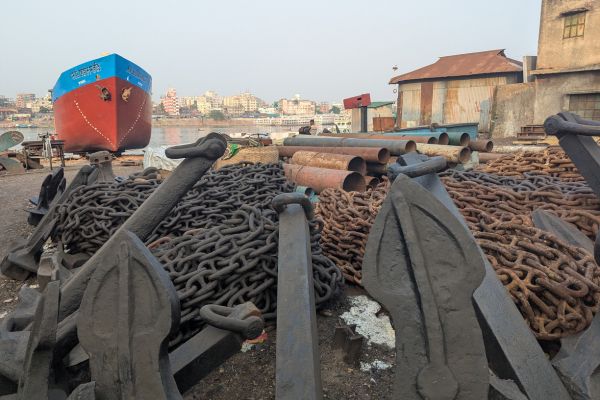
There are no life jackets, and yes, there will be large ships bearing down on you. On the other side, you’ll find more industrial areas, including small-scale shipbuilding and repair work. It’s not a formal attraction, but it’s a fascinating glimpse into another side of Dhaka.
It was a holiday when we visited, and the shipyard was closed, but we got to engage with a game of cricket played right there on the banks of the river instead!
- Address of Ferry Crossing: Sadarghat terminal area
- Cost of ferry ride: Very cheap (local fare is 10 BDT, expect to pay 50 BDT or 100 BDT)
- Opening hours of ferry crossings: Go during daylight hours, not Friday mornings, to see what’s happening across the river.
- How long to spend on ferry ride: 60 minutes, including crossing and return
- Map location of ferry crossing: https://maps.app.goo.gl/qfe8UhnnaohhyuaH6
Markets to Visit in Dhaka
Markets are a big part of daily life in Dhaka, and visiting them is one of the best ways to understand how the city really works. They’re busy, noisy, and not set up for tourists, but that’s exactly what makes them interesting. Some are end-user markets, and some are wholesale; it’s worth trying to visit both types.
Karwan Bazaar
Karwan Bazaar is one of the main wholesale markets in Dhaka and is at its busiest early in the morning. This is where restaurants, vendors from stalls, and other markets come to buy produce, and it’s a full-on experience.

It’s one of the busiest, oldest, and most important commercial markets in Bangladesh. Vendors come from all over Bangladesh each morning to trade their produce. You’ll see fruits in season, vegetables, and imported goods, like apples, for instance. There are sections for everything. Green vegetables, red vegetables, potatoes, fruits, meat, and fish.
- Address of Karwan Bazaar: Karwan Bazar, Dhaka
- Opening hours of Karwan Bazaar: Early morning is best
- How long to spend at Karwan Bazaar: 45–60 minutes
- How to get to Karwan Bazaar: Easily reached by rickshaw or ride-hailing app
- Map location of Karwan Bazaar: https://maps.app.goo.gl/oBMguiQqxKty7c1N9
Dhaka New Market
Dhaka New Market is much easier to navigate and more accessible for visitors. It’s a large series of streets, both covered and uncovered markets and stalls with a mix of clothing, household goods, and everyday items. If you want anything, you can get it here. It will be jam-packed in the early evening.
- Address of Dhaka New Market: Mirpur Rd, Dhaka 1205, Bangladesh
- Opening hours of Dhaka New Market: Open daily
- How long to spend at Dhaka New Market: 1–2 hours
- How to get to Dhaka New Market: Best reached by rickshaw or ride-hailing app
- Map location of Dhaka New Market: https://maps.app.goo.gl/FoXSzfpDUEPYbjAs6
Nazira Bazaar
Nazira Bazaar is best known for food, particularly local dishes and traditional restaurants. It’s a great place to try something different and see another side of Dhaka’s food culture. Head for Kazi Alauddin Road and towards the Nazira Bazaar crossroads.
If the idea of food in this environment daunts you, then head here with a local on a food tour – they’ll take you to hygienic, but tasty places. You can read a little about how it is here in Nazira Bazaar in this article from the Bangladesh Daily Star.
- Opening hours of Nazira Bazaar: Head here early evening, 17:30 onwards
- How long to spend at Nazira Bazaar: 1–2 hours
- Map location of Nazira Bazaar: https://maps.app.goo.gl/CSHwsjzfAYUUavjFA
Food in Dhaka – What to Try
Food is a big part of the experience in Dhaka, and it’s worth taking the time to try a few local dishes. Who am I kidding? Eat them all. Try everything. You’ll find plenty of rice-based meals, curries, lentils, and grilled meats, often served simply but full of flavor. Street food is everywhere, although it’s best to be a bit selective about where you eat.
Old Dhaka is known for its food scene, particularly places like Nazira Bazaar, where you can try more traditional dishes. At the same time, areas like Gulshan and Banani offer a mix of local and international options if you want something a bit more familiar or a more familiar environment.
If you’d like to try some of the great Bangladesh dishes, then I recommend Paturi. It’s in Banani (very close to the Omni Residency Hotel). Unusually for us, we ate here twice in four days, and left wanting to come back again. There was so much on the menu that we wanted to try. They specialize in Bangla dishes. They don’t tailor the taste, but they tailor the experience to Western tastes, so don’t worry, you’ll get forks, spoons, knives, and A/C. And while some of the reviews you’ll read say that they’re expensive, this isn’t by Western Standards. Each meal we ate here (and we left full) cost around 1600- 1800 BDT for two people. Paturi are located at Block G, House No 38, Rd No. 11, Dhaka 1213, Bangladesh – and here’s the Google Maps link – https://maps.app.goo.gl/rUXRe9p4K2r6Qf2M6
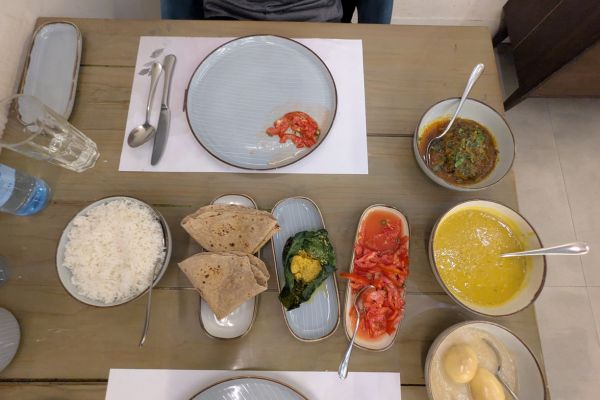
You can see photos of their menu on their Facebook Page.
Also in Banani is a local favourite, Jatra Biroti. It’s an arty place that puts as much emphasis on the environment and the look and feel as the food. They do great fruit drinks and varieties of lassi, as well as platters containing different options. We shared a table with a local journalist and his wife and had a great evening. You’ll find Jatra Biroti at House No 63, Road No. 17/A, Dhaka 1212, Bangladesh, and the Google Maps link is https://maps.app.goo.gl/mr6WKhNzdqoTHsUM8 . They have some great, useful things and some fabulous art in their gift shop, if only I had room in my backpack! Their menu is shared on photos in their Google reviews.
How to Get Around Dhaka
Getting around Dhaka takes time, no matter how far you’re going. Traffic is the biggest factor, and short distances can take much longer than expected. If you’re going from the north of the city to the south, then ask your taxi driver to take the toll road. It won’t be included in the rate you’re quoted for a taxi or ride-sharing app, but it’s worth it.
Rickshaws are everywhere – and many are electric rather than pedal-powered these days. They’re one of the easiest ways to travel short distances. They’re slow but practical, especially in busy areas. You can take rickshaws and CNGs from the airport too, here’s all the options for getting into the city.
Ride-hailing apps like Uber and Pathao are widely used and often the best option for longer distances, as pricing is clear and you avoid negotiating. You can opt for cars, CNGs (gas-powered tuk-tuks), or sometimes rickshaws. There is an option to pay on a card, but drivers prefer cash and may not accept your ride if you’re aiming to pay by card. Read my guide to ATMs and Fees here XXXX and try to build up a stash of small change, as no one ever has any change in this country.
If you’re planning on using ride-hailing apps, then you should read my guide to SIM cards for Bangladesh here.
There’s a metro, suburban trains, and tons and tons of buses, but public transport isn’t particularly straightforward for visitors; you’re much better off hailing a rickshaw or CNG.
How Long to Spend in Dhaka
Most travelers will find that one to two days in Dhaka is enough. We had four days (!) – but to be fair, we arrived on the last day of Eid al-Fitr, and then there was a National Holiday (Independence Day) and many businesses and people had turned it into a very, very long weekend, so we needed the extra time to see things that otherwise wouldn’t have been open.
2 days will give you time to see the main sights, explore Old Dhaka, and get a feel for the city without it becoming overwhelming. If you want to cut it down to one day, then I recommend taking a day tour of the city. It will be long and exhausting, but it’s great to have a local show you around.
We took a day tour with Arfin, arranged by Ontu of Trip2Bangladesh. You can contact Ontu on WhatsApp here (+880 1784-399339) or [email protected]. Tell him Sarah & Nigel sent you. You’ll need to pay Ontu upfront, and if you have a Wise account, this is easy; you can make a bank transfer, which may take 24-48 hours, or make a transfer to bKash, which usually goes through in 5 minutes.
When to Visit Dhaka
Bangladesh has six seasons, which are Summer, Monsoon, Autumn, Late Autumn, Winter, and Spring. The best time to visit Dhaka is between November and March, when the weather is cooler and more comfortable. It tends to get stormy and hot between March and May.
The monsoon season also brings heavy rain, which can make getting around more difficult, but if you’re visiting Bangladesh outside of Dhaka, then this is the best (perhaps towards the end of monsoon), and most beautiful time to visit, as trees, rice paddies, and flowers bloom at their best
Safety Tips for Visiting Dhaka
Dhaka is generally safe for travelers, but it’s important to stay aware of your surroundings. We felt 100% safe in Dhaka, even walking around late at night or early in the morning. It’s a surprise after places like Vietnam, where we’ve rocked up to train stations and people wanted to look at our printed train ticket, and we were concerned they’d take it out of our hands and run off. Nothing like that at all.
Everyone wants to help. Or rather, they want to know what’s going on; many can’t help, but someone always can. Trying to get a rickshaw driver to take you somewhere? He might not have a clue where you’re talking about or pointing to on Google Maps, but you’ll immediately draw a crowd, and someone will tell him.
Petty theft isn’t common here, but it can happen in crowded areas, so zip everything up. I didn’t feel concerned about getting my phone out to take photos, or my wallet to pay for things, but I am always cautious and try to have the right money ready in a separate pocket as soon as I know the cost of something.
Traffic is one of the biggest risks, so take care when crossing roads. Traffic also comes from all directions. Just because a sign says one way doesn’t mean it is. Rickshaws, CNGs, trucks, and buses just do what they want. Usually, with a blaring horn going.
BANGLADESH TRAVEL RESOURCES
STAY CONNECTED
WhatsApp with tour guides, get online easily and quickly.
Buy an eSim
HOTELS
Reserve a room here
Best city hotel? Need a laundry service? The best choice of hotels & places to stay.
TOURS & TRIPS
Most excursion choices, small groups, beach resort days passes, free cancellation, local guides.
Check options here.
AIRPORT TRANSFERS
Book now
Best choice of vehicles, English speaking drivers, 24 hour service.
Final Words on What to see and do in Dhaka
Dhaka is an experience. It’s busy, noisy, and constant. It’s interesting and difficult. It’s a really difficult place to visit; it’s definitely somewhere that needs a good hotel to go back to. You’ll see poverty, dirt, and so much trash, but you’ll also be welcomed, helped, and smiled at constantly. You’ll likely need to pass through Dhaka to get to where else you want to visit in Bangladesh, so it’s worth taking the time to see the parts of the city and the locations that have forged this young nation.
ASocialNomad is a participant in the Amazon Services LLC Associates Program, an affiliate advertising program designed to provide a means for sites to earn advertising fees by advertising and linking to amazon.com, amazon.co.uk, and amazon.ca. Amazon and the Amazon logo are trademarks of Amazon.com, Inc. or its affiliates. As an Amazon Associate, I earn from qualifying purchases.

