
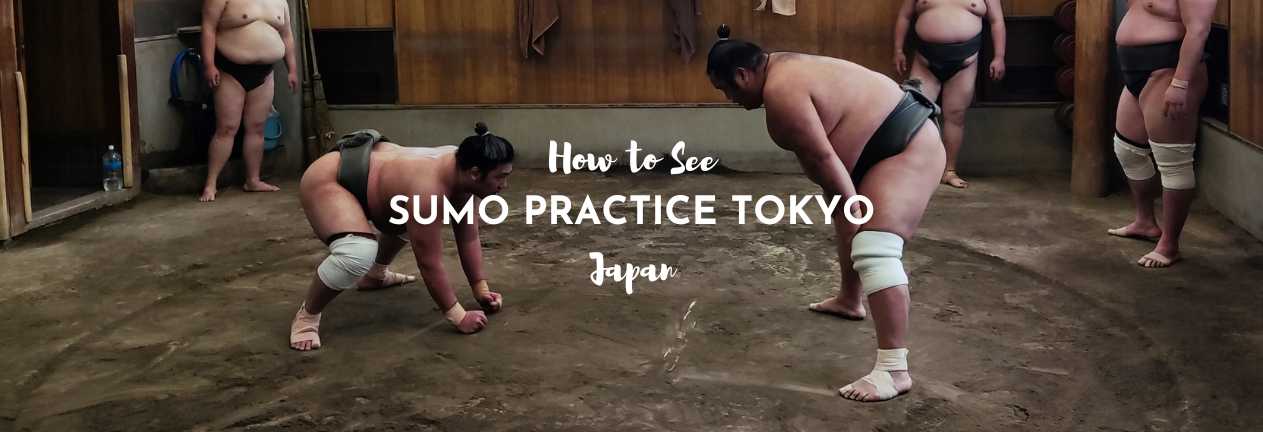
In our most recent trip to Japan, we hit another of our bucket list items for Japan. Visiting a sumo stable. It’s the only way, if you’re not traveling during the Sumo Tournament months, to see sumo wrestlers in Japan. And it was fabulous. A really, truly, fabulous experience. Heading along to sumo practice is a great way to experience one of these incredible Japanese traditions. And as you can imagine we had lots of questions about how to see sumo stables. So here’s our guide to Sumo Practice in Tokyo and we’ve also detailed our experience visiting a sumo stable.
THIS POST MAY CONTAIN COMPENSATED AND AFFILIATE LINKS MORE INFORMATION IN OUR DISCLAIMER
Sumo Wrestling is Japan’s National Sport and you’ll find grand sumo tournaments held 6 times a year – three of them are held in Tokyo, so Japan’s capital is the place to come if you want to experience a sumo stable. However. Tickets for the Sumo Tournaments sell quickly and if you’re not traveling during a sumo tournament time, then seeing a stable is your only way to experience Sumo in Japan. Here’s how to do that, and what to expect.
#1 TRIP

Come and see real sumo practice at a sumo stable in Tokyo. Get up close to the sumo wrestlers, see their training routines and get your photo with them too!
Sumo Tournaments in Japan
There are 6 sumo tournaments each year in Japan. Three of these are held in Tokyo, and there is one each in Osaka, Nagoya, and Fukuoka. Here are the months in which the sumo tournaments are held.
- January: Tokyo Sumo Tournament
- March: Osaka Sumo Tournament
- May: Tokyo Sumo Tournament
- July: Nagoya Sumo Tournament
- September: Tokyo Sumo Tournament
- November: Fukuoka Sumo Tournament
If you’re traveling during these months and want to go to a Sumo Tournament then the best way to buy sumo tournament tickets is here.
PRACTICAL TRAVEL TIPS
- 🛡️ Get Travel Insurance: Civitatis includes medical expenses, repatriation, theft, luggage delays. No deductibles or upfront payments. Get a quote here.
- 💰 Read about the Currency in Japan and ATM fees.
- 🔌 Check out Japan’s plug, socket & power situation.
- 📶 Get online EASILY & cheaply – One eSim for the world. Data never expires
How to Watch Sumo Practice in Tokyo
Most of the sumo stables in Tokyo are in the Ryogoku area of the city. Ryogoku is well served by the JR Ryogoku station and is easy to get to, although if you’re coming to morning training you’ll have to be here early. Oh don’t worry it’s not as early as the famous Tokyo Tuna Auction (another Japan bucket list item), but you’ll need to be in the area for around 08:00.
Watching Sumo Practice versus Watching a Sumo Tournament
While there can be no denying that watching a sumo tournament is a fantastic spectator sport, there are a variety of reasons why watching sumo practice is better.
- The time of year that you visit – there are sumo tournaments only in 6 months of the year, so there might not even be a tournament when you are visiting.
- You’ll get much, much closer to the wrestlers during practice than you will in a tournament
- If you take a guided tour, then you’ll get to understand more about sumo, the practice, and what being a sumo wrestler entails.
- Many of the sumo stables that allow visitors also allow you to take a photo with a wrestler at the end of practice. You won’t get this at a sumo tournament.
Sumo Stables in Tokyo
As of March 2021 there were 44 Sumo Stables in Japan, most of which are in Tokyo. The biggest grouping of sumo stables is around the Ryogoku area of Tokyo. Not all sumo stables accept visitors.
All professional sumo wrestlers must belong to a stable, which in turn belongs to one of five ichimon.
A sumo stable or a sumo-heya is a communal location where sumo wrestlers, live, eat, sleep, and train.
An ichimon is a clan and there are five of them. Nishonoseki, Dewanoumi, Tokitsukaze, Takasago and Isegahama.
Each stable is managed by a stable master, a retired sumo wrestler.
How to Watch Sumo Training in Tokyo
There are two ways in which you can watch sumo training in Tokyo. The easiest way to watch is to book a guided tour.
Watching Sumo Practice on a Guided Tour in Tokyo
You’ll meet your guide, usually at the Ryogoku station in Tokyo and then you will walk the few minutes to the stable in which you’ll watch practice. Some tours also include a tour of the stable, as well as watching practice and other tours also include a meal after the practice. The meal tends to be the traditional food – Chanko Nabe – that is eaten in the sumo stable.
Watching Sumo Practice for Free in Tokyo
The best place to watch sumo practice for free in Tokyo is at the Arashio-beya. Sumo practice at Arashio-beya usually takes place between 07:30 and 09:30 most mornings outside of sumo tournament times.
The Arashio-bey Sumo stable now have an online calendar on their webpage that shows if a practice is taking place or if they are away training or at a Sumo tournament. You can see the up to date calendar here. You no longer have to call them to check whether Sumo practice is taking place as the website has the up to date information.
You’ll watch sumo practice at the Arashio-beya by standing in the street and watching through the large windows. There’s a bike rack in front of the windows and you’re not allowed to stand in front of the bikes. You’re also not allowed to use flash photography or try to distract the sumo wrestlers as they practice. You’re also expected to keep quiet, refrain from eating and drinking, and not disturb the neighbors or sit on their steps.
What to expect when watching sumo practice
If you go inside the stable (as opposed to watching from outside a window in the free way to watch sumo practice), then you’ll be sitting either on a short chair or a cushion right next to the training ring.

You’ll watch as the wrestlers go through a series of drills, after warming up. During practice bouts, they’ll receive guidance and reinforcement from their stable master and coach. This often comes in the form of yelling about what to do differently.

It’s quite incredible to be this close to these athletes and as you watch them go through their training drills and practice bouts, you’ll see how much control and strength they have.
What Happens in Sumo Practice in Tokyo
The Sumo Ring is made of clay and is 4.5 meters (15 feet) in diameter and it’s where the sumo practice takes place.
Sumo practice begins with warming up and during the practice session you’ll see various wrestlers doing warm-up exercises that include:
Shiko: Where they lift each leg in turn, and bring it down. It helps them keep balance and strengthens the legs and back. This is part of a Shinto ritual and also helps ward off evil spirits in the ring.

Teppo: Wrestlers face a pole and repeatedly push it with their hands. This helps to strengthen the upper body.
Suriashi: This is a curious sliding walk. Wrestlers walk by sliding their feet while in a crouched position. It helps to strengthen the lower body and aids with balance.
Matawari: Probably best described as “almost like doing the splits” – it increases the flexibility of the hip joint and helps with preventing injury. (I definitely could NOT do this!)

The goal of sumo training is to increase the flexibility, speed, and strength of the sumo wrestlers. There are several bouts that the wrestlers go through.

- King of the Castle – where the winner remains in the ring and the winner appoints who replaces the loser who leaves the ring.
- The repeated practice – where two of the rikishi (the sumo wrestlers) fight over and over again until they’re exhausted.
- The Offense/Defense practice – the offense charges forward while the defense receives the hit, sliding backward.
- The fall-breaking drill – learning to land helps to prevent injury and minimize pain when being thrown.
Once the training is done, the Rikishi wash up in the bathroom and eat brunch (you don’t get to watch this bit!)
Sumo Stable Tours in Tokyo
There are a variety of sumo stable tours available in Tokyo, ranging from simply watching sumo practice to eating a traditional sumo lunch afterward. It’s best to work out when you plan on being in Tokyo and then look for availability.
Rules for Watching Sumo Practice in Tokyo
If you join a guided group to watch sumo practice in Tokyo, then you’ll be given a printed guide on what to expect, in terms of what you’ll be seeing, but also the etiquette that you’re expected to follow during your visit to the sumo stable.
On arrival at the stable, it is polite to bow to your usher and anyone else you meet on the way in.
You’ll need to remove your shoes before going into the training room.
There’s no smoking inside the sumo stable, although some stable masters may smoke, as this is a private building!
You’ll be expected to be silent. You should turn off the shutter sound of your phone or camera too.
If your mobile phone is on it must be on silent and you are expected not to use it as a phone while you are in the stable.
In most stables, there are cushions on the floor on which you can sit. You don’t need to kneel but should make sure that the soles of your feet do not point towards either the wrestlers or the ring.
You’re not allowed to eat, drink, or talk during the training. You will be allowed to drink plain bottled water in the heat of summer. Your guide will advise.
You may be allowed to take photographs, your guide will advise if you can, but there are NO selfies allowed and no flash photography.
You are unlikely to be allowed to leave early, so plan to be there for the duration of the training session.
All of these rules are to ensure that you’re not disturbing the training session, as this is a real training session it’s not a “put on for the tourists” event.
At the end of the sumo practice, one or more of the sumo wrestlers may accompany you outside, and you may be allowed to take photos.
All about Sumo Wrestling
The object of sumo wrestling is to drive the opponent out of the sumo ring or to force them to touch the ground with any part of their body apart from the soles of their feet. The sumo ring is made of clay and is 4.5 meters (15 feet in diameter).
Sumo wrestlers wear only a heavy-duty loincloth (a mawashi), and they use this to take a grip on their opponents. If the loincloth comes undone, then that also signifies the end of a bout (the wrestler without the mawashi is the loser).
Sumo wrestling dates back to the year 710 and was a popular spectator sport. After 1185 sumo was banned by the shoguns, and it wasn’t until 1600 that professional sumo wrestling and public matches were revived.
The grand champion of sumo is called the Yokozuna, a title which came into play in 1632, with Akashi Shiganosuke being the first to hold it.
Sumo fighters are recruited out of either middle or high school, and you’ll see a variety of ages of wrestlers during practice. They tend to gain weight gradually, around 10-12 kilograms (22 – 26 pounds) a year. Sumo wrestlers tend to peak in terms of performance between the ages of 27 years and 32 years. The bigger wrestlers will tend to the older than the smaller ones.
How to book a Sumo Practice Tokyo Tour
You can’t just turn up at a sumo stable and expect to be granted access. While at the Arashio-beya stable, you can stand outside and watch, if you want to go inside, then you’ll need to prebook. And it’s always wise to get this booked as soon as you know the dates that you’ll be traveling. You can book a sumo stable visit via
Each of these providers partners with different stables and they also have different timings and offerings. So it’s best to take a look at the different options. We ended up booking with GetYourGuide as they had the availability on the date that we wanted. (picking that particular date allowed us to head to Mount Takao on a day trip from Tokyo too)
Our Experience of Watching Sumo Practice in Tokyo
We booked our sumo practice experience in Tokyo through GetYourGuide – it was THIS SPECIFIC TOUR – and met our guide at the Ryogoku train station at 07:45, our official meeting time was 08:00. We stayed at the APA Hotel Asakusabashi during our time in Tokyo, and were able to easily walk here in 25 minutes.
As our group gathered for the sumo practice experience, we were given a printed guide on what to expect and read this before we walked to the Hakkaku-beya stable. Our experience lasted until 10:20 when we left the stable.
The stable master of the Hakkaku-beya stable is the ex-grand champion Yokozuna, the chairman of the Sumo Association. This stable is part of the Takasago ichimon group of stables. The stable was established in September 1993, by former Grand Champion Hokutoumi. As of January 2023, there were 21 wrestlers in this stable. It has produced nine sekitori (wrestlers in the top two professional divisions) and four makuuchi (the top division).
We walked to the sumo stable, which just looked like any other residential building in a residential area. I don’t know what I was expecting, but I wasn’t expecting it just to look like any other apartment building!

On arrival at the sumo stable, we removed our shoes in the entranceway and were ushered into the training room, where the sumo wrestlers were already well into their training. We were the fourth or fifth people into the viewing area and filed in. There were two rows for visitors, the front row where everyone say on cushions, and the back row where there were short stools. We sat on the short stools for the duration of the practice. It was NOT uncomfortable. If you’re unable to sit on the floor for the length of time of the practice (usually about 2 hours), then you should request to have a chair when you make a booking.
During the practice we were simply observers, there was no interaction between us, the visitors, and the sumo wrestlers. They ignored us completely and went on with their practice.
Not all the wrestlers were there all the time, when they finished practicing they went off to take a bath and eat their brunch.
At the end of the practice, we all filed out and waited as two of the wrestlers joined us outside and we were allowed to take photos.

Frequently Asked Questions about Watching Sumo Practice
Here are the questions that we had about watching sumo practice in Tokyo that will help you plan a trip to watch sumo training.
Can foreigners watch sumo practice in Tokyo?
Yes. Foreigners and tourists can watch sumo practice in Tokyo. The easiest way to do this is to book a sumo practice tour, this will guarantee that you’ll be able to see the practice. Here are three options for booking a tour to watch sumo practice in Tokyo.
Do you have to pay to watch sumo practice in Japan?
No. You don’t have to pay to watch sumo practice in Japan. You can watch sumo practice for free at the Arashio-beya in Tokyo. This sumo stable in the Nihonbashi area of Tokyo has large windows that face the street in front of the stable. You can get a reasonable view – although the bike rack between you and the window does obstruct the view (along with other tourists who might be gathered there).
Can you watch sumo practice for free in Tokyo?
Yes, you can watch sump practice for free in Tokyo. You’ll need to go along to the Arashio-beya in Tokyo and take your chances that you can see.
Can you take photos at sumo practice in Tokyo?
It depends. Some sumo stables allow you to take photos at sumo practice, others don’t. You won’t be allowed to take flash photographs and the rules and etiquette of sumo practice are that you don’t distract the wrestlers while they are practicing.
Can you watch sumo practice if you have tattoos?
It’s best practice in Japan to cover any tattoos that you may have.
JAPAN TRAVEL RESOURCES
TRAIN TICKETS
Easiest way to buy train tickets, use Klook for Shinkansen Train Tickets, check timetables & reserve seats.
Book Train Tickets
HOTELS AND APARTMENTS
See choices here
Sea view rooms? Budget rooms? Need a washing machine? The best choice of hotels & apartments.
TOURS & ATTRACTIONS
Most excursion choices, small group tours, skip-line tickets, free cancellation and top local guides.
Top options here.
CAR RENTAL GUIDE
Read my Guide
The best choice of vehicles, automatics, large or small cars, child seats. Book early for more options.
Final Words on Sumo Practice in Tokyo
Taking the time to go to sumo practice in Tokyo is a great way to experience some of the culture of Japan. Watching sumo practice means that you’ll get up close to some of Japan’s best athletes and truly once you’ve watched them go through the practice bouts you’ll have a whole new respect for their strength and skills. Learning a little more about sumo wrestling and also the skills that are needed for it, is a fascinating dive into more of Japan’s culture. Don’t miss it!
ASocialNomad is a participant in the Amazon Services LLC Associates Program, an affiliate advertising program designed to provide a means for sites to earn advertising fees by advertising and linking to amazon.com, amazon.co.uk, and amazon.ca. Amazon and the Amazon logo are trademarks of Amazon.com, Inc. or its affiliates. As an Amazon Associate, I earn from qualifying purchases.

