
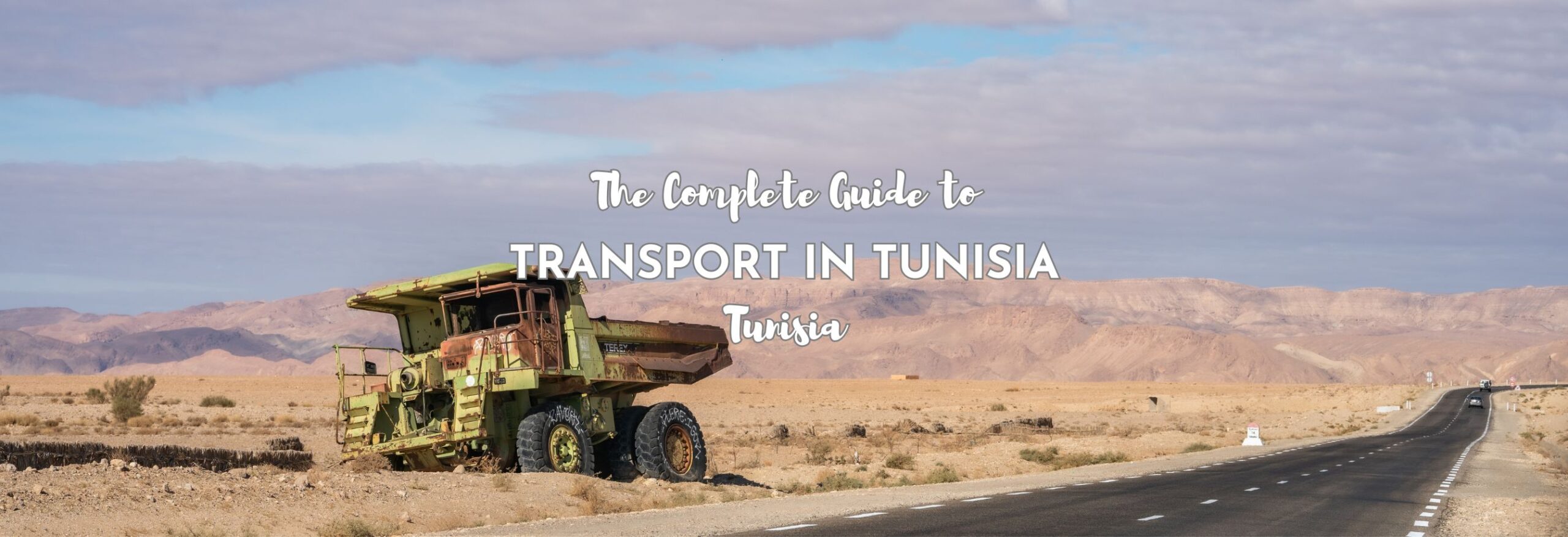
When it comes to transport in Tunisia, you’ll quickly learn that the country has a variety of options for getting from one place to another, but the trick is figuring out which one works best for you. Getting around Tunisia isn’t difficult once you understand the system—it’s just that Tunisian transport is a bit different from what many are used to. Distances can look small on a map, but services run on local schedules, not always international expectations. From buses and trains to louages, private transfers, and rental cars, there’s something to suit every budget and travel style. Whether you’re heading along the coast or inland towards the desert, knowing how Tunisian transport works will make your trip smoother. Here’s my guide to Transport in Tunisia.
THIS POST MAY CONTAIN COMPENSATED AND AFFILIATE LINKS MORE INFORMATION IN OUR DISCLAIMER
Once you’ve landed, it’s all about choosing the right way to travel. Tunisia’s land transport network covers just about every corner of the country, but each option has its quirks. Buses are cheap and reliable for major routes, while louages (shared minivans) are the fastest way to connect towns, though not always the most comfortable. Trains serve popular coastal destinations and a few inland spots, and private transfers are perfect if you want door-to-door convenience. Renting a car gives you maximum flexibility, especially if you’re exploring the Sahara or mountain regions. And for longer distances, like traveling from Tunis to Tozeur, domestic flights are often the most practical choice. With a little planning, you can mix and match these options to suit your trip. Here’s all of what we learned about getting around Tunisia.
Entering Tunisia
Getting to Tunisia is straightforward, with two main options: by air or by sea. Most visitors fly into one of the country’s international airports, arriving from Europe, the Middle East, or beyond. For those already in the Mediterranean region, ferries are another popular choice, linking Tunisia with Italy and France.
Arriving in Tunisia by Plane
Tunisia has several international airports that connect directly with Europe, the Middle East, and parts of Africa. The main gateways are Tunis–Carthage International near the capital, Monastir Habib Bourguiba, Enfidha–Hammamet, and Djerba–Zarzis. Together, these airports cover both the coastal resorts and inland travel, making arrivals convenient for different itineraries.
My guide on going from Tunis Carthage Airport to Tunis is here.
Arriving in Tunisia by Ferry
If you’re already in Europe, ferries are a great way to arrive in Tunisia with your own car or just as a foot passenger. Services connect Italian ports like Genoa, Civitavecchia, and Palermo, as well as Marseille in France, to Tunis’s La Goulette port, offering a slower but scenic alternative.
PRACTICAL TRAVEL TIPS
- 🛡️ Get Travel Insurance: Civitatis includes medical expenses, repatriation, theft, luggage delays. No deductibles or upfront payments. Get a quote here.
- 💰 Read about the Currency in Tunisia and ATM fees.
- 🔌 Check out Tunisia’s plug, socket & power situation.
- 📶 Get online EASILY & cheaply – One eSim for the world. Data never expires
Types of Transport in Tunisia
Tunisia offers a wide range of transport options, from planes and trains to buses, louages, taxis, and rental cars, each suited to different journeys and budgets.
Getting Around Tunisia by Plane – Flights in Tunisia
Flying is the quickest way to cover Tunisia’s longer distances, especially when you’re short on time. Domestic flights link the capital, Tunis, with far-flung spots like Tozeur in the southwest and Djerba off the southern coast. While the distances may not look huge on a map, traveling overland can take most of a day, so flights can save hours. We originally planned to take a train to Tozeur on our visit, but the train wasn’t running, and the bus journey felt like a waste of a day, so we flew. (and it’s great because one of the things we wanted to see in Tozeur was at the airport!
The main airports offering domestic services include:
- Tunis–Carthage International: hub for most domestic flights
- Djerba–Zarzis International: for island connections
- Tozeur–Nefta International: gateway to the desert and oasis towns
- Monastir Habib Bourguiba International: covering central Tunisia
The national carrier, Tunisair, operates alongside its subsidiary, Tunisair Express, which runs most domestic routes. These flights can be limited in number, so it’s best to book ahead to secure your seat. If you’re planning to explore the desert or southern Tunisia, flying is often the smartest choice.
Getting Around Tunisia by Train
Tunisia’s train network is a practical choice for traveling along the coast and to a few inland destinations. It’s run by the SNCFT (Société Nationale des Chemins de Fer Tunisiens) and is generally affordable, though not always the fastest option. Trains are most useful for linking Tunis with coastal cities such as Sousse, Sfax, and Gabes, as well as for regional journeys around the Sahel area.
My guide on going from Tunis to Sousse is here.
Tickets can usually be purchased at the station on the day of travel, with cash being the standard form of payment. Some stations allow advance booking, (but only usually 3 days ahead!) and it’s less common than in Europe. There are different classes of service—first class provides more comfortable seating and air-conditioning, while second class is cheaper but often busier.
If your itinerary follows Tunisia’s coast, trains are a good choice for predictable, budget-friendly travel without the hassle of navigating roads or negotiating fares.
There are different routes and types of trains – the Sahel Metro is like a light rail service, that will get you for instance from Sousse to Monastir. The TGM runs up the coast from Tunis round to Carthage and onto Sidi Bou Said.
Getting Around Tunisia by Bus
Buses are one of the most common and budget-friendly ways to get around Tunisia, especially if you’re traveling between major cities. Large coaches are run (mostly) by the national company SNTRI, and they cover long-distance routes across the country. These coaches are generally comfortable, with set departure times, and they connect coastal cities with inland towns and regions.
In the absence of a train, after we’d finished with our time in Tozeur we took a bus from there up to Sousse, our next stop.
Tickets are almost always bought with cash at the bus station on the day of travel. While this keeps things simple, it does mean you’ll need to arrive early to secure a seat, especially on popular routes. Don’t expect the bus stations to be centrally located—many are on the edges of towns, so you may need a short taxi ride to reach them.
For long journeys on a budget, the SNTRI buses are reliable, though you’ll want to plan for delays and factor in extra travel time.
Getting Around Tunisia by Minivan aka the Louage
The louage is Tunisia’s unique take on shared minivan travel and is often the fastest way to get between towns. These white minibuses with red or blue stripes operate from dedicated louage stations, and each one departs only when it’s full—usually five to seven passengers. Louages run fixed routes, linking cities, towns, and even some villages across the country.
Buying a ticket is simple: you pay the driver in cash, and prices are generally fixed and affordable. Louages are great for short- to medium-distance travel where you want a quick, no-fuss ride. However, they’re not ideal if you’re carrying bulky luggage, as space is limited. They also run almost exclusively during daytime hours, so don’t rely on them for early mornings or late nights.
They’re useful for such routes as Sousse to El Jem (my guide to El Jem is here).
If you want to travel like a local and don’t mind close quarters, louages are an efficient, authentic part of Tunisian transport.
Taxis in Tunisia
Taxis are widely available in Tunisian cities and towns, with most operating on a metered system. Always make sure the meter is running before setting off, and remember that payment is cash only. Some taxis work only within a set local area, so you can’t simply hire one in Sousse and expect to ride all the way to Tunis.
Bolt in Tunisia
Bolt was once a convenient ridesharing option in Tunisia, especially in cities like Tunis, but as of May 2025 it’s no longer available. The app was suspended after regulatory and operational challenges, leaving taxis and transfers as the main alternatives. You can read more about the shutdown in this news report: Bolt suspended in Tunisia.
Private Transfers in Tunisia
Private transfers are a great option if you want convenience and certainty, particularly for routes like Tunis to Hammamet where schedules can be irregular. You can prebook online and pay in advance, which is useful since most Tunisian transport is cash only.
Check out my detailed guide here: Tunis Airport to Hammamet.
If you’re planning ahead, also read my tips on money: Currency and ATMs in Tunisia.
Rental Cars in Tunisia
Renting a car is one of the best ways to explore Tunisia at your own pace, especially if you’re planning to visit remote desert or mountain areas. You’ll need an International Drivers Permit alongside your home license, and a 4WD is recommended for rough terrain. For price comparisons and choice, I recommend using DiscoverCars: Get a price here.
Highways are toll roads, and speed limits are generally 110 kilometers (68 miles) on national highways, 90 kilometers (56 miles) on open roads, and 50 kilometers (31 miles) in towns. Driving is on the right-hand side.
If you’re a Star Wars fan, many filming locations are scattered across the desert, you’ll need a 4WD for independent visits—check out my guide here: Star Wars sites in Tunisia.
Bicycles in Tunisia
Cycling can be a fantastic way to explore Tunisia’s historic sites, particularly around Carthage where distances are short, and the scenery is rewarding. Many local operators offer rentals, and biking lets you cover more ground than walking without worrying about traffic. For more details, see my guide: Visiting Carthage.
Transport in Tunis
The Tunis medina is a maze of narrow alleys, so the only way to get around inside is on foot. For longer journeys across the city, there’s a simple metro system that’s handy for reaching key sights like the Bardo Museum. Local buses also operate, though they’re cash-only and often crowded, with services slowing down in the evenings.
Another useful option is the TGM (Tunis–Goulette–Marsa), a suburban train running from central Tunis to the northern suburbs, including La Goulette, Carthage, Sidi Bou Said, and La Marsa. It’s a cheap way to visit coastal towns and historic sites, like Carthage, though expect older rolling stock and frequent stops. Combined, walking, the metro, buses, and the TGM make exploring the capital relatively straightforward.
Booking Transport in Tunisia
Most transport in Tunisia is arranged on the spot and paid for in cash, but if you’d prefer to plan ahead there are a few platforms that make it easier.
- For private transfers, you can compare and book routes with Daytrip.
- And if you’re looking for domestic flights, 12Go Asia offers online booking options.
FAQS for Transportation in Tunisia
Here are the questions that we get asked about getting around Tunisia – don’t forget if you have a question about how to travel around Tunisia you can send us an email, or ask in the comments below and we’ll answer for everyone else to see.
What’s the cheapest form of transport in Tunisia?
Louages are usually the cheapest way to travel, especially for short and medium distances between towns.
Is Grab available in Tunisia?
No, Grab does not operate in Tunisia—taxis, buses, and louages are the main options.
Is Uber available in Tunisia?
Uber is not available in Tunisia, so you’ll need to rely on local transport services.
Is Bolt available in Tunisia?
Bolt used to operate in Tunisia but as of May 2025, it has been suspended.
TUNISIA TRAVEL RESOURCES
AIRPORT TRANSFERS
24/7 pickup & drop off. Trusted, local English speaking drivers. Prebook & prepay online with cards.
Book a Transfer
HOTELS AND APARTMENTS
See choices here
Sea view rooms? Budget rooms? Need a washing machine? The best choice of hotels & apartments.
TOURS & ATTRACTIONS
Most excursion choices, small group tours, skip-line tickets, free cancellation and top local guides.
Top options here.
CAR RENTAL OPTIONS
Choose cars here
Best choice of vehicles, automatics, large or small cars, child seats. Book early for more options.
Final Words on Transportation in Tunisia
Traveling around Tunisia is easier once you understand how the local systems work. From trains and buses to louages, private transfers, and rental cars, there’s a way to suit every traveler’s budget and itinerary. Plan ahead where you can, carry cash, and you’ll get where you need to go.
ASocialNomad is a participant in the Amazon Services LLC Associates Program, an affiliate advertising program designed to provide a means for sites to earn advertising fees by advertising and linking to amazon.com, amazon.co.uk, and amazon.ca. Amazon and the Amazon logo are trademarks of Amazon.com, Inc. or its affiliates. As an Amazon Associate, I earn from qualifying purchases.

