
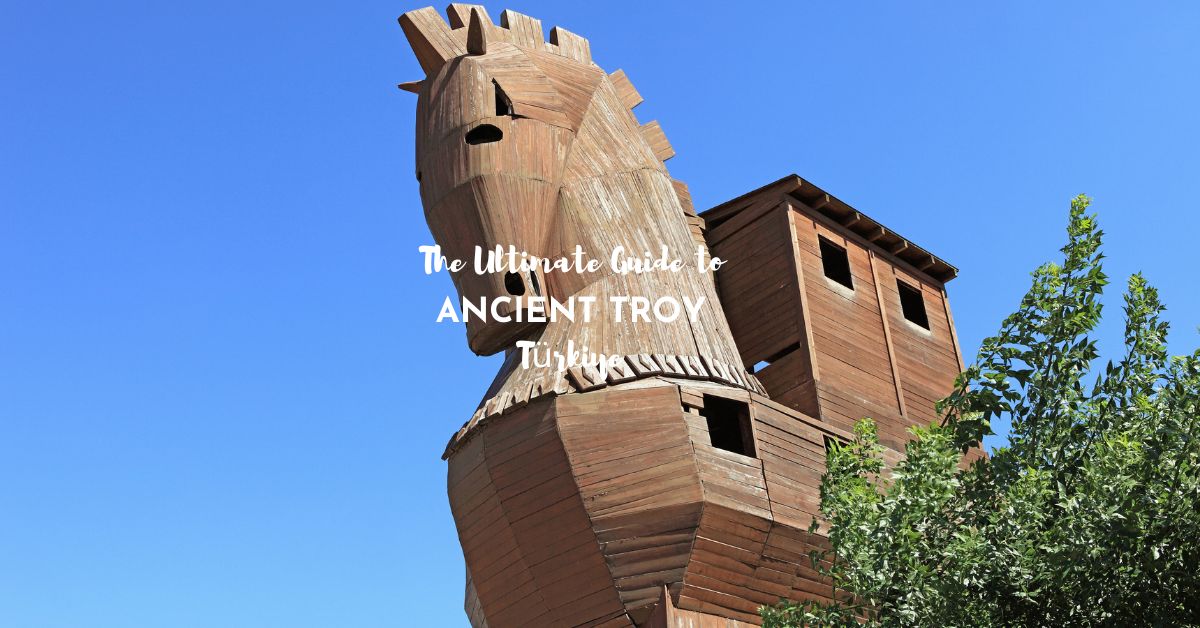
Troy is a real, historic city on Türkiye’s northwest Aegean coast, near the small village of Tevfikiye and about 30 kilometers (19 miles) from Çanakkale. It’s the setting for Homer’s Iliad and the legendary Trojan War, and its ruins, a full nine layers of the city built one on top of the other across roughly 4,000 years, are open to visitors every day of the year. Ancient Troy holds a unique position in history, literature, and archaeology. Ancient Troy. Truva in Turkish and its location has been written about by ancient Greek and Latin Authors for centuries, however, the location of ancient Troy wasn’t identified until relatively recently. The site of the ancient ruins of Troy became a UNESCO World Heritage site in 1998. Here’s my guide on how to visit Troy.
THIS POST MAY CONTAIN COMPENSATED AND AFFILIATE LINKS MORE INFORMATION IN OUR DISCLAIMER
Troy at a Glance
| Detail | Information |
| Location | Tevfikiye village, Çanakkale Province, Türkiye |
| Opening hours | Open daily, generally early morning to sunset (check the official site for exact seasonal times) |
| Entrance fee | €27 (as of 2026) – includes entry to the Troy Museum |
| Nearest city | Çanakkale (30 kilometers / 19 miles) |
| Distance from Istanbul | 5 to 6-hour drive |
| Suggested visit time | 1 to 2 hours for the ruins; 3 to 4 hours if you include the museum |
The Best Way to See Troy
There are three main ways to visit Troy: drive yourself and explore independently, take a local dolmuş or taxi from Çanakkale and buy your ticket on-site, or join a guided tour from Istanbul or Çanakkale. If Troy is your only ancient site in Türkiye, a guided tour is absolutely worth it; much of what you’re looking at is foundations and low walls rather than complete structures, and a guide makes a real difference in bringing the layers to life. If you’re already staying in Çanakkale, a half-day trip is plenty; if you’re coming from Istanbul, plan for a full and fairly long day.
How to Get to Troy, Türkiye
The site of the Troy ancient ruins is located 1 kilometer (0.6 miles) from Tevfikiye, and it is an easy walk. It is 31 kilometers (19 miles) from Çanakkale.
To get to Troy from Çanakkale
Dolmuşes (minibuses) travel from the Çanakkale local bus station (close to the bus station, but under the white bridge) to Troy. The travel time to Troy from Çanakkale is 45 minutes, and buses leave from 07:00 every hour. The last bus from Çanakkale to Troy is at 15:00. Returning to Troy from Çanakkale, buses leave from 09:30 until 17:30. The bus to Troy costs a few Turkish lira per person; fares have risen with inflation, so confirm the current price locally before you travel.
To get to Troy from Istanbul
You can take tours from Istanbul to Troy; it’s about a 5 to 6 hour drive each way, so day tours usually leave around 07:00 and don’t arrive back in Istanbul until about 22:00. We recommend this tour to Troy from Istanbul.
2-Day Troy & Gallipoli Tour
Many tour operators combine Troy with a visit to the Gallipoli Peninsula, the site of the WWI battles that hold particular significance for Australian, New Zealand, and Turkish visitors. A 2-day tour typically covers Gallipoli and Troy on separate days with an overnight stay in Çanakkale; it’s a good option if you want to see both without rushing either. Book this 2-day Troy and Gallipoli tour from Istanbul.
#1 DAY TRIP

This is the TOP Rated Tour of Troy
This top-rated tour of Troy from Istanbul is the perfect way to visit Troy. Get all transport, an English-speaking guide, and your entrance.
What to See at Troy
There are a variety of things to see here at Troy, and it starts right by the ticket office.
Trojan Horse Model
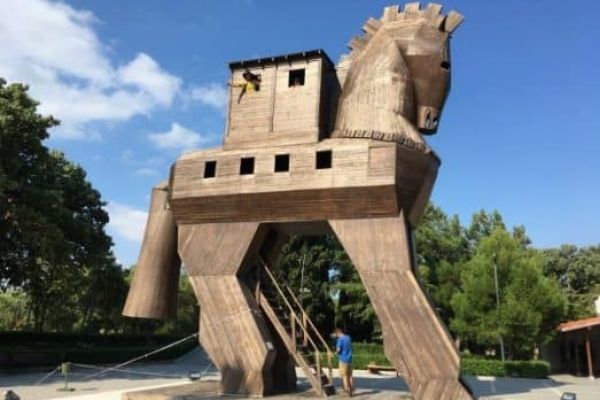
Just past the ticket office, you’ll find a large wooden horse model. It’s not historically accurate, but a fun photo opportunity, and you can climb inside. Note this isn’t the horse used in the 2004 film Troy starring Brad Pitt; that one stands separately on the waterfront in Çanakkale city (more on that below).
The Main Gate and Walls of Troy
The most visually striking remains are the fortified walls and the south gate, with an eight-meter-high north-east bastion still standing in places. It takes a bit of imagination to picture the citadel in its heyday, but signboards around the site help explain what you’re looking at.
The Layers of Troy
Troy isn’t one city but nine, each built on the ruins of the last across roughly 4,000 years. Troy I is the oldest, at the bottom; Troy IX, the most recent, sits at the top. The layer most closely associated with Homer’s Iliad is generally identified as Troy VI or VII, dating to the Late Bronze Age; there’s more on this below.
The Troy Museum
The Troy Museum sits just outside the main archaeological site and opened in 2018. It houses artefacts from all nine layers of the city’s history, including pottery, jewellery, and weapons, in a modern, well-laid-out building. Entry is included with your Troy ticket (€27 as of 2026), so it’s well worth the extra hour or two. .
The Discovery of Ancient Troy
The ruins of Ancient Troy are found in the current Hissarlik, Türkiye; however, it was the Englishman, Charles Maclaren, who, in 1822, suggested that this might be the location of the city. Frank Calvert then convinced the millionaire German amateur archaeologist, Heinrich Schliemann, that this location was correct.
Between 1870 and 1890, Schliemann excavated the area in a brutal fashion. His North to South Trench literally cut through layers and layers of historical artifacts. He announced his discovery and the finds of what he called Priam’s Treasure. The treasures were relocated to Berlin. When Berlin was sacked by the Red Army during WWII, they were moved to Moscow and have not been returned.
Schliemann’s excavations uncovered evidence of nine periods of building, living, and destruction. At the end of each time, further building took place on top of the previous layer. The destruction generally occurred because of an earthquake or fire.

The History of Ancient Troy: 9 Periods
These nine separate layers of Ancient Troy began with the oldest, Troy I at the bottom and ended with Troy IX at the top. For the first seven periods, Troy was a stronghold with a king’s residence and the associated supporting family and slaves. The local population lived in fields nearby, only taking refuge in the stronghold in dangerous times. Troy is now 5 kilometers (3 miles) from the sea, but it was originally very close to the river mouth.
The original Troy was small, just 300 feet in diameter with around 20 houses. By contrast, Troy II was twice as big. Troy II was leveled after a fire, and it was in this layer that Schliemann found a treasure trove, identified it with Homer’s Troy, and labeled it Priam’s Treasure. Troy’s III, IV, and V were larger than Troy II but contained smaller, more densely located residences within.
Troy VI and VII came about in the Middle and Late Bronze Ages. The city grew, domesticated horses were present, and a fifteen-foot-thick city wall was constructed of limestone. After an earthquake leveled Troy VI, it was quickly rebuilt with houses crowded together and large storage locations for food. It was then destroyed by fire, which historians believe was on purpose by enemies, who also looted the city.
Homers Troy
It was this Troy that historians believe was the Troy of Homer’s Iliad legend, where King Priam and his treasure came from. Although the city was rebuilt, it was soon abandoned for four hundred years. The Greeks began to settle the city in 700 BC, and it became Troy VIII. Following a sacking by the Romans in 85 BC and its subsequent restoration, the city took on its final form in Troy IX.
Troy Legend: the Trojan War
Paris, one of the 50 sons of wealthy King Priam, was tasked by the Greek goddesses, Aphrodite, Hera, and Athena, to judge which of the three goddesses should receive the golden apple of Eris, the goddess of discord, which would define them as the most beautiful. In an under-the-table deal, Aphrodite promised him the most beautiful woman in the world and thus won the apple. Paris then headed off to Greece and eloped with Helen, the wife of the King of Sparta.
Despite a great expedition and the sacking of many nearby towns by the Greeks in an effort to recover Helen, the Trojans refused to return her. The ancient city of Troy withstood a siege for 10 years. Even the gods took sides. Hera, Athena, and Poseidon sided with the Greeks, with Aphrodite, Apollo, and Ares on the side of the Trojans.
Homer’s Troy: the Iliad
Homer’s Iliad is set in the 10th year of the siege and tells of the battle between Agamemnon and Achilles, which led to the death in battle of Priam’s eldest son, Hector. To cut a long story short, a huge wooden horse was built. Some of the Greek warriors hid inside, and the rest of the Greek army sailed away to a nearby island. While Priam’s daughter, Cassandra, warned against the movTroy VI and VII came about in the Middle and Late Bronze Ages. The city grew, domesticated horses were present and a fifteen feet thick city wall was constructed of limestone. After an earthquake leveled Troy VI, it was quickly rebuilt with houses crowded together and large storage locations for food. It was then destroyed by fire, which historians believe was on purpose by enemies, who also looted the city.
Where is Ancient Troy Today?
There’s little that remains today of the nine periods of Ancient Troy. An impressive ticket office bars your entry, and a wooden horse replica takes pride of place as you pass through the barriers (see “What to See at Troy” above for more on this). You can also have a bit of dress-up fun on your Troy visit. Roman gladiator costumes and a chariot are available if you want to play dress-up and get a photo taken.

Signboards around the site provide a heap of information, although they’re not always obvious; you do have to seek them out. It takes more than a little imagination to figure out the center of commerce that this must once have been.
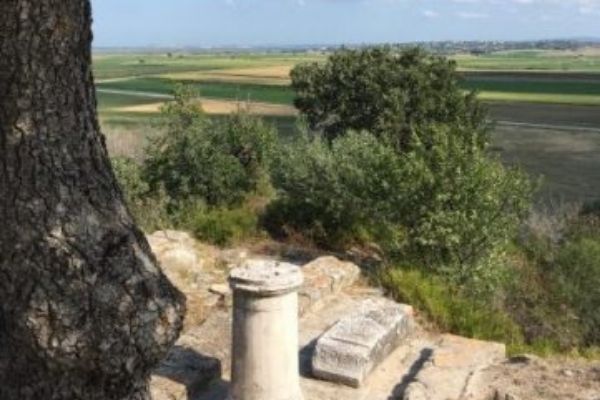
The views over the surrounding countryside are pleasant but by no means commanding. Some restoration has taken place and continues to, and Schliemann’s trench is easy to spot.

It’s an easy site to traverse. There are boardwalks, signboards, and no one to really stop you from going where you want. When we visited, there was continuing archaeological work, but one assumes by the size of the pick axes that they don’t expect to find anything new here. Or if they do, then they don’t mind it being in several pieces.
Nearby Sights to Troy
While you’re in the area, it’s worth taking the time to see a few other spots.
The Trojan Horse Statue, Çanakkale
After filming the 2004 movie Troy, the production donated its enormous wooden horse prop to the city of Çanakkale, where it now stands on the waterfront. It’s a popular photo stop if you’re staying in or passing through Çanakkale, and quite different from the smaller replica at the Troy site itself.
Kepez Viewpoint
About 5 kilometers (3 miles) outside Çanakkale on the road to Troy, near the town of Kepez, there’s a parking area with sweeping views over the Dardanelles Strait, the narrow waterway connecting the Aegean and Black Seas, that made Troy such a strategically important city in the first place. Worth a quick stop if you’re driving yourself.
Where to Stay in Troy
There are some great places to stay in Troy: Here’s our pick of the luxury places to stay in Troy, mid-range places to stay in Troy, and budget accommodations in Troy.
Hisarlik Hotel, Türkiye: The Hisarlik Hotel is located right by the entrance of Troy and at the edge of the Turkish village of Hisarlik. Each room of this quirky hotel near Troy is equipped with air-conditioning, a private bathroom with shower and towels, and a vanity table. Plan your stay by reading more reviews and checking rates and availability here.
Troia Pension, Türkiye: The Troia Pension is situated just 600 meters from the entrance to the historical site of Troy. The pleasant rooms of this Troy hotel include two beds, air-conditioning, and a private bathroom with a shower. Each room opens to a large garden with stunning views. The Troia Pension is a great place to stay to visit Troy. See room rates and available dates here.
Hotel Pelit, Çanakkale: Hotel Pelit (formerly known as Pelit Troya Hotel) is located in Çanakkale just 32 kilometers (20 miles) away from Troy. Each room is equipped with a flat-screen TV, air-conditioning, a private bathroom with shower and hairdryer, soundproofing, and a seating area. The hotel offers daily complimentary breakfast and has an on-site bar. Check more reviews, room rates, and dates available here.
Where to Eat Near Troy
There are a handful of simple tourist restaurants about 100 meters from the main entrance, serving the usual Turkish staples, pide, köfte, mezze, and chips. They’re fine for a quick lunch between the ruins and the museum. For something a little more memorable, the small village of Güzelyalı, a short drive away, has a few fish restaurants with lovely sunset views over the water.
Troy on Screen & In Books
Movies about Troy
The best-known dramatization is 2004’s Troy, starring Brad Pitt as Achilles and Eric Bana as Hector, although it was filmed primarily in Malta, not on location.
Documentaries about Troy
- Unearthed: Lost City of Troy on the Science Channel website
- Troy, with Manfred Korfmann
Books about Troy
For a different perspective on the story, try The Song of Achilles by Madeline Miller, which retells the Trojan War through the eyes of Achilles’ companion Patroclus.
Stephen Fry’s Troy gives a fresh take on the myths and legends of Troy and is a delightful wander through the stories of old.
Troy Türkiye FAQ
Just here for the facts? Here are a few about Troy and more details on visiting.
Where is Troy?
The city of Troy is located on the northwest coast of Türkiye in the province of Canakkale. The closest village is Tevfikiye. Today’s Turkish name for the site is Hisarlik.
Where was Ancient Troy?
Ancient Greeks colonized the area of present-day northwest Türkiye around 2,700 years ago, leading to the question of whether Troy was in Greece or Türkiye. (both answers appear to depend on the time period).
Is there a map of Ancient Troy?
Here’s the map of Troy and how to find the city of Troy today.

Who excavated the Ancient City of Troy?
Frank Calvert, an English archaeologist, did some initial excavations in 1865; he had previously bought a field from a local farmer. It was German amateur archaeologist Heinrich Schliemann who did the major excavations on the site of Troy in 1868.

When can you visit Troy, Türkiye?
Troy is open every day of the year. Opening times have historically run 08:30 to 19:00 from April to October and 08:00 to 17:00 from November to March, though we’d recommend checking the official site for current times before you go, since these can shift.
How can you visit Troy?
The site of Ancient Troy costs €27 as of 2026, which now includes entry to the on-site Troy Museum. Under 12s go in for free. A ticket to Troy may also be included on the Türkiye-wide Museum Pass (pricing and coverage for the pass change fairly often, so check current details officially if you’re visiting several sites, rather than relying on a fixed number here)
There’s no map as such, but guidebooks such as Fodors Türkiye, Insight Guides, and Lonely Planet do have extensive write-ups on the site and its history.
How long do you need to visit Troy Türkiye?
We spent 90 minutes visiting the site and found that was more than enough time for our level of interest. And no, we didn’t dress up as Gladiators, although we did take our turn inside the wooden horse.
Is Troy worth visiting?
That depends on your interests. Troy isn’t as visually dramatic as some of Türkiye’s better-preserved ancient sites like Ephesus, since most of what remains is foundations and low walls rather than standing structures. But if you’re drawn to the history, the mythology, or the story of its rediscovery, it’s a genuinely fascinating stop, especially with a guide to help bring the layers to life.

What’s the best time to visit Troy?
Spring (April to May) and autumn (September to October) offer the most comfortable weather and smaller crowds than summer. If you visit in high summer, aim for late morning or late afternoon to avoid both the heat and the large tour bus groups that tend to arrive right when the site opens.
What should I wear to visit Troy?
Comfortable walking shoes are essential, since the full circuit will take you over gravel paths and boardwalks. There’s very little shade on-site, so bring sun protection, water, and a hat, especially in summer.
Travel Tips for Exploring Turkey
- Get Travel Insurance: Civitatis includes medical expenses, repatriation, theft, luggage delays. No deductibles or upfront payments. Get a quote here.
- Get online immediately with an eSIM – one SIM for the whole world, data never expires.
- Download and install a VPN BEFORE you travel to Turkey > discount coupon here
- Book the best tours and attractions in Turkey with GetYourGuide
- Book free Istanbul tours with Civitatis
- Book Buses in Turkey with Bookaway – use code NOMAD5 for a discount
- Book accommodation in Turkey with Booking.com
Final Words on How to Visit Troy
This is a fascinating site to visit, whether you come on a day trip from Cannakale, Istanbul or stay more locally. We explored en route from Istanbul to Nepal, added in a visit to Gallipoli and then headed off to Ephesus (which is also well worth a visit). You’ll get more out of the visit if you read up a little in advance. Or even, take a gander at the Brad Pitt movie again.
ASocialNomad is a participant in the Amazon Services LLC Associates Program, an affiliate advertising program designed to provide a means for sites to earn advertising fees by advertising and linking to amazon.com, amazon.co.uk, and amazon.ca. Amazon and the Amazon logo are trademarks of Amazon.com, Inc. or its affiliates. As an Amazon Associate, I earn from qualifying purchases.


One thought on “Visit Ancient Troy: How to Explore Troy, Türkiye”
Hi Sarah,
Ancient Troy looks fascinating. We only saw Istanbul in Turkey. We had a few more trips lined up but had to head home for family stuff, cutting our trip short. If we do return to the place we will see more of the country. Istanbul was quite unlike any major city we have seen. Drips with culture, and history, very much a step back a few centuries at least as you walk around. I also liked the different feel between the Asian and European sides of the city.
Ryan