
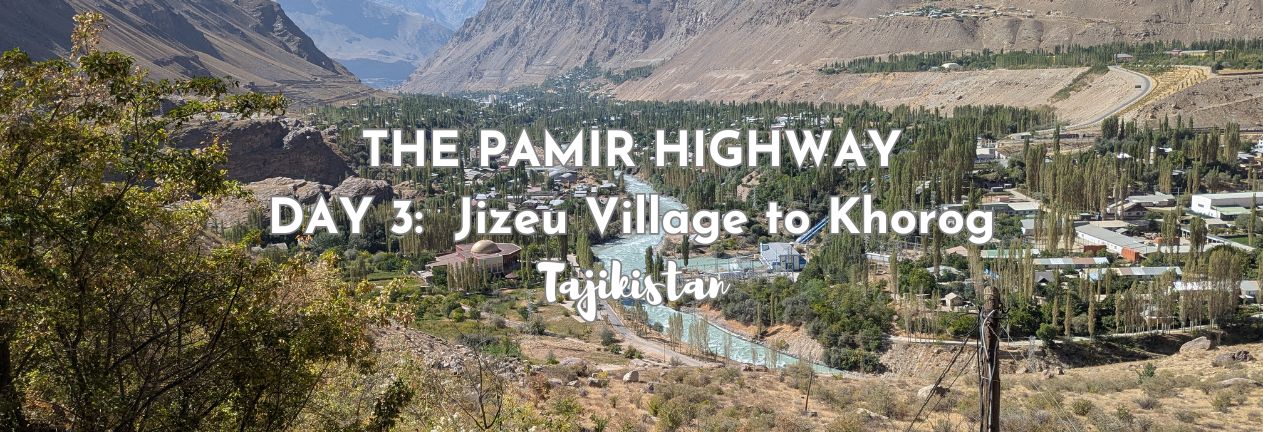
We wake at 2,500 meters (8,201 feet). We’re in a dorm of two rooms with maybe 20 people here. But it’s still quiet when we get up. The valley is quiet, and the air is chilly. We’re in Jizeu Village, and this is Day 3 of our 7-day Pamir Highway journey from Dushanbe to Osh. Today we’ll hike back down to the Bartang River, cross the suspension bridge again, and rejoin the Pamir Highway.
THIS POST MAY CONTAIN COMPENSATED AND AFFILIATE LINKS MORE INFORMATION IN OUR DISCLAIMER
After a night in Jizeu, a village with no road access, little electricity, and no dust thrown up by other road vehicles, we’ve definitely bonded with our fellow travelers, and this feels like more of an adventure than “just” a road trip.
If you want the full route overview first, jump back to my 7-day Pamir Highway itinerary here.
Quick Overview of the Route and Statistics
Start: Jizeu Village. End: Khorog
- Hike distance (the return trip): 6 kilometers (3.7 miles)
- Hike time (descent): 2 hours
- Driving distance: Approximately 80 kilometers (49.7 miles)
- Driving time: 2-3 hours
- Costs today: 400 for two of us for dinner, bed and breakfast, Lunch 180 TJS, Khorog museum 20 TJS, Khorog Botanical Garden 40 TJS per person
- Starting altitude: 2,500 meters (8,201 feet)
- Lowest altitude today: 2,083 meters (6,833 feet)
- Overnight altitude: 2,200 meters (7,217 feet)
- Road conditions: Rough leaving Bartang Valley, mixed paved and broken sections on M41
- Overnight location: Traditional Pamiri House Homestay, Khorog
If you’re reading this without seeing the previous day – then you can find that here.
Day 3 – Pamir Highway, What to Expect
The descent from Jizeu has to be taken carefully, especially with Nigel’s ankle problems; the loose shale is no kinder on the way down than it was climbing up. Trekking poles are worth their weight in gold here.
We were first out, despite some of our fellow travelers supposedly having breakfast earlier than us (spoiler, they didn’t). Hiking down is peaceful; again, we have the valley to ourselves. It’s glorious. Even crossing the suspension bridge feels somewhat less intimidating the second time.
Today is a short day in terms of driven distance, just 80 kilometers. But it started with our breakfast of tea, bread, and a type of omelette, and then we hiked back down the valley to meet Habib. This is Habib’s home valley; his village is higher up in the Bartang Valley, but too far for him to drive home for the evening.
He is Pamiri, he tells us, not Tajik. It’s an ancient culture that was formed more than 2000 years ago, and it formed and was developed by the extremely harsh conditions here. (There’s more on the culture here.)
Tourists travel the Pamir highway only really during the months from May to October. Weather conditions are too brutal outside of these times. And so Habib, in the past, has gone to work in Russia over the winter, because the wages he can earn in Tajikistan over the winter months are paltry. The average monthly wage here is US$314, but he didn’t earn anywhere near that, as the average includes the high salaries in finance and insurance, too.
We are driving close to the border with Afghanistan and are in the “GBAO” region – Gorno-Badakhshan Autonomous Province, which requires a specific permit as well as the evisa that we’ve bought for Tajikistan. This area covers more than 40% of Tajikistan’s territory, has only 2.5% of the population, but some of the biggest mountains.
There are regular checks of our paperwork. And stops by the military, who are all incredibly young. There’s National Service here – all men from the age of 18-27 are subject to it and are expected to serve for 2 years. Apart from public servants (teachers, etc), and only sons. Habib is an only son. In October, he’s not going to Russia to work; he’s going to spend the winter in Dushanbe learning English so that he can get a better job. He’s an amazing driver, and we communicate well considering our lack of language skills.
Some Tajik’s, he tells us, have gone to work in Russia and have been conscripted into the Russian Army and sent to Ukraine. He knows of many who have died fighting.
The drive toward Khorog is steady. Afghanistan remains visible across the Panj River for long stretches. Villages appear more frequently again. Life feels slightly busier.
And then we arrive in Khorog. After Kalai Khumb and Jizeu, Khorog feels almost metropolitan.
It’s the administration center of the GBAO region. And actually it’s rather nice. Our homestay is fabulous. Nigel and I end up in a double room with our own bathroom. The family here is fabulous; the niece of the owner is studying Tajik, English, and Russian, and tells us that, despite Khorog being a city, everyone knows everyone.
We visit the Botanical Gardens, where Tajikistan’s President maintains a(nother) home, a museum with little in Russian or Tajik, let alone English. And then saunter back to the homestay via the bazaar. We eat walnuts directly from the tree and share the Tajik wine from the Khujand region with Robert, Vladimir, and a French solo motorcyclist, Paul. The company is good, the wine, semi-sweet red, is, shall we say, not to our taste.
The head of state here is the President. The current President is Emomali Rahmon; he’s been in power since 1994. Prior to Ramon, there were two other presidents after Tajikistan’s independence from the Soviet Union. There was a 7 year term limit, but that was abolished. The President is also the head of the Armed Forces. In elections over the years, his % of the vote increases each time. In 2015, Rahmon was given the title “Founder of Peace and National Unity – Leader of the Nation,” which means he has lifelong immunity from prosecution, veto powers over all major state decisions, the freedom to address the nation and parliament on all matters he deems important, and the privilege of attending all government meetings and parliament.
Rahmon and his wife have 9 children, including two who are senior officials in his administration, and another is a “high up” in one of Tajikistan’s largest banks. His offspring’s talents don’t end there. One of his grandchildren apparently bought a luxury beachfront condo in Dubai’s Palm Jumeirah at the age of 9. It’s now valued at US$1.3 million.
Pamir Highway Day 3: Costs today
- 400 for two of us for dinner, bed and breakfast
- Lunch 180 TJS (for two)
- Khorog museum 20 TJS each
- Khorog Botanical Garden 40 TJS per person
Pamir Highway Day 3: Road Conditions & Driving Reality
The Bartang Valley road is as rough as it was yesterday, bumpy, uneven, and slow-going. Once we’re back on the main road, the surface improves in sections but remains unpredictable in its unpredictability. Broken tarmac, potholes, and patchwork repairs are normal.
Pamir Highway Day 3: Key Stops along the Way
It’s a short drive day, so once we’ve arrived at our homestay for the night, we have time for a cup of tea, and then we’re off exploring Khorog.
Khorog Botanical Garden
We visited the Botanical Garden today, and it’s worth it. The gardens are perched high above town at around 2,300 meters (7,546 feet), and it’s one of the highest botanical gardens in the world. The views over Khorog and the surrounding mountains are outstanding. It’s not manicured in a European sense — it’s expansive, slightly wild, and peaceful. It won’t take you long to walk around, but it’s nice to just have a wander.
Pamir Highway Day 3: Altitude Notes
Today is helpful for acclimatization. After descending from 2,500 meters (8,201 feet) to around 2,083 meters (6,833 feet), we will sleep at 2,200 meters (7,217 feet) in Khorog. I don’t know whether we’ve descended a little, or whether it’s a proper bed we’re sleeping in, but I definitely sleep better. It’s one of the reasons we picked this direction for our experience of the Pamir Highway.
For a full breakdown of altitude progression on the Pamir, see my altitude guide here.
Pamir Highway Day 3: Accommodation in Khorog
We stayed at the Traditional Pamiri House Homestay in Khorog. It wasn’t prebooked, but if you have the chance, I’d recommend it. It’s close enough to the center of Khorog to explore on foot (not the Botanical Gardens, you’ll want to take the car up there), but it’s quiet, and the owners are fabulously friendly. Dinner is great, and breakfast is too.
Nigel and I have a private room; there’s a shared bathroom next to it, but I don’t think anyone else uses it. There’s also a museum of traditional Tajik and Pamiri items. It’s fascinating. There’s also electricity, indoor plumbing, and a comfy bed. We paid 200 TJS per person for dinner, bed, and breakfast.
We get to crack open some walnuts and eat them fresh. It’s fabulous. Robert is planning to go to the Walnut Harvest in Aslanbob, Kyrgyzstan, once we arrive there, and part of me wants to change our plans to also go.
Khorog is also where you can:
- Withdraw cash (read my guide to ATMs and cash in Tajikistan here)
- Stock up on snacks
- Buy basic supplies
- Recharge all devices
Ready for the next day? Here’s Day 4 on the Pamir Highway.
TAJIKISTAN TRAVEL RESOURCES
AIRPORT TRANSFERS
24/7 pickup & drop off. Trusted, local English speaking drivers. Prebook & prepay online with cards.
Book a Transfer
HOTELS AND APARTMENTS
See choices here
Double rooms?Budget rooms? Need a washing machine? The best choice of hotels & apartments.
TOURS & ATTRACTIONS
Most excursion choices, small group tours, skip-line tickets, free cancellation and top local guides.
Top options here.
PAMIR HIGHWAY
Choose routes here
Best choice of vehicles, dates, drives and routes. Book early for more options.
Final Thoughts on Day 3 of the Pamir Highway
Ah, it was lovely waking up in Jizeu Village, a great breakfast set us up for the hike back down to meet up with Habib. And then just a short day of driving towards the center of the GBAO administration, Khorog. Our day felt almost leisurely, especially after yesterday’s early start! Tomorrow it gets serious again, we’re heading into the Wakhan Valley.
ASocialNomad is a participant in the Amazon Services LLC Associates Program, an affiliate advertising program designed to provide a means for sites to earn advertising fees by advertising and linking to amazon.com, amazon.co.uk, and amazon.ca. Amazon and the Amazon logo are trademarks of Amazon.com, Inc. or its affiliates. As an Amazon Associate, I earn from qualifying purchases.

