
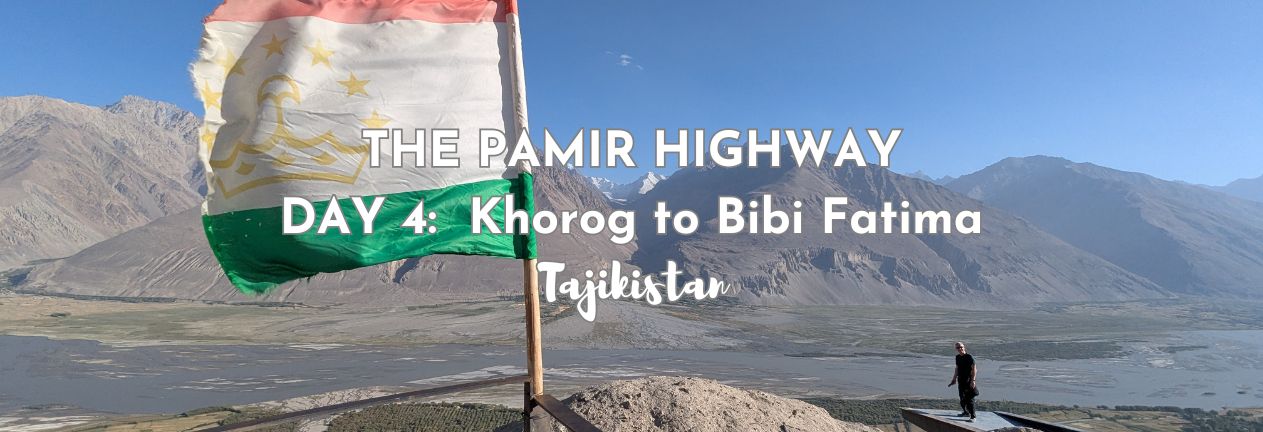
Khorog has been a delight. I mean, truly. We spent it with a lovely family, and all of us had a wander around. It’s comfortable, and I really could spend more time here. Easily. But this is Day 4 of our 7-day Pamir Highway journey from Dushanbe to Osh, and today we leave the relative calm of Khorog and head deeper into the Wakhan Valley. We’re traveling from Khorog to Bibi Fatima today. It’s a journey of 210 kilometers, and we’re starting from an altitude of 2120 meters. We’ll end our day’s journey at an altitude of about 3,200 meters. It feels as though we’re really starting to move into the wilderness today. The valley widens, Afghanistan feels incredibly close across the Panj River, and the landscape starts to feel even more remote. Today is where the history of the Silk Road becomes visible. We’ll see (and visit) ancient fortresses perched on cliffs, villages tucked along the riverbanks, and you get the feeling that we’re just another set of travelers heading on this route that has been traversed for centuries.
THIS POST MAY CONTAIN COMPENSATED AND AFFILIATE LINKS MORE INFORMATION IN OUR DISCLAIMER
In no time at all, we’re out of Khorog, stopping for a brief view of the overlook to the city. And you know, for a city of what, 30,000 people, it feels awfully like a village. That’s how Habib and our hosts’ niece describe it. “A village”. Everyone knows everyone. It’s walkable. Vladimir even got his shoes mended. His sole had detached from the shoe, and he’d asked our host’s husband where to get them fixed, as he’d had no joy the day before (It was Friday, and most shoe repair places were closed for prayers). As we sat and ate breakfast, he found out that his shoes had already been dropped off at the shoe repair. And he just had to turn up and pay, but our host drove him there to collect them. Less than US$5, and he has a working pair of hiking shoes again.
I digress. Let’s get back to day 4 of our 7 day Pamir Highway traverse – you can see the full 7 day itinerary here.
PRACTICAL TRAVEL TIPS
- 🛡️ Get Travel Insurance: Civitatis includes medical expenses, repatriation, theft, luggage delays. No deductibles or upfront payments. Get a quote here.
- 💰 Read about cash, ATMS and paying for things in Tajikistan
- 🔌 Check out the Tajik plug, socket & power situation. Buy this adapter.
- 📶 Get online EASILY & cheaply – One eSim for the world. Data never expires
Quick Overview of the Route and Statistics
Start: Khorog. End: Bibi Fatima (Wakhan Valley)
- Distance: Approximately 210 kilometers (130 miles)
- Driving time: 6-7 hours, including stops
- Starting altitude: 2,200 meters (7,217 feet)
- Highest altitude today: Around 3,200 meters (10,499 feet)
- Overnight altitude: Approximately 3,200 meters (10,499 feet)
- Costs Today: Garm-Chashma hot springs: 20 TJS per person, Lunch in Ishkashim: 90 TJS (manti, tea) + 15 TJS for water, Bibi Fatima hot springs entrance: 25 TJS, Dinner, bed, and breakfast: 250 TJS per person.
- Road conditions: Mostly paved but narrow with occasional rough sections
- Overnight location: Mekhmonkhona “Vakhon”, Bibi Fatima Hot Springs
If you’re reading this without seeing the previous day – then you can find that here.
Day 4 – Pamir Highway, What to Expect
Breakfast is egg (fried, as usual), crepes, hot dog sausages, and bread with oodles of homemade jam. And tea. Always tea. Black or green, it doesn’t matter; it’s a good way to get liquid into us as we climb. Vladimir sticks to his instant coffee (“better than nothing”), but I’m avoiding coffee until I get back to Osh’s altitude. He’s also the expert at rooting out beer, which he finds later in Ishkashim.
Today, we’re driving up the Wakhan Valley, a narrow high valley where the Panj River (named for the five rivers feeding into it) carves a path alongside Afghanistan. The mud-encased, flat-roofed brick houses with hay and straw drying on the roofs are interspersed with those tall, thin poplar trees. The houses in the village on this side of the river are similar. Some villages look desolate, some look rather nice. And then there are the Taliban flags across the river—a reminder that this isn’t just another scenic drive. It’s not just flags. We can see occasional motorbikes, a random truck every now and then, but mainly the mode of transport seems to be walking.
We’re definitely closer to Afghanistan than we’ve been, even though the valley feels wider, unlike the tighter valleys earlier in the journey. There are snow-capped peaks that look within touching distance, and the river is now wider and running through gravel plains. We’ve got fortresses on our list today, another reminder that this was (and still is to some extent) an ancient trade route between Central Asia, China, and the Middle East.
Today is the day when it’s very clear what season we’re in. Harvest. Everywhere we look, even if it hadn’t been obvious when we were up at Jizeu Village, there is dried straw and hay in the fields. There are tractors. There are entire villages out harvesting produce for the winter.
The photos don’t do it justice. Half of the photos are from the middle seat of the LandCruiser, but I can’t help myself. It is stunning. The contrast between the small fields yielding sustenance, the bare rocks, and the glacial meltwater in the rivers and streams.
Costs on Pamir Highway Day 4
- Garm-Chashma hot springs: 20 TJS per person
- Lunch in Ishkashim: 90 TJS (manti, tea) + 15 TJS for water
- Bibi Fatima hot springs entrance: 25 TJS,
- Dinner, bed, and breakfast: 250 TJS per person.
Pamir Highway Day 4: Road Conditions & Driving Reality
The road through the Wakhan Valley is generally better than the Bartang section, but it’s still narrow and occasionally rough. Regardless of where you sit in the Land Cruiser its wise to keep your eyes on the road, to anticipate the lurches as Habib avoids the potholes. There are stretches of decent tarmac followed by broken patches and uneven shoulders. It’s comfortable, but still very much mountain driving.
Pamir Highway Day 4: Key Stops along the Way
We’ve got quite a few stops today, of varying interests. We are definitely in hot spring country, so there are two hot spring stops and two fortresses. Our first stop, though, is the overlook of the city of Khorog, and again, it’s a stunning city that melds well into the landscape.
Garm-Chashma Hot Springs
One of the first stops of the day is Garm-Chashma, a natural hot spring complex famous for its mineral-rich waters. The pools are set against white mineral deposits that have built up over centuries. The bathing areas are separated by gender, and the facilities are simple but worth a stop. It costs just 20 TJS per person (about US$2 per person). The men have an outdoor option, and so they all disappear here.
The women’s is more like a hut, but the water is delightfully warm, and I share the experience with four women and their three children. I don’t speak Pamiri, Tajik, or Russian; they don’t speak English, but we smile at each other.
Clothing is optional, but not expected. And it would be weird to strip off and then put my swimsuit on. So I don’t bother. You have to knock on the door to get one of the women inside to let you in. The pool is enclosed with a concrete wall, and the changing area is just a bench and some hooks.
The Afghan Border Market at Ishkashim
Today is also the day that we find the Afghan Border Market. It’s held on most Saturdays. And while the market is held on the Tajik side of the border, it’s called the Afghan Border Market. Foreign visitors, when they’re allowed, have to leave their passports with the Tajik border police before they go to the market. Yes, despite it being on the Tajik side.
One of the reasons we planned this route was to be here on the day the market was running, in the hope that foreigners might be allowed access.
But foreign visitors aren’t currently allowed. There have been “skirmishes” on the border just a few weeks ago. Shots have been fired. Someone died. Not near here. But we can’t go. So we gawp from a distance and take a few random shots. It looks as though people buy normal things here. Vegetables. Huge rolls of insulation. Cans of drinks. Nothing too exciting. It’s just another market. The draw, for foreign visitors, is, I guess, the word “Afghan”.
No entrance and no photos were allowed in the border zone, which is understandable given that it’s an international border crossing.
This whole trip is full of exotic words and places. The Hindu Kush, the Afghan, the Panj River. Magical names and places I’ve only ever read about.
We have lunch in Ishkashim, the village after the Afghan Border Market. We go to Habib’s second choice of place to eat, as a group of 8 jeeps toting Chinese tourists has filled the normal place that he stops.
It’s a good choice. Vladimir finds beer. We get manti. And tea. And a good toilet.
As we’re driving further into the Wahkan Valley, there are more signs of Autumn. Trees are changing color, and there are more and more people in the fields. Harvesting, collecting dried grass, although this is the first sign of any machinery we’ve seen. They’re getting ready for winter. I don’t think anyone can deny that this is simply stunning countryside. We make a brief stop at an ancient border fortress of Qahqaha, with glorious views down the valley and over to Afghanistan.
Qaha Fortress
Qaha Fortress is one of the less visited but most impressive stops in the Wakhan Valley, when it comes to views anyway. There’s not much of what was once a huge fortress. There’s no entrance fee, and the best views are to be found, of course, by heading to the top. There are enormously wide-ranging views across the Wakhan Valley and the Panj River into Afghanistan.
And now, as the river widens, we start a climb up in the trusty Land Cruiser, which had the most comfortable middle seat I’ve ever found. We find the reconstructed Yamchun fortress. It was originally built in 300 B.C. and overlooks the Wakhan Valley and the Hindu Kush, an 800-kilometer-long mountain range to the west of the Himalayas. The views are truly spectacular.
Yamchun Fortress
It’s undergone a significant amount of reconstruction work (don’t get me wrong, it’s still more of an outline of a fortress, but the scale of the fortress remains impressive. Again, there’s currently no entrance fee, but I suspect that might change. And again, the real highlight is the view.
From the walls, you can see far across the Wakhan Valley and deep into Afghanistan. The viewpoint is extremely high and exposed, definitely not for the faint-hearted, but the panorama is extraordinary.
After a brief exploration, we head higher still, to the Bibi Fatima hot springs.
Bibi Fatima Hot Springs
The Bibi Fatima Hot Springs are set into the mountainside above the valley. They’re famous locally and are traditionally visited for their healing properties. The bathing pools are gender-separated, and while the hike up the hill from the place we’re staying for the night has me breathing hard, I decide to give them a go. I’m the only female using them, so it’s my own private hot spring. And you know, I’m good with that. My first experience of public naked hot springs was back in 2014, in the middle of a typhoon in Japan (read about it here), and there were few people there too. Just how I like it.
There’s a shrine here too, but these hot springs are rather nice and a huge step up from the ones earlier today at Garm-Chashma. They cost 25 TJS per person.
Pamir Highway Day 4: Altitude Notes
It felt like a steady climb in altitude today. We left Khorog at 2,200 meters (7,217 feet) and slept at around 2,900 meters (9,514 feet). I was definitely experiencing slight breathlessness when walking uphill, and my sleep was lighter and more interrupted. That could, of course, have been the dogs barking outside.
But I’m avoiding beer, drinking about 2 liters of water a day, and aside from the sleep and breathlessness, I seem to be coping well with the altitude. We all do. It feels like we’re adjusting gradually. For the full breakdown of altitude along the route, see my Pamir Highway altitude guide here.
Pamir Highway Day 4: Accommodation
We stayed at Mekhmonkhona “Vakhon”, a simple guesthouse just down from the Bibi Fatima Hot Springs. Accommodation in this part of the Wakhan Valley is usually family-run and fairly basic – this means simple (shared) rooms, shared bathrooms, limited electricity, and home-cooked meals.
Habib hadn’t prebooked anything, and we found the last three beds at a homestay, where most of the beds have been taken by a group of touring Russian motorcyclists. Robert, Nigel, and I share a room. Vladimir has decided he’s going to sleep outside with Habib. They have good sleeping bags. They sleep on the tapchan. It’s a wooden raised platform, covered with carpets and cushions, it’s designed for socializing, eating, and yes, sleeping. There’s more about tapchan’s here. They’re found throughout Central Asia, and the ones in that article are considerably fancier than any of the ones that we encountered.
Dinner is hot tea, although there’s beer if you want it, soup with vegetables, and a huge chunk of unchewable meat. Could be beef, could be yak. And bread. There’s always bread.
There’s a cat too. Who takes to Nigel. Literally. Claws in. Won’t let go. Even when he says that he’s actually a dog person.
There’s a single shower for what must be 30 beds in the homestay. It has hot water, though, but the door frame does come away from the wall when you open the door. I’m not convinced that someone won’t just walk in, but they don’t. There are two toilets, the main one definitely comes across as having been well used by the 20 or so Russian motorcyclists whom we left after dinner, drinking beer.
Despite the altitude, the window stays open until around 04:00, when the dogs barking outside becomes too much. When we meet for breakfast the next morning, Vladimir says it was much louder outside.
Ready for the next day? That’s here. Day 5 on the Pamir Highway.
TAJIKISTAN TRAVEL RESOURCES
AIRPORT TRANSFERS
24/7 pickup & drop off. Trusted, local English speaking drivers. Prebook & prepay online with cards.
Book a Transfer
HOTELS AND APARTMENTS
See choices here
Double rooms?Budget rooms? Need a washing machine? The best choice of hotels & apartments.
TOURS & ATTRACTIONS
Most excursion choices, small group tours, skip-line tickets, free cancellation and top local guides.
Top options here.
PAMIR HIGHWAY
Choose routes here
Best choice of vehicles, dates, drives and routes. Book early for more options.
Final Thoughts on Day 4 of the Pamir Highway
It feels like there is a lot packed into this day. And there is. We’ve seen a lot of harvest, we’ve jumped up a lot in altitude, hot springed (twice for me and Vladimir), and the landscape has changed subtly again. It feels vast. And glorious.
ASocialNomad is a participant in the Amazon Services LLC Associates Program, an affiliate advertising program designed to provide a means for sites to earn advertising fees by advertising and linking to amazon.com, amazon.co.uk, and amazon.ca. Amazon and the Amazon logo are trademarks of Amazon.com, Inc. or its affiliates. As an Amazon Associate, I earn from qualifying purchases.

