
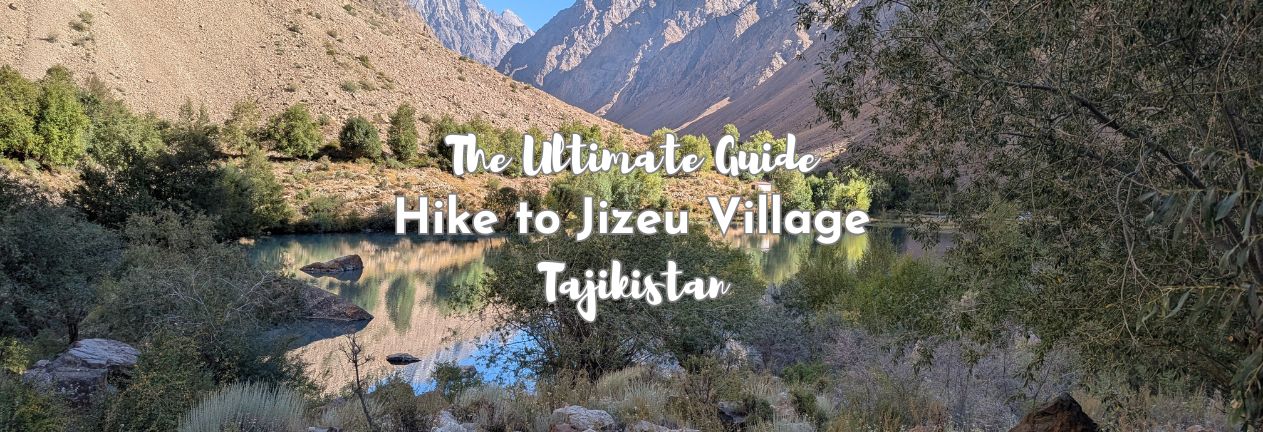
Jizeu Village was for me one of the most memorable detours we took from the Pamir Highway, not because it is dramatic in the obvious sense, but because it is entirely cut off from the road. It is a secondary reason we decided to travel the Pamirs in this direction; the primary reason was that altitude acclimatization is better in this direction. The village (and valley) of Jizeu is tucked neatly into the Bartang Valley. There is no vehicle access at all, and reaching the village requires crossing a narrow suspension bridge over the scarily raging Bartang River and hiking steadily uphill for several hours. We made this journey on Day 2 of our seven-day route from Dushanbe to Osh, setting off before dawn to reach the trailhead early and have the valley almost entirely to ourselves. That gloriously quiet walk into Jizeu is one of my strongest memories of the Pamirs. Here’s what you can expect on the Jizeu Village hike.
THIS POST MAY CONTAIN COMPENSATED AND AFFILIATE LINKS MORE INFORMATION IN OUR DISCLAIMER
If you’re planning the route, you can read how this fits into our Day 2 itinerary, or start with the full Pamir Highway guide for more of an overview.
The Jizeu Valley hike is one of the easiest multi-day hikes you can do in the Pamirs, and it’s the perfect way to acclimatize early on in your Pamir journey.
Jizeu Village Hike: At-a-Glance Overview
- Location: Bartang Valley, Tajikistan
- Total distance: 6 kilometers (3.7 miles) one way
- Total duration: 4-5 hours, plus overnight stay
- Start elevation: 2,083 meters
- Overnight elevation: 2,500 meters
- End elevation: 2,083 meters
- Elevation gain: Approximately 417 meters
- Difficulty: Moderate: Loose shale underfoot combined with noticeable altitude
- Start and end point: Suspension bridge at Jizeu Bridge, Bartang Valley
PRACTICAL TRAVEL TIPS
- 🛡️ Get Travel Insurance: Civitatis includes medical expenses, repatriation, theft, luggage delays. No deductibles or upfront payments. Get a quote here.
- 💰 Read about cash, ATMS and paying for things in Tajikistan
- 🔌 Check out the Tajik plug, socket & power situation. Buy this adapter.
- 📶 Get online EASILY & cheaply – One eSim for the world. Data never expires
Where Is Jizeu Village & How Do You Get There?
Jizeu Village is found in the Bartang Valley, a dramatic side valley that branches off from the main M41 Pamir Highway. If you are traveling from Kalai Khumb toward Khorog, the turnoff into the Bartang appears as a small junction, I mean you’d miss it if you blinked, rather than a grand entrance to one of the most beautiful and remote valleys in Tajikistan. From the main road, it takes roughly forty-five minutes of slow, rough driving to reach the suspension bridge that marks the beginning of the hike. It’s about 28 kilometers (17.3 miles) from Rushan to the start of the hike.
If you’re traveling the Pamir (read our guide to the route here), from Dushanbe to Osh, you’ll likely be able to hike to the Jizeu Valley on Day 2. You can read our full day 2 experiences on the Pamir here.
The hike itself begins at the suspension bridge over the Bartang River. There is no formal parking area, and the signage is “blink, and you miss it”; instead, your vehicle will stop near the bridge, and from there the route continues entirely on foot. You’ll know you’re there when you see the bridge and the weather-faded sign “to Jizeu” painted on it.
Once you cross that bridge, the only way forward—or back—is by walking. I suppose, of course, that judging by the donkey poo on the trail, a ride back down could be an option, but I’d prefer to trust my own two feet to all that loose shale.
What to Take on the Jizeu Village Hike
Although the hike to Jizeu is not technical, it should not be underestimated. The trail is exposed in places, the ground is very loose underfoot, and the altitude is noticeable, particularly if you have only just begun your ascent into the Pamirs.
- Take your passport and your GBAO Permit; this hike is in the GBAO area, and while you’re unlikely to be asked to produce it, you should take it with you.
- Proper hiking shoes are essential. Much of the trail consists of loose shale and uneven rock, and regular trainers simply do not provide enough grip or ankle support. I also don’t recommend hiking sandals as the loose shale is brutal on the toes.
- Trekking poles are strongly recommended, particularly for the descent the following morning, when tired legs and shifting stones can make footing uncertain.
- Sun protection is equally important, as there is limited shade during the early sections of the hike and the mountain sun can feel surprisingly intense at altitude.
- You should carry enough water for the hike itself and for the following morning, as there are no reliable refill points until you reach the village. If you have a filter water bottle, then you’re ok.
- A small first aid kit, sunscreen, and toilet paper are basic but necessary additions.
- If you are staying overnight, pack lightly but take a change of clothes, a warm jacket or fleece for the colder evening temperatures, toiletries, a small towel if you intend to use the cold shower, and a headlamp in case you need to move around after dark.
- A camera isn’t an optional item here; the scenery is stunning.
You will need to carry everything, so leave all your larger bags in the 4WD.
The Hike from the Bartang River Crossing to Lower Jizeu Village
The walk to Jizeu begins with the crossing of the suspension bridge over the Bartang River, and although it is structurally sound, it feels far more dramatic than it looks from a distance. You’re supposed to cross just one person at a time, but on our return, we saw 4 people bouncing in the middle. Rather them than me.
The wooden planks shifting slightly beneath your feet, while the bridge sways over the fast-moving river, makes you feel as if the entire world is moving, especially if you look down.
After crossing the bridge, you’ll hug the rocks and turn around to the right, seeing the crystal clear waters of the Jizeudarya River mixing with the muddy brown of the Bartang River, and then follow what feels like a very flat section to get you started.
The first section of the hike follows a relatively gentle path along the valley floor, on the right-hand side of the Jizeudarya River. The trail is relatively easy to follow, although there is little in the way of formal signage. At this stage the walking is an easy start. The river will go underground for a while, but don’t worry, you’ll find it again soon, after about 1 kilometer (0.6 mile).
At first, it feels easy. The trail is clear enough — no signage, just a trodden path vaguely following the Jizeudarya River. But much of it is loose shale. Not fine gravel. Large, shifting chunks.
It starts gently and then gradually; however, the incline increases and the terrain changes. Loose shale and larger unstable rocks become more frequent underfoot, and the path begins to climb in earnest. The combination of the shifting ground and the rising altitude makes the hike feel harder than the distance alone would suggest. You can read more about altitude on the Pamir Highway here.
Of course, we’ve chosen the hottest part of the day to hike.
Roughly halfway to the village, the first lake appears, a quiet and unexpectedly vivid stretch of water that offers a brief flattening of the trail, we skirt round the lake. It’s a beautiful color, cold too. From here, the path resumes its steady climb, winding higher toward the lower Jizeu Village. As you approach the houses, the altitude becomes more apparent, not dramatically so, but enough that breathing is a bit harder, and to be fair, you’re not even sure that you’ve even got to the village, which is just a small collection of houses, and a building that’s the local school.
Hike from the Lower Jizeu Village to the Upper Village
It is tempting, once you reach the lower village, to assume that the hike is complete. After all, you’ve crossed the suspension bridge, climbed steadily for several kilometers, and arrived at a cluster of stone houses surrounded by green fields and fruit trees. However, stopping here would mean missing what makes this valley truly extraordinary.
I would stop for a while, though. Find yourself a homestay (I recommend Gulsha’s, where we stayed, it’s the second house in the village, the first is Lola’s homestay). Rest for a while on the tapchan, take tea and a snack of dried fruit and nuts, and claim a bed in the dorm rooms. And then walk a little (or a lot) further.
The guest accommodation at Gulsha’s is separate from the family home. There’s a sitting and dining area — traditionally carpets on the floor, but with chairs thoughtfully provided for Western visitors who may prefer back support. There’s tea, of course. Snacks of dried nuts and fruits.
Don’t just stop here at the lower village. Keep going. Continue up through the village to the second and third lakes and the upper Jizeu settlement. It’s breathtaking. No one else around. Just lakes, mountains, silence.
This is why we came. This is why you should come.
Beyond the lower village, the trail continues upward toward Upper Jizeu and a series of small alpine lakes. We traveled here in September, and the entire community was hard at work harvesting everything literally. Grass was being cut and dried for hay for the animals over the winter. Fruits were being dried, everything was being tidied up for the upcoming winter, which wouldn’t be far away (our trip from Osh to Bishkek saw snow on the high passes just a week later!)
The trail here to the upper village, on the left-hand side of the river as you hike up, is much flatter, and it’s easy. It continues for about 2 kilometers. The trail on the other side of the river isn’t a trail as such, more a slope of loose shale. And it doesn’t get any better than when you first cross the river. You can recross the river back down at the lower village, but this will be a tough walk.
The second and third lakes are particularly striking, and they’re glorious to watch the reflected mountains and sky in this extremely rugged setting. When we walked beyond the lower village, there was no one else around. The earlier start meant that we had arrived before other groups, and for a period of time, the valley felt completely empty.
Hiking further on from the Jizeu Villages
If you have the time or energy, then you can continue higher up from the upper village. We didn’t, but Robert, whom we traveled with, did. It’s another 5 kilometers (3.1 miles) to Tsakinkul Lake, and beyond that, it’s a further 8 kilometers (5 miles) to Toraz-Dogobkul Lake.
Where to Stay in Jizeu village
Accommodation in Jizeu is simple, community-run, and refreshingly straightforward. Half of the houses here in the village are homestays, and they’re scattered between the lower and upper parts of the village. If you arrive as part of a shared 4WD journey, your driver will usually arrange a place in advance. If you haven’t had anything arranged in advance, just ask around. Someone will find you a bed.
We stayed in Gulsha’s homestay, where the guest accommodation was housed in a separate building from the family’s main living quarters. Sleeping arrangements were dorm-style, with mattresses laid out on a concrete base along the walls, with heavy blankets provided for the cooler night temperatures. Tea appeared immediately, along with dried fruit and nuts, and sitting on the tapchan, or the chairs provided, it was easy to see why the families stay here.
Dinner at all the homestays is usually served in the early evening, often around 19:00, although you’ll be told when, so you can arrange to be back. Dinner usually consists of a version of plov—rice cooked with onions and carrots, sometimes accompanied by meat, though not always. Bread is a constant presence at every meal in Tajikistan, and tea flows freely throughout your stay. Breakfast the following morning is equally straightforward but filling, often including bread, tea, and eggs, so you’re ready to face heading back down the valley. After paying, of course. You’ll need to pay cash; there’s no other way of paying here. (Read my guide to ATMs and currency in Tajikistan here).
The toilets here are long-drop style, usually located in a separate hut outside where you’ll sleep. If there are showers (there are Gulsha’s), then they are fed from barrels filled with river water. The water is unheated and bracingly cold; it was, though, bearable.
We paid 400 TJS for two people, which included dinner, bed, and breakfast.
If you can, it’s worth arriving earlier in the day. Those who arrived in the village in the late afternoon didn’t have much time to explore beyond the village before it got dark. Most were in bed not long after it got dark.
It’s worth it, though, getting up after moonset, if it’s a clear night, the dark skies here are a beautiful thing to experience.
How Hard Is the Jizeu Hike?
The hike to Jizeu is not technical in the sense of requiring scrambling, specialist equipment, or advanced mountain skills, but it is physically demanding enough that it should not be approached casually. We’ve hiked to Everest Base Camp, we’ve hiked to Machu Picchu, and to altitude in Colombia several times.
Our challenge was that Nigel had hurt the tendons in his ankle, so it was strapped up and tightly fastened in his boots.
The distance itself is easily manageable at six kilometers one way, yet the combination of steady elevation gain, and mostly the loose shale underfoot makes it feel more substantial than the numbers suggest.
If you have knee issues, the descent can be just as demanding as the climb. I highly recommend trekking poles, particularly for stability on loose shale and for reducing strain on the knees during the return back down to the river crossing.
When Is the Best Time to Hike Jizeu?
The best time to hike to Jizeu Village is during the main Pamir travel season, which runs broadly from May to September. You are unlikely to find shared 4WD trips through the Pamir outside these months. Daytime temperatures are generally comfortable for hiking, though the sun can be strong, and early starts are advisable to avoid walking during the hottest part of the day. Of course, we managed to be hiking uphill during the hot part of the day, but it was worth it.
July and August tend to offer the most stable conditions, with clearer skies and longer daylight hours.
Winter hiking to Jizeu is not common and is generally unsuitable for most travelers. Snow, extreme cold, and limited access to the Bartang Valley make it much more difficult.
FAQS about hiking to Jizeu Village
Hiking to Jizeu is one of the most searched detours from the Pamir Highway, and there are a handful of practical questions that come up repeatedly when planning it.
Is it Jizeu, Jiseu, or Jizev?
You will see the village spelled in several different ways, including Jizeu, Jiseu, and occasionally Jizev. These variations come from transliteration differences between Tajik, Russian, and English spellings, as well as how the name is pronounced locally. The pronunciation is closer to “Gee-zow” or “Jee-zow,” which explains why multiple spellings appear in travel blogs and maps. In this guide, I use “Jizeu” as it is the most commonly accepted English transliteration, but all of these variations generally refer to the same village in the Bartang Valley.
How long is the Jizeu village hike?
The hike from the Bartang River suspension bridge to Lower Jizeu Village is approximately 6 kilometers (3.7 miles) one way. Most people treat it as a two-day experience, hiking up on the first day, staying overnight in the village, and returning the following morning. This is how I’d recommend doing it.
How long does it take to hike to Jizeu village from the Bartang River Crossing?
For most reasonably fit hikers, the ascent takes between two and three hours, depending on pace, heat, and how often you stop for water or photographs. The descent is usually slightly faster but still requires a lot of care on the loose shale sections.
Can you hike Jizeu Valley in one day?
Technically, yes. It is possible to hike up and back in a single long day if you begin early and are comfortable walking for several hours at altitude. However, doing so means missing the experience of staying overnight in the village and exploring the upper lakes in quieter evening or early morning light. In my view, the overnight stay is what makes this an amazing experience.
Do you need to pre-book accommodation in Jizeu village?
Prebooking is not typically necessary, especially during the main season, as several homestays operate in the village. However, if you are traveling with a shared 4WD journey along the Pamir Highway, your driver will usually arrange accommodation in advance. If you are traveling independently, just ask around on arrival; you’ll always find somewhere to sleep and eat.
What are the costs for accommodation at Jizeu Village?
We paid 400 TJS for two people, which included dinner, bed, and breakfast.
Can you camp at Jizeu village?
Camping is possible in the valley, but you must carry all of your equipment across the suspension bridge and up the trail yourself. There are no formal campsites, and it is important to camp respectfully, well away from homes and cultivated areas. Even if you don’t stay at a homestay, you can ask if it’s possible to buy dinner and breakfast from them.
What language is spoken in Jizeu?
You are very firmly in Pamiri country here, rather than Tajikistan, as Habib, our driver, reminded us. The language spoken here is Bartangi, a Pamiri language. However, they also usually speak and understand Tajik, as well as Russian. Gulsha, who runs the homestay that I recommend, speaks Russian and English.
Is there a mobile signal in Jizeu Village?
No. There’s no phone signal in the entire Jizeu Valley area. When you leave your driver at the Bartang River crossing, he’ll arrange a time for you to meet him the next day.
Is there electricity in Jizeu Village?
Your homestay may have the ability to charge your mobile phone or camera, but this is likely to be for a limited time, and the charging is likely to be in the owner’s home, rather than in the dorm rooms.
Where is the start of the Jizeu valley hike?
The hike begins at the suspension bridge over the Bartang River in the Bartang Valley. Reaching this point requires a 4WD vehicle from the main M41 Pamir Highway, typically accessed from the Kalai Khumb to Khorog stretch. There is no formal signage marking the trailhead; the bridge itself signals the start of the walk.
TAJIKISTAN TRAVEL RESOURCES
AIRPORT TRANSFERS
24/7 pickup & drop off. Trusted, local English speaking drivers. Prebook & prepay online with cards.
Book a Transfer
HOTELS AND APARTMENTS
See choices here
Double rooms?Budget rooms? Need a washing machine? The best choice of hotels & apartments.
TOURS & ATTRACTIONS
Most excursion choices, small group tours, skip-line tickets, free cancellation and top local guides.
Top options here.
PAMIR HIGHWAY
Choose routes here
Best choice of vehicles, dates, drives and routes. Book early for more options.
Final Words on hiking the Jizeu Valley in the Bartang Valley
This was a truly glorious introduction to hiking in Tajikistan. It felt like we’d really arrived in the Pamirs, and it made it much more of a journey than just a road trip. Don’t get me wrong, I didn’t think that necessarily while sweating and panting my way up in the heat of the day, worried that I’d slip on the shale and disappear into the river. But this is a glorious introduction to Tajikistan hiking and a superb hike and overnight stay to experience.
ASocialNomad is a participant in the Amazon Services LLC Associates Program, an affiliate advertising program designed to provide a means for sites to earn advertising fees by advertising and linking to amazon.com, amazon.co.uk, and amazon.ca. Amazon and the Amazon logo are trademarks of Amazon.com, Inc. or its affiliates. As an Amazon Associate, I earn from qualifying purchases.

