

The Golden Circle is the most famous route in Iceland, and also the easiest one to do entirely on your own if you’re self-driving. There are no F-roads, no multi-day planning, no need for a guide to find anything. The Golden Circle is simply a loop to the east of Reykjavik that connects three of the country’s best-known natural sights in a single day. It’s the route most people do first, and for good reason. Here’s our guide to the Golden Circle…
THIS POST MAY CONTAIN COMPENSATED AND AFFILIATE LINKS MORE INFORMATION IN OUR DISCLAIMER
If you’re planning Iceland’s Golden Ring, another name you’ll see used interchangeably with the Golden Circle, I’ll walk through everything you need: what’s actually included in the classic route, add-on attractions and detours that you might want to take, how to get there and in what order, where to stay if you want more than a single day, how long to actually budget, where to buy groceries and grab a meal along the way, and whether self-driving or joining a tour makes more sense for your trip.
PRACTICAL TRAVEL TIPS
- 🛡️ Get Travel Insurance: Civitatis includes medical expenses, repatriation, theft, luggage delays. No deductibles or upfront payments. Get a quote here.
- 🛏️ Sea view? Laundry? Private bath? Book a Room.
- 🔌 Be ready for the plug, socket & power situation.
- 📶 Get online EASILY & cheaply – One eSim for the world. Data never expires
What’s Included in Iceland’s Golden Circle
Iceland’s classic Golden Circle is three stops on a 300-kilometer (190-mile) loop route from Reykjavik: Þingvellir National Park, the Geysir Geothermal Area, and Gullfoss waterfall. That’s it, in the traditional sense; everything else you’ll see mentioned is an add-on rather than part of the original route. Many of the guided tours you can take from Reykjavik include the Kerið Volcano Crater as a stop too.
Iceland has a nubmer of famous routes, the Golden Circle is the most famous, the Ring Road another. Here’s my guide to the routes and circles of Iceland.
TOP THING TO DO

Take a Small Group Tour of the Golden Circle
See the best of southwest with Icelands best local guides on this Golden Circle tour from Reykjavik. Visit the spectacular Geysir area, and go to the cascades of Gullfoss Waterfall. Discover where the North American and Eurasian tectonic plates meet in Þingvellir National Park
Þingvellir National Park aka Thingvellir National Park
Þingvellir is a UNESCO World Heritage Site and sits in the rift valley between the North American and Eurasian tectonic plates. It’s also where Iceland’s parliament, the Alþingi, was founded in 930 AD, making it the site of the world’s oldest still-functioning legislature. The parliament remained here until 1798, and this was also the ceremonial site of Iceland’s declaration of independence (from Denmark) in 1944. Sveinn Björnsson was appointed Iceland’s first president here. The new Alþingi is in Reykjavik and there’s more about it here.

If you’re up for it, Silfra Fissure here offers snorkeling or diving in some of the clearest water anywhere, a constant 2°C (35°F) year-round since it never freezes. You’ll need a dry suit certification to dive here, but snorkeling is open to novices. The water is spectacularly clear, with visibility extending to 330 feet (100 meters). If you’re looking for unique things to do in Iceland, then this is one of them, here are a host more.
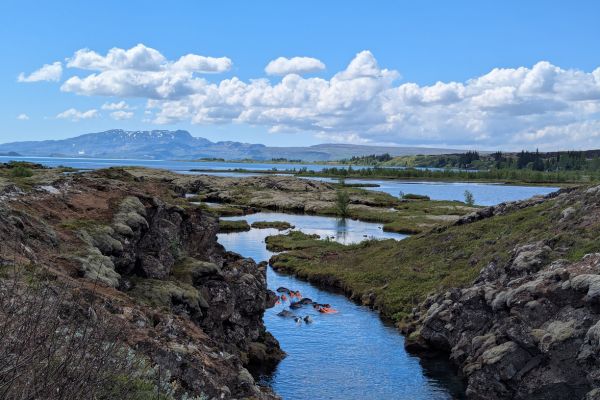
There are free guided walks with park rangers here during the summer (14:00 is a popular time to be here for them).
- How to get to Þingvellir: From Reykjavik, take Route 1 east and then Route 36 north. The drive typically takes 45-60 minutes.
- Þingvellir Entry: Free, open year-round
- Þingvellir Parking: 1,000 ISK, pay via kiosk or Checkit.is
Geysir & the Geothermal Haukadalur Valley
Geysir gave its name to every geyser on Earth, though the original Geysir itself is largely dormant now; its neighbor Strokkur does the actual work, erupting every 5 to 10 minutes, usually to around 20 meters (66 feet), occasionally up to 40 meters (132 feet).

The geothermal area has steaming vents, bubbling mud pots, and fumaroles. It’s no Yellowstone, but if you’ve never seen a geothermal area, it’s pretty amazing. There are a couple of other geysers here too, Smiður and Litli-Strokkur. If geothermal aspects interest you, then read my guide to geothermal Iceland, it just may surprise you!
- How to Get to Geysir in the Haukadalur Valley: If you’re coming from Þingvellir, then stay on Route 36, continue to Route 365, then 37 and then 35 (it’s all signposted). It’s about 60 kilometers (37 miles). If you’re starting from Reykjavik, then it’s about 100 kilometers (62 miles) and takes about 1 hour and 40 minutes.
- Geysir in the Haukadalur Valley Entry: Free, open year-round
- Geysir in the Haukadalur Valley Parking: 1,000 ISK via kiosk or Parka app.
Gullfoss
Gullfoss wraps up the classic three attractions of the Golden Circle. Foss is the Icelandic for waterfall, and you’ll see a lot of them here (our guide to top waterfalls to see in Iceland is here). Gullfoss is a two-tier waterfall dropping 32 meters (105 feet) into a dramatic canyon carved by the Hvítá River.

It’s also got a genuinely good story behind it too, and you’ll see information boards at the falls detailing the story. In the early 1900s, a local farmer named Sigríður Tómasdóttir fought off a plan to dam the falls for hydroelectric power. And she’s (yes, that’s right, she was a woman!) remembered today as Iceland’s first environmentalist, with a memorial on the clifftop overlooking the falls.
Fun fact: It was Iceland’s first president, Sveinn Björnsson, who acted as her lawyer when she was fighting the British developers who wanted to harness the falls for hydroelectricity.
- How to get to Gullfoss: From Geysir, take Route 35; it’s about 10 kilometers (6 miles) and takes 10 minutes or so. If you’re coming here directly from Reykjavik, then take Route 1, then Route 35 at Selfoss (again it’s signposted). It will take about 1 hour and 40 minutes to drive the 100 kilometers (60 miles).
- Gullfoss Entry: Free
- Gullfoss Parking: Free.
Two additional attractions accessible on the Golden Circle are worth planning for even though they’re not part of the “official” big three.
Kerið Volcano Crater
Kerið, a volcanic crater with a striking red-and-blue-green color contrast, has become close to a standard fourth stop on most modern tours. It’s a collapsed volcanic cone about 6,000 years old, some 55 meters (180 feet) deep, with a strikingly turquoise lake sitting at the bottom against reddish-black scoria walls.

Walking the full rim only takes about 15 minutes, or take the steeper path down for the better photo. It’s privately owned, which is why it’s the only stop here that charges admission, and it draws a crowd, so build it into your timing rather than treating it as a quick five-minute add-on. Save time by pre-purchasing your ticket here.
- How to get to Kerið: From Reykjavik, take Route 1 then Route 35 towards Selfoss, and on to Kerið; it’s about 60 kilometers (37 miles) and takes around 50 minutes. Coming from Gullfoss or Geysir, it’s about 40 kilometers (25 miles) back along Route 35, roughly 35 minutes.
- Kerið Entry: 750 ISK per person – you can prebook your tickets here.
- Kerið Parking: Free, although this is a small area; you might have to wait to get in.
Bruarfoss
Bruarfoss, Iceland’s bluest waterfall, is the detour people ask about most, reached by a short hike rather than a roadside stop. The color is the whole draw of this waterfall. It’s an almost unnaturally saturated blue channel squeezed between black rock, smaller in scale than Gullfoss but I’d say more photogenic.

Getting there is easy. It’s just a 5-minute walk from the parking area. It’s a flat, easy path, with no special gear required. It gets busy in peak season given how much it’s been shared online, so an early start helps if you want the water to yourself for a few minutes.
- How to get to Bruarfoss: From Geysir or Gullfoss, take Route 355, then 37 and follow signs to the Brúarhlöð trailhead car park; it’s about 15 kilometers (9 miles) and takes 20 minutes or so.
- Bruarfoss Entry: Free
- Bruarfoss Parking: 750 ISK, payable by kiosk or Parka app.
How to Get to the Golden Circle
From Reykjavik, take Route 1 east, then Route 36 north to Þingvellir. It takes about 45-60 minutes depending on traffic and weather. From Þingvellir, continue via Route 365, then Route 37 and Route 35 through Haukadalur Valley to reach Geysir; this takes roughly another hour. Gullfoss is just 10 minutes further along Route 35.
If you’re driving straight to any one stop rather than the whole loop, Geysir and Gullfoss are both about 100 km (62 miles) from Reykjavik, roughly 1 hour 40 minutes direct each.
The Golden Circle is on EVERY itinerary. Every single one. And I’ve included it in both my 5 day Iceland itinerary and also my 7 day Iceland itinerary.
Map of the Golden Circle & Driving Directions
Here’s our map of the attractions we’ve referenced for Iceland’s Golden Circle. You can also see the map here.

Where to Stay to Explore the Golden Circle
Most people do the Golden Circle as a day trip from Reykjavik and never need to stay overnight, but if you want to slow down, spend an evening in the area, or catch the geysers at sunrise before the tour buses arrive, there are some good options close by. You’ll need, though, to book rooms early, as accommodation here is in short supply and the good rooms book out early.
Hotel Geysir sits directly across from the geothermal area itself, about as close as accommodation gets to Strokkur. Don’t miss breakfast, which includes geothermally baked bread. Check room rates here.
Efstídalur Farm Hotel is the other end of the spectrum, a working dairy farm with rustic rooms, farm-fresh meals, and seriously good homemade ice cream. Ride Icelandic Horses during summer, and enjoy geothermally heated hot tubs at all times of the year. Book a room with a terrace to enjoy the volcanic landscape here.
How Long to Visit the Golden Circle
You should budget from 6 to 8 hours to see the classic three stops of the Golden Circle in a single day, including driving time and a reasonable amount at each site, less if you’re moving fast. Arriving early or late is a good idea, as you’ll miss tour groups from Reykjavik and/or cruise ship passengers. You’ll need longer if you’re adding in visiting the Kerið Crater and/or Bruarfoss. And then there are a couple of geothermal pools along the way that might interest you. If you’re staying overnight in the region, spreading it over two days gives you a much more relaxed pace and the option of an early morning or late evening visit to Geysir with significantly fewer people around.
Grocery Shopping Near the Golden Circle
Selfoss, just off the route, has both Bónus and Krónan, Iceland’s two main discount supermarket chains, and is the easiest place to stock up if you’re self-catering or just want snacks for the drive. Smaller shops exist closer to the actual sights, but Selfoss is where you’ll find proper grocery shopping at a more reasonable price.
Food & Drink Options on the Golden Circle
Friðheimar, in Reykholt, is the one everyone talks about most, a working tomato greenhouse where you eat lunch surrounded by the actual tomato plants. It’s the homemade tomato soup and fresh artisan bread that are the signature order here. You can book a table in the bistro here, but don’t worry if there’s no availability; you can walk up and sit in the “bar” area. The menu is more limited (but tomato soup is on everywhere!), but at least you’ll have eaten here. Be sure to walk around the greenhouse (but don’t touch the plants); the tomatoes and basil that are growing here smell divine.
If you’d prefer to sit in the bistro, then some of the tours from Reykjavik include lunch here.

Efstídalur, mentioned above as a place to stay, doubles as a genuinely good restaurant, with burgers and homemade ice cream made from the farm’s own dairy cows, which you can watch from your table.
For something a bit different, Fontana Spa in Laugarvatn runs a geothermal rye bread experience, rúgbrauð, baked by burying the dough in hot ground for up to 24 hours, a genuinely old tradition and a memorable stop even if you’re not there for the spa itself. You’ll need to prebook the geothermal bread experience.
The Golden Circle: Self-Drive vs. Guided Tour
Self-driving the Golden Circle really is one of the easiest independent drives in Iceland. There are well-paved roads, clear signage, there’s no 4×4 required, and there are short distances between stops. If you’re comfortable driving and want control over timing, when you arrive at each stop, how long you stay, whether you detour to Kerið or Bruarfoss, self-driving is hard to beat.
A guided tour makes more sense if you’d rather not drive at all, want the context a guide provides, or you’re combining the Golden Circle with an add-on like Silfra snorkeling or glacier snowmobiling that’s genuinely easier to book as part of an organized day. Read our guide to day trips from Reykjavik for how the Golden Circle compares to other options if you’re deciding between routes rather than just self-drive versus tour.
Book a Golden Circle tour here.
FAQs on Visiting the Golden Circle
Got questions about visiting Iceland’s Golden Circle? Here are some quick answers to the questions we hear most about visiting the Golden Circle.
Can you do Iceland’s Golden Circle in one day?
Yes, easily; it’s the most common way to do it. You’ll need to budget 6-8 hours for the three main stops, including driving time.
Is the Golden Circle worth it with kids?
Generally yes, the stops are short walks rather than long hikes, and watching Strokkur erupt is great at any age. Just keep a close eye near Gullfoss and Þingvellir’s cliff edges.
Do you need a 4×4 for Iceland’s Golden Circle?
No, the roads are paved and well-maintained year-round. A standard rental car handles the whole route without any issue.
What’s the best time of day to visit?
Early morning or early evening, especially in summer, gives you significantly smaller crowds at Þingvellir and Geysir, the two busiest stops. You’ll find most of the larger tour buses arriving between about 11:00 and 14:00.
Is the Golden Circle free to visit?
The three core stops, Þingvellir, Geysir, and Gullfoss, are all free to enter. You’ll pay for parking at the locations that I’ve referenced, and extras like Silfra snorkeling or a hot spring spa or lagoon visit cost separately. You should read my guide to parking in Iceland, it will save you money.
Can you add extra stops to the classic Golden Circle route?
Yes, and plenty of people do. Kerið Crater and Bruarfoss waterfall are the two most common additions, both a short detour from the main loop.
ICELAND TRAVEL RESOURCES
AIRPORT TRANSFERS
24/7 pickup & drop off. Trusted, local English speaking drivers. Prebook & prepay online with cards.
Book a Transfer
HOTELS AND APARTMENTS
See choices here
Rooms with a view? Budget rooms? Need a washing machine? The best choice of hotels & apartments.
TOURS & ATTRACTIONS
Most excursion choices, small group tours, skip-line tickets, free cancellation and top local guides.
Top options here.
CAR RENTAL OPTIONS
Choose cars here
Best choice of vehicles, automatics, large or small cars, child seats. Book early for more options.
Final Words on Exploring Iceland’s Golden Circle
The Golden Circle is the most accessible big-ticket route in Iceland; it’s easy to drive yourself, easy to fit into a single day, and easy to build into a longer trip if you want more time. There are three main stops, well-paved roads, and no special equipment required; it is a great way to start your visit to Iceland. If you only have one day near Reykjavik, this is where to spend it.
ASocialNomad is a participant in the Amazon Services LLC Associates Program, an affiliate advertising program designed to provide a means for sites to earn advertising fees by advertising and linking to amazon.com, amazon.co.uk, and amazon.ca. Amazon and the Amazon logo are trademarks of Amazon.com, Inc. or its affiliates. As an Amazon Associate, I earn from qualifying purchases.

