
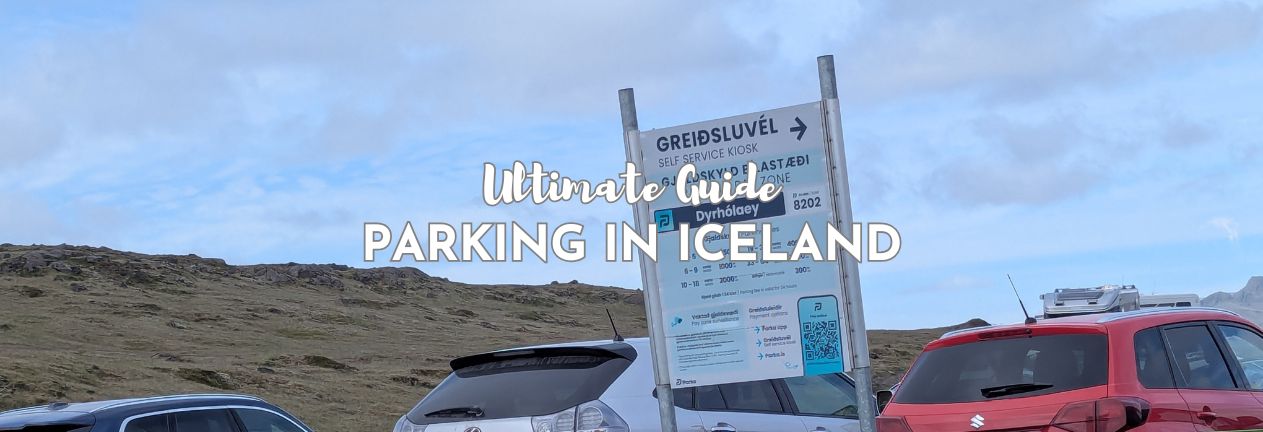
Parking in Iceland isn’t complicated, but it’s not quite the same as parking back home. Free parking is becoming something of a rarity, especially around Iceland’s waterfalls, geysers, and other natural attractions. But you have to pay attention and plan; the fines are real, cameras are everywhere, and unpaid tickets follow you home through your rental company. It’s not hard, but you do need to understand how it works at each of the places you’re going to stop. Here’s our guide to parking in Iceland…
THIS POST MAY CONTAIN COMPENSATED AND AFFILIATE LINKS MORE INFORMATION IN OUR DISCLAIMER
If you’re trying to figure out Iceland parking before your trip, or specifically searching for free parking in Iceland or even worrying ahead of time about Iceland’s parking fines, then you’re asking the right questions. I’ll walk through how the system actually works, what’s different in Reykjavik versus at tourist attractions, where parking genuinely is free, and the mistakes that get people fined without them ever realizing they did anything wrong. There’s more on planning a trip to Iceland in my guide here.
PRACTICAL TRAVEL TIPS
- 🛡️ Get Travel Insurance: Civitatis includes medical expenses, repatriation, theft, luggage delays. No deductibles or upfront payments. Get a quote here.
- 🛏️ Sea view? Laundry? Private bath? Book a Room.
- 🔌 Be ready for the plug, socket & power situation.
- 📶 Get online EASILY & cheaply – One eSim for the world. Data never expires
How Parking Works in Iceland
Most paid parking in Iceland runs on one of two systems: you either pay via an app or QR code, or pay at a kiosk, where you input your car license plate. There’s rarely a ticket to display on your dashboard; cameras read your license plate instead as you enter the parking area, so there’s nothing physical to leave behind, and nothing to forget. Apart from paying, of course.
Parka and EasyPark are the two apps worth having. There’s more on apps worth having in Iceland in my guide to essential apps here. Anyways. Parka covers most tourist attractions, EasyPark handles Reykjavik’s street parking, and a handful of sites also run on checkit.is. Download all three apps before you land, and register your rental car’s plate once you pick it up. It takes a couple of minutes and saves you fumbling with it standing in a parking lot. I’ll cover the downsides of paying via app versus using the kiosks below.

I’d suggest taking a photo of your rental car’s plate as soon as you pick it up. There’s more on renting a car in Iceland and what you need to know here. You’ll need to type it in at every single kiosk and app payment, and having it saved on your phone beats squinting at the car every time.
Bear in mind also that parking at these paid spots is for a limited amount of time, the posted signs will indicate how long the time frame it, and it is 99% of the time a lot longer than you’ll actually be there for.
Kiosks exist at some sites as a backup, but they usually have a line, especially in high season. Some attractions have one, some don’t. Where they do exist, they’re card and contactless only;

Iceland is effectively cashless, so don’t expect a coin slot. Want to more about this? Here’s my guide to currency and paying for things in Iceland.
(The only place we found a “pay with cash” option was at the Ölkelda mineral spring on the Snaefellsnes Peninsula.) QR codes you’ll see at some parking areas aren’t a separate system either; they just open the relevant app or a web payment page for that specific location.
All of this depends on having a working data connection. Iceland’s cell coverage is genuinely excellent outside of the Highlands, but that’s no use to you without a SIM, eSIM, or data plan already sorted; see our guide to the best SIM and eSIM options for Iceland for that.
BEST eSIM ICELAND

The Best eSIM Card for Iceland
If you want to get online as soon as you land, make sure you can pay parking fees by app, and navigate your way around Iceland, the this eSIM from Airalo is the perfect option. Easy to use, easy to manage.
If you don’t have signal and there’s no kiosk, you’re not stuck. There’s usually a grace window to pay once you’re back in data range. Take a photo of the sign so you remember which app and which lot, note when you arrived, and pay as soon as you can. If you never pay, the charge is sent to your rental company, and they’ll add their own admin fee before passing it on to you, and they are never insignificant.
If you’re driving an EV or plug-in hybrid, know that charging and parking are billed separately. You pay the charging network, ON or Ísorka among others, for the electricity, and the parking lot owner for the space itself. Don’t assume paying for one covers the other. However, Reykjavik’s own parking authority details that if you’re actively charging at an on-street charger, you skip the parking fee entirely; you only pay for the electricity. If you’re just parked in a charging bay without actually charging, the normal parking fee still applies.
Paying for Parking via Apps versus Kiosk
At each of the parking locations run by the parking apps, Parka, EasyPark, and checkit.is, you should have the option to pay at a kiosk too, which is essentially just a machine where you input your car license plate (you’ll learn the plate pretty quickly; they’re short and easy), then tap or swipe your card.
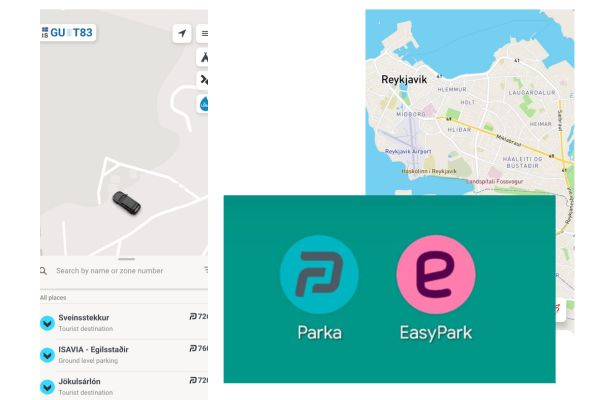
So should you use the app, or pay at the kiosk when parking in Iceland?
It’s cheaper to pay for parking using a Kiosk
Each of the attraction parking locations posts the cost of parking. If you use the kiosk, that’s the price you pay. If you use the app instead, you’ll pay an additional service fee on top; for example, Parka’s service fee is 89 ISK per transaction. You can pay a monthly subscription of 490 ISK instead of that per-time fee if you’re parking often. Either way, that’s just the service fee; you still have to pay to park. There’s more details on how to save money in my guide on saving money when traveling in Iceland here.
Parking in Reykjavik
Reykjavik runs on a color-coded zone system, P1 through P4, and which one you’re in determines both the price and how long you can park there. P1 and P2 cover the most central streets and are enforced every single day, including Sundays; don’t assume a Sunday means free parking downtown, it doesn’t. P3 and P4 are further out from the central area, cost less, and are free on weekends. Every zone is free outside its posted paid hours.
Note that some parking areas in the city are free on public holidays. If parking is free on a particular date, the app or kiosk simply won’t let you pay; there’s nothing to charge. The full list of parking fee exempt days is:
- New Year’s Day
- Holy Thursday
- Good Friday
- Easter Sunday and Monday
- the first day of summer
- May 1st
- Ascension Day
- Whit Sunday and Monday
- June 17th (Iceland’s national day)
- Commerce Day
- Christmas Day
- Boxing Day.
Rates vary by zone and do change, so it’s worth checking current pricing in the Parka app or on Reykjavik’s official parking rates page before you rely on a number from a blog post, ours included. As a general guide:
P1 (red and pink) covers the most central and busiest streets, and it’s the priciest zone too, 660 ISK an hour, with fees running 09:00 to 21:00 on weekdays and 10:00 to 21:00 on weekends, and a maximum stay of 3 hours. P2 (blue) covers the next ring out, 240 ISK an hour, on the same hours as P1. P3 (green) is cheaper again, 240 ISK an hour for the first two hours, dropping to 70 ISK an hour after that, but it’s only enforced 09:00 to 18:00 on weekdays. P4 (orange) is the cheapest and most limited of the four, 240 ISK an hour, weekdays only, 08:00 to 16:00.
P1 is the only zone with a posted maximum stay (3 hours). P2, P3, and P4 don’t have a separate time cap; you just pay for as long as you’re parked within their paid hours.
A ticket bought in a higher zone carries over: a P1 ticket is valid in all four zones, a P2 ticket covers P2, P3, and P4, but a P3 or P4 ticket only covers that zone itself. Worth knowing if you’re moving around the city rather than staying put.
If you’d rather not deal with street parking, Reykjavik also has parking garages scattered through downtown, near Harpa, the City Hall, and along Laugavegur among others, useful if you’d rather not hunt for a space or work out a zone at all. There’s an entire department in Reykjavik that deals with parking in the city, and there’s everything you need to know (and more) on their official parking pages.
Most municipal garages are open from 07:00 to midnight and are not 24 hours, so don’t leave your car there overnight before an early flight or you may find yourself locked out until morning. Check the signage to make sure. A handful of other garages, including Harpa’s, are open 24/7 if that’s a concern. Reykjavik’s own parking authority actually recommends garages over street parking if you are unfamiliar with the city, they’re usually cheaper than street parking.
Once you’ve picked up your car (read our guide to renting a car in Iceland if you haven’t already), this map of Reykjavik’s parking zones is one of the clearest visual breakdowns we’ve found, worth bookmarking before you arrive.
Akureyri, Iceland’s second city, runs a similar paid zone system in its center, just on a smaller scale than Reykjavik’s. Most parking at the edges of town is free.
Parking at Tourist Attractions in Iceland
Plenty of Iceland’s biggest sights are free to visit but charge for parking anyway, and that’s not a tourist tax, it’s usually because the parking itself sits on private land. The fee covers upkeep of the parking area, maintains access, and for a lot of landowners, it’s a genuine part of how they make a living off land that sees an enormous number of people every year. If you look at it that way, it’s a fair trade, not a cash grab.
You should take posted rules seriously for the same reason: if you park on private land without permission, or ignore what a sign is telling you, the landowner has the right to have your car towed without any further warning.
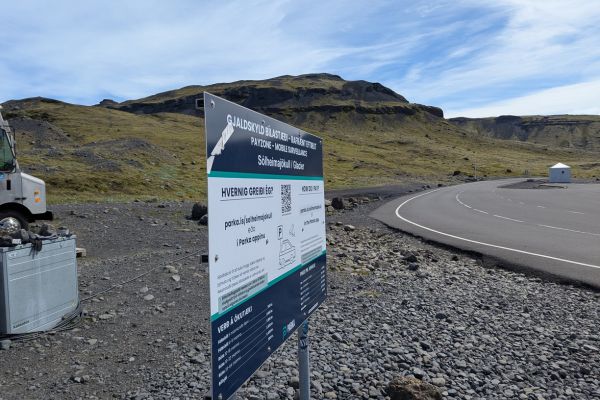
On each of my guides, you’ll find the cost of the parking and a reminder of which app you can use to pay (or the kiosk if its available).
Golden Circle and South Coast stops in particular have shifted to paid parking over the last several years, Þingvellir, Geysir, Gullfoss, Seljalandsfoss, Skógafoss, and Reynisfjara among them. Exactly which app or kiosk applies varies by site.
Which Parking App Is Used at Which Iceland Attractions
| Attraction | Parking App / Method | Cost (Regular Car) |
| Brúarfoss | Kiosk or Parka App | 750 ISK |
| Dynjandi | Parka | 750 ISK (toilets included) |
| Dyrhólaey | Parka / Kiosk | 750 ISK |
| Eyvindarhólar (DC-3 Plane Wreck) | Parka | 1,000 ISK |
| Fjaðrárgljúfur | Parka | 1,000 ISK |
| Fjallsjökull | Parka | 1,000 ISK |
| Geysir | Parka / Kiosk | 1,000 ISK |
| Gígjagjá / Hjörleifshöfði (Yoda Cave) | Easy Park | 1,000 ISK (part of Viking Park) |
| Gullfoss | — | Free |
| Hafnarhólmi / Borgarfjörður eystri | Checkit.is | 1,000 ISK |
| Hengifoss | Checkit.is | 1,000 ISK |
| Hótel Arnarstapi | Parka | 1,000 ISK |
| Hverir | Easy Park | 1,200 ISK |
| Hvítserkur | Parka | 1,100 ISK |
| Jökulsárlón / Fellsfjara (Glacier Lagoon & Diamond Beach) | Parka | 1,110 ISK (covers both) |
| Kerið | On-site | 750 ISK per person (not per vehicle) |
| Kirkjufell | Easy Park | 1,400 ISK |
| Kvernufoss | Parka | 750 ISK (parking at Skóga Museum) |
| Reykjadalur (hot river) | Parka | 300 ISK first hour, 1,000 ISK up to 5 hrs |
| Reykjafoss | On-site | 1,500 ISK (access currently closed) |
| Reynisfjara (Black Sand Beach) | Parka / Kiosk | 1,000 ISK P1 / 750 ISK P2 (3-hr limit) |
| Seljalandsfoss | Checkit.is / Kiosk | 900 ISK |
| Seltún (Krýsuvík) | Checkit.is | 750 ISK |
| Skaftafell (Vatnajökull National Park) | Parka | 1,110 ISK (50% off if same day as Jökulsárlón) |
| Skíðaskálinn Hveradalir | Parka | 1,000 ISK |
| Skógafoss | Parka / Kiosk | 1,000 ISK |
| Sólheimajökull | Parka | 750 ISK |
| Sólheimasandur (Plane Wreck) | Parka | 750 ISK |
| Stokksnes / Vestrahorn | On-site — paid in the cafe | Free (parking) — 1,100 ISK per person entrance fee |
| Stuðlagil | Parka | 1,000 ISK |
| Þingvellir (Thingvellir National Park) | Checkit.is / Kiosk | 1,000 ISK (valid all day, all 5 lots) |
| Valahnúkamöl (for duelling keyboards) | Kiosk | 1000 ISK |
| Ytri-Tunga (Seal Beach) | Checkit.is | 900 ISK |
Attraction parking is almost universally camera-enforced, there’s no barrier arm and no ticket, just a license plate scan on the way in. Go past the camera and there will be a requirement to pay, even if you just drive straight out again. If the parking area is full and you can’t find anywhere to park, your best bet is to contact the parking management company for that attraction and explain your issue, they are generally very responsive.
The exceptions to this enforcement are structured garages and airport lots, some of these do use an old-fashioned physical barrier and ticket on entry, rather than a camera. Either way, once you’ve paid, keep the receipt or screenshot until the charge has actually cleared on your statement, just in case.
Free vs Paid Parking in Iceland
Plenty of parking in Iceland is free, quiet pull-offs, many rural stops, and some lesser-known sights still don’t charge anything. But don’t assume free is the default the way it might be at home, at this point, paid parking is common enough at major sights that it’s the safer assumption until a sign tells you otherwise.
Outside Reykjavik’s paid hours and paid zones, street parking is generally free. In the countryside, if there’s no sign, no machine, and no app instructed on-site, it’s very likely free, just double-check for a small sign you might have missed, they’re not always obvious. Usually, if there’s a camera scanning license plates, that’s your sign there’s a charge.
Parking Fines & Mistakes to Avoid in Iceland
A few mistakes account for most of the fines people pick up without meaning to.
- Park in the direction of traffic. Crossing oncoming lanes to park on the “wrong” side of the street is a fineable mistake in Iceland, even if it’s normal where you’re from.
- Never park on grass or moss to get a better photo or a closer spot. It’s illegal, you are in essence driving and parking off-road, and that’s illegal in its own right. Moss can take decades to recover from being driven or parked on (we cover this in our guide to driving in Iceland too), and it’s an easy way to turn a nice stop into an expensive one.
- Fines escalate the longer you leave them. On top of the fine itself, your rental company will usually add their own admin fee, often another 3,000 to 5,000 ISK, for handling it, so the real cost of ignoring a fine is often close to double the original amount.
- Never park on the road shoulder or the roadside if there’s no marked or designated parking area nearby. It’s not just illegal, it’s genuinely dangerous on Iceland’s narrow roads with minimal visibility.
- Sleeping in your car overnight outside a designated campsite is illegal in Iceland and heavily fined, even if you’re not driving a camper van or motorhome. If you want to sleep in the car, find an actual campsite.
What parking fines can add up to in Iceland
Here’s an example of what fines look like in Reykjavik specifically: a missed or expired parking meter runs 4,500 ISK, discounted to 3,400 ISK if you pay within 3 business days, rising to 6,750 ISK after 14 days and 9,000 ISK after 28 days if it’s left unpaid. Parking somewhere prohibited jumps to 10,000 ISK, discounted to 8,900 ISK for immediate payment, rising to 15,000 ISK after 14 days and 20,000 ISK after 28 days. And parking in a handicapped space without a permit is somewhere in the region of 18,000 to 19,000 ISK for prompt payment, roughly double the standard illegal-parking fine, sources vary slightly on the exact figure, so treat it as an estimate rather than a precise number.
Reykjavik doesn’t print physical tickets anymore, it’s part of a push to cut down on paper, so there’s nothing waiting on your windshield to find. You can check directly on the city’s official site whether you’ve picked up a fine. If you have, you can generally pay it three ways: to an officer on the spot, often with the same kind of discount for immediate payment as a speeding fine, at a local bank on a weekday, or to your rental car agency if you’ve missed it completely.
Appealing Parking Fines in Iceland
If you think a fine was issued unfairly, you can appeal. In Reykjavik that means submitting a review request directly with your plate, the date, the location, and your reason, within 14 days. Outside the capital, it’s the local municipality instead. After 14 days, the fine is final either way.
If you hold a disability parking permit from home, it’s generally recognized in Iceland, but you’ll need to display a printed international notice alongside your regular card, not just the card on its own. The International Transport Forum’s website has the specifics on what that notice needs to look like.
FAQs on Parking in Iceland
Here are quick answers to the parking questions we get asked most.
Is parking free in Reykjavik?
Sometimes, P3 and P4 zones are free on weekends, and every zone is free outside its posted paid hours. P1 and P2 are enforced daily, including Sundays, so don’t assume a weekend means free parking downtown.
Do parking meters take credit cards?
Most meters accept cards, but plenty of areas have moved to app-only payment. Don’t rely on finding a meter, the apps are your safest bet.
How do parking wardens know I’ve paid?
Icelandic parking wardens use license plate scanners, not paper tickets. When you pay through Parka or EasyPark, your plate is registered in their system instantly, there’s no ticket to print and no receipt to put on the dashboard. If your plate is in the system, you’re covered, and that’s the same whether you’re parked on the street or in a tourist attraction lot.
What does “Gjaldskylda” mean on parking signs?
It confuses a lot of people the first time they see it. “Gjaldskylda” isn’t a place, it simply means “payment required,” marking a paid parking zone. It’s not the name of a car park, a neighborhood, or a tourist attraction, so don’t type it into your maps app hoping to find it.
What does “Einkastæði” mean on parking signs?
Same idea, different word. “Einkastæði” means “private parking.” If you see it, that space belongs to someone specific, a resident, a business, whoever, and parking there without permission can get you towed or fined even if the spot looks empty and available.
Driving into a paid parking area but didn’t stay. Do I still have to pay?
Often, yes. Camera systems register the moment you enter, and plenty of them treat that as a chargeable event regardless of whether you actually parked. If the signage indicates monitored, pay-by-plate parking, pay it, even if you just turned around and left.
How do I know if a lot is camera-monitored?
Look for signage that mentions monitoring, license plate recognition, or video surveillance. If you’re not sure either way, assume it’s monitored and pay, that’s a much safer bet than assuming it isn’t.
Can my rental company get a parking fine cancelled?
Not directly, parking fees and fines are issued by whoever manages that lot or zone, not your rental company. Most rental companies will forward dispute paperwork on your behalf if you put it in writing, but the appeal deadlines still apply while it’s being reviewed, so don’t wait around.
What if my phone dies or I have no signal?
Pay as soon as you have power or signal again. Most systems allow delayed payment within a limited window, so it’s rarely as urgent as it feels in the moment. Keep your receipts and screenshots until you can confirm the charge went through.
Do I have to pay to park at waterfalls?
At most of them, yes. Plenty of well-known waterfalls and other sights now charge for parking even though the sight itself is free, usually because the parking sits on private land.
What app do I need for parking in Iceland?
Parka and EasyPark cover most of the country between them, Parka for most tourist attractions, EasyPark for Reykjavik streets, with a few sites also running on checkit.is. Download all three before you land: Parka, EasyPark, checkit.is.
What happens if I don’t pay a parking fine?
If you don’t pay a parking fine, it gets sent to your rental company, who will add their own admin fee before passing the charge on to you, often making the total cost close to double the original fine.
ICELAND TRAVEL RESOURCES
AIRPORT TRANSFERS
24/7 pickup & drop off. Trusted, local English speaking drivers. Prebook & prepay online with cards.
Book a Transfer
HOTELS AND APARTMENTS
See choices here
Rooms with a view? Budget rooms? Need a washing machine? The best choice of hotels & apartments.
TOURS & ATTRACTIONS
Most excursion choices, small group tours, skip-line tickets, free cancellation and top local guides.
Top options here.
CAR RENTAL OPTIONS
Choose cars here
Best choice of vehicles, automatics, large or small cars, child seats. Book early for more options.
Final Words on Parking in Iceland
Parking in Iceland really isn’t complicated, go in with the attitude that you’ll have to pay to park at most of the attractions you want to visit, and treat any free parking as a bonus. Download the three parking apps before you get to Iceland and you’ll be ahead of the game, use kiosks or machines over the apps to avoid the service fees, and just check each time you park for signs that tell you the payment requirement and the hours in which it applies.
ASocialNomad is a participant in the Amazon Services LLC Associates Program, an affiliate advertising program designed to provide a means for sites to earn advertising fees by advertising and linking to amazon.com, amazon.co.uk, and amazon.ca. Amazon and the Amazon logo are trademarks of Amazon.com, Inc. or its affiliates. As an Amazon Associate, I earn from qualifying purchases.

