

Puffins are one of Iceland’s most beloved sightings, with brightly colored beaks, a clumsy little waddle, a seriously ungainly landing, and a gloriously photogenic presence that makes them one of the most requested wildlife encounters for those visiting Iceland. But they’re also more time-limited than people expect; these aren’t a year-round resident, they’re only actually in Iceland for a few months each summer, and timing your visit wrong means missing them entirely. Here’s our guide to puffins in Iceland…
THIS POST MAY CONTAIN COMPENSATED AND AFFILIATE LINKS MORE INFORMATION IN OUR DISCLAIMER
If you’re specifically trying to plan around seeing Iceland’s puffins, whether that’s picking the right month, the right location, or working out whether you need a boat tour at all, I’ll walk through everything: when they’re actually around, the best places to see them ranked by distance from Reykjavik, some real puffin facts worth knowing, tours versus self-drive viewing, how to photograph them without disturbing anything, and the etiquette that keeps both you and the birds safe.
PRACTICAL TRAVEL TIPS
- 🛡️ Get Travel Insurance: Civitatis includes medical expenses, repatriation, theft, luggage delays. No deductibles or upfront payments. Get a quote here.
- 🛏️ Sea view? Laundry? Private bath? Book a Room.
- 🔌 Be ready for the plug, socket & power situation.
- 📶 Get online EASILY & cheaply – One eSim for the world. Data never expires
When Puffins Are in Iceland
Puffins arrive in Iceland starting in April, build up through May, and stick around in real numbers through mid-August. By early September, most have already left, back out to the North Atlantic where they spend the rest of the year alone on the open water. Grímsey Island, being the furthest north of any of our suggested puffin spotting locations, tends to see its puffins leave a little earlier than the mainland colonies, sometimes by mid-August rather than September.
EASIEST PUFFIN EXPERIENCE

Encounter charismatic puffins and other sea birds close-up from Reykjavik: Sail to Akurey, Engey or Lundey to see the puffin breeding grounds, you’ll get up-close views via the free on-board binoculars
The Best Time of Year to see Puffins in Iceland
If puffins are the priority, plan your trip for May through mid-August; that’s the genuinely reliable window. Outside it, you’re either too early or simply too late; there’s no consolation sighting waiting for you in October.
The Best Time of Day to see Puffins in Iceland
Time of day matters too. Puffins spend a lot of the daylight hours out fishing, so early morning or early evening, when they’re back at the burrows, gives you a noticeably better chance than the middle of the day.
The Best Places to See Puffins in Iceland
Iceland has more puffin colonies than any single trip can realistically cover, unless, of course, you’re here just for the puffins, so here are six worth actually planning around, ordered roughly by how far you’ll need to go from Reykjavik.
Puffins in Akurey and Lundey
Akurey and Lundey, two small islands in Faxaflói Bay, are the easiest of all, a short boat tour straight from Reykjavik’s Old Harbor, no driving required at all. If you’ve only got a few hours to spare in the city, this is genuinely the fastest way to tick puffins off the list, and you’ll often spot dolphins or whales in the same waters. This trip gets you to see them
Puffins at Dyrhólaey
Dyrhólaey, on the South Coast, is the next easiest, an easy add-on to a South Coast day trip or a Ring Road drive, with striking basalt cliffs and a rock arch alongside the puffins themselves. The colony here is smaller than some of the others, but it’s easily accessible, and easy to combine with the rest of the South Coast in a single day.

However, as this location is so easily accessible from Reykjavik and the Ring Road, there are strict rules about when you can visit, and the site is often closed between 19:00 and 09:00 so give the puffins some peace and quiet. We saw puffins easily here at Dyrhólaey. And all my puffin photos are taken with a Pixel phone. I’ve included visiting Dyrhólaey in my 7 day Iceland itinerary.

Puffins at Vestmannaeyjar
Vestmannaeyjar, the Westman Islands, hosts the largest Atlantic puffin colony anywhere in the world, reached by ferry from Landeyjahöfn on the South Coast. Heimaey, the only inhabited island, has both boat tours and land-based viewing from the Stórhöfði peninsula, and it’s also home to the puffling patrol tradition, more on that below.
Puffins at Látrabjarg
Látrabjarg, in the Westfjords, is Iceland’s westernmost point and one of the largest sea-bird cliffs in Europe. It’s a proper journey to get there, but the sheer scale of birdlife along these cliffs, puffins included, is hard to overstate. Well-marked paths make it accessible without a tour. You should read my guide to Iceland’s Wesfjords here.
Puffins at Borgarfjörður Eystri
Borgarfjörður Eystri, in the East Fjords, is one of the easiest and safest places in the country to watch puffins up close, thanks to boardwalks and viewing platforms at Hafnarhólmi that let you get right up to the colony without any risk to you or the burrows.
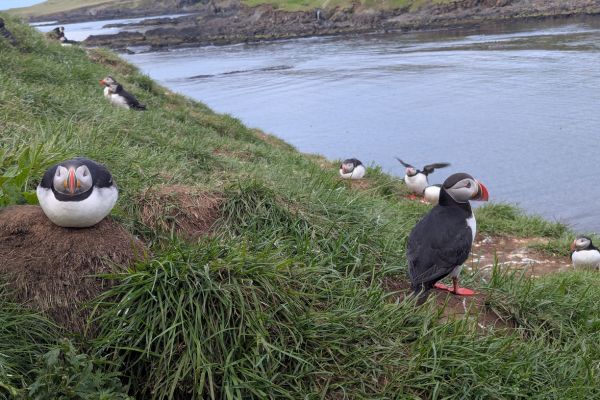
Around 10,000 pairs nest here each summer, and it’s our personal favorite of the six; the combination of easy access and arms-length closeness to the birds is hard to beat. What I was also pleasantly surprised about here was the people who were here. No noise, no chattering, no exclamations of loud delight, just people watching, quietly. It was perfect.
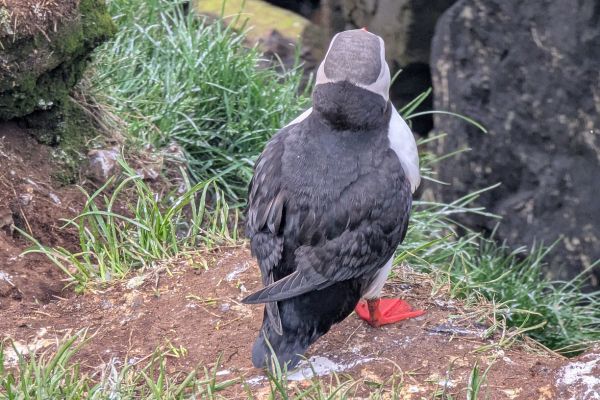
If you’re not sure about making the drive all the way up here. It’s a long haul (although I do recommend you come and stay overnight at the glorious Blabjorg Resort, but before you set off, or even along the way, there’s a live webcam that you can check out to see what it’s like. Here’s the link to the live webcam at Borgarfjörður Eystri
Puffins at Grimsey Island
Grímsey Island, currently sitting on the Arctic Circle itself, is the furthest of the six and not necessarily the easiest to reach, but a seriously special spot, and you get a passport stamp (if you want) for crossing into the Arctic to go with the puffins. Why currently? Read my guide to unique things to do in Iceland, and you’ll understand.
Other places in Iceland to see Puffins
A handful of other colonies exist too; Ingólfshöfði Cape and the Tjörnes Peninsula both offer quieter alternatives to the busier spots, Breiðafjörður near the Snæfellsnes Peninsula has boat tours out of Stykkishólmur, and Papey Island off the East Fjords is about as remote and uncrowded as puffin watching gets in Iceland. It’s worth knowing they exist, even if the six above cover most people’s trips.
One tradition also worth understanding if you’re in Vestmannaeyjar in mid-to-late August: every year, fledgling puffins, called pysjur, leave their burrows for the ocean for the first time, and plenty get confused by the town’s lights on Heimaey and crash-land in the streets instead. Local kids have spent generations collecting these lost pysjur in cardboard boxes overnight and releasing them safely from the cliffs the next morning, a charming bit of small-town tradition built entirely around looking out for the birds. And if you want the local word for it, Icelanders just call a puffin a lundi. It’s called the “Puffling Patrol,” and you can read about it here.
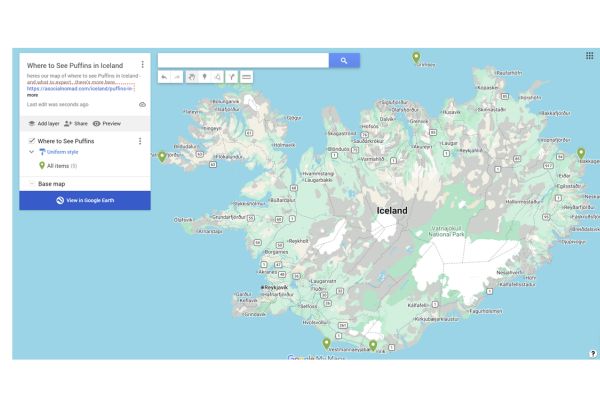
Map of Best Places to See Puffins in Iceland
Here’s our map of where to see Puffins in Iceland; you can also see the map here.
Puffins 101 – Facts, Figures and Info on Puffins
Puffins are one of those animals everyone thinks they already know, until they’re standing in front of one, so here’s the rundown on what they actually look like, how they live, and just how many of them call Iceland home.
What Do Puffins Look Like?
Puffins are smaller than most people expect, only about 30 centimeters (12 inches) from beak to tail and standing around 20 centimeters (8 inches) tall. The black and white body is fairly plain, but the bright orange beak and matching orange feet are the real signature, and that color is seasonal; it fades to a duller shade once breeding season ends and doesn’t return until spring.
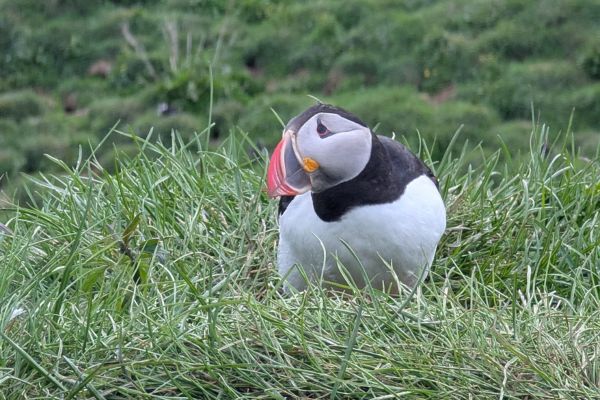
Fun Fact: Although it’s not necessarily for a fun reason. Climate change is altering the Atlantic Puffin. Puffins expel heat from their body through their beak; it’s been noted that beaks are noticeably changing in size, increasing to deal with a warmer climate. Their beak also changes color, but only temporarily; during the breeding season it gets brighter, most likely to attract a mate. Come winter, that bright color is shed, and the beak is duller and grey.
Puffin Behavior & Lifespan
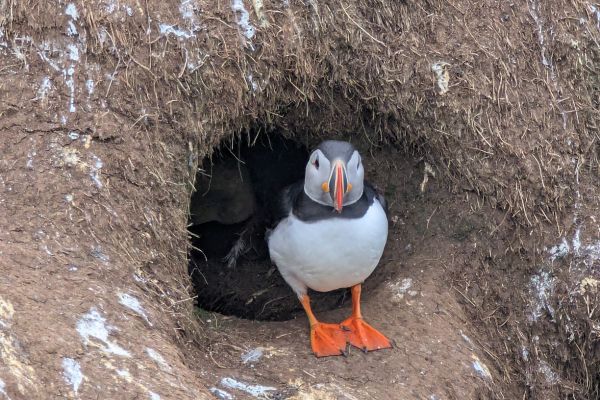
Puffins are monogamous, pairing with the same partner for life; some couples for 20 years or more, and they return to the same burrow year after year. They don’t build nests so much as dig burrows, up to a meter deep, into soft cliffside earth. They’re also famously bad fliers, beating their wings 300-400 times a minute just to stay airborne and often crash-landing rather than gracefully touching down. It is fascinating and mesmerizing to watch. Puffins are, though, excellent swimmers, diving to depths of 60 meters (200 feet) in search of food. In the wild, they live for around 20 years.
What Puffins Eat
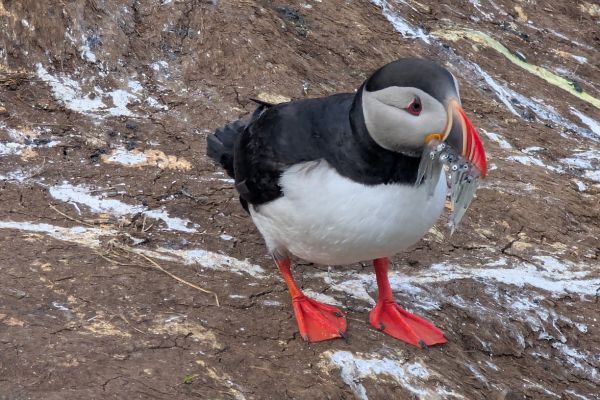
Puffins eat small fish, mainly sand eels, herring, and hake, caught by diving rather than surface feeding. Sand eels in particular matter a lot here (and that’s what you’ll see in the photos with puffins with full beaks); warming seas have pushed them further from the cliffs in recent years, which is part of why some colonies have struggled to successfully raise chicks lately.
The Puffin Population in Iceland
Iceland hosts the largest population of puffins anywhere in the world, commonly cited at around 60% of the global total, roughly 3 million breeding pairs. You’ll see higher figures thrown around occasionally, but 60% is the number backed by actual named researchers – see Nat Geo for more on this – rather than just repeated across blog posts, so that’s the one we’d trust. It’s worth knowing too that despite how strongly puffins are associated with Iceland, they’re not actually the national bird; that’s the Gyrfalcon, which was so named in 1984.
Puffin Watching Tours vs. Self-Drive Viewing
Several of these puffin watching locations, Dyrhólaey, Vestmannaeyjar, and Borgarfjörður Eystri among them, work perfectly well without a boat tour if you’re happy viewing from land or a boardwalk instead. Others, like Akurey and Lundey specifically, require a boat; there’s no land-based way to reach them.
A tour makes the most sense if you want the boat access, or if you’d rather have a guide point things out and handle the logistics. Self-drive works well for the land-based colonies; Dyrhólaey, Látrabjarg, and Borgarfjörður Eystri all sit right off a road, no tour required at all if you’re comfortable finding your own way there.
If you’re self-driving, then you should read my guides
Photography Tips for Puffins
Puffins are surprisingly tolerant of people once they’ve settled; sit or stand still for a few minutes after you arrive rather than walking straight up, and they’ll often relax enough to pop out of the burrow within arm’s reach entirely on their own. You should bring binoculars regardless of the season, and a windproof layer even in midsummer; exposed clifftop sites like Látrabjarg and Dyrhólaey catch a particularly cold Atlantic wind no matter how warm it looks.
Puffin Etiquette — Keeping Your Distance
A few simple habits will keep both you and the birds safe.
- Approach slowly and quietly rather than rushing in.
- Stay well back from cliff edges, not just for your own safety, but because puffin burrows sit right under the soft ground you’d be standing on, and a collapsed burrow is a dead chick.
- Never touch a puffin, not even to help, unless it’s genuinely injured or lost (but then, how would you know?). If you’re on a boat, a good operator keeps a respectful distance and doesn’t gun the engine near a colony.
- And don’t feed them; they’re excellent hunters and don’t need help from your sandwich.
Atlantic puffins are rated Vulnerable on the IUCN Red List, not endangered, but facing a real risk over the medium term from climate change, overfishing of the sand eels they depend on, and marine pollution. Puffin is still legally hunted in parts of Iceland and occasionally served in restaurants as a local dish. Whether to try it is your own call to make; we won’t tell you it’s off-limits, but given the Vulnerable listing, I’d personally lean toward giving it a pass.
FAQs for Puffins in Iceland
Got questions about seeing Puffins in Iceland? Here are quick answers to the questions we hear most about puffins in Iceland.
When do puffins leave Iceland?
Most have left by early September, though numbers thin out from late August onward. Grímsey’s colony tends to leave a little earlier than the mainland ones.
Where’s the best place to see puffins?
It depends how far you’re willing to travel. Akurey and Lundey are the easiest, right from Reykjavik’s harbor; Dyrhólaey is easy if you’re doing the Ring Road, I loved Borgarfjörður Eystri; while Vestmannaeyjar hosts the largest colony in the world if you’ve got time for the ferry. (we didn’t)
Can you see puffins in Iceland without a boat tour?
Yes, Dyrhólaey, Látrabjarg, and Borgarfjörður Eystri are all land-based and reachable by car, no boat required.
Are puffins endangered in Iceland?
Puffins are not endangered, but rated Vulnerable on the IUCN Red List due to climate change, overfishing of their food sources, and pollution. Iceland’s population remains the largest in the world, but it’s not immune to those pressures.
Is it okay to get close to puffins for photos?
Puffins are often tolerant of people nearby, but keep your distance from burrows and cliff edges, never touch them, and let them come to you rather than chasing a closer shot. All of the photos in this blog post were taken with a Pixel Phone.
Can you see puffins from Reykjavik?
Yes, Akurey and Lundey islands are reachable by a short boat tour straight from the city’s Old Harbor; there’s no need to leave the capital area at all.
ICELAND TRAVEL RESOURCES
AIRPORT TRANSFERS
24/7 pickup & drop off. Trusted, local English speaking drivers. Prebook & prepay online with cards.
Book a Transfer
HOTELS AND APARTMENTS
See choices here
Rooms with a view? Budget rooms? Need a washing machine? The best choice of hotels & apartments.
TOURS & ATTRACTIONS
Most excursion choices, small group tours, skip-line tickets, free cancellation and top local guides.
Top options here.
CAR RENTAL OPTIONS
Choose cars here
Best choice of vehicles, automatics, large or small cars, child seats. Book early for more options.
Final Words on Puffins in Iceland
Puffins are seriously one of the most rewarding sightings in Iceland, but only if you time it right. Get the season right, May through mid-August, pick a location that suits how much traveling you want to do, and keep a respectful distance once you’re there, and puffins in Iceland become one of the easiest wildlife encounters to plan for and one of the best to actually experience.
ASocialNomad is a participant in the Amazon Services LLC Associates Program, an affiliate advertising program designed to provide a means for sites to earn advertising fees by advertising and linking to amazon.com, amazon.co.uk, and amazon.ca. Amazon and the Amazon logo are trademarks of Amazon.com, Inc. or its affiliates. As an Amazon Associate, I earn from qualifying purchases.

