
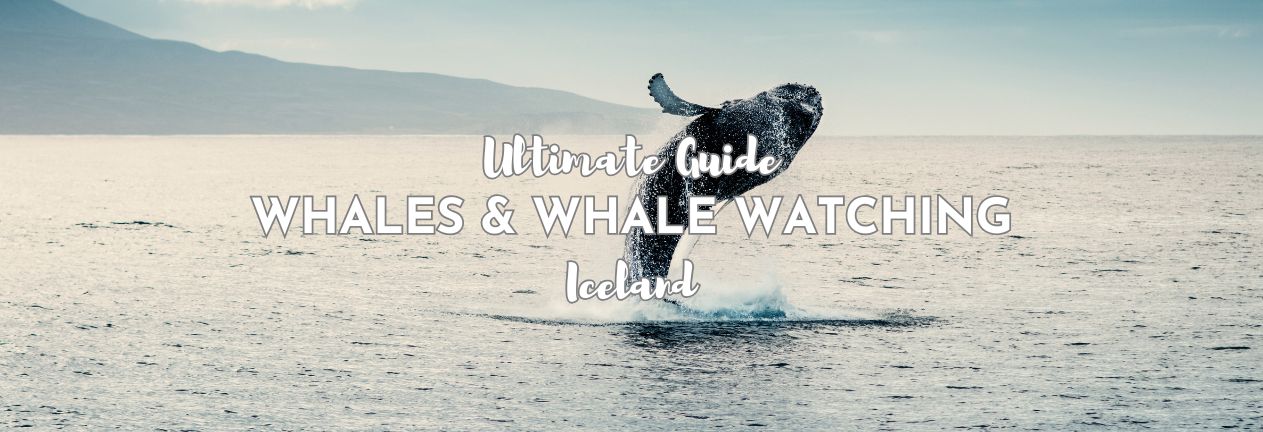
Iceland is one of the best places on the planet to watch whales in the wild, no aquarium tank, no telephoto trickery, actual whales in actual open water. It didn’t happen overnight either; the first official whale watching tour here didn’t leave port until 1991, carrying fewer than a dozen curious passengers. Fast forward to 2018 and that number had grown to nearly 300,000 people a year. That’s not a fad; that’s an entire industry built on enormous animals showing up reliably enough to build a livelihood around. Here’s our guide to whale watching in Iceland…
THIS POST MAY CONTAIN COMPENSATED AND AFFILIATE LINKS MORE INFORMATION IN OUR DISCLAIMER
If you’re trying to work out how to actually plan Iceland whale watching tours, here’s the rundown: what whales you’ll actually see, the best departure ports and how they differ, the whale museums worth a stop (including one that guarantees a sighting even if the weather doesn’t cooperate), the history and mythology built up around these animals over a thousand years, the best time of year to go, what a tour is actually like depending on the boat you pick, and a few tips for improving your odds. Whale watching in Iceland isn’t just a bucket-list tick; once you understand what’s actually swimming out there, it becomes something else entirely.
PRACTICAL TRAVEL TIPS
- 🛡️ Get Travel Insurance: Civitatis includes medical expenses, repatriation, theft, luggage delays. No deductibles or upfront payments. Get a quote here.
- 🛏️ Sea view? Laundry? Private bath? Book a Room.
- 🔌 Be ready for the plug, socket & power situation.
- 📶 Get online EASILY & cheaply – One eSim for the world. Data never expires
What Whales Can You See in Iceland
Iceland’s waters host more than 20 species of cetacean, but a handful show up often enough that you can actually plan a trip around them.
Humpback Whales
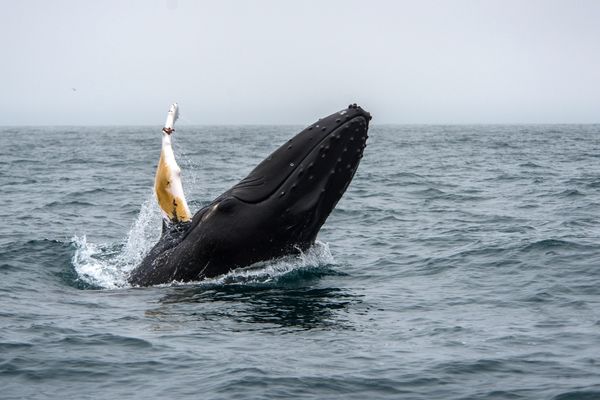
Humpbacks arrive around April to feed and breed through summer, then migrate south again by October. They’re the acrobatic showoffs of the group, known for breaching, tail-slapping, and a distinctive move called the peduncle throw, lifting their tail and rear end clear out of the water before slamming back down. They swim close enough to shore that they’re a common sight on shorter tours out of both Faxaflói Bay in Reykjavik and Skjálfandi Bay in Húsavík.
Minke Whales
Minke whales are the smallest baleen whale in Icelandic waters, but also the most numerous, which makes them the species you’re most likely to actually see, from almost any port, at almost any time of year. They’re curious enough to approach boats on their own, though their behavior is unpredictable: several quick surfacings followed by a long, deep dive, then a reappearance somewhere else entirely.
Blue Whales
The blue whale is the largest animal to have ever lived on Earth, up to 30 meters long and around 100 tonnes. Your best odds are mid-June to mid-July near Húsavík’s Skjálfandi Bay. Worth being honest here: sources disagree on just how common a blue whale sighting actually is; some call it one of the more frequently seen species, others call it pure luck, so treat any sighting as a proper highlight rather than something to expect.
If all else fails, go to the Husavik Whale Museum (tickets here xxxx), and you can learn more about Blue Whales there, including seeing this Blue Whale skeleton up close.

Fin Whales
Fin whales are the second-largest animal on Earth after the blue whale, reaching up to 20 meters, and they’ve earned the nickname “razorback” thanks to a distinctive ridge behind the dorsal fin. One odd detail worth knowing: their jaw coloring is asymmetrical; the lower right side is white, the lower left is black, and their tongue is colored in reverse. They tend to stick to open water rather than the coast, usually traveling in small pods.
Orcas
Orcas are famous as “killer whales,” but technically, they’re not whales at all; they’re the largest member of the dolphin family. Your best odds are around the Snæfellsnes Peninsula and Breiðafjörður between January and March, when they follow migrating herring into the area. Iceland’s most famous orca, Keiko, the whale who played Willy in Free Willy, gets a section of his own further down.
Beyond these five, keep an eye out for the rarer sightings too: sperm whales (which can hold their breath for up to two hours on a single dive), sei whales, pilot whales, white-beaked dolphins (which even appear on Iceland’s 5-krona coin), harbor porpoises, and the occasional stray beluga or narwhal that’s wandered south from the Arctic.
Best Places for Whale Watching
Where you leave from matters almost as much as when you go.
Whale Watching from Húsavík
Húsavík, in North Iceland, is widely considered the country’s whale-watching capital, and up to 11 different species have been recorded in its Skjálfandi Bay, including blue whales. Tours run on a mix of traditional oak fishing boats, modern carbon-neutral electric boats, and RIBs, and the nearby waters around Grímsey Island mean whales often show up close enough that tours don’t need to travel far to find them.
Whale Watching from Reykjavik
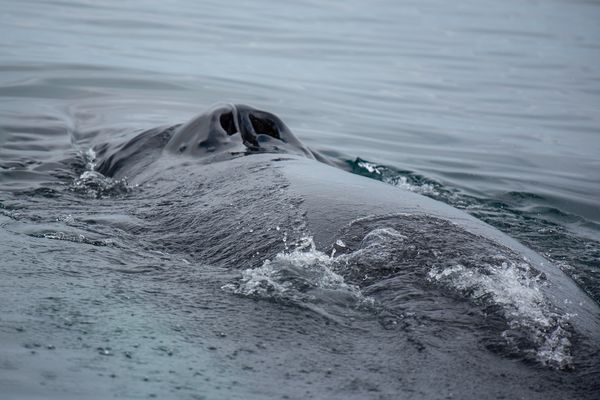
Reykjavik’s Old Harbour is the most convenient option by a wide margin, mostly because nearly every visitor passes through the capital anyway, at the start or end of their trip. Tours here run year-round, unlike the northern ports, which are seasonal, and minke whales, dolphins, and porpoises are common in Faxaflói Bay, with the occasional humpback or orca. Since puffins nest on nearby islands, combined whale-and-puffin tours are common in summer; if that’s on your list too, our puffins guide covers it in more depth.
Whale Watching from Akureyri
Akureyri sits on Eyjafjörður, Iceland’s longest fjord, and its calmer, sheltered waters make for a smoother ride than the open ocean. Species are similar to Húsavík’s, and being the biggest town outside the capital region, there’s more to fill the rest of your day with once the tour’s done. Read more about Akureyri in our guide to North Iceland here.
Other Departure Points Worth Knowing About
A handful of other ports are properly worth knowing about, even if they’re not headline destinations. Ólafsvík, on the Snæfellsnes Peninsula, has the best odds in the country for orcas, particularly April to May, and sperm whales turn up in the deeper waters of Breiðafjörður come summer. The Westfjords and East Iceland both run smaller, quieter tours if you’re already exploring those regions. And Heimaey, in the Westman Islands, is home to the world’s first beluga whale sanctuary, where two rescued belugas, Little Grey and Little White, now live.
Whale Museums in Iceland
If the weather doesn’t cooperate, or you’d just like more depth than a boat deck gives you, Iceland has three museums worth knowing about. Iv’e got heaps of details in my guide to Iceland’s Unique Museums
The Húsavík Whale Museum
Right by the harbor, this is a good way to spend the time before your tour departs. It houses a full blue whale skeleton and goes deep on whale biology, the history of Icelandic whaling, and current conservation efforts.

- Address of the Húsavík Whale Museum: by the harbor in Húsavík.
- Entry to the Húsavík Whale Museum: Adults 2,650 ISK. You can get your ticket ahead of time here.
- Opening Hours of the Húsavík Whale Museum: May to September 09:00 – 18:00, October to April 10:00 – 16:00
- How Long to Spend at the Húsavík Whale Museum: 60 + minutes.
- Website of the Húsavík Whale Museum: https://hvalasafn.is/en/
- How to Get to the Húsavík Whale Museum: on the harbor front in Húsavík, there’s free parking just outside.
Whales of Iceland (Reykjavik)
This exhibition uses life-size models rather than real skeletons, but it’s properly worth seeing regardless, and some tour operators bundle entry in with a boat ticket.
Perlan — The Weather-Proof Backup Option
Perlan’s whale exhibition is part of a much larger nature museum in Reykjavik, and the whale section centers on a curved cinema screen that immerses you in an underwater journey alongside humpback, minke, fin, and blue whales, plus life-size model whales, 23 species in total, suspended overhead, and interactive exhibits covering their anatomy, communication, and behavior. Unlike a boat tour, it’s completely unaffected by weather, season, or sea conditions, so if your tour gets cancelled or you strike out on sightings, this is the fallback that guarantees the encounter anyway. Book Perlan tickets here.
Book Perlan’s Wonders of Iceland tickets here if you want the fullest single-stop introduction to Iceland’s natural world the capital has to offer.
- Address of Perlan: Öskjuhlíð, 105 Reykjavík.
- Entry to Perlan: tickets from US$58 per person. Skip the lines and buy your ticket for Perlan here.
- Opening Hours of Perlan: daily, 09:00-21:00, last admission 19:30.
- How Long to Spend at Perlan: 2 hours.
- Website of Perlan: perlan.is
- How to Get to Perlan: on Öskjuhlíð hill, a short drive or bus ride from downtown Reykjavik.
Whales in Icelandic History and Culture
This isn’t just an old fishing-economy footnote; whales sit right at the center of how Icelanders have understood their own island for a thousand years.
The Warlock-Whale Saga
According to the Heimskringla saga, when the scheming Danish king Harald Bluetooth planned to invade Iceland, he sent a sorcerer ahead in the shape of a giant whale to scout the island’s weaknesses. Every time the whale-sorcerer tried to come ashore, one of Iceland’s four guardian spirits turned it back: the dragon of the east, the eagle of the north, the bull of the west, and the stone giant of the south. The invasion never happened. Those same four guardians still appear today on Iceland’s coat of arms.
Hvalreki — Iceland’s Windfall Word
The Icelandic word “hvalreki” does double duty; it means both “beached whale” and “stroke of good luck.” In medieval Iceland, food was hard to come by, and a beached whale meant enough meat and oil to get an entire community through the winter. The word has stuck around long after the reason for it mostly disappeared.
Keiko
Iceland’s most famous whale isn’t a saga creature; he was a real orca captured in Reyðarfjörður, East Iceland, in 1979, and originally named Siggi. After years of being sold between aquariums, he was cast in 1993’s Free Willy, playing the title role. The Free Willy-Keiko Foundation, formed in 1995, eventually flew him back to Iceland in 1998 aboard a US Air Force cargo plane, where he was rehabilitated in Klettsvík Bay in the Westman Islands ahead of a planned release.
In August 2002, Keiko finally left Icelandic waters alongside a pod of wild orcas. By September, he’d turned up in a Norwegian fjord instead, seeking out human contact rather than his new pod. He died of pneumonia there on December 12, 2003, at the age of 27. Klettsvík Bay, Keiko’s old home, now houses two rescued belugas instead, Little Grey and Little White, who arrived from an aquarium in Shanghai in June 2019.
The History of Commercial Whaling
Whaling in Iceland stretches back to the 12th century in some form, though the industrial version began in the late 19th century. The most dramatic chapter came in 1986, when anti-whaling activists sank two of the country’s whaling ships, Hvalur 6 and Hvalur 7, in Reykjavik harbor. Most environmentalists actually distanced themselves from the act; some called it outright terrorism, and domestically, the sabotage backfired: public opinion swung firmly in favor of the whaling industry as a reaction against outside interference. Both ships were raised, and whaling continued for years afterward, with even stronger public support than before.
That support has faded since, as the whale-watching industry has grown, and whale meat today is eaten far more by curious tourists than by Icelanders themselves.
Whaling continues to be very controversial in Iceland; despite a two-year break, it began again in 2026, with a quota for 150 fin whales and 168 minke whales issued to the controversial Hvalur hf. company, led by Kristján Loftsson. There is more on whaling in Iceland here.
Eating Whale in Iceland
Should you actually eat whale while you’re here? Honestly, I lean towards no. Most of the whale meat served in Reykjavik exists because tourists ask for it, not because it’s part of daily Icelandic life anymore, and the whale-watching industry itself has done far more for the country than whaling has in decades. That said, I understand the impulse to try something once, out of curiosity rather than habit, and if you do want to, it’s worth doing properly. Here’s where you can try whale meat in Iceland.
Íslenski Barinn leans into traditional Icelandic home cooking with a modern twist, and it’s as much a bar as a restaurant, serving both fin whale (on an Icelandic crumpet with remoulade and pickled cucumber) and a peppered minke whale steak alongside its other Icelandic dishes.
- Address: Ingólfsstræti 1a, 101 Reykjavík
- islenskibarinn.is
- Hours: Sun-Thu 9:30-01:00, Fri-Sat 9:30-03:00, kitchen open daily until 22:00
Hereford Steakhouse, Reykjavik’s oldest steakhouse, runs a specific three-course whale and puffin tasting menu alongside its regular grill offerings, priced around 6,950 ISK, a good option if you’d rather try it as part of a proper sit-down meal than a single dish.
- Address: Laugavegur 53b, 101 Reykjavík
- hereford.is
There’s more on food and drink in Iceland in my guide here.
Best Time of Year for Whale Watching
If your trip to Iceland is specifically to see the whales, then there is a better time of year to come, but I’m guessing that’s just one of the reasons to come, so here’s what you can expect at various times of the year.
Summer Whale Watching in Iceland
April through October is the easiest, most reliable window for whale watching in Iceland. The weather is calmer, cancellations are rarer, and the sheer diversity of species is at its highest; minke and humpback whales are as close to a sure thing that you’ll get from nearly any port, sperm whales become findable in Breiðafjörður, and you might even spot a basking shark, the world’s second-largest fish, cruising calmly near the surface. Puffins and Arctic terns are usually part of the same view during these months too.
Winter Whale Watching in Iceland
Winter tours are quieter, colder, and less crowded, and while overall diversity drops, there are real edge cases worth knowing about. You’ll have a lot fewer options for boats making trips. Orcas are actually more likely in Breiðafjörður during winter, since it’s a herring wintering ground, and belugas become more likely up north, having drifted south from Arctic ice. There’s also a real chance of pairing your tour with the northern lights, something summer obviously can’t offer.
What a Whale Watching Tour Is Like
The type of boat you choose defines the whole Whale Watching experience, not just the view you’ll get. What type of boat is best? It depends on what you want and how much time you have. Our best ever whale watching experience was on a ferry in Alaska, when surrounded by a whale pod, our skipper stopped the boat (yes, a scheduled ferry!) and decided we weren’t going anywhere until we’d done a lot of whale watching! It was spectacular, and we’ve never beaten that whale watching experience, despite trying!
Fishing, Traditional and Passenger Boats
Larger, slower, and steadier, these boats keep you dry and comfortable, and in Reykjavik specifically, some come with a cabin, a toilet, and even a small bar. They’re the better choice for families, for anyone sensitive to cold or seasickness, and tours typically run around three hours. The tradeoff: since these boats can’t chase a sighting, your odds of getting properly close to a whale are lower than on a RIB.
- Traditional Boat Whale Watching Tours from Reykjavik
- Traditional Boat Whale Watching Tours from Akureyri
- Traditional Boat Whale Watching Tours from Ísafjörður
RIB / Zodiac Boats
Smaller, faster, and far more exposed to the elements, RIBs can range further out to sea and actually catch up to whales, which meaningfully improves your odds of a close sighting. Expect wind, spray, and a bumpier ride; operators provide storm coats, but there’s no getting around the cold. Tours are usually shorter, around two hours, typically carry a minimum age limit of 10 to 12, and there’s no toilet on board. Prices vary by operator and season, worth checking current rates before booking rather than relying on older listings.
Seasickness — What to Know Before You Book
If you’re prone to seasickness, a larger fishing or passenger boat will treat you far better than a RIB. Take any medication you’d normally use well before departure rather than after symptoms start, sit toward the middle of the boat where motion is least noticeable, and keep your eyes on the horizon rather than your phone screen. It’s a really common concern, and a boring one to solve, but solving it in advance beats solving it partway through a three-hour tour. I much prefer the bigger boats, rather than the ribs for whale watching, as those are the ones where the adrenaline rush comes from seeing the whales, not bouncing from wave to wave.
Map of Whale Watching Locations in Iceland
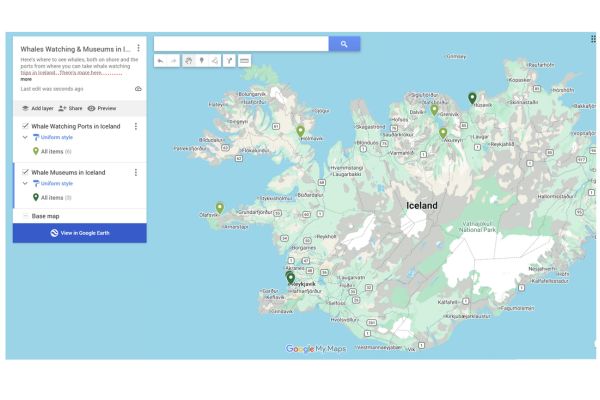
Here’s our map of the main whale watching ports around the country and whale museums around Iceland; you can also see the map here.
Tips for Increasing Your Chances of Sightings of Whales in Iceland
A handful of small habits will actually improve your odds of a whale sighting, wherever you end up going.
- Travel between April and October for the widest range of species and the calmest conditions.
- Choose a RIB over a fishing boat if getting close matters more to you than comfort, and you’re not prone to seasickness.
- Stay flexible with your dates if you can; bad weather is the biggest reason tours get cancelled or sightings drop.
- Dress in warm layers regardless of season or boat type; the water stays cold even in July.
- Bring binoculars, and a telephoto lens if you’re on a passenger boat; a phone camera is fine for the closer RIB stops.
- If you don’t see anything, ask about a free re-booking; many operators offer one, and Perlan is always a weather-proof backup.
FAQs on Whale Watching in Iceland
Got questions about whale watching in Iceland? Here are quick answers to what we’re asked most.
What’s the best month for whale watching in Iceland?
Broadly, April through September is the best time for whale watching in Iceland, with blue whales at their best mid-June to mid-July near Húsavík, and orcas at their best January through March around Snæfellsnes and Breiðafjörður.
Is Húsavík better than Reykjavik for whale watching?
It depends what you want. Húsavík has more species diversity and the best odds for blue whales, but only runs spring through autumn. Reykjavik is more convenient for most people, runs year-round, and is reliable for minke whales, dolphins, and porpoises.
What whales are most commonly seen?
Minke and humpback whales, by a wide margin; both are close to a sure thing from most Icelandic ports during summer.
Are whale watching tours guaranteed to see whales?
No tour can guarantee wildlife, but success rates during the season are actually high, often quoted in the 95-99% range by operators, and many offer a free re-booking if nothing is spotted.
Is whale watching possible in winter?
Yes, tours run year-round from Reykjavik especially, and winter actually has a real edge for orcas and belugas, even though overall species diversity drops.
Can I combine whale watching with puffin watching?
Yes, many Reykjavik and Húsavík operators run combined tours in summer. See our puffins guide for more on timing that side of it.
What happens if no whales are spotted?
Many operators offer a free re-booking if nothing is seen on your tour. If you’d rather guarantee an encounter regardless of weather or luck, Perlan’s whale exhibition is an excellent, weather-proof backup.
Do I need to tip on my Iceland Whale Watching Tour?
No. Read my guide to tipping in Iceland to understand why.
ICELAND TRAVEL RESOURCES
AIRPORT TRANSFERS
24/7 pickup & drop off. Trusted, local English speaking drivers. Prebook & prepay online with cards.
Book a Transfer
HOTELS AND APARTMENTS
See choices here
Rooms with a view? Budget rooms? Need a washing machine? The best choice of hotels & apartments.
TOURS & ATTRACTIONS
Most excursion choices, small group tours, skip-line tickets, free cancellation and top local guides.
Top options here.
CAR RENTAL OPTIONS
Choose cars here
Best choice of vehicles, automatics, large or small cars, child seats. Book early for more options.
Final Words on Whale Watching in Iceland
Whale watching earns its place near the top of any Iceland itinerary. These are actual wild animals in Icelandic waters, a thousand years of saga and superstition behind them. The industry here has grown from a dozen curious passengers in 1991 to hundreds of thousands a year. Pick your port, pick your boat, and go in with realistic expectations; no operator can promise a sighting, but few destinations on Earth make you feel this close to something this big. Whale watching in Iceland is worth building a full day of your trip around.
ASocialNomad is a participant in the Amazon Services LLC Associates Program, an affiliate advertising program designed to provide a means for sites to earn advertising fees by advertising and linking to amazon.com, amazon.co.uk, and amazon.ca. Amazon and the Amazon logo are trademarks of Amazon.com, Inc. or its affiliates. As an Amazon Associate, I earn from qualifying purchases.

