
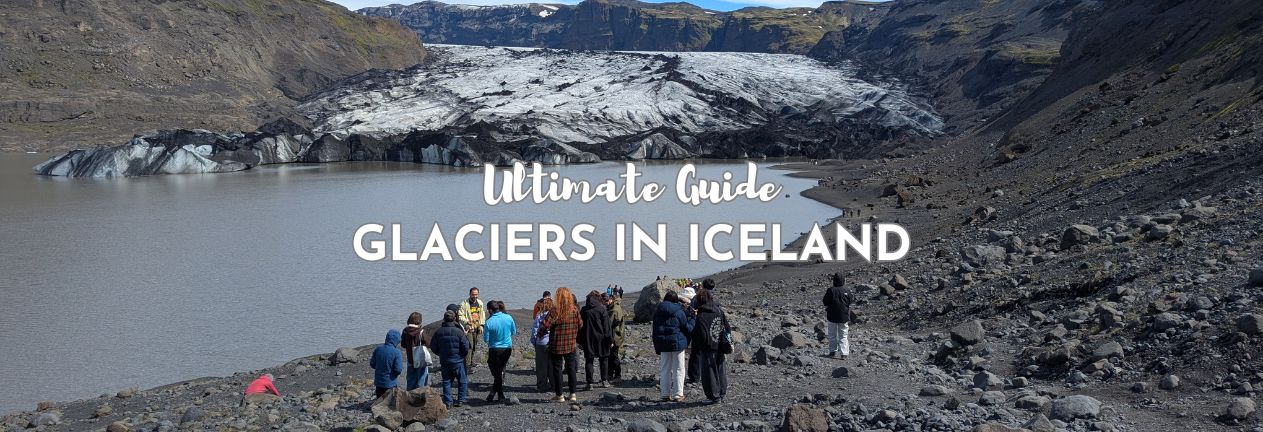
Iceland is a land of ice and fire, and nowhere is that more literal than standing on one of its glaciers with an active volcano somewhere underneath your feet. Around 11 percent of the country is covered in ice, and the glaciers in Iceland aren’t just scenery; they’re the reason half the South Coast looks the way it does. We’ve explored some of them, kept our distance from others, and picked up a lot of lessons about why you don’t do any of this without a guide. Here’s our guide to the glaciers in Iceland, the ones worth knowing, and how to actually get out onto one.
THIS POST MAY CONTAIN COMPENSATED AND AFFILIATE LINKS MORE INFORMATION IN OUR DISCLAIMER
Iceland’s glaciers aren’t all the same, and they’re not all equally easy to reach either. Some are a short drive off the Ring Road, others are deep in the Highlands and see almost nobody. Below, we’ll run through the quick facts, take you through the seven major glaciers (and their most visited glacier tongues), cover how you can actually get out onto the ice, and finish with the safety stuff that matters more than any of it.
PRACTICAL TRAVEL TIPS
- 🛡️ Get Travel Insurance: Civitatis includes medical expenses, repatriation, theft, luggage delays. No deductibles or upfront payments. Get a quote here.
- 🛏️ Sea view? Laundry? Private bath? Book a Room.
- 🔌 Be ready for the plug, socket & power situation.
- 📶 Get online EASILY & cheaply – One eSim for the world. Data never expires
Iceland’s Major Glaciers — A Quick Overview
Before we get into individual glaciers, here are the numbers that put the whole thing in context.
- How many glaciers does Iceland have? There are around 269 named glaciers in Iceland, ranging from vast ice caps down to small mountain glaciers you’d barely notice from the road.
- How much of Iceland is covered in ice? About 11 percent of the country is covered in ice, with Vatnajökull alone accounting for roughly 8 percent of that.
- How old is the ice in Iceland? Most of Iceland’s glaciers formed around 2,500 years ago, though some of the oldest ice inside Vatnajökull is far older than that.
- Are Iceland’s glaciers shrinking? Yes. They’ve lost more than 7 percent of their total volume since 2000, and some of the smaller glaciers could disappear within a century.
TOP THING TO DO
Iceland’s TOP Selling Glacier Trip
On this, Iceland’s TOP SELLING GLACIER TOUR hike across the Vatnajökull ice cap with a certified glacier guide, get breathtaking views of Falljokull Glacier and along the way learn how glaciers are formed and hear about the impact of global warming
The Glaciers in Iceland
Unless you’re doing a glaciers-only trip to Iceland, you won’t get to all of them. We didn’t. And there are different reasons to visit each one, and honestly, most visits are really about the glacier tongues, the lakes, or the lagoons that spill off the main ice cap, rather than the ice cap itself. To be fair, a lot of people just want to see the icebergs on the black sand at Diamond Beach. And that’s fair enough. Below, I’ll detail what’s best for what type of experience and call out our favorite moments on Iceland’s glaciers.
See Iceland’s Glaciers Without Leaving Reykjavik
First though, if you want to experience Iceland’s glaciers without leaving the capital region, head to Perlan. It’s Iceland’s largest museum and the top attraction in Reykjavík, and it packs in a real ice cave, an exhibit on how volcanoes actually work, and a Planetarium show where the northern lights dance overhead, no clear night required.
It’s a seriously extensive museum and experience, meaning that even if you never make it out of Reykjavik, you’ll still walk away with a real taste of what makes Iceland special. Book your tickets for Perlan here.
The Different Ways to Experience Iceland’s Glaciers
It’s worth noting that experiences related to Iceland’s glaciers tend to fit into one of three categories:
- Walking on the glacier
- Walking inside the glacier
- Floating, boating, or kayaking on the glacier lagoons
We’ve done all three over the years. And these experiences can be magnificent. And truly some of the most unique experiences you can have. Our first experience of kayaking a glacier was in Alaska, where it was just us two and a guide. As we paddled away, part of the glacier calved. It was desperately sad, exceedingly exciting, and yes, we did paddle away a heck of a lot quicker after that!
Vatnajökull
Vatnajökull is the largest glacier in Iceland as well as the largest in Europe; it is in the southeast and covers roughly 8 percent of the entire country. It’s less of a single glacier, and more an ice cap the size of a small nation, with dozens of glacier tongues flowing out from it in every direction. It really is quite difficult to estimate the size until you get here. It’s massive and seems to go on forever. It makes you feel very small.
- How to get to Vatnajökull: most access points are along the South Coast Ring Road, roughly a 4 to 5 hour drive from Reykjavik.
- Map location: Here’s the map location for Vatnajökull.
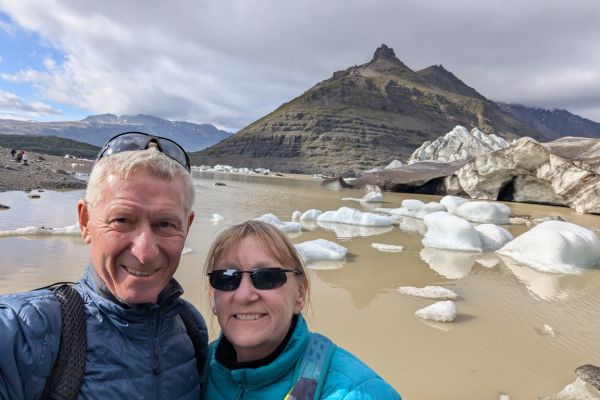
Vatnajökull’s Main Glacier Tongues
Vatnajökull is so big that most people never actually set foot on the ice cap itself; they visit one of its glacier tongues instead. Here are the ones worth knowing about:
- Breiðamerkurjökull: the best known by far, since it feeds Jökulsárlón Glacier Lagoon and Diamond Beach, two of the most photographed spots in the country.
- Fjallsjökull: flows into Fjallsárlón, a smaller and much quieter lagoon just down the road from the more famous Jökulsárlón.
- Skaftafellsjökull: is inside the Skaftafell area of Vatnajökull National Park, and it’s one of the easiest tongues to reach on foot for a look without booking a tour.
- Falljökull and Svínafellsjökull: both popular starting points for guided glacier hikes, a short drive from the Skaftafell visitor center.
There are more tongues than this (Vatnajökull has dozens), but these are the ones that account for almost all of the tourist traffic, so they’re the ones we’re covering in any depth.

If you want to get out onto one of these yourself, you can explore Jökulsárlón Glacier Lagoon by boat, take a guided hike on Fjallsjökull, hike out onto Skaftafellsjökull, or head out to Svínafellsjökull instead. Each one gives you a different angle on Vatnajökull entirely, so pick based on how much walking you want to do and how far you’re willing to drive.
Mýrdalsjökull
Mýrdalsjökull is on the South Coast near Vík, and underneath it is Katla, one of Iceland’s most active volcanoes. You’ll rarely hear anyone talk about visiting “Mýrdalsjökull” directly; what they actually mean is one of its outlet glaciers, and that’s exactly how we experienced it too.
- How to get to Mýrdalsjökull: the South Coast, roughly a 2.5-hour drive from Reykjavik to the Sólheimajökull parking area.
- Map location: Mýrdalsjökull location here.
Mýrdalsjökull’s Main Glacier Tongues
Sólheimajökull is one of the most accessible glacier hikes in Iceland, a short walk from the parking area to the ice edge, and a small lagoon has formed at the base in recent years where chunks of ice break off and drift. It’s an easy stop on Iceland’s South Coast.
It’s amazingly quiet considering that it’s so accessible, even though your heart might sink when you see the size of the parking lot.

- Sólheimajökull: This is an easy one to hike and get to as well, but in high season you’ll want to reserve your spot early.
- Kötlujökull: This is on the eastern side of Mýrdalsjökull and is where tours depart for the Katla Ice Cave, which is unusual for being open in summer as well as winter thanks to the ash layers strengthening the ice.
Snæfellsjökull
Snæfellsjökull is right at the tip of the Snæfellsnes Peninsula, capping a stratovolcano and looking out over the North Atlantic. It’s smaller than Vatnajökull or Mýrdalsjökull by a huge margin, but it’s famous for a different reason: it’s the glacier Jules Verne sent his characters down into in Journey to the Center of the Earth.
- How to get there: the western tip of the Snæfellsnes Peninsula, around 2 to 2.5 hours from Reykjavik.
- Map location: Map link here for Snæfellsjökull here
Langjökull
Langjökull is the closest big glacier to Reykjavik and, for most visitors, the easiest one to actually get out onto. We haven’t hiked this one ourselves, but it’s worth including because it’s easily the most convenient glacier experience in the country, and it comes up constantly in Golden Circle planning. The Into the Glacier ice tunnel here is the only man-made tunnel inside a glacier in Iceland, open all year, which makes it one of the few glacier experiences that isn’t weather-dependent.
- Best for: combining with the Golden Circle, since Langjökull feeds the Hvítá River that runs over Gullfoss.
- How to get there: roughly a 2-hour drive from Reykjavik, or as an add-on from the Golden Circle.
- Map location: link to map here
Eyjafjallajökull
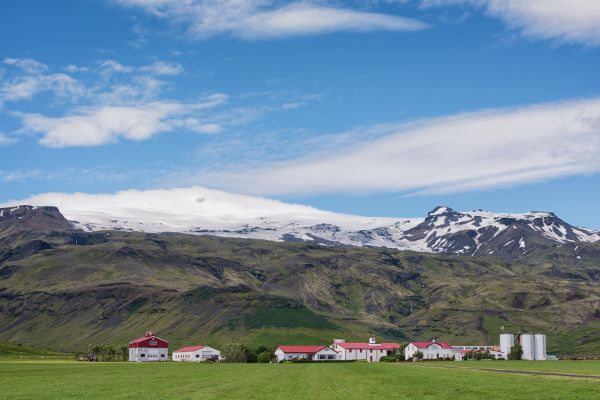
Eyjafjallajökull is smaller than Vatnajökull or Langjökull, and most people couldn’t pronounce it before 2010. Then the volcano underneath it erupted, sent ash across European airspace for weeks, and grounded flights across the entire continent.
I was in Edinburgh, Scotland, on business at the time, and couldn’t fly home, so managed to snag one of the last seats on a southbound train and was in the carriage with the ex-Director General of MI5 (and her security staff). She’d been speaking at an event that I was also speaking at!
It’s one of the closest glaciers to Reykjavik, and it’s easily visible from the Ring Road as you drive the South Coast, and the eruption alone earns it a place here. It’s possible to go snowmobiling on Eyjafjallajökull or hike to the summit, but you’ll need a guide for both activities.
- Best for: the view from the road and the story, or snowmobiling (which is available from November to May each year).
- How to get to Eyjafjallajökull: visible from the Ring Road along the South Coast, between Skógafoss and Vík.
- Map location: here’s the map location for Eyjafjallajökull
Hofsjökull
Hofsjökull is Iceland’s third-largest glacier, located deep in the Central Highlands between Langjökull and Vatnajökull. Most travelers won’t make it up here; the interior routes nearby (Kjölur and Sprengisandur) are 4×4-only and only open in summer. It’s one of the country’s defining Highland landmarks all the same, and it feeds several of Iceland’s major rivers, including Iceland’s longest river, the Thjórsá, which runs for 230 kilometers (143 miles). Its name means “Temple Glacier,” and it’s home to the largest active volcano in Iceland.
- Best for: Highland road trippers with a 4×4 and time to spare, not a casual day trip.
- How to get there: via the Kjölur or Sprengisandur highland routes, 4×4 only, summer only.
Drangajökull
Drangajökull is the only glacier in the Westfjords and the northernmost glacier in Iceland. It’s small, just 160 square kilometers (62 square miles), is located entirely below 1,000 meters (3,300 feet), and is remote. There’s no major tour operation built around it, and getting close usually means a long hike into the Westfjords interior rather than a parking-lot glacier walk.
- Best for: Westfjords travelers looking for something really off the beaten path, not a first-time glacier experience.
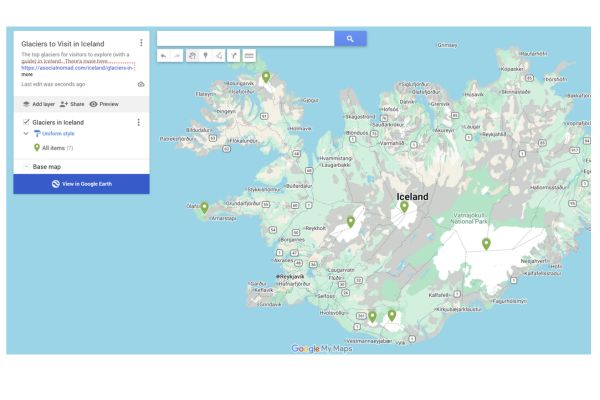
Map of Iceland’s Glaciers
Here’s a map showing where each of these seven glaciers is located, so you can see how they match up with your Iceland itinerary. You can also see the map here.
How to Explore a Glacier in Iceland
Once you’ve picked a glacier, there are a handful of ways to actually get out onto (or into, or around) the ice. Here they are.
Glacier Hiking in Iceland
Glacier hiking is the most common way to experience the ice, and it’s what we’d recommend for a first glacier experience. You’ll be fitted with crampons, given a helmet and an ice axe, and led by a guide who knows exactly where the crevasses are, which is NOT something you want to be guessing at yourself. A typical hike runs for 3 to 4 hours including gear and safety instruction. These are NOT big group trips and you wouldn’t want them to be, you want that guide’s attention! There are many glacier hikes you can take in Iceland, so I’ve picked my favorite, because this is easily accessible from Vík (so you can head back and have a special black crust pizza afterwards!). Anyways, here’s that glacier hike for you.
Snowmobiling on Glaciers in Iceland
Snowmobiling tours run year-round and are one of the more exciting ways to cover a lot of ice quickly. Langjökull and Mýrdalsjökull are the most popular spots for it, with shorter tours also available on Eyjafjallajökull and Vatnajökull. It’s a completely different feeling from hiking, less about the ice up close, more about the sheer scale of a white ice cap stretching to the horizon.
Snowmobiling is exhilarating and fun. We first did it in West Yellowstone (honestly, that park is amazing!) some years ago and it was magical. Snowmobiling here in Iceland is just as magical and you can take this trip year round.
Kayaking on Iceland’s Glacier Lagoons
Kayaking is the quiet option, paddling among floating icebergs with the glacier wall somewhere behind you. Jökulsárlón, Fjallsárlón, and the small lagoon at Sólheimajökull are the main spots for this, and it’s a properly different pace from the crampons-and-ice-axe experience of a hike.
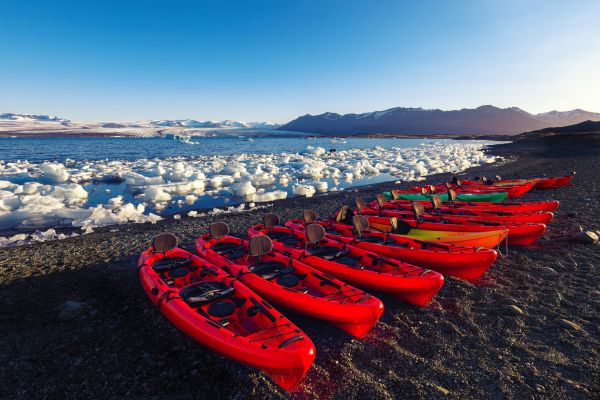
- Kayaking at Jökulsárlón: Take a 90 minute kayaking tour on the glacial lagoon here.
- Kayaking at Heinaberg Lagoon: This is totally off the beaten track and just 35 minutes drive from Höfn. You won’t see anything else on the water here. The kayaks are sit-on-top style, perfect for beginners. This is bliss, book it now.
Ice Climbing in Iceland
Ice climbing is the most physically demanding way to explore a glacier, up a vertical wall of ice with ropes, crampons, and an ice axe rather than across a flat surface. It’s suitable if you’re reasonably fit, and most operators run it at Sólheimajökull or in the Skaftafell area of Vatnajökull. You can do this as a beginner with a full intro here.
Ice Caving in Iceland
We’ve written a full guide to visiting an ice cave in Iceland separately, since it deserves its own space. The short version: most natural ice caves are winter-only, with the Katla Ice Cave under Mýrdalsjökull being the notable summer exception. Winter, in Iceland, of course starts somewhere around October. But as for that ice cave you can visit in summer? It’s here.
Glacier Safety in Iceland — Why You Need a Guide
Here’s the thing about a glacier: it’s not a static block of ice, it’s moving, constantly, and that movement is exactly what creates the crevasses that make unguided glacier walks so dangerous. And despite looking as though they’re covered in grit, they are incredibly slippery. Yes, I have dirty trousers because of that fact. Many of Iceland’s glaciers also sit directly on top of active volcanoes, which means conditions can change fast, a subglacial eruption can trigger a jökulhlaup, a sudden flood of meltwater, with almost no warning. None of this is meant to scare you off, glacier hiking is truly one of the best things you can do in Iceland, but it’s ALWAYS with a guide, NEVER on your own, and NEVER without proper gear. The ice that looks solid from the parking lot is not the same ice you’ll be standing on an hour into a guided hike.
That said, walking up to a glacier tongue and exploring around it on foot is a different story, without clambering around. That’s generally fine to do on your own, there’s nothing stopping you from getting close enough for photos as the ice tips into the lake or lagoon. You should, however, abide by all notices and warnings posted. It’s clambering around ON the ice itself that’s dangerous, and that’s the part you never do without a guide.
FAQs on Glaciers in Iceland
Here are the questions we get asked most about glaciers in Iceland, quick and to the point.
Can you walk on a glacier without a guide?
You shouldn’t. Crevasses are often hidden under a thin layer of snow, and a guide is trained to read the ice in a way that takes years to learn.
Which glacier is closest to Reykjavik?
Langjökull, at roughly 2 hours away, is the closest glacier to Reykjavik. Eyjafjallajökull and Sólheimajökull on the South Coast are close behind, at around 2.5 hours.
Is glacier hiking dangerous?
Not with a guide and proper gear. Unguided, yes, absolutely, crevasses and sudden weather changes are a real risk.
What should I wear for a glacier hike?
You should, like everywhere in Iceland, wear warm layers, waterproof outer layers, and sturdy hiking boots. Most operators provide crampons, helmets, and ice axes as part of the tour.
Are Iceland’s glaciers shrinking?
Yes, Iceland’s glaciers are shrinking. They’ve lost more than 7 percent of their volume since 2000, and some of the smaller glaciers could disappear entirely within a century.
Can you visit a glacier in summer?
Yes, glacier hiking, snowmobiling, and kayaking on the lagoons all run through summer. Natural ice caves are the exception, most are winter-only, though the Katla Ice Cave stays open year-round.
How many glaciers does Iceland have?
There are 269 named glaciers in Iceland, from the huge ice caps down to small mountain glaciers most people never hear about.
What’s the difference between an ice cap and an outlet glacier?
An ice cap is the huge sheet of ice covering mountains and highlands, like Vatnajökull. An outlet glacier (or glacier tongue) is a long arm of ice that flows down from the ice cap into a valley, that’s the part of the glacier that most people actually visit.
What is the easiest glacier to see in Iceland?
Sólheimajökull, for a hike, it’s a short walk from the parking area to the ice. For a no-hiking option, Langjökull’s Into the Glacier ice tunnel is open year-round and needs no fitness or gear beyond warm clothes.
What are the best glaciers to visit in Iceland?
It depends what you’re after. Vatnajökull for scale and Jökulsárlón, Sólheimajökull for an accessible first hike, Snæfellsjökull if you’re already doing the Snæfellsnes Peninsula, Langjökull if you want the easiest possible add-on to a Golden Circle day.
ICELAND TRAVEL RESOURCES
AIRPORT TRANSFERS
24/7 pickup & drop off. Trusted, local English speaking drivers. Prebook & prepay online with cards.
Book a Transfer
HOTELS AND APARTMENTS
See choices here
Rooms with a view? Budget rooms? Need a washing machine? The best choice of hotels & apartments.
TOURS & ATTRACTIONS
Most excursion choices, small group tours, skip-line tickets, free cancellation and top local guides.
Top options here.
CAR RENTAL OPTIONS
Choose cars here
Best choice of vehicles, automatics, large or small cars, child seats. Book early for more options.
Final Words on Glaciers in Iceland
Glaciers in Iceland are worth every bit of the hype, but only if you go about it the right way. Whether you want to walk over the top of them, walk through them, float on the water that was once them, or do all three, that means picking the right ones for what you actually want to do, going with a guide who knows the ice, and accepting up front that you’re not going to see all seven of them in one trip, and that’s fine. We didn’t either.
ASocialNomad is a participant in the Amazon Services LLC Associates Program, an affiliate advertising program designed to provide a means for sites to earn advertising fees by advertising and linking to amazon.com, amazon.co.uk, and amazon.ca. Amazon and the Amazon logo are trademarks of Amazon.com, Inc. or its affiliates. As an Amazon Associate, I earn from qualifying purchases.

