

Black sand isn’t a novelty here; it’s most of the coastline. Iceland’s beaches look almost otherworldly compared to what you’re picturing when you hear the word “beach”: dark volcanic sand, crashing surf, basalt columns rather than palm trees. They’re also, without exception, more dangerous than they look. Here’s our guide to the black sand beaches in Iceland…
THIS POST MAY CONTAIN COMPENSATED AND AFFILIATE LINKS MORE INFORMATION IN OUR DISCLAIMER
If you’re trying to work out which black sand beaches in Iceland are actually worth putting on your Iceland itinerary, then here’s the rundown: why the sand is black in the first place, eight beaches worth knowing about (and visiting), spread right across the country, and the one safety topic that matters more than anything else on this list, sneaker waves, which have killed people at these beaches and need to be taken seriously.
Why Iceland’s Beaches Are Black
Iceland sits on top of a mid-ocean ridge, which is constantly volcanically active, and its beaches are built from that activity rather than the usual slow erosion of light-colored quartz and coral you’d find elsewhere. Black sand here is almost always basalt, dark volcanic rock, ground down by centuries of waves into sand and pebbles. Where lava has met the sea directly, sometimes explosively, the result is beaches that look like nowhere else on Earth.
The Black Sand Beaches of Iceland
There are eight beaches below, spread across the whole country. I’ve detailed where they are, what they’re famous for (I mean aside from being black sand), so that you can, if you want, just visit one black sand beach in Iceland, and not go off your chosen route.
Reynisfjara Black Sand Beach
Iceland’s most famous black sand beach, and its most dangerous. Towering hexagonal basalt columns line one end of the beach, the same end where the parking area sits, and the Reynisdrangar sea stacks rise straight out of the water just offshore, said locally to be trolls turned to stone mid-heist, caught by the sunrise while trying to drag a ship ashore. National Geographic named it one of the world’s top 10 non-tropical beaches back in 1991, and it still earns that billing.
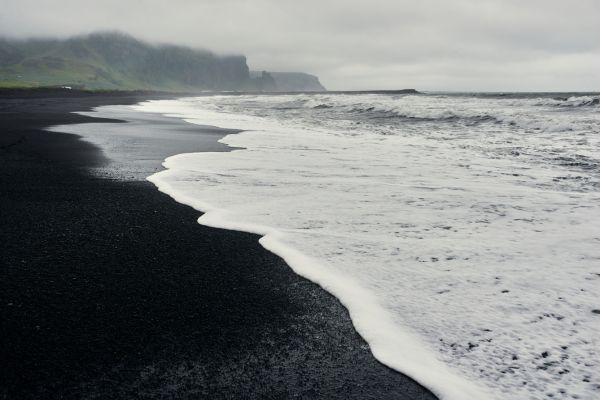
The beach experienced significant erosion in February 2026, and higher sea levels mean parts of it are now inaccessible, so don’t be surprised if it looks different from older photos. There’s more about Reynisfjara Beach in our South Coast guide.
- How to get to Reynisfjara: just 6 kilometers (4 miles) from Route 1, take the exit marked Route 215.
- How long to spend at Reynisfjara: 45 minutes to 1 hour.
- Entry: free.
- Parking: 1,000 ISK, pay via kiosk or the Parka app.
Diamond Beach
This black sand beach on Iceland’s South Coast is famous (and named) for the chunks of glacial ice, calved from Jökulsárlón lagoon and washed up on black volcanic sand just a five-minute walk away, across Route 1. The contrast between shimmering ice and jet-black sand really doesn’t get old, and it’s every bit the photo opportunity you’ve seen online. However, the timing matters here; you’ve got a noticeably better chance of seeing large ice chunks on the sand at low tide. Checking tide times before you go is worth the two minutes it takes.
There’s more on the glacier that theese chunks come from in my guide to Iceland’s glaciers here.
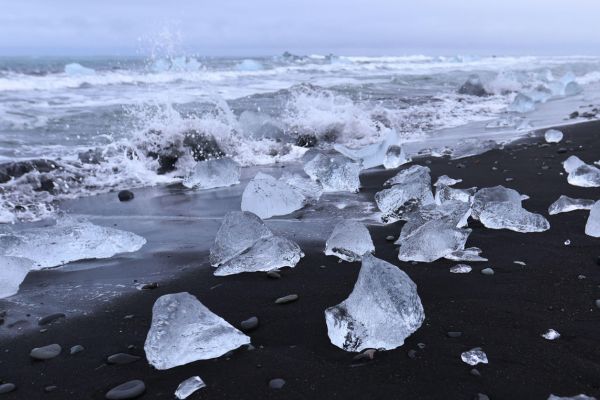
As the tide comes back in, the surf pushes the bigger bergs out into deeper water and the beach empties out considerably. Full details are in our South Coast guide.
- How to get to Diamond Beach: a five-minute walk from Jökulsárlón, opposite and across Route 1.
- How long to spend at Diamond Beach: 30-45 minutes.
- Entry: free.
- Parking: 1,110 ISK, pay via kiosk or the Parka app, shared with Jökulsárlón’s main lot.
Book a Jökulsárlón glacier lagoon boat tour here if you’d like to get out among the icebergs rather than just view them from the shore.
Sólheimasandur Black Sand Beach
This is not a beach to bathe at (not that many are in this guide; truly these are all photo opps, not bathers and sunnies beaches). However, this is the stop for the airplane wreck alone. A US Navy DC-3 made an emergency landing here in 1973 after the pilot mistakenly switched to an empty fuel tank. Everyone aboard survived; the plane didn’t, and it’s sat there, stripped and rusting, ever since. Driving a personal vehicle out to it is banned outright now, not just discouraged, so you’re choosing between a roughly hour-long walk each way from the parking area, or an ATV or shuttle tour instead. I wouldn’t attempt the walk in winter or bad weather. The full walking directions are in our South Coast guide.
- How to get to Sólheimasandur: a 9-10 minute drive on Route 1 from Kvernufoss/Skógafoss, then roughly an hour’s walk each way from the parking area, or an ATV/shuttle tour.
- How long to spend at Sólheimasandur: around 2.5 hours, including the walk both ways.
- Entry: free. Book a shuttle to the plane wreck here if you’d rather skip the hour-long walk each way.
- Parking: 750 ISK, pay via kiosk or the Parka app.
Djúpalónssandur Beach
This is a black pebble, rather than fully sandy, beach on Snaefellsnes with some interesting history attached to it. The four “lifting stones,” here Fullsterkur (full strength), Hálfsterkur (half strength), Hálfdrættingur (weakling), and Amlóði (useless), once tested a fisherman’s strength before he’d be hired onto a crew, and you can still try lifting them today.

Also scattered across the shore are the rusting remains of the Epine GY7, a British trawler out of Grimsby that wrecked here on the night of March 13, 1948, with the loss of 14 of her 19 crew. It’s popular enough now that marked paths and barriers protect the fragile shoreline from the crowds. There’s more detail on the beach in our Snaefellsnes guide.
- How to get to Djúpalónssandur: off Route 574, a short walk down from the car park.
- How long to spend at Djúpalónssandur: 30-45 minutes.
- Entry: free.
- Parking: free, but arrive early in summer; the small parking area fills quickly.
Stokksnes (Vestrahorn)
This is my favorite black sand beach in Iceland, despite it blowing a hooley when we were there. The jagged mountain range that Vestrahorn is part of rises straight out of black sand on the Stokksnes peninsula. I’m led to believe that the tide pools double as a natural mirror on a calm day, but we got nothing like that on our visit.

There’s an entrance fee of 1,100 ISK per person to access the beach and viewpoints here, since the land is privately owned. It includes access to a recreated Viking village film set nearby that you can walk through as part of the same visit, built for a 2010 film project that ultimately never got made. It’s a seriously windy spot most days; sunglasses earn their keep here for keeping grit out of your eyes as much as for the sun. There’s more in our East Iceland guide.
- How to get to Stokksnes (Vestrahorn): signposted off Route 1, a short detour onto the Stokksnes peninsula east of Höfn.
- How long to spend at Stokksnes (Vestrahorn): 45-60 minutes.
- Entry: 1,100 ISK per person, paid at the on-site café.
- Parking: free, included with entry.
Sandvík Black Sand Beach
The black sands here were a close enough match to the beaches of Iwo Jima that it stood in for them in the films Flags of Our Fathers and Letters from Iwo Jima, twin films meant to be watched together if you haven’t already seen them. The beach sits on the Reykjanes Peninsula, close to the Bridge Between Continents, and it’s an easy, atmospheric stop on its own merits regardless of the film connection, wide, windswept, and backed by dunes rather than cliffs, with a wilder feel than the more sheltered black sand beaches further along the South Coast. There’s more about the beach and other attractions nearby in our Reykjanes Peninsula guide.
- How to get to Sandvík: on Iceland’s southwestern coast, close to the Bridge Between Continents.
- How long to spend at Sandvík: 20-30 minutes.
- Entry: free.
- Parking: free.
Sauðárkrókur Black Sand Beach
This black sand beach in North Iceland has glorious mountain views and, unlike Reynisfjara, hardly any crowds; we saw two other people here on our own visit. Sauðárkrókur town itself is also the departure point for tours out to Drangey Island, a nature reserve with puffins and other seabirds. The town doubles as a handy supply stop if you need groceries or fuel while you’re in the area.

There’s not much to see on this beach, but it is lovely and quiet. There are more details about this area in our Skagafjörður & Tröllaskagi guide.
- How to get to Sauðárkrókur Beach: in the town of Sauðárkrókur, off Route 75.
- How long to spend at Sauðárkrókur Beach: 20 minutes at the beach.
- Entry: free.
- Parking: free.
Grótta Black Sand Beach
Grótta sits right at the tip of the Seltjarnarnes peninsula, just outside Reykjavik itself, which makes it the closest black sand beach to the capital by a long way. A small lighthouse, in operation since 1947, stands on its own tidal island, connected to the mainland by a narrow strip of sand that’s only walkable at low tide. At high tide, the causeway disappears underwater completely, and you’ll need to admire the lighthouse from a distance instead, so it’s worth checking tide times before you plan a visit specifically around it. The reserve is also closed to visitors during spring bird nesting season. It’s a truly popular spot for both sunset walks and Northern Lights viewing given how close it sits to the city, without needing to drive anywhere near as far as the South Coast.
- How to get to Grótta: about a 10-15 minute drive from central Reykjavik, at the western tip of the Seltjarnarnes peninsula, past the golf course.
- How long to spend at Grótta: 30-45 minutes, longer if you time it around sunset.
- Entry: free.
- Parking: free.
The beach and area are managed by the Seltjarnarnes municipality, open access most of the year (the causeway itself is walkable only at low tide), and closed to the public during spring nesting season; see Seltjarnarnes’s official nature page for current closure dates before you plan around it.
If you’d rather see the South Coast’s beaches with someone else driving, this waterfalls, black sand & glacier day tour covers several of the stops above in one trip from Reykjavik. Or for something more hands-on, this South Coast black sand beach horseback riding tour lets you ride an Icelandic horse along the sand itself, glaciers and waterfalls in view the whole way. You can read more about Icelandic horses in my guide here.
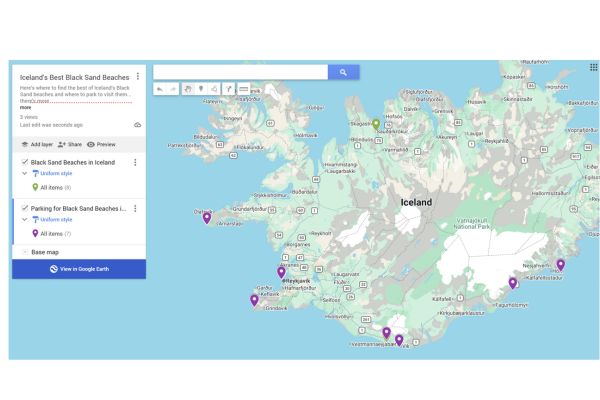
Map of Black Sand Beaches in Iceland
Here’s our map of all eight beaches in this guide, spread right across the country; you can also see the map here.
Safety Tips — Sneaker Waves
This is the most important section in this entire guide, as Iceland’s sneaker waves are truly dangerous.
A sneaker wave is an unusually large wave that arrives without warning, far beyond the normal wave line, on a beach that otherwise looks calm and predictable. Iceland’s south coast beaches are particularly prone to them: the steep drop-off just offshore, the long open stretch of the North Atlantic these waves have traveled across, and loose black volcanic sand that offers almost no grip once the water pulls back out, all combine to make them both more frequent and more dangerous here than on most beaches elsewhere in the world.
This isn’t an exaggerated warning label. People have actually died at Reynisfjara specifically because of sneaker waves, dragged into the ocean after getting too close to the waterline, sometimes with their back turned, sometimes just misjudging how far the water could reach. 6 people have died since 2013 because of this. It’s a real, recurring pattern, not a rare freak accident, and the beach has reportedly been introducing a revised warning system in response.
So rules you should abide by on these beaches (especially Reynisfjara)
- Never turn your back to the ocean, not even for a photo.
- Stay well back from the visible waterline; sneaker waves can reach dramatically further up the beach than the water currently sitting there.
- Keep a real distance from sea caves and the base of cliffs; both are common places people get caught out.
- If a wave does knock you down, the instinct to stand and run is the wrong one; staying low and getting away from the water’s pull matters more than getting upright immediately.
None of this means avoid these beaches; they’re really worth seeing. It means treat the ocean with respect and pay attention.
FAQs on Black Sand Beaches in Iceland
Got questions about Iceland’s black sand beaches? Here are quick answers to what we’re asked most.
Are all the beaches in Iceland black sand?
No, most are, given how volcanically active the country is, but there are exceptions. Ytri Tunga on Snaefellsnes (a good spot to see seals in Iceland, read my guide to Icelandic wildlife here) and Sauðárkrókur’s neighboring beaches in the north both have unusual golden sand instead.
Is Reynisfjara dangerous?
Yes, truly so. People have died here from sneaker waves. 6 in the last 13 years. It’s absolutely worth visiting, but read the safety section above properly before you go, and take it seriously once you’re there.
What’s the difference between Reynisfjara and Diamond Beach?
Reynisfjara is known for its basalt columns and sea stacks; Diamond Beach for the glacial ice chunks that wash up on its sand from the nearby lagoon. Both are on the South Coast, and both carry real sneaker wave risk.
Are Iceland’s black sand beaches safe to swim at?
No, not for recreational swimming. The water is cold, currents are strong, and sneaker waves make even standing near the water’s edge risky. These are beaches to look at and photograph, not to swim at.
Which black sand beach is closest to Reykjavik?
Grótta, at the tip of the Seltjarnarnes peninsula, just outside the city itself. It’s a completely different experience from Reynisfjara, quieter, tidal, and centered on a lighthouse rather than dramatic cliffs.
What should I know about sneaker waves?
Sneaker waves are large, unpredictable waves that can reach far beyond the normal waterline without warning. Never turn your back to the ocean, stay well back from where the water’s been reaching, and treat any black sand beach on this list with real caution, not just casual interest.
ICELAND TRAVEL RESOURCES
AIRPORT TRANSFERS
24/7 pickup & drop off. Trusted, local English speaking drivers. Prebook & prepay online with cards.
Book a Transfer
HOTELS AND APARTMENTS
See choices here
Rooms with a view? Budget rooms? Need a washing machine? The best choice of hotels & apartments.
TOURS & ATTRACTIONS
Most excursion choices, small group tours, skip-line tickets, free cancellation and top local guides.
Top options here.
CAR RENTAL OPTIONS
Choose cars here
Best choice of vehicles, automatics, large or small cars, child seats. Book early for more options.
Final Words on Black Sand Beaches in Iceland
Iceland’s black sand beaches are some of the most striking coastlines anywhere in the world, and also truly some of the most dangerous, a combination worth respecting rather than brushing past for the sake of a photo. See them, admire them, and keep your distance from the water while you do.
ASocialNomad is a participant in the Amazon Services LLC Associates Program, an affiliate advertising program designed to provide a means for sites to earn advertising fees by advertising and linking to amazon.com, amazon.co.uk, and amazon.ca. Amazon and the Amazon logo are trademarks of Amazon.com, Inc. or its affiliates. As an Amazon Associate, I earn from qualifying purchases.

