

Iceland runs on cards, not cash. That’s the short version, and it surprises a lot of people who arrive expecting to need a stack of krónur, aka ISK, for everyday spending. Card terminals sit at hot dog stands, campsite check-ins, and parking areas, not just hotels and restaurants. If you’re wondering how to pay in Iceland without overthinking it, the answer starts with your bank card and a working PIN. Here’s our guide to how to pay in Iceland…
THIS POST MAY CONTAIN COMPENSATED AND AFFILIATE LINKS MORE INFORMATION IN OUR DISCLAIMER
There’s more to get right than just “bring a card,” though. ATMs in Iceland, payment methods in Iceland, and a couple of quirks around contactless limits and petrol pumps all need a little bit of explanation so you don’t trip up. I’ll walk through whether you need cash at all, what currency to actually pay in, how cards and digital wallets work here, and the one gas station habit that catches almost every first-time driver off guard.
PRACTICAL TRAVEL TIPS
- 🛡️ Get Travel Insurance: Civitatis includes medical expenses, repatriation, theft, luggage delays. No deductibles or upfront payments. Get a quote here.
- 🛏️ Sea view? Laundry? Private bath? Book a Room.
- 🔌 Be ready for the plug, socket & power situation.
- 📶 Get online EASILY & cheaply – One eSim for the world. Data never expires
What’s the Currency in Iceland?
Iceland’s currency is the Icelandic króna, written as ISK and shown on price tags as “kr.” Banknotes come in 500, 1,000, 2,000, 5,000, and 10,000 kr denominations, and coins in 1, 5, 10, 50, and 100 kr, though the smallest coins are rarely seen in daily use. Who am I kidding? You’ll rarely see cash at all in Iceland. We saw it once. Yes. Just once. You’ll see prices quoted only in ISK almost everywhere, since dual pricing in euros or dollars isn’t the norm outside a handful of tourist-facing shops.

Do You Need Cash in Iceland?
Practically, no. Card payments are so thoroughly the default here that going a whole trip without touching cash is entirely realistic, and increasingly the norm rather than the exception. We saw the need for cash once in our trip. And the only place? This one on the Snaefellsnes Peninsula.
#1 TIP FOR CASH & CARDS

Get a WISE Card to take to on your travels. Two free ATM withdrawals per month, plus free to use to pay by card with zero foreign transaction fees.
Why You Really Don’t Need Cash in Iceland
The strongest approach isn’t to carry an emergency stash of krónur; it’s to remove the need for cash before you even land. And that helps you with a whole lot of other planning issues for Iceland. Like doing it all ahead of time. So you’ll want to prebook and prepay your accommodation, car rental, and any tours or activities in advance, so the bulk of your trip cost is already settled before you arrive.
Travel with a spare card or two, kept separately from your main wallet, in case one gets declined or lost. Set up Apple Pay or Google Pay before you leave home, since both work at the vast majority of tills, fuel pumps, and ticket machines across the country. Between prepayment, a backup card, and a digital wallet, cash stops being something you need to plan on having. There’s more on the apps that you’ll need in my guide here.
Getting Cash If You Still Want It in Iceland
If you’d still rather have some ISK in hand, use an ATM once you’ve landed rather than exchanging currency at home or at the airport kiosk, since airport exchange rates are consistently worse.
You’ll pay a fee at each ATM for withdrawing cash. There are no fee- free ATMs in Iceland, and there are around 200 ATMs in the country, and most of them charge a fixed fee and a variable fee, a percentage based on what you withdraw. There are three main banks with ATMs
- Landsbankinn: 300 ISK
- Arion Bank: 605 ISK (although this seems to be a set fee plus 1.1% of the withdrawal amount
- Islandsbanki – I have no idea what this fee is; I didn’t try it. Did you?

What Currency to Pay In When Paying by Card in Iceland
At many card terminals in Iceland, you’ll be offered a choice between paying in ISK or in your home currency.
Choose ISK every time.
That home-currency option is Dynamic Currency Conversion (DCC), and it applies an exchange rate set by the terminal’s provider rather than your card network’s rate, which is almost always worse for you. Paying in ISK hands the conversion over to your own bank instead, which is the better deal in nearly every case.
Cards & Digital Wallets in Iceland
Not every card and wallet works equally well here, and knowing in advance saves an awkward moment at the till.
Which Cards Work Everywhere in Iceland
Visa and Mastercard are accepted almost universally in Iceland, from filling stations to campsite offices. American Express has patchier coverage, and is generally limited to larger hotels and restaurants in Reykjavik rather than smaller businesses or rural areas. Discover cards are rarely accepted at all, so it’s worth having a Visa or Mastercard as your primary option regardless of what else you’re carrying.
Chip-and-PIN is essential: Know Your PIN Before You Go.
Iceland runs on chip-and-PIN, not chip-and-signature. If your card normally goes through on a signature at home (American readers, I’m looking at you here). That won’t work here, and a card you don’t know the PIN for can actually leave you stuck at a self-service till or fuel pump.
Confirm your PIN with your bank before you travel. Some banks take several days to send a reminder, so this isn’t a same-day fix if you’ve forgotten it.
Contactless & Digital Wallet Limits in Iceland
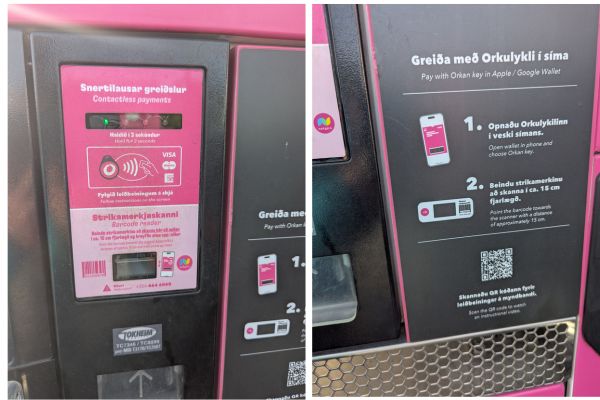
Contactless payments are widely accepted, but they come with two limits worth knowing. I’ve confirmed with Íslandsbanki, one of Iceland’s main banks, that a single contactless tap is capped at 7,500 ISK, and you can tap up to a cumulative 15,000 ISK before the terminal requires your PIN. Once you enter it, the contactless counter resets and you can go back to tapping. Apple Pay is widely accepted across shops, restaurants, and many fuel pumps. Google Pay is well supported too. Samsung Pay has much patchier coverage, so I wouldn’t rely on it as your main method.
The Petrol Pump Pre-Authorization Hold
This is the one that appears constantly in questions about Iceland. Usually a panicked comment in a Facebook Group or Reddit thread, with people scared that their card has been pre-authed for thousands of ISK.
Self-service fuel stations in Iceland (and most of them are self-service, in terms of both filling your vehicle and paying with a machine at the pump) place a temporary hold on your card before you start pumping, to confirm there’s enough available balance on it.
I’ve confirmed via Orkan’s official terms and conditions that choosing the “full tank” option can trigger a hold of up to 30,000 ISK. N1 and Olís run similar systems, generally with holds in the same range, sometimes slightly lower than Orkan’s ceiling.
This isn’t a charge, it’s a hold, and once you’ve finished pumping, only the actual cost of your fuel is deducted. The rest is released, typically very quickly, but usually within a few business days, though the exact timing depends on your bank rather than the fuel station. Don’t panic if you spot the full hold amount sitting on your statement right after filling up; it corrects itself.
Even if you opt to fill only 5,000 ISK worth of fuel, and then only manage to put in 4,000 ISK, you’ll only be charged 4,000 ISK. There’s more on driving in Iceland in my guide here.
Currency Exchange in Iceland — Is It Worth It?
Exchanging cash before you arrive, whether at your home bank or at the airport, tends to come with a worse rate than simply paying by card once you land. If you want ISK in your hands, then an ATM after arrival is the better route. For most people, skipping currency exchange altogether and relying on card and digital wallet payments is the simplest option, and increasingly the standard one.
Tipping in Iceland is its own entire topic. I’ve covered exactly where it fits, and where it truly doesn’t, in our full guide to tipping in Iceland.
FAQs on Paying in Iceland
Here are quick answers to the questions we hear most about paying for things in Iceland.
Is Iceland a cashless society?
Iceland is as close to a cashless society as we’ve seen. Card and digital wallet payments cover the vast majority of transactions, and going a full trip without using cash at all is easily achievable.
Is it best to pay in ISK or your own currency? (DCC)
Always choose ISK at the terminal. The home-currency option is Dynamic Currency Conversion, and it applies a worse exchange rate than your own bank would.
Do I need to know my PIN in Iceland?
Yes. Iceland uses chip-and-PIN rather than chip-and-signature, so confirm your PIN with your bank before you travel.
Why was I charged extra at a petrol pump in Iceland?
You likely weren’t; it’s a temporary pre-authorization hold rather than an actual charge. Self-service stations place a hold, sometimes up to 30,000 ISK, that releases once the real fuel cost is deducted. Read more in my guide to driving in Iceland
Are there ATM fees in Iceland?
There’s no standard Icelandic surcharge for foreign cards. I’ve detailed what the ATM fees are above. If you’ve got updated information on this, drop a comment, or send me an email (sarah at asocialnomad dot com) and I’ll update this for everyone else who asks.
Can I use my US or UK card everywhere in Iceland?
Visa and Mastercard, yes, almost everywhere. American Express is limited to bigger Reykjavik hotels and restaurants, and Discover is rarely accepted.
ICELAND TRAVEL RESOURCES
AIRPORT TRANSFERS
24/7 pickup & drop off. Trusted, local English speaking drivers. Prebook & prepay online with cards.
Book a Transfer
HOTELS AND APARTMENTS
See choices here
Rooms with a view? Budget rooms? Need a washing machine? The best choice of hotels & apartments.
TOURS & ATTRACTIONS
Most excursion choices, small group tours, skip-line tickets, free cancellation and top local guides.
Top options here.
CAR RENTAL OPTIONS
Choose cars here
Best choice of vehicles, automatics, large or small cars, child seats. Book early for more options.
Final Words on Paying in Iceland
Iceland’s reputation for being tricky to navigate financially isn’t real. It’s a myth. Prepay what you can – it definitely helps with planning. Bring a card, know your PIN, set up a digital wallet, and travel with a backup card, and you’ve covered nearly every situation you’ll run into. The one thing worth actually remembering is the petrol pump hold; everything else takes care of itself.
ASocialNomad is a participant in the Amazon Services LLC Associates Program, an affiliate advertising program designed to provide a means for sites to earn advertising fees by advertising and linking to amazon.com, amazon.co.uk, and amazon.ca. Amazon and the Amazon logo are trademarks of Amazon.com, Inc. or its affiliates. As an Amazon Associate, I earn from qualifying purchases.

