

Iceland’s lagoon scene has grown well past the Blue Lagoon; there’s a proper spa or bathing experience for practically every budget and mood now. This guide covers the paid, purpose-built hot springs and lagoon experiences specifically, the bucket-list ones, the quieter ones, and the ones most visitors have never heard of. If you’re after Iceland’s free, natural hot pots instead, that’s a different guide entirely, which I’ll share below. Here’s our guide to hot springs and lagoons in Iceland…
THIS POST MAY CONTAIN COMPENSATED AND AFFILIATE LINKS MORE INFORMATION IN OUR DISCLAIMER
If you’re trying to work out which of hot springs and lagoons in Iceland is actually worth your time and money, here’s the overview: why the country has so many of these in the first place, the big-name lagoons, the lesser-known ones that are just as good in different ways, how to actually pick between them, and booking tips so you don’t miss out in peak season. For the free, natural alternative to everything on this list, see our free soaking guide instead; this one is entirely about the paid, purpose-built experiences.
PRACTICAL TRAVEL TIPS
- 🛡️ Get Travel Insurance: Civitatis includes medical expenses, repatriation, theft, luggage delays. No deductibles or upfront payments. Get a quote here.
- 🛏️ Sea view? Laundry? Private bath? Book a Room.
- 🔌 Be ready for the plug, socket & power situation.
- 📶 Get online EASILY & cheaply – One eSim for the world. Data never expires
Why Iceland Has So Many Hot Springs & Lagoons
Iceland sits on top of the Mid-Atlantic Ridge, where two tectonic plates are slowly pulling apart, and that geological restlessness is exactly what makes the country so volcanically and geothermally active. I’ve got an entire post on Geothermal activities in Iceland – well beyond the scope of this post. So, back to the matter in question. Groundwater seeps down, gets heated by magma close to the surface, and rises back up as hot springs, geysers, and steam vents all over the country. Icelanders have been bathing in it for centuries; the paid lagoons on this list are really just a modern, purpose-built version of something people here have always done.
The Big-Name Lagoons in Iceland
Lagoons and Hot Springs are big business in Iceland, and they’re massively popular, so prebooking is essential in high season, especially when your time is limited in Iceland. Here’s the top lagoons and what makes them special.
The Blue Lagoon in Iceland
Iceland’s most famous lagoon, a striking milky-blue geothermal pool set in a black lava field near Grindavík, is recognized by National Geographic as one of its 25 Wonders of the World. The water is a naturally occurring blend of roughly 70% seawater and 30% freshwater, rich in silica, algae, and minerals, and it self-renews every 40 hours with nothing added. There are two ticket tiers that cover most visitors:
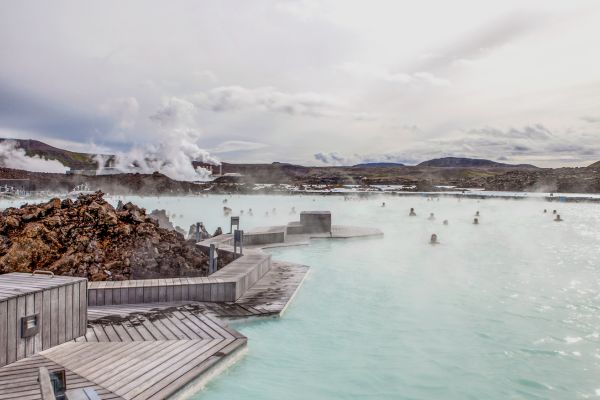
Comfort admission includes a towel, a drink, and one Silica Mud Mask; Premium admission adds a bathrobe, a trio of in-water masks, and a mask to take home.
- Address of Blue Lagoon: Norðurljósavegur 9, 240 Grindavík.
- Entry: Comfort admission from US$144, Premium admission from US$167. Book Comfort admission here or book Premium admission here.
- Opening Hours: roughly 08:00-22:00 most of the year, extending to 07:00-23:00 or later during peak summer (mid-June through August). Check the official site for the exact current schedule before you go.
- How long to spend at Blue Lagoon: 2-3 hours.
- Website: bluelagoon.com
- How to get to Blue Lagoon: about 45 minutes from Reykjavik, close to Keflavík Airport, easily combined with an arrival or departure day. Parking is free on site.
The Blue Lagoon is located on the Reykjanes Peninsula – and there’s a lot to do here
The Sky Lagoon in Iceland
Reykjavik’s own oceanside lagoon, opened in 2021, with an infinity-edge pool looking straight out to sea and a multi-step “Skjól” ritual, lagoon, cold plunge, sauna, cold mist, body scrub, steam room, and a taste of crowberry juice to finish, that’s become as much a part of the experience as the water itself.
Two passes are on offer: Saman, with shared changing facilities, from around US$119, and Sér, with private changing rooms and shower cabins, from around US$143. Either way, you get full entry and the same 7-step ritual; the difference is really just how much privacy you want when getting changed.
- Address of Sky Lagoon: Vesturvör 44-48, 200 Kópavogur, Iceland.
- Entry: Saman Pass from US$119, Sér Pass from US$143. Book Sky Lagoon tickets here.
- Opening Hours: seasonal, roughly 10:00-21:00 in winter, extending to 08:00-23:00 in summer.
- How long to spend at Sky Lagoon: 2-3 hours.
- Website: skylagoon.com
- How to get to Sky Lagoon: about 15-20 minutes from central Reykjavik, in Kópavogur.
Mývatn Nature Baths aka Earth Lagoon
North Iceland’s answer to the Blue Lagoon, milky blue geothermal water drawing on the same volcanic activity that shapes the wider Mývatn area, with noticeably smaller crowds than its southern counterpart.
You can see what it looks like here. Two main pools sit at different temperatures, plus a scattering of smaller steam-filled nooks worth seeking out if you want somewhere quieter than the main pool. The setting does a lot of the work here too, low hills and lava fields ringing the water rather than a car park, giving it a wilder feel than most geothermal lagoons on the Ring Road.
- How to get to Mývatn Nature Baths: a short drive from the lake, signposted off Route 1.
- How long to spend at Mývatn Nature Baths: 2-3 hours.
- Entry: from US$63 per person. You can prebook your tickets here.
- Parking: free on site.
Lesser-Known Lagoons & Baths
Of course there are more lagoons outside of those big-name attractions; you might have to travel a little further afield, but I promise you, it’s worth it. And so, of course, are you.
Iceland’s Secret Lagoon (Gamla Laugin)
Iceland’s oldest swimming pool, dating back to 1891, is a much simpler, more rustic setup than the Blue or Sky Lagoons, with a small geyser bubbling away right next to the pool itself, erupting every few minutes. The Secret Lagoon is less polished, considerably more atmospheric; this is the lagoon to pick if you want the geothermal soak without the design-forward extras, just warm water, a rustic wooden deck, and steam drifting across the surface.
The water temperature is around 38-40°C (100-104°F) year-round, and changing facilities are simple but perfectly adequate.
- Address of Secret Lagoon: Hvammsvegur, 845 Flúðir, Iceland.
- Entry: 4,500 ISK for adults (15+) you can check current pricing here.
- Opening Hours: winter (October-May), 10:00-19:00; summer (June-September), 10:00-20:00.
- How long to spend at Secret Lagoon: 1.5-2 hours.
- Website: secretlagoon.is
- How to get to Secret Lagoon: near Flúðir, in the Golden Circle area, about 90 minutes from Reykjavik.
Iceland’s Fontana / Laugarvatn
A quick note before you plan around this one: Fontana closed in October 2025 for a major renovation and expansion, and fully reopened on August 1, 2026, with new geothermal pools reaching directly into Lake Laugarvatn and a panoramic sauna added to the site.

The Geothermal Bakery Tour, baking rye bread the traditional way using the ground’s natural heat, continued to run daily throughout the closure, so it was still worth a stop even before the baths themselves reopened. It’s a lakefront spa built around natural steam baths rising straight up through the ground, alongside outdoor mineral pools and a sauna, right on the shore of Laugarvatn, and the steam baths specifically are the reason to come, a really different sensation from a standard geothermal pool.
Even before the baths reopen, the Geothermal Bakery Tour is worth booking on its own; watching rye bread come out of the ground is a memorable stop regardless of whether you’re soaking that day.
- Address of Fontana: Hverabraut 1, 840 Laugarvatn, Iceland.
- Entry: 7,490 ISK for adults, 4,990 ISK for youth (6-15), children 5 and under free; these are the new post-renovation prices.
- Opening Hours: daily, 10:00-21:00.
- How long to spend at Fontana: 1.5-2 hours.
- Website: fontana.is
- How to get to Fontana: in Laugarvatn, in the Golden Circle area, about 75-90 minutes from Reykjavik.
GeoSea (Húsavík)
Geothermal sea baths perched on a cliff above Skjálfandi Bay in Húsavík, with a view out over the water where you might spot a whale between soaks. The infinity-edge design means the pools appear to run straight into the bay itself, and with three separate temperature pools plus a swim-up bar, it’s built for lingering rather than a quick dip.
Sunset visits are worth planning around if your schedule allows; of course, during summer that would be pretty late, but the light over the bay at that hour is one of the better views in this area.
- Address of GeoSea: Vitaslóð 1, 640 Húsavík, Iceland.
- Entry: from US$59 per person. Prebook GeoSea entry tickets here.
- Opening Hours: daily, roughly 10:00 until midnight.
- How long to spend at GeoSea: 1.5-2 hours.
- Website: geosea.is
- How to get to GeoSea: on the outskirts of Húsavík.
Vök Baths (East Iceland)
Vök Baths is East Iceland’s answer to the Blue Lagoon, modern geothermal pools floating directly on Lake Urriðavatn near Egilsstaðir, Iceland’s only floating geothermal pools. (My guide to East Iceland is here) The name means “ice-free,” an old word for the patch of open water that never quite freezes on the lake even in the depth of winter, which is exactly what first drew attention to the site. A main pool sits alongside two smaller floating pools out on the water itself; temperatures across the baths range from about 38-41°C (100-106°F), with a roughly 50°C (122°F) sauna and a cold mist tunnel at the other end of the scale if you want the full contrast.
- Address of Vök Baths: Vök by Lake Urriðavatn, 701 Egilsstaðir, Iceland.
- Entry: from $61 per person. Prebook your tickets here.
- Opening Hours: seasonal, roughly 10:00-21:00 in winter, extending to 10:00-23:00 in summer. Check the official site for the exact current schedule before you go.
- How long to spend at Vök Baths: 1.5-2 hours.
- Website: vokbaths.is
- How to get to Vök Baths: on Lake Urriðavatn, a short drive from Egilsstaðir.
- Parking: free on site.
Iceland’s Forest Lagoon (Skógarböðin)
A newer geothermal spa tucked into Vaðlaskógur forest just across the fjord from Akureyri, with sweeping views over Eyjafjörður from the pools themselves. It’s become one of North Iceland’s most talked-about additions, a proper reason to linger in the Akureyri area a little longer.
Two pools connect to swim-up bars, a Finnish-style dry sauna delivers the same fjord views, and a cold plunge pool rounds out the hot-cold routine. You can prebook your visit to the Forest Lagoon here.
- Address of Forest Lagoon: Vaðlaskógur, 605 Akureyri, Iceland.
- Entry: tiered by inclusions, from 7,490 ISK for basic entry up to 11,210 ISK for entry with towel and two drinks.
- Opening Hours: daily, roughly 09:00-10:00 until midnight.
- How long to spend at Forest Lagoon: 2-3 hours.
- Website: forestlagoon.is
- How to get to Forest Lagoon: about a 5-minute drive from central Akureyri, across the fjord in Eyjafjarðarsveit.
Krauma Spa
A modern geothermal bath complex sitting right beside Deildartunguhver, the most powerful hot spring in Europe by flow rate. Krauma blends the spring’s boiling water with cold glacial runoff to fill five pools of varying temperature, plus a cold plunge and two saunas, a properly well-designed, unrushed soak rather than a single big pool.
It’s the natural stop if you’re already doing the Silver Circle, West Iceland’s quieter answer to the Golden Circle, and want a spa break that isn’t the Blue Lagoon detour back toward Reykjavik.
- Address of Krauma: Deildartunguhver, 320 Reykholt í Borgarfirði, Iceland.
- Entry: from 7,900 ISK for adults; sources vary by season and package, worth confirming at booking.
- Opening Hours: daily, 11:00-21:00.
- How long to spend at Krauma: 1.5-2 hours.
- Website: krauma.is
- How to get to Krauma: near Reykholt in West Iceland, about 90 minutes from Reykjavik, in the same area as the Silver Circle.
Map of Iceland’s Hot Springs and Lagoons
Here’s our map of every lagoon in this guide; you can also see the map here.

How to Choose Which Lagoon to Visit
If you want the classic, bucket-list version, the Blue Lagoon still delivers the entire experience, despite the crowds. If you’d rather stay closer to Reykjavik with a more design-forward experience, Sky Lagoon is the one. If you want something quieter and more rustic, the Secret Lagoon or Fontana both fit, and if you’re already up in North Iceland or East Iceland, Mývatn Nature Baths, GeoSea, Forest Lagoon, and Vök Baths all mean you don’t need to backtrack south for a proper soak. Krauma is the pick if you’re doing the Silver Circle and want a spa stop that isn’t the Blue Lagoon detour.
Hot Spring and Lagoon Booking Tips
Book the Blue Lagoon and Sky Lagoon well ahead in peak season; both regularly sell out specific time slots days or weeks in advance during summer. The smaller, lesser-known options on this list are more forgiving; walk-ins are often possible outside of July and August, but booking ahead still isn’t a bad habit to get into anywhere on this list.
FAQs on Hot Springs & Lagoons in Iceland
Got questions about Iceland’s hot springs and lagoons? Here are quick answers to what we’re asked most.
Do I need to book the Blue Lagoon in advance?
Yes, essentially always, especially in summer. Walk-ins aren’t accepted; every visit needs a pre-booked time slot. Book your visit here.
What’s the difference between the Blue Lagoon and Sky Lagoon?
The Blue Lagoon is further out near Grindavík, with the milky-blue water Iceland’s become famous for. Sky Lagoon is much closer to Reykjavik, oceanfront rather than lava-field, and built around its multi-step Skjól ritual rather than the water color itself. Both are truly worth doing; they’re different experiences rather than one being a lesser version of the other.
Are Iceland’s lagoons natural or man-made?
A mix. The geothermal water itself is entirely natural, drawn from real hot springs, but the pools, facilities, and infrastructure around most of these, the Blue Lagoon and Sky Lagoon especially, are purpose-built. The Secret Lagoon leans more toward the natural end of that spectrum than most.
Can I visit a lagoon without booking ahead?
For the Blue Lagoon and Sky Lagoon, no, you must book ahead. For most of the smaller options on this list, walk-ins are often fine outside peak summer, though booking ahead is still the safer habit.
What should I bring to an Icelandic lagoon?
A swimsuit, a towel (some venues rent them, some don’t), flip-flops for the changing rooms, and a hair tie if you’ve got long hair; the mineral-rich water isn’t kind to it. Most places provide shower facilities and require you to shower without a swimsuit beforehand, a real Icelandic norm, not optional.
Are lagoons open year-round?
Yes, every lagoon on this list operates year-round, though hours often shift shorter in winter and longer in summer. Winter actually has its own appeal; soaking in hot water while snow falls around you is one of Iceland’s better contrasts.
ICELAND TRAVEL RESOURCES
AIRPORT TRANSFERS
24/7 pickup & drop off. Trusted, local English speaking drivers. Prebook & prepay online with cards.
Book a Transfer
HOTELS AND APARTMENTS
See choices here
Rooms with a view? Budget rooms? Need a washing machine? The best choice of hotels & apartments.
TOURS & ATTRACTIONS
Most excursion choices, small group tours, skip-line tickets, free cancellation and top local guides.
Top options here.
CAR RENTAL OPTIONS
Choose cars here
Best choice of vehicles, automatics, large or small cars, child seats. Book early for more options.
Final Words on Hot Springs & Lagoons in Iceland
There’s a lagoon here for every budget and every mood: a bucket-list milky-blue classic, a design-forward oceanfront ritual, a rustic 1891 pool with a geyser next door, or a quiet forest spa most visitors have never heard of. Pick based on where you already are and what kind of soak you actually want, not just the name you recognize.
ASocialNomad is a participant in the Amazon Services LLC Associates Program, an affiliate advertising program designed to provide a means for sites to earn advertising fees by advertising and linking to amazon.com, amazon.co.uk, and amazon.ca. Amazon and the Amazon logo are trademarks of Amazon.com, Inc. or its affiliates. As an Amazon Associate, I earn from qualifying purchases.

