
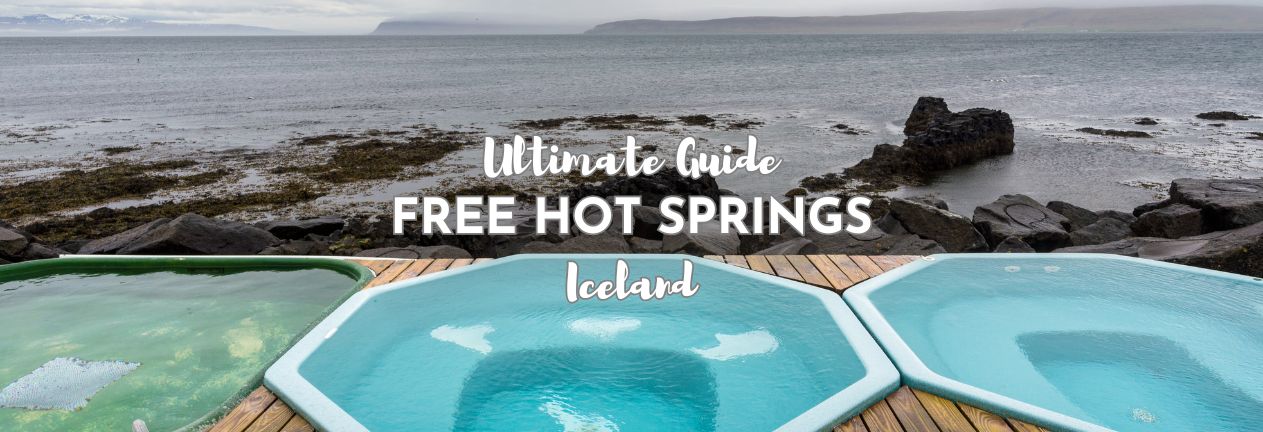
Not every great soak in Iceland comes with an entrance fee. The Blue Lagoon and Sky Lagoon get most of the attention, but scattered across the country are natural hot springs, rivers, and hot pots where the water is just as warm, and the price tag is zero. Here’s our guide to free hot springs in Iceland…
THIS POST MAY CONTAIN COMPENSATED AND AFFILIATE LINKS MORE INFORMATION IN OUR DISCLAIMER
Some of these take a bit of a hike, others are right by the road, and a couple come with a small donation box rather than a real ticket price. We’ll cover what “free” actually means at each of these spots, run through the best free hot pools in Iceland one by one, and finish with what to actually bring so you get the full experience once you get there.
PRACTICAL TRAVEL TIPS
- 🛡️ Get Travel Insurance: Civitatis includes medical expenses, repatriation, theft, luggage delays. No deductibles or upfront payments. Get a quote here.
- 🛏️ Sea view? Laundry? Private bath? Book a Room.
- 🔌 Be ready for the plug, socket & power situation.
- 📶 Get online EASILY & cheaply – One eSim for the world. Data never expires
What “Free” Really Means in Iceland
“Free” doesn’t always mean untouched. A handful of these spots have a small honesty box for upkeep, and none of them come with the changing rooms, showers, or staff you’d find at a paid lagoon. “Free” also doesn’t always mean free parking, so I’ve included all these details so that you can manage your expectations accordingly: you’re trading the high ticket (but seriously once in a lifetime) experiences you’ll get at Iceland’s Hot Springs and Lagoons (read my guide here) for the kind of experience you can’t book a ticket for.
The Free (or Nearly Free) Spots
Here’s every one free (or nearly free) hot spring spot worth planning a stop for, roughly in order of how much effort it takes to reach them.
The Reykjadalur Hot Spring River
Reykjadalur means “Steam Valley,” and it earns the name. A hot river runs down through a geothermal valley near the town of Hveragerði, and once you’ve made the hike in, from the parking area, you can bathe in it for free. It’s become one of the most-loved free soaking spots in the country precisely because it delivers a real hot-river experience for the cost of a hike rather than an entrance fee. Walk upstream a little if the water where you enter feels too cool, and downstream if it’s running too hot; the temperature shifts noticeably along the river’s length. I’ve included this as an optional hike in my 7 day Iceland itinerary
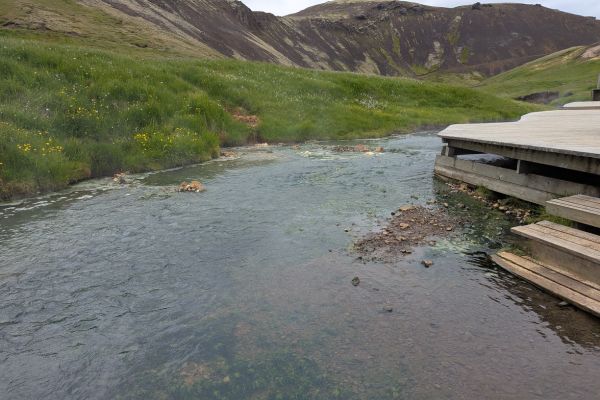
You will need to pay for parking here, unless you’ve parked on the side of the road back down in Hveragerði, but that will add a couple of kilometers to your hike. It’s worth spending a little time in town too, read about it in my guide to Geothermal Iceland here.
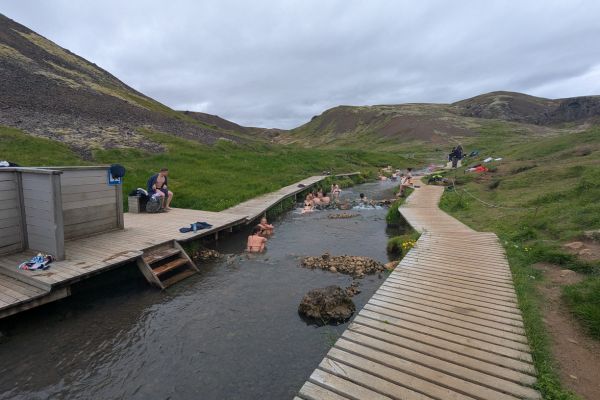
It takes about an hour to hike UP, yes, UP to the hot river. There is a well-marked trail, and while there’s loose gravel in places, that will trouble you more on the way back down. Don’t want to hike? Ride an Icelandic Horse up there instead.
- How to get to Reykjadalur: Take Route 1 out of Reykjavik and head southeast. It takes about 40 minutes to reach the town of Hveragerði. At the first roundabout, take the third exit and follow signs toward the Reykjadalur valley, where you’ll find the parking area that marks the start of the hike.
- How long to spend at Reykjadalur: Plan on 2 hours minimum, including the hike in and out, more if you spend a while soaking.
- Entry to Reykjadalur: Free, open year-round, though the hike is best tackled outside deep winter conditions.
- Parking at Reykjadalur: 300 ISK first hour, 1,000 ISK up to 5 hrs, payable via kiosk or the Parka app.
Seljavallalaug
Tucked into a quiet valley near the Eyjafjallajökull glacier, Seljavallalaug is one of Iceland’s oldest swimming pools, built in 1923 and, for over a decade, the largest in the country. The pool is fed by a trickle from the mountainside forming one of its walls, so the water is lukewarm rather than hot, and green algae is a regular feature rather than an exception.
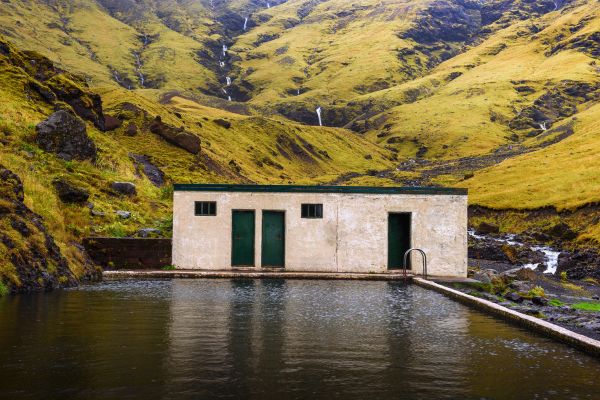
It’s still worth the walk in; there’s something about swimming laps with a mountain wall as one side of the pool that no paid lagoon replicates.
- How to get to Seljavallalaug: Turn onto Road 242 off the Ring Road, then walk 15 to 20 minutes from the parking area.
- How long to spend at Seljavallalaug: Plan on 40 minutes to walk round trip from the parking area, plus however long you spend in the water.
- Entry to Seljavallalaug: Free.
- Parking at Seljavallalaug: Free parking.
Landmannalaugar
Landmannalaugar is located high in the Fjallabak Nature Reserve, in the Icelandic Highlands, and it’s the hardest of this list to reach, accessible only in summer, and only by F-road or highland bus. The reward for the effort is a proper wild bathing area where a warm spring mixes with a cold river, letting you find your own comfortable spot in the current. Although don’t let that fool you into thinking you’ll have the place to yourself. Far from it.
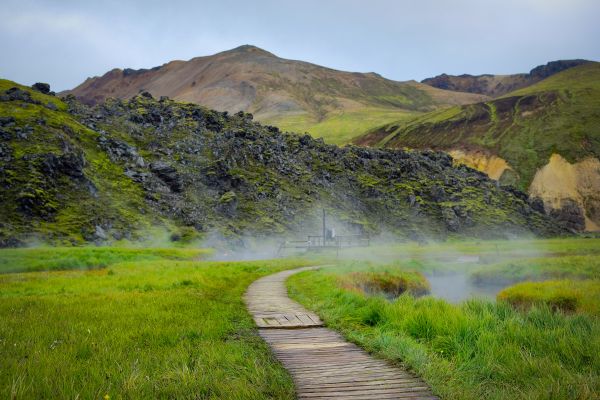
This is a very popular place, and it’s as much a hiking destination as a soaking one; people often arrive here at the end of a multi-day trek through the surrounding mountains, and the hot spring is the reward waiting at the end of it.
If you don’t have a 4×4 for driving in the highlands, you can take a tour to hike up here and enjoy the hot spring.
- How to get to Landmannalaugar: By F-road in a 4×4 (F208 or F224, both closed outside summer), by highland bus from Reykjavik, or book a hiking and hot spring tour.
- How long to spend at Landmannalaugar: Half a day at minimum if you’re combining the springs with any of the surrounding trails.
- Entry to Landmannalaugar: Free to bathe; the adjacent campsite charges a small fee for its facilities. (1,100 ISK for a shower, tent camping 3,400 ISK)
- Parking at Landmannalaugar: 1,500 ISK for parking (payable via Parka app); you can also reserve parking here.
Drangsnes Hot Pots
Drangsnes is a small fishing village in the Westfjords, and right on its waterfront sit three hot tubs looking straight out over the fjord toward the island of Grímsey. There’s no dramatic hike here, just a short walk from the village itself, which makes this one of the easiest wild soaks on the whole list once you’ve actually made it out to the Westfjords. My guide to the Westfjords is here.
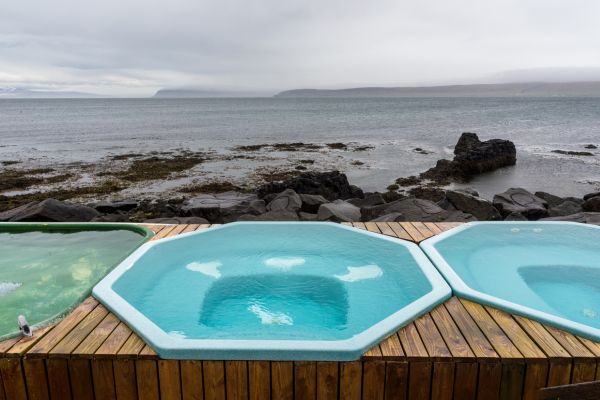
Use of the hot pots is free, but please do donate to support their ongoing maintenance.
- How to get to Drangsnes Hot Pots: In the village of Drangsnes, on the western side of the Westfjords, a short walk from the main road.
- How long to spend at Drangsnes Hot Pots: 45 minutes to an hour.
- Entry to Drangsnes Hot Pots: Free. You can take a shower before or afterwards across the road for 1,200 ISK per person (payable with card or cash).
- Parking at Drangsnes Hot Pots: Free, on the street beside the tubs.
Grotta Lighthouse Footbath aka Kvika Footbath
Grotta is different from everything else on this list; it’s a footbath, not a pool, so don’t plan on a full soak here. Set on the Seltjarnarnes peninsula at the edge of Reykjavik, the Kvika footbath is a small, heated basin right beside the lighthouse, built for exactly one thing: sitting on the edge, feet in the warm water, watching the sun go down over the sea. It’s an easy add-on if you’re already in the city and don’t want to drive anywhere for a soak.
One thing to know before you go: Grotta sits inside a tidal area, and the causeway out to the lighthouse floods at high tide. Check tide times before you head out, since the footbath itself and the path to it aren’t accessible when the water’s in.
- How to get to Grotta: On Seltjarnarnes, a short drive or walk from downtown Reykjavik.
- Entry to Grotta: Free.
- Parking at the Lighthouse Parking:Free
Low-Cost Hot Tubs and Soaks in Iceland
If a hike doesn’t appeal, or the wild spots above are fully booked by weather or tide, Iceland’s town swimming pools are the cheap, no-fuss alternative most people overlook entirely.
Nearly every town in the country, however small, runs its own heated swimming pool with attached hot tubs, part of daily life here rather than a tourist add-on. Entry is cheap, and unlike the wild spots above, you get an actual changing room, a shower, and someone on-site if anything goes wrong. It’s a properly different kind of experience from a natural hot spring, less scenery, more routine, but it’s a real part of Icelandic culture and a reliable backup when the weather turns.
Hofsós Swimming Pool, up in Skagafjörður, is a great example of what these small-town pools offer: a cliff-edge pool overlooking the fjord, paired with a hot tub, for 1,400 ISK for adults and 426 ISK for children aged 6 to 17 (free under 6). I’ve covered it in full in our Skagafjörður & Tröllaskagi guide, alongside the rest of that route.
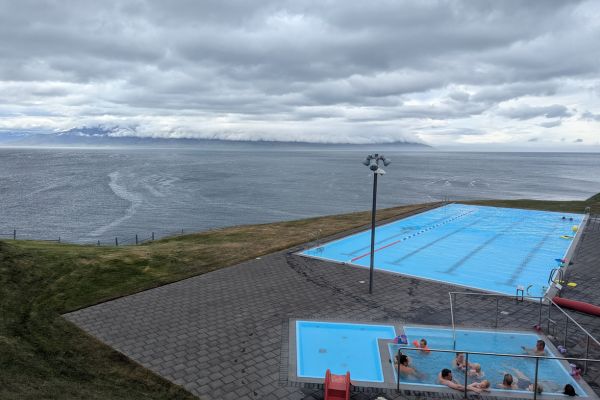
Reykjavik has its own versions of the same idea on a bigger scale: multiple outdoor pools with a run of hot tubs at different temperatures, steam rooms, and a truly social atmosphere. Icelanders use these as a place to meet and talk as much as to swim. If you’re staying in the city for any length of time, a visit to one of the local pools is worth it even if you’ve already ticked off a lagoon or two.
Map of Free Hot Springs in Iceland
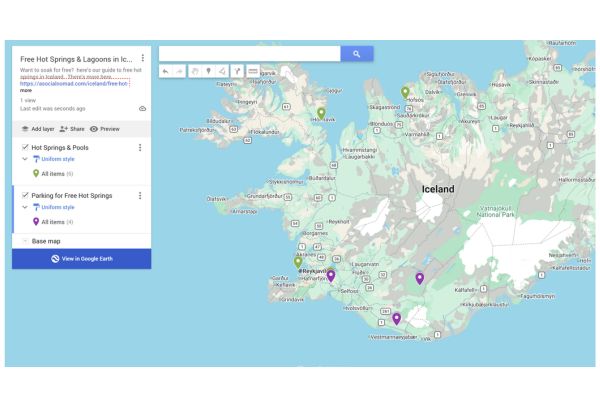
Here’s our map of every stop covered above; you can also see the map here.
What to Bring & Hot Spring Etiquette in Iceland
Bring a towel, and footwear you don’t mind getting wet or muddy on the walk into the pool; flip-flops work well for most of these, but you’ll need proper hiking shoes or boots to get to the hot spring pool area. Leave-no-trace applies fully: take your rubbish with you, don’t leave clothing or gear behind, and treat any donation box as exactly that, an actual contribution to keeping the site open for the next person. In the main, Iceland is cash-free (read my guide here), but these places are where you might actually want a few krona.
FAQs on Free Hot Springs in Iceland
Here are quick answers to the questions we hear most about free hot springs in Iceland.
Are natural hot springs in Iceland really free?
Some of them, yes. A few have a small donation box for upkeep, and parking sometimes carries a fee even when the spring itself doesn’t. We’ve taken one that we visited off this list (you can read about it here), as access was recently closed to it.
Is Reykjadalur hard to hike to?
No, it’s not technically difficult, but it is a real hike, about 3 kilometers (1.9 miles) uphill, taking roughly an hour each way. No special gear needed, just reasonably sturdy shoes.
Do free hot springs have changing facilities?
Rarely, and when they do, it’s usually just a basic hut or boarded-off area rather than a proper changing room. Plan to arrive already dressed for the water where you can. Here’s a photo of what the facilities are like at the Reykjadalur hot river.
Is it safe to soak in natural hot springs?
Generally, yes, but check the temperature with your hands before getting in, since it can vary a lot from spot to spot and even within the same pool.
Are Iceland’s swimming pools worth visiting if I’m not into hot springs?
Yes. They’re part of daily life here, not just a soaking alternative, and worth a visit for the experience alone, hot springs aside.
Can you visit free hot springs in winter?
Some, like Drangsnes and Seljavallalaug, stay accessible year-round. Others, especially Landmannalaugar, are only reachable in summer.
ICELAND TRAVEL RESOURCES
AIRPORT TRANSFERS
24/7 pickup & drop off. Trusted, local English speaking drivers. Prebook & prepay online with cards.
Book a Transfer
HOTELS AND APARTMENTS
See choices here
Rooms with a view? Budget rooms? Need a washing machine? The best choice of hotels & apartments.
TOURS & ATTRACTIONS
Most excursion choices, small group tours, skip-line tickets, free cancellation and top local guides.
Top options here.
CAR RENTAL OPTIONS
Choose cars here
Best choice of vehicles, automatics, large or small cars, child seats. Book early for more options.
Final Words on Free Hot Springs in Iceland
Some of the best experiences in Iceland cost nothing at all. A hot river in a steam valley, a pool built into a cliff, three tubs looking out over a fjord- none of these need a booking or a ticket, just a bit of effort to reach them. Between the wild spots and the town pools, there’s a free (or nearly free) soak within reach of almost anywhere you’ll travel in Iceland.
ASocialNomad is a participant in the Amazon Services LLC Associates Program, an affiliate advertising program designed to provide a means for sites to earn advertising fees by advertising and linking to amazon.com, amazon.co.uk, and amazon.ca. Amazon and the Amazon logo are trademarks of Amazon.com, Inc. or its affiliates. As an Amazon Associate, I earn from qualifying purchases.

