
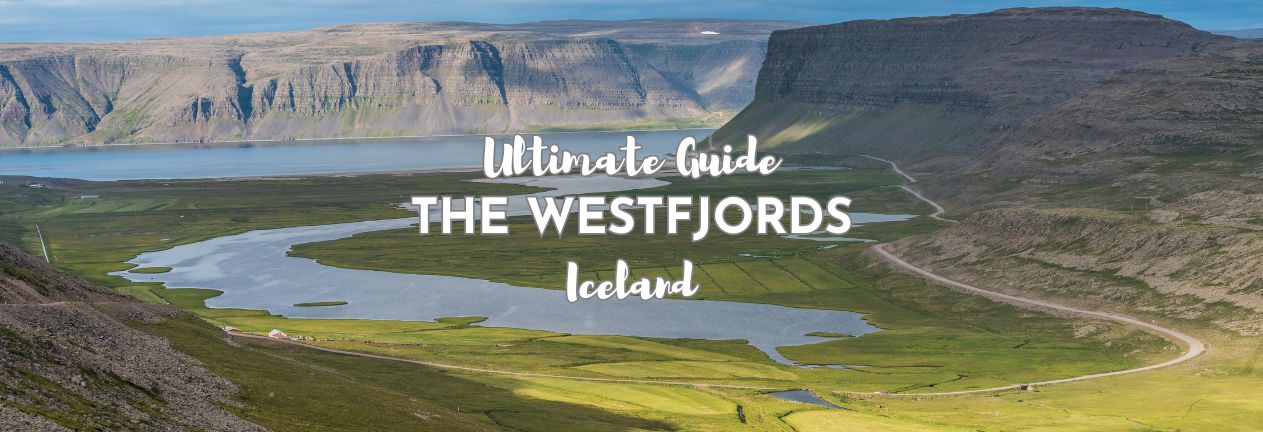
Only about one in ten visitors to Iceland ever makes it to the Westfjords, although Isafjordur, the largest settlement in the area, receives regular cruise ship traffic. This is the country’s most remote major region, a peninsula of fjords, mountains, and small fishing villages that sits well off the Ring Road, reachable only if you actually commit the time to get here. Here’s our guide to Iceland’s Westfjords…
THIS POST MAY CONTAIN COMPENSATED AND AFFILIATE LINKS MORE INFORMATION IN OUR DISCLAIMER
If you’re planning a trip to Iceland’s Westfjords, here’s everything this guide covers: the natural highlights, the region’s excellent scattering of hot springs, its towns and villages, its surprisingly rich museum scene, how to actually get here, where to stay, and where to eat.
PRACTICAL TRAVEL TIPS
- 🛡️ Get Travel Insurance: Civitatis includes medical expenses, repatriation, theft, luggage delays. No deductibles or upfront payments. Get a quote here.
- 🛏️ Sea view? Laundry? Private bath? Book a Room.
- 🔌 Be ready for the plug, socket & power situation.
- 📶 Get online EASILY & cheaply – One eSim for the world. Data never expires
What to See in the Westfjords
Your visit to Iceland’s Westfjords will be very personal, and there are stops that you’ll want to make that I don’t, so I’ll cover the basics. These are the five stops that make up the natural heart of this region, and each one is worth real time.
Dynjandi
Dynjandi is often called the “Jewel of the Westfjords,” and isn’t one waterfall but a whole cascade of them, running down a mountainside in a fan shape that widens as it falls. The main drop is about 100 meters (328 feet); it’s narrow at the top and spreads out into a soft, veil-like curtain of water by the time it reaches the bottom.
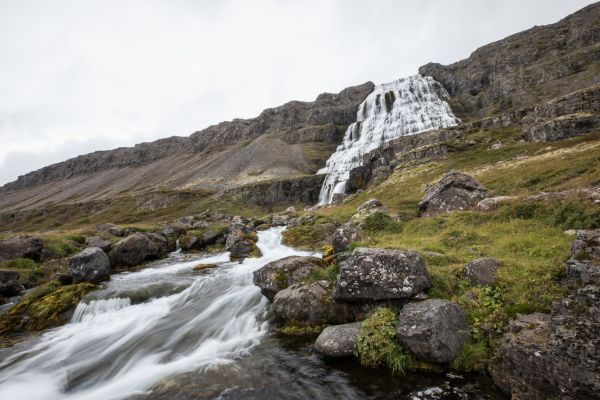
A short marked trail climbs past a series of smaller waterfalls beneath it; each one is worth a pause, if just for breath, if nothing else, on the way up. If you’re visiting Iceland to check out its waterfalls, then be sure to read my guide here.
- How to get to Dynjandi: on Road 60 in the Westfjords, a short detour off the main coastal route.
- How long to spend at Dynjandi: 30-45 minutes for the main viewpoint, longer if you walk the full trail past all the smaller falls.
- Entry to Dynjandi: free.
- Parking at Dynjandi: free at the trailhead lot, restrooms open in summer only.
Látrabjarg
Látrabjarg is Europe’s largest bird cliff, a wall of rock stretching 14 kilometers (8.7 miles) and rising to 440 meters (1,440 feet) above the sea. It’s home to more than a million seabirds in summer, including one of the best places in the world to see puffins up close. It’s also the westernmost point of Iceland, and one of the westernmost points in Europe entirely.
Puffins share these cliffs with several other species that nest here each summer: razorbills, in one of the largest colonies of their kind anywhere in the world, alongside common guillemots, Brünnich’s guillemots, northern fulmars, and black-legged kittiwakes. All of them return each spring to nest on these ledges, and by midsummer the cliff face is dense with birds.
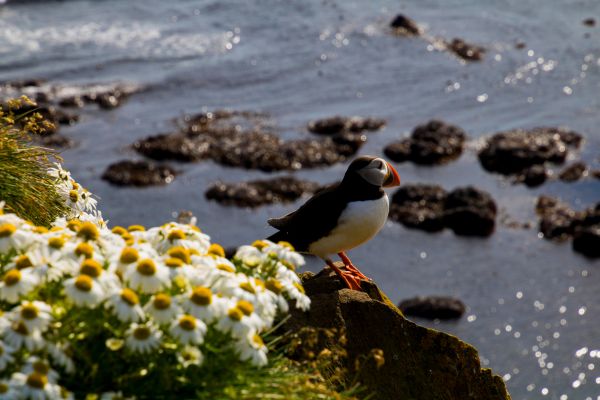
Late April through mid-August is the best window, with birds tucked into burrows along the grassy upper edges rather than out on the open rock face. No tour is required; well-marked paths run along the top, though The Grand West tour pairs Látrabjarg with Rauðasandur in one guided day if you’d rather not self-drive. For full details on the best time of year and other places to spot them, see our guide to puffins in Iceland.
In 1947, the British trawler Dhoon crashed into the rocks below the cliffs, and local farmers, experienced climbers from working these cliffs for generations, descended on ropes and rescued all twelve survivors, one of the more remarkable rescue stories in Icelandic maritime history.
- How to get to Látrabjarg: by car via gravel roads from Patreksfjörður, the nearest settlement and main base for visiting.
- How long to spend at Látrabjarg: 1-2 hours, longer if you’re serious about birdwatching.
- Entry to Látrabjarg: free.
- Parking at Látrabjarg: free at the car park, from where a trail runs along the clifftop.
Rauðasandur Beach
Rauðasandur means “red sand,” and this is a warm, reddish-gold beach in a country famous for black volcanic sand. The color comes from crushed red and pink shells mixed into the sand, shifting tone with the light, sometimes soft and golden, sometimes deep copper under cloud cover. The beach stretches about 10 kilometers (6.2 miles), and walking its full length means crossing a shallow stream that you’ll need to be wearing proper boots for.
- How to get to Rauðasandur: near Látrabjarg, about an hour’s drive from Patreksfjörður.
- How long to spend at Rauðasandur: 1-2 hours.
- Entry to Rauðasandur: free.
- Parking at Rauðasandur: free.
Hornstrandir Nature Reserve
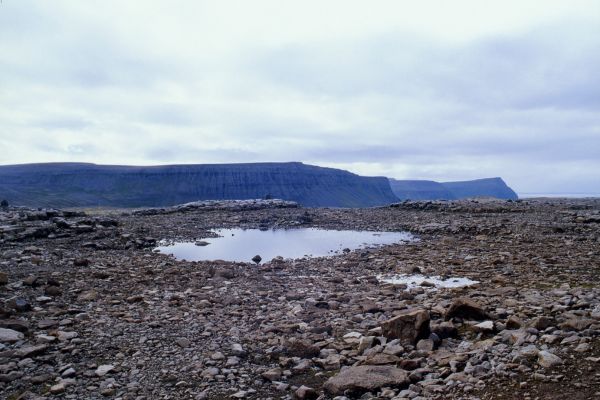
Hornstrandir is about as remote as Iceland gets, uninhabited since the 1950s, reachable only by boat, and one of the best places in the entire country to see Arctic foxes in the wild. There’s more on Arctic foxes in Iceland in my guide to Icelandic wildlife here. With no permanent human presence and no grazing animals, the reserve’s Arctic flora and wildlife have thrived largely undisturbed, and the foxes here are noticeably less shy of people than anywhere else in Iceland. Seabird cliffs, seals, and even the occasional whale round out the wildlife on offer.
- How to get to Hornstrandir: by boat from Ísafjörður; there’s no road access at all.
- How long to spend at Hornstrandir: a full day at minimum; guided hiking tours typically run as day trips with a boat transfer included.
- Entry to Hornstrandir: free, though boat transfers and guided tours are ticketed separately.
- Parking at Hornstrandir: free in Ísafjörður at the departure point.
Flatey Island
Flatey sits in Breiðafjörður Bay, roughly halfway between the Westfjords and Snaefellsnes, and it’s a truly different pace of place, car-free, with a single dirt road, and a real sense that time has stopped somewhere in the last century. The island was once an important medieval cultural and religious center, and it lends its name to Flateyjarbók, one of Iceland’s most significant medieval manuscripts.
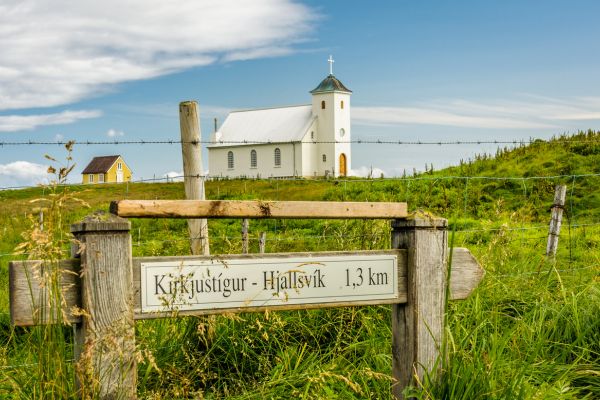
A small, preserved village of colorful old houses and a church with a striking fresco make for a peaceful stop on the ferry crossing. In summer, the Baldur ferry runs twice daily from Stykkishólmur (once on Saturdays), with every sailing stopping at Flatey along the way. Check the current sailing schedule here before you go, and book ahead specifically if you want to break your journey on the island, since a Flatey stop needs reserving in advance rather than just showing up.
- How to get to Flatey: via the Baldur Ferry between Stykkishólmur and Brjánslækur, which stops at Flatey along the way.
- How long to spend at Flatey: a half day if you break your ferry journey here; the island itself is only about 2 kilometers by 1 kilometer.
- Entry to Flatey: free to visit, ferry fare applies.
- Parking at Flatey: not applicable, the island is car-free.
Hot Springs in the Westfjords
This region has one of the best scatterings of natural and small-scale hot springs anywhere in Iceland, most of them free, all of them worth the detour. It’s worth knowing before you start: “laug” is the Icelandic word for a hot spring or pool, and it shows up in most of the names on this list, Hellulaug, Reykjafjarðarlaug, and Krossneslaug included, so half these names already tell you what you’re looking at once you know the word.
Hellulaug
A small natural pool near Flókalundur in the southern Westfjords, right on the coast with open ocean views, especially beautiful at sunset. It’s one of the easiest hot springs in the region to reach, just a short walk from the parking area.
- How to get to Hellulaug: near Flókalundur, a short walk from the roadside parking area.
- How long to spend at Hellulaug: 30-45 minutes.
- Entry to Hellulaug: free, open year-round; a donation box is on site for maintenance costs.
- Parking at Hellulaug: free.
Reykjafjarðarlaug
A geothermal pool complex in Reykjafjörður, in the northern Westfjords, with both a man-made hot tub and a small swimming pool fed by natural hot water, plus basic changing facilities on site.
- How to get to Reykjafjarðarlaug: right next to Road 63, about 19 kilometers (12 miles) from Bíldudalur.
- How long to spend at Reykjafjarðarlaug: 45-60 minutes.
- Entry to Reykjafjarðarlaug: free.
- Parking at Reykjafjarðarlaug: free.
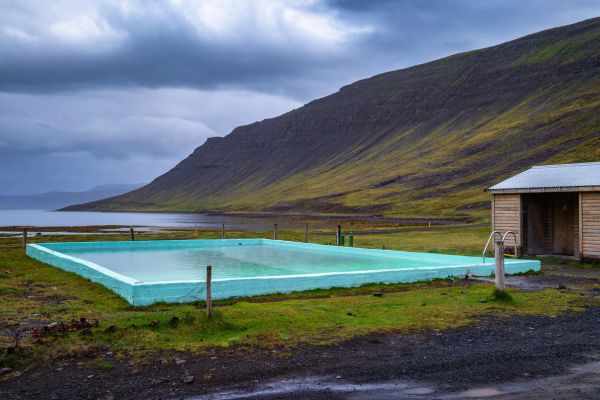
Pollurinn
A simple, local-style hot pot near the village of Tálknafjörður, overlooking the fjord and surrounding mountains, popular with both locals and visitors passing through the southern Westfjords.
- How to get to Pollurinn: near Tálknafjörður, in the southern Westfjords.
- How long to spend at Pollurinn: 30-45 minutes.
- Entry to Pollurinn: free.
- Parking at Pollurinn: free.
Krossneslaug
One of the most remote hot springs in the entire country, sitting right on the edge of the Atlantic on the Strandir Coast near Norðurfjörður. The long drive to reach it is properly part of the experience, and the payoff is a pool where sea and sky meet at the horizon.
- How to get to Krossneslaug: on the Strandir Coast, near the small village of Norðurfjörður, in the northern Westfjords.
- How long to spend at Krossneslaug: 45-60 minutes.
- Entry to Krossneslaug: a small entrance fee applies, helping maintain the facility.
- Parking at Krossneslaug: free.
Drangsnes Hot Tubs
This collection of three small geothermal hot tubs sits directly on the shoreline in the coastal village of Drangsnes, with views over the fjord and nearby islands. They’re a favorite for northern lights viewing in the colder months, right by the water with almost nothing blocking the sky. They feature in my guide to free hot springs and tubs in Iceland.
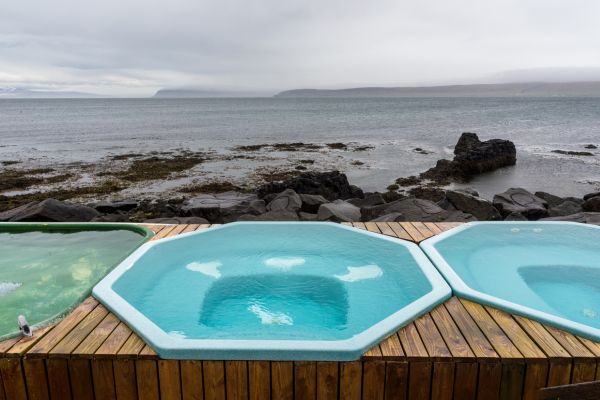
- How to get to Drangsnes Hot Tubs: in the village of Drangsnes, on the eastern Strandir Coast.
- How long to spend at Drangsnes Hot Tubs: 30-45 minutes.
- Entry to Drangsnes Hot Tubs: free, open year-round.
- Parking at Drangsnes Hot Tubs: free.
Towns & Villages in the Westfjords
The Westfjords aren’t just landscapes to visit; they’re working fishing towns and villages, each with its own real character, scattered along the fjords.
Ísafjörður
Known as the “Capital of the Westfjords,” Ísafjörður is home to around 2,700 people and offers the widest range of accommodation, restaurants, and services in the region. Well-preserved buildings dating back to the 18th century give parts of town a truly old-world feel, and the fjord setting makes it a natural base for kayaking, hiking, and biking. It’s also the departure point for boat trips into Hornstrandir.
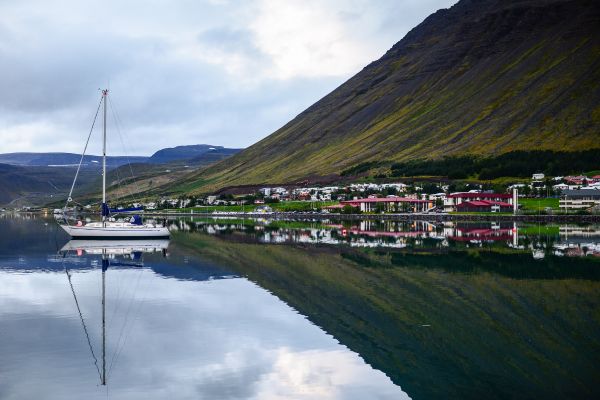
Top things to see in Ísafjörður
Beyond the museums and the hike up to Naustahvilft, Ísafjörður is delightful, a slow wander through its old harbor streets just as much as any single stop.
- Naustahvilft (the Troll Seat): a huge crescent-shaped bite out of the mountainside above town, reached by a steep but manageable hike, with one of the best views over the fjord in the region.
- Neðstikaupstaður Old Town: a cluster of 18th-century wooden buildings by the harbor, among the oldest in Iceland, home to the Westfjords Heritage Museum and a handful of small shops.
- Dokkan Brugghús: a local brewery and taproom right on the waterfront, a good stop for a pint after a day outdoors.
- Vigur Island: a boat tour out to a tiny, still-inhabited island with eider duck farming, puffins, and one of Iceland’s last standing windmills.
Best place to stay in Ísafjörður: Tangs, scores 9.9 (Exceptional) on Booking.com from 235 reviews, is a ground-floor apartment about 150 meters from the town centre with free parking and a full kitchen, roomy enough for a family or a longer stay. Check availability here
Patreksfjörður
A small fishing town in the southern Westfjords, and the most practical base for visiting Látrabjarg and Rauðasandur, both within an hour or two’s drive. Just outside the village, the Garðar BA 64 lies dramatically on the shoreline, Iceland’s oldest steel ship, built in 1912, the same year as the Titanic, once used for whaling and fishing before being retired here.
Top things to see in Patreksfjörður
Patreksfjörður is a working town first and a tourist stop second, but there’s more to see here than just the shipwreck outside town.
- Patreksfjörður Swimming Pool: a newer, well-regarded outdoor pool with hot tubs and a fjord view, a proper way to warm up after a day out at Látrabjarg or Rauðasandur.
- The Man in the Mountain: a small statue and local landmark, worth a quick stop on a walk around town.
- HÚSIÐ (House of Creativity): a community art and culture space showcasing local craft and creative work.
- Free village walking tours: locals offer informal, free guided tours of the fishing village on request, including a look at the fish processing side of the town’s economy.
Best place to stay in Patreksfjörður : Sigtún 4, scores 9.0 (Superb) from 141 reviews, is a self-catering apartment about 1.3 kilometers from the centre with free parking, sleeping up to five. Check availability here
Hólmavík
Hólmavík is the largest settlement in the remote Strandir area, though still a small, quiet coastal village, known above all for its deep connection to Icelandic folklore and the history of witchcraft. It’s also a good base for exploring the wider Strandir coast, Drangsnes, the abandoned herring factory at Djúpavík, and the remote pool at Krossneslaug further north.
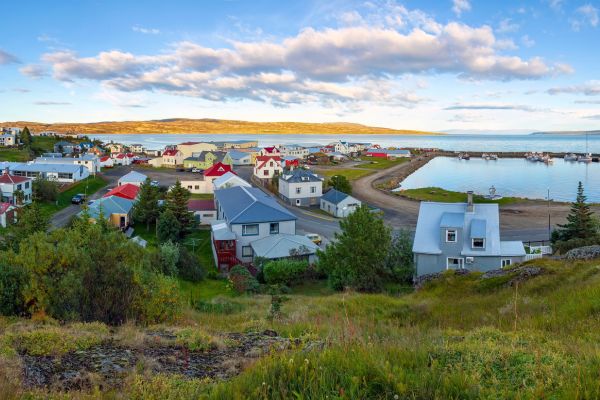
Top things to see in Hólmavík
Hólmavík’s reputation runs on witchcraft and whales, but a few smaller stops round out a visit here.
- Whale watching with Láki Tours: boat trips out into Steingrímsfjörður, one of the more reliable whale-watching bases in the Westfjords.
- Hólmavíkurkirkja: the town church, a distinctive piece of local architecture worth a quick look.
- Galdur Brugghús: a small local brewery named, fittingly, after Hólmavík’s connection to Icelandic folklore and magic.
- Café Riis: a long-standing café and restaurant set in one of the town’s older buildings.
Best place to stay in Hólmavík: Kriukot, scores 8.3 (Very good) from 223 reviews, sits about 450 meters from the centre with sea views from some rooms and free parking. Check availability here
Bíldudalur
This small village on Arnarfjörður is home to the Icelandic Sea Monster Museum and close to Reykjafjarðarlaug hot spring. Quiet and coastal, it’s a good stopover point in the northern part of the region.
Top things to see in Bíldudalur
Beyond the Sea Monster Museum, Bíldudalur’s small size hides a properly eclectic mix of stops.
- Fossfjörður Waterfall: a scenic waterfall just outside town, an easy stop if you’re already exploring Arnarfjörður.
- Samúel Jónsson’s Art Farm: in nearby Selárdalur, a self-taught folk artist’s home and sculpture garden, one of the more unusual roadside stops in the Westfjords.
- The Old Blacksmith Shop: a preserved piece of the village’s working history.
Bíldudalur’s local reputation for having some of the best hamburgers in Iceland is worth testing for yourself.
Best place to stay in Bíldudalur: Harbour Inn – Guesthouse, scores 9.0 (Superb) from 448 reviews, is about 250 meters from the centre with free parking, the clear standout given how few options this small village has. Check availability here
Flateyri
This peaceful village is surrounded by dramatic flat-topped mountains and is home to one truly unique landmark: the Old Bookstore, Iceland’s oldest original bookstore, founded in 1914 and still run by a descendant of its first owner, with decor that’s barely changed since it opened. Interested in books? Then read my guide to books about (and in Iceland).
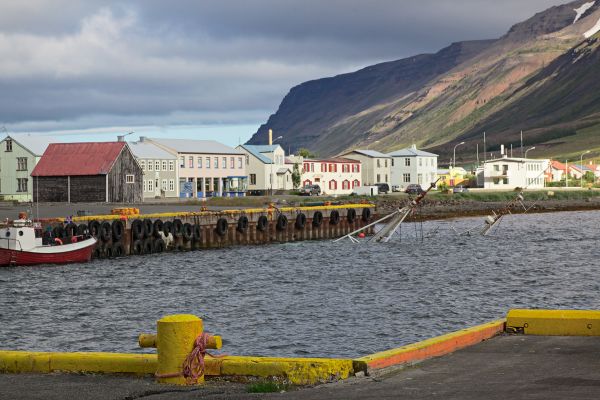
Top things to see in Flateyri
Flateyri’s charm is mostly about slowing down rather than ticking off a list, but a few stops are worth building time around.
- Avalanche Protection Wall and Memorial: built after the devastating 1995 avalanche, a somber but important part of understanding the town’s history.
- Vagninn: a small local cultural house showcasing community art and history.
- Kayaking or hiking in Önundarfjörður: the fjord itself is calm enough for an easy paddle, with hiking trails climbing into the surrounding mountains.
Best place to stay in Flateyri: The Holt Inn, scores 9.3 (Superb) from 170 reviews with its own hot tub, is the highest-rated option in Flateyri. Check availability here
A handful of smaller villages round out the region and are each worth a brief stop rather than a full visit: Reykhólar, known for its seaweed-processing industry and mineral-rich sea baths; Bolungarvík, with centuries of fishing history behind it; Önundarfjörður, home to a rare golden-sand shoreline near Flateyri; and Djúpavík, an atmospheric, half-abandoned village built around a long-closed herring factory.
Museums in the Westfjords
A small but truly distinctive collection of museums here focuses hard on local history, folklore, and maritime heritage, rather than generic exhibits. My guide to Iceland’s unique museums is here.
Museum of Icelandic Sorcery and Witchcraft
Based in Hólmavík, this museum covers Iceland’s witchcraft, folklore, and magic history through rune staves, manuscripts, and recreated artifacts tied to the country’s “dark arts” tradition. The on-site café, Kaffi Galdur, is a good place to unwind afterward with traditional Icelandic dishes made from local ingredients.
- Address of the Museum of Icelandic Sorcery and Witchcraft: Höfðagata 8–10, 510 Hólmavík.
- Entry: 1,000 ISK for adults, 850 ISK for students, 700 ISK for seniors and people with disabilities, free for children.
- Opening Hours: summer (May 15–September 30), daily 09:00–18:00; winter (October 1–May 14), Monday–Friday 12:00–18:00, Saturday–Sunday 13:00–18:00.
- How long to spend at the museum: 45–60 minutes.
- Website: galdrasyning.is
- How to get to the museum: in Hólmavík, right on the main road through town.
Icelandic Sea Monster Museum
In Bíldudalur, dimly lit rooms walk you through the sea monsters said to have terrorized farmers and fishermen along this coast for centuries. The museum overlooks Arnarfjörður, believed in folklore to be home to more sea monsters than anywhere else in Iceland.
- Address of the Icelandic Sea Monster Museum: Strandgata 7, Bíldudalur.
- Entry: 1,250 ISK for adults, free for children aged 0–10.
- Opening Hours: May 15–September 15, daily 10:00–18:00.
- How long to spend at the museum: 45–60 minutes.
- Website: skrimsli.is
- How to get to the museum: in the village of Bíldudalur, on the harbor front.
Westfjords Heritage Museum
This museum, in Ísafjörður, focuses on the region’s maritime history, fishermen, their boats, and the hardships they faced at sea. Over 15 traditional oak boats have been restored as part of the museum’s collection, alongside a surprisingly extensive accordion collection, several once owned by notable Icelandic musicians.
- Address of the Westfjords Heritage Museum: Neðstikaupstaður, Ísafjörður, in the oldest cluster of buildings in the country.
- Entry: 1,750 ISK for adults, 1,300 ISK for seniors and students.
- Opening Hours: daily 10:00–17:00, May 15–August 31; shorter hours 11:00–15:00, September 1–15; winter by appointment.
- How long to spend at the museum: 45–60 minutes.
- Website: nedsti.is
- How to get to the museum: in Neðstikaupstaður, right by the old harbor in Ísafjörður.
The Arctic Fox Center
Located in the village of Súðavík, this center focuses on the conservation and research of Iceland’s only native land mammal, the Arctic fox. You’ll find exhibits covering the Arctic fox’s biology, behavior, and adaptation to the harsh Arctic environment, pairing well with a Hornstrandir visit if foxes are a priority for your trip.
- Address of the Arctic Fox Center: Eyrardalur, Súðavík.
- Entry: 1,500 ISK per adult.
- Opening Hours: June, July, and August, daily 09:00–18:00; shorter hours in the shoulder months of May, September, and October.
- How long to spend at the center: 45–60 minutes.
- Website: melrakki.is
- How to get to the center: about 20 minutes’ drive from Ísafjörður, in the village of Súðavík itself.
Book a guided bus tour from Ísafjörður here if you’d rather not self-drive.
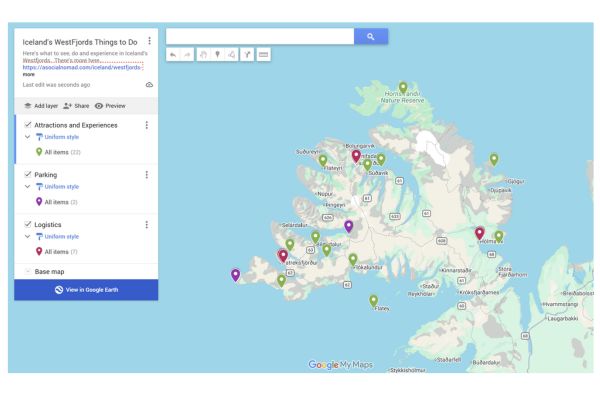
Map of the Westfjords
Here’s our map of everything in this guide, spread across the region; you can also see the map here.
Visiting the Westfjords
There are three real ways to reach this region, and whichever you choose will impact your trip differently.
Driving to the Westfjords
Most visitors arrive by road, typically north on Route 1 and then branching off via Route 60, with Hólmavík and Patreksfjörður as common entry points. The drive from Reykjavik to Ísafjörður takes about 455 kilometers on paved road, but many roads deeper into the region are gravel rather than paved, and travel times are often longer than the map suggests. A 4×4 is worth having, but not strictly required everywhere. You might find that adds real comfort and confidence on mountain routes and longer gravel stretches.
The Baldur Ferry
A scenic, practical alternative to the long drive around, the Baldur Ferry runs between Stykkishólmur on Snaefellsnes and Brjánslækur in the southern Westfjords, a 2-3 hour crossing through Breiðafjörður Bay, with an optional stop at Flatey Island along the way. You can bring your rental car onboard, making it easy to break up a long driving day while still making progress toward your destination. The ferry operates year-round and takes around 46 cars (depending on their size). Check timetables and make bookings here.
Flying to Ísafjörður or Bíldudalur
If you’re short on time, flying is the fastest option. Flights from Reykjavik Domestic Airport to Ísafjörður take around 40-45 minutes, and there are also several flights a week to Bíldudalur. From either airport, you’re already close to the region’s major attractions.
How to Get to the Westfjords
You’ll need a real chunk of time set aside for this trip regardless of how you arrive; this is not a region to rush. Whichever of the three options above you choose, plan for extra hours beyond what GPS estimates suggest; weather, gravel roads, and mountain passes all add a lot of extra time here.
How Long to Visit the Westfjords for
A rushed loop covering the main highlights of the Westfjords takes at least three to four days, given the driving distances involved. Five days or more lets you actually add Hornstrandir and a proper stop on Flatey without feeling rushed.
Grocery Shopping in the Westfjords
Stock up properly in Ísafjörður or Patreksfjörður before heading into the more remote stretches; options thin out fast once you leave the main towns. If you’re arriving via the Baldur Ferry, Bónus in Stykkishólmur is a good last proper stock-up point before the crossing. Smaller stores exist throughout the region even in remote spots, so you won’t go hungry, but don’t expect much selection outside the main towns.
Food & Drink Options in the Westfjords
Options are truly limited given how remote this region is, but what’s here is worth planning meals around rather than settling for whatever’s closest.
- Kaffi Galdur (Hólmavík) — the café at the witchcraft museum, traditional Icelandic dishes made from local ingredients.
- Stúkuhúsið — Aðalstræti 50, 450 Patreksfjörður, great fresh fish.
- Tjöruhúsið — Neðstakaupstað, 400 Ísafjörður, a strong option for fresh seafood.
FAQs on the Westfjords
Got questions about visiting the Westfjords? Here are quick answers to what we’re asked most.
Is the Westfjords worth the detour?
Yes, if you have the time. This isn’t a quick add-on to a standard Ring Road trip; it’s a real detour that asks for several extra days, but you’ll get magnificent and empty landscapes and a sense of remoteness nowhere else in Iceland quite matches.
How remote are the Westfjords really?
They are genuinely remote. Only around one in ten Iceland visitors makes it here; roads are longer and slower than the map suggests, and parts of the region have no road access at all.
Do you need a 4×4 for the Westfjords?
No, not strictly; the main routes are manageable in a standard car in good conditions, but a 4×4 is properly worth having for comfort and confidence on the gravel roads and mountain passes that make up much of the region.
Can you fly to the Westfjords instead of driving?
Yes, flights from Reykjavik – that’s Reykjavik, not Keflavik, to Ísafjörður take around 40-45 minutes, with additional flights to Bíldudalur a few times a week, both real, fast alternatives to the long drive. Flights from Akureyri go via Reykjavik.
Are the Westfjords accessible in winter?
No, not in a reliable sense. Heavy snowfall, strong winds, and frequent road closures make winter a difficult time to visit, and some routes can become impassable entirely. Summer, roughly May through September, is when the region is truly accessible and safe to explore properly, but the weather is very different each year.
Is Hornstrandir worth visiting?
Yes, if you have a full day and don’t mind committing to a boat transfer and guided hike. It’s one of the best places in Iceland to see Arctic foxes in the wild, and the sense of true remoteness here is hard to match anywhere else in the country.
Can I see puffins in the Westfjords?
Yes, Látrabjarg is one of the best puffin-watching spots in the entire country, with thousands nesting along the cliff edges during the summer breeding season. You can book a puffin tour here.
Are there hot springs in the Westfjords?
Yes, and there is a good scattering of them here, most free, ranging from an easy roadside soak to a decent multi-hour drive out to Krossneslaug on the remote Strandir Coast.
ICELAND TRAVEL RESOURCES
AIRPORT TRANSFERS
24/7 pickup & drop off. Trusted, local English speaking drivers. Prebook & prepay online with cards.
Book a Transfer
HOTELS AND APARTMENTS
See choices here
Rooms with a view? Budget rooms? Need a washing machine? The best choice of hotels & apartments.
TOURS & ATTRACTIONS
Most excursion choices, small group tours, skip-line tickets, free cancellation and top local guides.
Top options here.
CAR RENTAL OPTIONS
Choose cars here
Best choice of vehicles, automatics, large or small cars, child seats. Book early for more options.
Final Words on the Westfjords
The Westfjords ask more of you than almost anywhere else in Iceland: more driving time, more planning, more willingness to be somewhere truly remote. In return, you get bird cliffs, red sand beaches, hot springs with nobody else around, and villages that feel like they’ve been quietly getting on with life long before tourism found the rest of the country. Give it the time it deserves.
ASocialNomad is a participant in the Amazon Services LLC Associates Program, an affiliate advertising program designed to provide a means for sites to earn advertising fees by advertising and linking to amazon.com, amazon.co.uk, and amazon.ca. Amazon and the Amazon logo are trademarks of Amazon.com, Inc. or its affiliates. As an Amazon Associate, I earn from qualifying purchases.

