
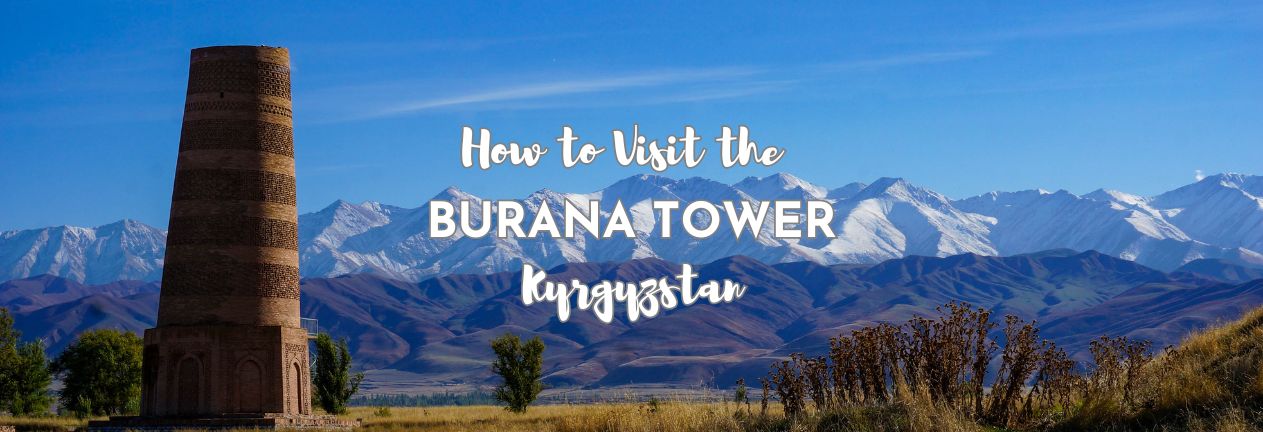
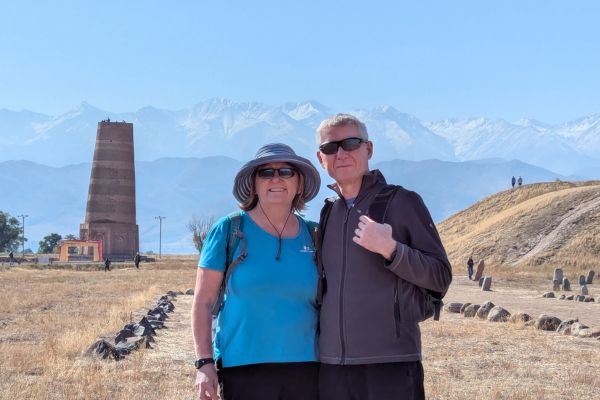
Burana Tower is Kyrgyzstan’s most atmospheric historical site, the sole surviving structure from the Silk Road city of Balasagun. It’s also refreshingly EASY to visit. Here in the Chüy Valley, this lone minaret rises out of an empty field about 80 kilometers (50 miles) east of Bishkek, with the Tian Shan mountains as a backdrop and a scatter of ancient carved grave markers at its base. It doesn’t look like much from a distance, just a stone tower standing on its own, but climb the original interior staircase and the view really is rather lovely. You can be at the tower, wander the balbal field around it, and be back in Bishkek in time for dinner, all in one easy half-day trip. This is my guide to visiting Burana Tower.
THIS POST MAY CONTAIN COMPENSATED AND AFFILIATE LINKS MORE INFORMATION IN OUR DISCLAIMER
This guide covers the tower’s history, every way to get to Burana Tower from Bishkek, what’s worth seeing on site, and the practical details, entry fee, opening hours, and best time to visit that make or break a trip like this. Burana Tower is one of the best day trips from Bishkek, and it’s just off the same road east that leads to Konorchek Canyon, so the two pair up naturally as one day out. If you’d rather see Burana Tower, Konorchek Canyon and Issyk-Kul Lake all in one guided day instead of arranging each independently, read our verdict on whether that combined tour is worth it.
Why Visit the Burana Tower
Burana Tower is the last structure left standing from an entire Silk Road city. Balasagun once had walls, mosques, and mausoleums. Now it has one tower, a field of carved stone grave markers, and grass. That contrast between what was here and what’s left is what makes the site worth the trip on its own. Yeah, and it’s a rather lovely place to visit too.
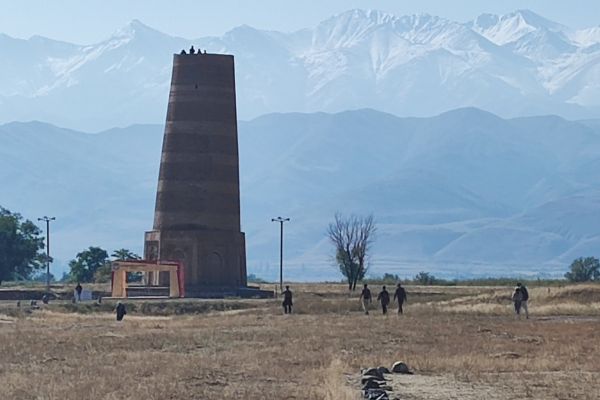
Back in 2001, the Burana Tower was added to the UNESCO World Heritage list, but in 2014 it became part of a collection of UNESCO World Heritage sites in the Chang’an Tianshan Corridor (across Kyrgyzstan, Kazakhstan and China) that are collectively called the Great Silk Road UNESCO network. Issyk-Kul Lake is also part of this collective.
It also helps that it’s easy. Burana Tower is a half-day trip from Bishkek, no overnight stay required, no multi-day trek involved. You get a real Silk Road ruin, the wide open Chüy Valley, and the Tian Shan mountains on the horizon, all without moving on from your base in the city. For the history, for the views, or just for an easy morning out of Bishkek, it is a fabulous addition to a Kyrgyzstan itinerary.
Burana Tower At-a-Glance
- Location: approximately 80 kilometers (50 miles) east of Bishkek near Tokmok, in the Chüy Valley.
- Best for: History and Silk Road fans, and an easy half-day escape from Bishkek, or take the whole day and visit Konorchek Canyon and Issyk-Kul Lake too.
- Time needed: around 90 minutes on site, plus travel time each way.
- Getting there: marshrutka, taxi or Yandex, self-drive, or guided tour.
- Entry fee: 220 KGS, covering the tower, balbal field and museum.
- Opening hours: 09:00-17:00 daily.
- Highlight: climbing the tower itself via its original interior staircase.
How to Get to Burana Tower
Getting to the Burana Tower from Bishkek is EASY, and you’ve got four relatively easy options: marshrutka, taxi or Yandex, self-drive, or a guided tour.
We’ve already covered Yandex Go as the reference ride-hailing app for independent travel in Kyrgyzstan, so set it up before you leave for the country if you haven’t already.
Marshrutkas are the cheapest option by a long way if you’re a solo traveler, but it means two separate minibuses and some patience with the lack of Kyrgyz scheduling. Taxis and Yandexes cost more but avoid transfer in Tokmok. Self-driving works fine if you’ve already got a rental car; the roads out here are paved the whole way. And a guided tour takes the logistics off your hands entirely. This is useful if you’re also planning Konorchek Canyon and want someone else to drive and manage the logistics for the whole day. Anyways, each option is broken down below, with costs and timings for what to expect.
Marshrutka to the Burana Tower
The budget option to get to the Burana Tower is to take two marshrutkas. From Bishkek’s Eastern Bus Station, take marshrutka 353 to Tokmok; it costs 100 KGS and takes just over an hour. You’ll need to pay cash (read my guide to currency and ATMS here). Don’t forget that marshrutkas leave when full, rather than when you want to, so you should factor this in when traveling. The marshrutkas run from Bishkek to Tokmok from 06:00 until 20:00
In Tokmok, at the bus terminal, take the underground passage and either change to marshrutka 212, which runs the last stretch out to Burana for 50 KGS and takes 25 to 30 minutes. Or get a taxi and ask them to wait for you and return you to Tokmok. The last quote I got for this (September 2026) was 1500 KGS return fare including waiting.
Alternatively, from the Tokmok bus terminal, get a Yandex (current price 425 KGS) and negotiate waiting time and a return trip.
Taxi and Yandex to Burana Tower
Yandex covers this route too, and it’s the easier option if you don’t fancy the marshrutka to Tokmok and then onwards. You can, as I type this, get a Yandex from Bishkek to the Burana Tower for 2,179 KGS.
Make sure you’ve got Kyrgyz data sorted before you set off; you’ll want Yandex working properly out here. Our SIM and eSIM guide for Kyrgyzstan covers what to buy and where.
Guided Tours to Burana Tower
If you’d rather not deal with any of the above, plenty of small-group and private tours run out to Burana Tower from Bishkek. Most include an English-speaking guide, return transport, and your museum entry, and take around five to six hours all in.
A visit to the Burana Tower is also commonly paired with Kegeti Gorge and its waterfall for a fuller day out, and it’s worth considering if you want more than just the tower and don’t mind a longer day. And if you’d rather see all three of Burana Tower, Konorchek Canyon and Issyk-Kul Lake in a single guided day instead of organizing each one independently, book the same tour we did and read our full verdict on whether it’s worth it.
The History of Burana Tower and Balasagun
The Burana Tower is the ONLY structure still standing from Balasagun, a Silk Road city founded here in the Chüy Valley by the Karakhanid dynasty. The Karakhanid khaganate ran from roughly the 9th to the 11th century, and Balasagun was one of its major cities, complete with walls, mosques, and mausoleums, until Genghis Khan’s Mongols sacked it in 1218. The city limped on for a while afterward but had largely vanished by the 14th century, and later still, Russian builders took bricks from the ruins for construction elsewhere.
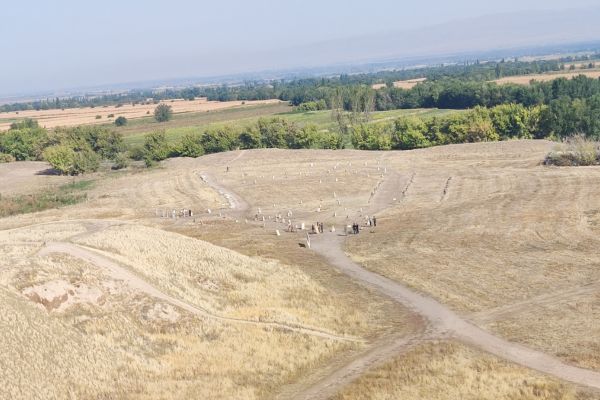
The tower itself was built as a minaret in the 11th century; the platform from which the call to prayer was given existed before loudspeakers and mosque sound systems existed. A 15th-century earthquake knocked it down from an original 45 meters (148 feet) to its current 25 meters (82 feet). Restoration work began in the 1970s. What’s left today is the tower, a field of carved stone grave markers called balbals gathered here from elsewhere in the valley, some petroglyphs, and the low earthwork remains of the mausoleums that once stood alongside it. The balbals that you see today aren’t marking existing graves; they’ve been placed there as a tourist attraction.
What to See at Burana Tower Site
There’s more to see here than just the tower; here are the spots worth making sure that you see.
Climbing the Burana Tower
Climbing the Burana Tower is the highlight, and most people’s whole reason for coming. An external staircase gets you partway up outside, then you duck into a narrow spiral staircase inside the tower itself, with uneven, worn steps and NO lighting at all. Bring a torch, or just use your phone’s flashlight; you’ll need it.
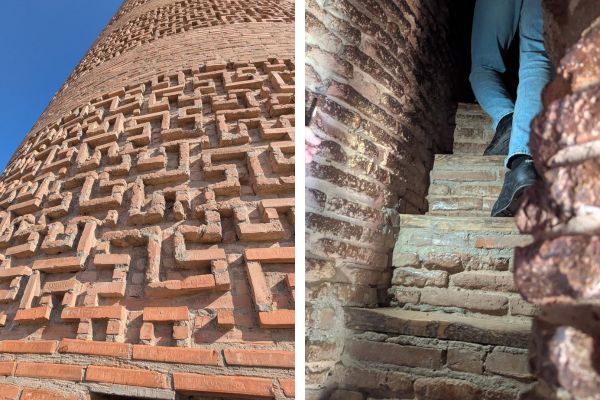
It’s tight, a little disorienting in the dark, and absolutely worth it. Coming down is harder. From the top, the Chüy Valley opens out in every direction, with the Tian Shan mountains lined up along the horizon.
The Balbal Stone Field at the Burana Tower
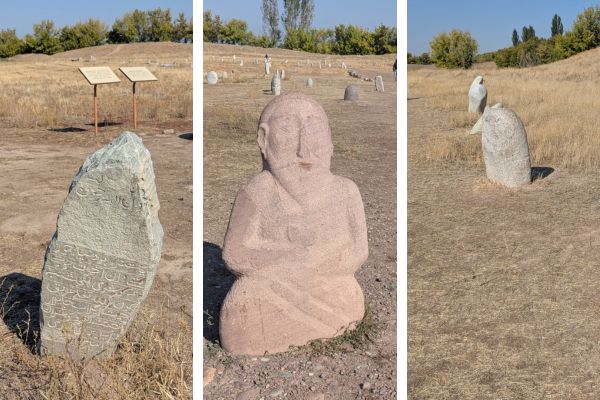
Scattered around the base of the tower is a field of balbals, ancient carved stone grave markers also known as Kurgan stelae. They weren’t found here originally; they’ve been gathered from sites across the valley into what’s effectively an open-air museum, so this isn’t actually a burial ground itself. Look closely, and you can make out individual features on some of them: weapons, jewelry, even a cup held in one hand, carved by hand centuries ago to represent whomever they were made for. There are some more great balbal examples outside the State History Museum in Bishkek if you want to get up close with them there too.
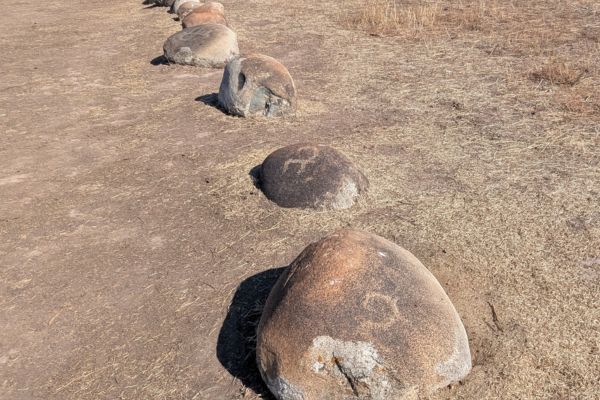
Petroglyphs at the Burana Tower
As you walk towards and amongst the Balbals, you’ll also find a collection of petroglyphs. These come from all around Kyrgyzstan.
The On-Site Museum
The small museum on site is easy to miss, but worth the five minutes it takes to walk through. It holds relics recovered from Balasagun itself, plus photos of the tower from before its 1970s restoration, useful if you want to see how much has been rebuilt versus what’s original. There are no photos allowed inside the museum.
The Mausoleum and Earthworks
Beyond the tower and balbal field, low earthwork mounds mark where Balasagun’s mausoleums and city walls once stood. There’s not much left to see structurally; centuries of Mongol destruction and Russian brick-scavenging saw to that, but walking the perimeter gives a better sense of just how big this is.
Practical Info for Visiting Burana Tower
Here’s what you need to know before you go.
- Entry fee: 220 KGS. You’ll need cash to enter if you’re not here on a tour; don’t take large notes.
- Opening hours: 09:00-17:00 daily.
- Best time of day: early morning, right at opening time. The site gets busy with tour groups by 10:00-11:00. We arrived at 09:20, and the parking lot was jammed when we left 90 minutes later.
- Facilities: no food, drinks or water sold on site; bring your own, and toilet facilities are basic.
FAQs on Visiting Burana Tower
A few more questions answered on visiting Burana Tower.
Can you climb Burana Tower?
Yes. An external staircase gets you partway up, then you go into a narrow, unlit spiral staircase for the rest of the climb, uneven steps and all. It’s VERY VERY narrow, and you use the same spiral staircase to come down. Go as early in the day as you can, before the tour buses and minivans arrive; you don’t want to be queuing on a dark spiral staircase behind a tour group. Because you’ll be waiting until they come down too!
Is there an entrance fee for Burana Tower?
Yes, 220 KGS is the entrance cost for visiting the Burana Tower site.
How long do you need at Burana Tower?
We spent 90 minutes here, and this was a comfortable amount of time. It gives you time to climb the tower, walk through the balbal field, and have a quick look at the museum. Add more if you’re keen on photography or want to walk around the wider earthworks, but you won’t need half a day here.
PRACTICAL TRAVEL TIPS
- 🛡️ Get Travel Insurance: Civitatis includes medical expenses, repatriation, theft, luggage delays. No deductibles or upfront payments. Get a quote here.
- 🛏️ Sea view? Laundry? Private bath? Book a Room.
- 🔌 Be ready for the plug, socket & power situation.
- 📶 Get online EASILY & cheaply – One eSim for the world. Data never expires
Final Words on Visiting Burana Tower
Burana Tower is one of those rare sites that delivers on both counts, real history and an easy day out. You get a real Silk Road ruin, a climb worth doing, a field of centuries-old carved stone, and the Tian Shan mountains lined up behind it all, and you can do the whole thing as a half-day trip without an overnight stay anywhere near Tokmok. If you’re basing yourself in Bishkek for a few days, it’s worth pairing with a look at our guide to things to do in Bishkek to round out your stay. Go early, climb the tower before the tour groups arrive, and give yourself time to look at the balbals rather than rushing past them on the way to the exit. Pair it with Konorchek Canyon if you’ve got the time, or keep it as a standalone half-day. Either way, it’s one of the better value trips out of Bishkek.
ASocialNomad is a participant in the Amazon Services LLC Associates Program, an affiliate advertising program designed to provide a means for sites to earn advertising fees by advertising and linking to amazon.com, amazon.co.uk, and amazon.ca. Amazon and the Amazon logo are trademarks of Amazon.com, Inc. or its affiliates. As an Amazon Associate, I earn from qualifying purchases.

