
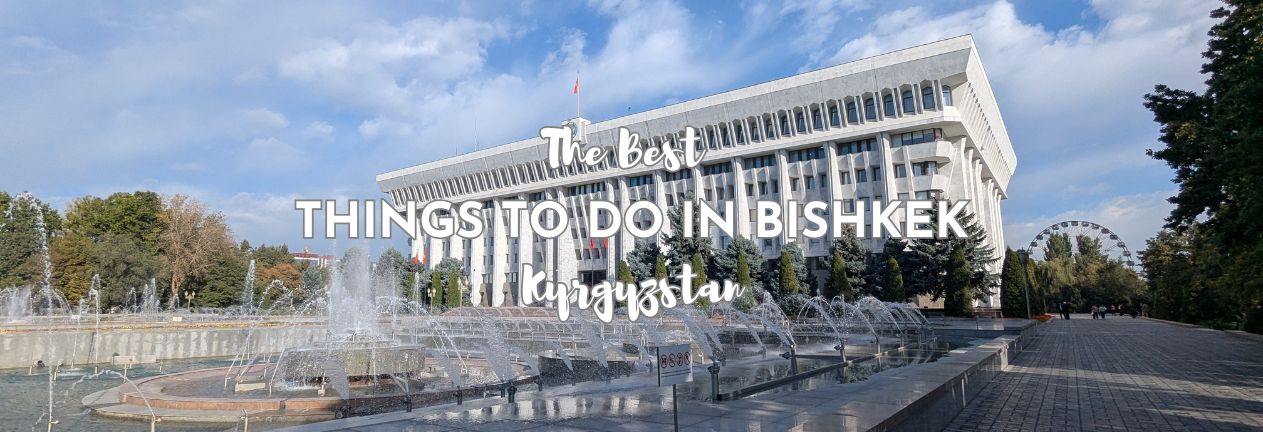
Bishkek is Kyrgyzstan’s capital, and for most travelers it’s both the first and the last stop in the country, whether you’re landing or leaving through Manas International Airport, or travelling overland from Kazakhstan. After the smaller, more chaotic feel of Osh, Bishkek feels like a monster city, all wide Soviet-planned avenues, leafy boulevards and endless lanes of traffic. It’s low-key compared to flashier Central Asian capitals, more of a working capital than the showy Astana in Kazakhstan, but that’s part of the charm. You could easily write it off as a couple of days to kill before or after the mountains. Don’t. Here’s what to do in Bishkek.
THIS POST MAY CONTAIN COMPENSATED AND AFFILIATE LINKS MORE INFORMATION IN OUR DISCLAIMER
If you’re putting together your own list of things to do in Bishkek, this guide covers all of it: how to get here and get around, how long to spend in the city, the best things to do in Bishkek from Soviet monuments to bazaars, a few good places to eat and drink, and answers to the questions people actually ask before they visit. I’ve also included a day trips section and a map, so you can plan your own route around the city rather than following mine step by step.
How to Get to Bishkek
Most visitors reach Bishkek by air, through Manas International Airport, about 25 kilometers (16 miles) north of the city center. If you’re coming overland, the routes are well trodden. We arrived the first time after traveling from Osh, and you can read the full breakdown in my how to go from Osh to Bishkek guide. If you’re arriving from Almaty, Kazakhstan, then my guide on how to go from Almaty to Bishkek is here.
If you’re leaving Bishkek and heading to Osh, then my guide on how to do this is here.
Getting Around Bishkek
Getting around Bishkek is easy. Yandex Go covers taxis across the city, cheap and with pricing upfront, with no haggling needed, just like everywhere else we’ve used it in both Kyrgyzstan and Central Asia. For public transport, city buses and trolleybuses cost 11 KGS a ride and marshrutkas around 15 KGS, though most travelers, us included, use Yandex for most trips, as it’s so convenient.
Download 2GIS before you arrive; it’s the app locals use for transport routes in Kyrgyzstan. Before you fly, sort your SIM card, see my guide to the best SIM and eSIM for Kyrgyzstan, and pack the right power adapter for Kyrgyzstan.
How Long to Spend in Bishkek
1-2 days covers Bishkek’s central sights comfortably. There’s the main – Ala-Too – square, a couple of museums, a wander through Osh Bazaar and an evening or two eating out. Stay longer if you’re using the city as a base for day trips; Ala Archa National Park is close enough to visit for a half-day hike, and there’s more beyond it if you want to explore further afield. We stayed here 4 nights and used Bishkek as a base rather than rushing through. And laundry. Yeah, there’s always a requirement to get laundry done too!
The Best Things to Do in Bishkek
Here’s what to prioritize, roughly grouped from the main square outward, though everything below is walkable from the center if your legs are up to it. It’s all flat and easy. The only thing that will bother you is the constant traffic.
Take a walking tour of Bishkek.
The best way to get your bearings in Bishkek is on foot, and a guided walking tour is an easy way to do it in one go rather than piecing the city together yourself. It’s also a great way to understand a little more of the history of the country.
We did the Bishkek hidden gems, landmarks and culture walking tour, a 2.5-hour loop starting at Ala-Too Square that takes in Soviet mosaics, street art and monuments scattered around the center, plus the changing of the guard. There’s even a photo of us in the tour’s own promo material, which still makes us laugh.
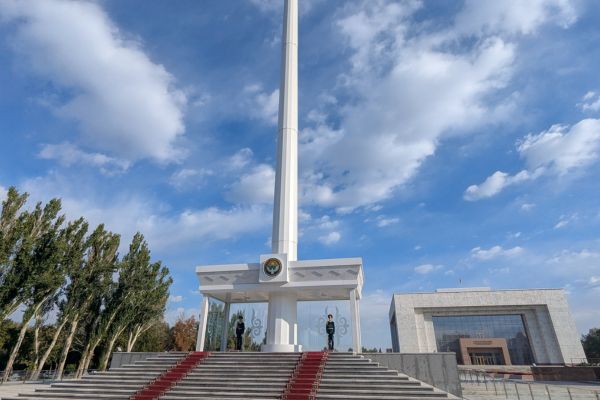
That changing of the guard ceremony is the same one you’ll see performed with minor variations all over the world. Here in Bishkek, the guards are apparently selected for their “attractiveness and slim build.” High kicks and a dead straight marching leg don’t seem to be part of the selection criteria though, and at least one guard on our visit was visibly lacking in that department. Small joys.
If you’d rather go deeper on modern Kyrgyz identity than Soviet architecture, there’s also a nomad identity and modern Kyrgyz life walking tour covering similar ground from a different angle.
- How long to spend on a walking tour: around 2.5 hours for the full loop.
- Costs of a Bishkek walking tour: You don’t actually go inside any attractions, so you can check the current pricing here.
See Ala-Too Square
Ala-Too Square is Bishkek’s central square and the natural starting point for exploring the city on foot; most of the other central sights are also within easy walking distance from here. There’s a huge statue of Manas, the legendary hero of the Kyrgyz national epic, on horseback at one end, and fountains that turn the square into a hangout spot on a warm evening.
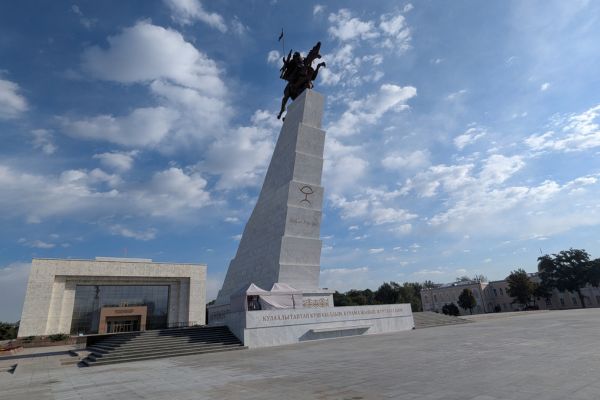
It’s also where the 2010 uprising played out, and there’s more on that under the White House below.
The White House (Presidential Office Building)
Bishkek’s White House is impossible to miss; it’s right off Ala-Too Square, a slab of Stalinist Soviet architecture modeled on Moscow’s Duma. It’s been the seat of Kyrgyzstan’s government since independence, and twice the scene of the country’s biggest political upheavals. In the 2005 Tulip Revolution, protests against corruption and authoritarian rule forced the then president to flee by helicopter, first to Kazakhstan and then to Moscow.
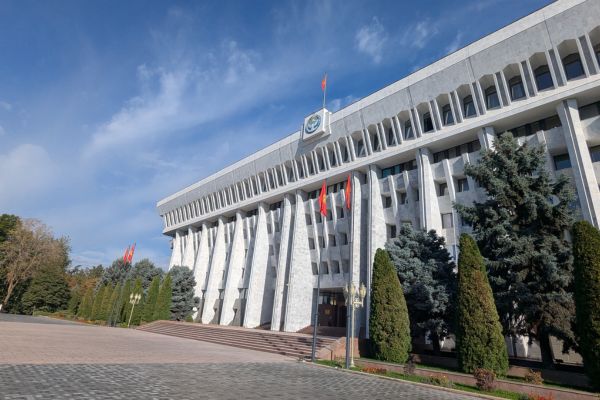
The 2010 uprising, sometimes called the Melon Revolution or the People’s Revolution, was far bloodier. Police used tear gas and then live ammunition against protesters who filled Ala-Too Square, and 90 people were killed. Their names are now on the White House’s gates, which stand open to the public as a memorial.
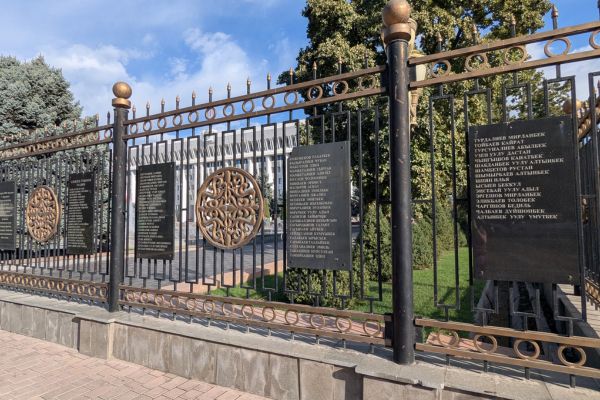
This is a working building so it’s not possible to visit the interior, but you’re fine to wander through the gates, which are now symbolically open.
Bishkek’s State History Museum
Located right on Ala-Too Square itself, the State History Museum is worth popping into if you want context for everything else you’ll see around the city, from Soviet-era propaganda art to exhibits on Kyrgyz nomadic culture. It’s open from Tuesday to Sunday, 10:00 to 18:00, and entry costs around 300 KGS. A Lenin statue that used to stand out front (and what was behind the original name of this museum) now stands around the back instead.
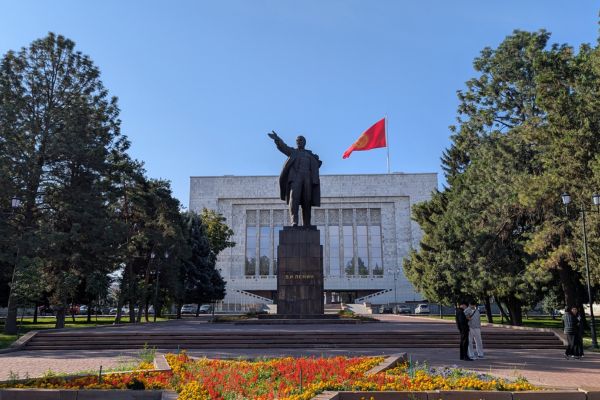
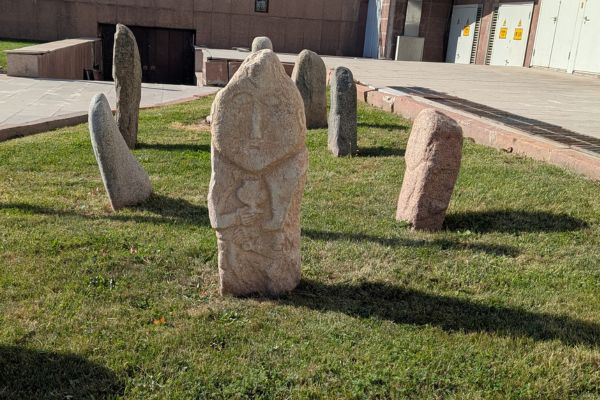
Each floor is dedicated to a different part of Kyrgyzstan’s history timeline, and if you’ve been (or are planning to go) to the Burana Tower, then it’s worth taking a look at the collection of balbals (gravestones) outside the entrance; they’re similar to those on display there. Tickets cost 200 KGS for adults.
Osh Bazaar (Bishkek)
Don’t confuse this with the Bazaar in the city of Osh, a very different market on the other side of the country. Bishkek has its own Osh Bazaar, which was so named as it was built by workers who came from Osh.
You’ll find Osh Bazaar at the corner of Chuy and Kuliev right here in the capital. It’s the biggest market in Bishkek, sprawling and chaotic in the best way, selling everything from fresh produce and dried fruit to household goods, clothes and spare parts. It’s also a good spot for photos if that’s your thing, and it’s a fabulous spot to wander through.
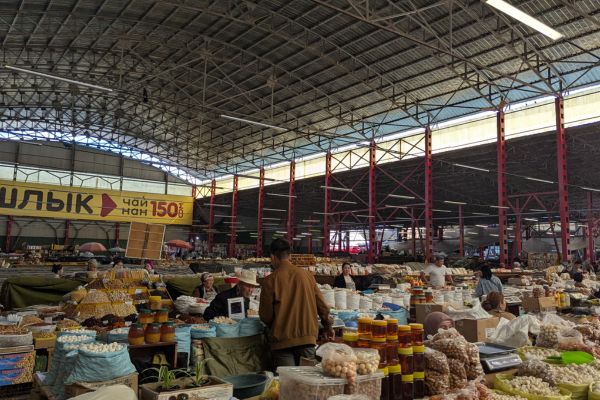
If you plan on buying anything here – food, drinks, souvenirs, then you’ll need to bring cash and should read my guide to ATM fees and cash in Kyrgyzstan.
Bishkek’s Central Mosque (Imam Sarakhsi Mosque)
Bishkek’s enormous Central Mosque, which is also known as the Imam Sarakhsi Mosque, opened in September 2018 and is the largest mosque in Central Asia. Turkey’s Diyanet, its Directorate of Religious Affairs, funded the mosque, built in Ottoman-revival style with four minarets loosely modeled on Istanbul’s Kocatepe Mosque.
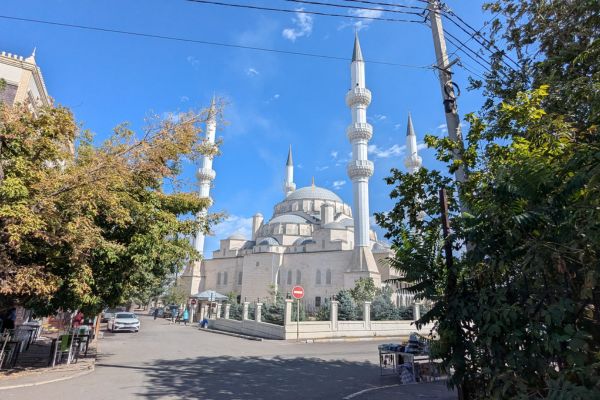
There’s room for 9,000 worshippers inside, and up to 30,000 across the building and courtyard combined. Around 90% of Kyrgyzstan’s population is Muslim, mostly Sunni, though the constitution guarantees religious freedom and the country feels notably relaxed about it in practice. Alcohol is freely available, and headscarves are the exception rather than the rule.
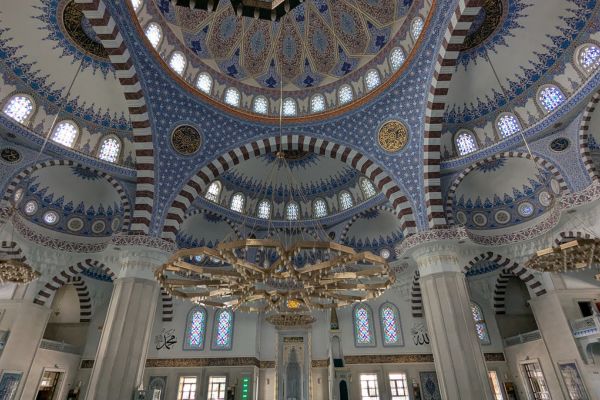
Non-Muslim visitors are welcome outside prayer times; just dress modestly, arms and legs covered, headscarves for women, and be ready to take your shoes off at the door. The mosque provides full dresses and scarves for visitors if you don’t have your own, or are wandering around the city in shorts and T-shirts.
Panfilov Park in Bishkek
Panfilov Park is Bishkek’s go-to spot for a break from sightseeing, a star-shaped city park built with old-school Soviet amusement rides, from a wobbly Ferris wheel to bumper cars and a couple of rollercoasters that look like they’ve seen better decades. It’s popular with local families, especially at weekends, and it’s a relaxed, low-key place to sit with an ice cream and watch the world go by rather than tick off another monument. It’s also a fabulous place to get some shade; there are some magnificent tree-lined avenues in here.
Victory Square
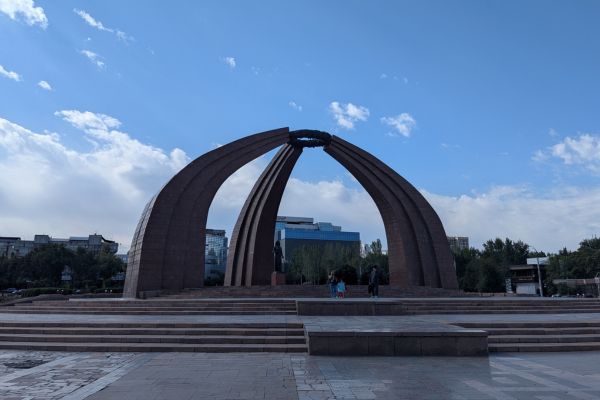
Victory Square is built around three huge, curved concrete arcs shaped like the frame of a yurt, a striking WWII memorial that’s also become one of Bishkek’s most popular spots for wedding photos. There’s an eternal flame underneath, and it’s an impressive piece of Soviet-era design, whatever you make of the politics behind it.
The Kyrgyz State Circus
Another ex-Soviet state city, another State Circus Building. This one was built in 1976; its swooping, almost UFO-like concrete form is one of the more striking pieces of late-Soviet modernist architecture left standing in Bishkek. A team of Soviet architects, Nezhurin, Mironovich, Leontiev, Shadrin and Segal, designed it, and it’s one of dozens of near-identical circus buildings built across the old USSR in the same era.
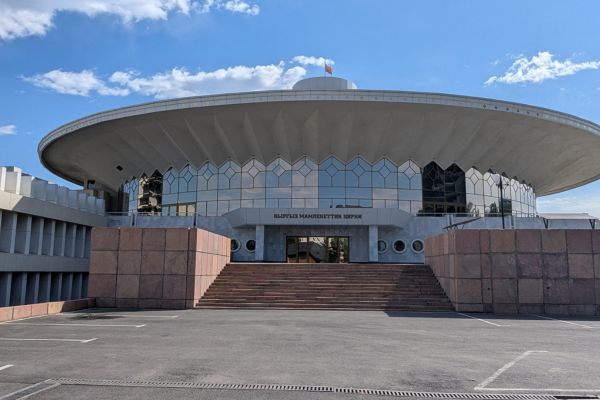
You will spot others on your travels through the former Soviet Union. And this one in particular is still operating, with touring circus shows scheduled through the year; tickets typically start from around 600 KGS depending on the performance. Even if there’s nothing on when you’re here, the building itself is worth a look from outside. You can find out what’s on at the Bishkek State Soviet Circus here.
Because so little was documented, it’s hard to say exactly when circus performance began. As early as the 11th century, wandering entertainers known as skomorokhy traveled across Russian lands, blending music, sleight of hand, dance, and physical comedy into their acts. These performers were closer to street entertainers than circus artists in the modern sense, but they laid the groundwork; before long, temporary show booths sprang up featuring trapeze work and gymnastic feats.
Russia’s first permanent circus building opened in St. Petersburg in 1877, drawing crowds from the aristocracy, who quickly took to the performers’ daring stunts. Everything changed after the 1917 Bolshevik Revolution: the aristocratic class was dissolved, and the circus itself was nationalized, elevated to the status of a serious art form alongside opera and ballet. Under Soviet patronage, troupes such as the Moscow Circus became internationally renowned, and purpose-built circus venues sprang up in major cities across the USSR, Bishkek among them.
Karl Marx and Friedrich Engels Monument
A Soviet-era statue of Karl Marx and Friedrich Engels, seemingly deep in conversation, stands in Oak Park, Bishkek’s oldest park, a short walk from Ala-Too Square. A monument to Stalin previously stood on this exact spot before the city swapped it out for Marx and Engels, a neat illustration of how political tides have quietly rewritten Bishkek’s monuments over the decades. There’s a Lenin statue nearby too, so this corner of Oak Park is a handy one-stop spot for Soviet-monument spotting.
Day Trips from Bishkek
Bishkek makes a good base for day trips, and the standout is Ala Archa National Park, just 40 kilometers (25 miles) south of the city and popular with Bishkek locals as well as travelers. It’s a half-day-plus outing rather than a quick stop, so budget accordingly. I’ve covered the hiking trails and how to get there in a dedicated guide to Ala Archa National Park, and there’s a wider roundup of other day trip options, Konorchek Canyon, Burana Tower and Issyk-Kul Lake among them, in my guide to day trips from Bishkek. If a guided option suits you better, this all-in-one-day tour covers Konorchek Canyon, Issyk-Kul and Burana Tower together without you having to organize transport yourself. We liked it a lot, and I wrote about it here.
If you’re heading further around Issyk-Kul Lake after Bishkek, see my guides on getting from Bishkek to Karakol, Bishkek to Balykchy and Bishkek to Cholpon-Ata.
Map of Things to Do in Bishkek
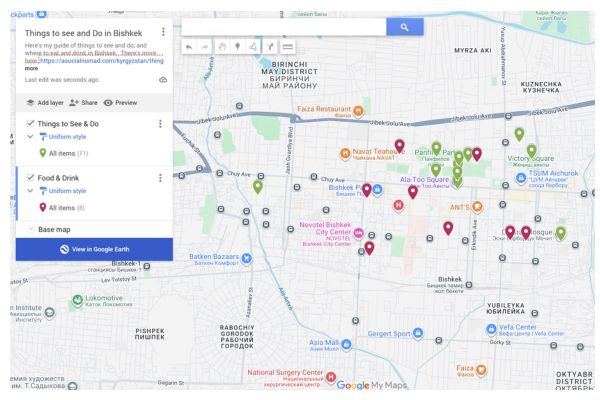
While Yandex Maps or 2GIS is best for directions, it’s easier (in my view) to understand where everything is on Google Maps. So I’ve put together a Google My Maps with every stop from this guide pinned, so you can see how everything sits relative to everything else and plan your own route around the city.
Where to Eat and Drink in Bishkek
Bishkek’s food scene runs from Soviet-era canteens to a small, growing craft beer scene, and you won’t go hungry or thirsty here. Below are a handful of places worth seeking out from our own visit, alongside a proper rundown of Kyrgyz food and drink if you want the bigger picture on what you’re actually eating. All these places to eat are marked on the map.
Navat
Navat serves traditional Central Asian cuisine, think beshbarmak, naryn, kuurdak and shashlik, in richly decorated, Central-Asian-themed dining rooms, with English menus and English-speaking staff on hand. There are two branches in Bishkek, one on Turusbekov Street and one on Togolok Moldo Street, and both serve the same good rundown of Kyrgyz classics if you want to try the national dishes in a setting that does some of the explaining for you.
Sierra Coffee
Sierra Coffee is a Bishkek-born coffee chain with several branches around the city, reliably good espresso-based drinks and a menu that stretches to proper breakfasts and cakes too. It’s an easy, air-conditioned stop when you need a break from the heat or a decent flat white that doesn’t taste like it’s been sitting on a hot plate all morning.
Frunze Restaurant
Frunze Restaurant is upscale, all elegant artwork, an outdoor terrace with a fountain, and a European-leaning menu of refined mains, soups, and salads. It’s pricier than most of what’s on this list, but still reasonable by the standards of European capitals, and a good pick for a proper sit-down dinner if you want to dress it up a bit for one night in Bishkek. It’s really rather lovely in here.
Brewster
Brewster is, for me, the top name behind Bishkek’s small but growing craft beer scene, and it’s worth knowing about if you’re missing a proper pint after weeks of Central Asian lager. Expect a rotating list of house-brewed beers, a casual pub-style setting, and the kind of prices that make ordering a second round an easy decision. The pizza here is also great. The “Craft Center” near Ala Too square wasn’t to our taste, either beer or layout/service.
Ashlyan-Fu (Karakol-style)
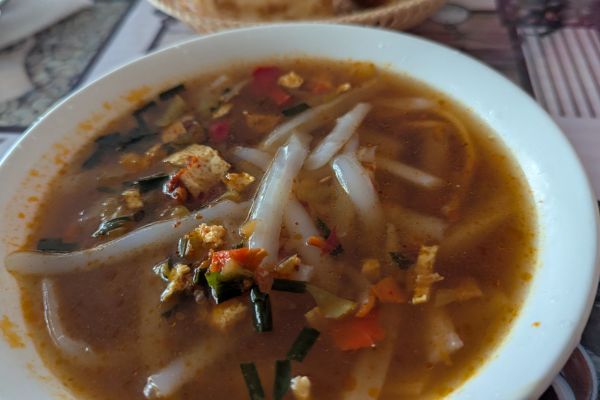
Ashlyan-fu, a cold, spicy noodle-and-broth dish of Dungan origin, is originally a Karakol specialty, but you’ll find Karakol-style versions served here in Bishkek too, usually at small, no-frills canteens rather than sit-down restaurants. This was one of my favorite things to eat in Central Asia. That and the Qurotob from Dushanbe, Tajikistan. This little place is a tiny place, and while it may not be up to Karakol connoisseur tastes, I loved it. I’ve marked it on the map to make it easier to find, because blink and you’ll miss it.
Vkus Vostoka
Vkus Vostoka, on Moskovskaya 51, serves an Asian and Eastern European menu at moderate prices and is well reviewed locally. It’s an easy, no-fuss option for a decent meal without booking ahead, more of an everyday spot than a special-occasion one. You’ll want to eat family style here. It’s a similar menu to Navat, but less fancy and cheaper.
FAQs on Visiting Bishkek
Here are a few more questions worth answering about visiting Bishkek.
How many days do you need in Bishkek?
1-2 days is enough to cover the central sights comfortably. Add extra time if you’re using the city as a base for day trips like Ala Archa National Park, or if you’re just here to slow down and do laundry between bigger legs of a Central Asia trip.
Is Bishkek walkable?
Yes. The center sits on a wide, leafy Soviet-planned grid that’s easy to walk around, with proper sidewalks and shade from mature trees along most of the main avenues. You’ll still want Yandex Go for anything further out, like the bus station or the edge of town, but the central sights are all within a comfortable walk of each other.
Is Bishkek safe?
Yes, Bishkek is a safe city to explore, with the usual big-city caveats: watch your bag in crowded spots like Osh Bazaar, and don’t wander unlit backstreets alone late at night. We never felt unsafe walking around, even after dark.
Is Bishkek worth visiting, or just a stopover before the mountains?
It’s worth a proper look, not just a stopover. Bishkek won’t blow you away the way the mountains will, but it’s an easy, low-key city with enough Soviet history, monuments and decent food to fill a couple of days before or after you head into more dramatic scenery.
Do I need a separate Yandex Go account for Kyrgyzstan?
No. The same Yandex Go account works across Kyrgyz cities, Bishkek included, so if you’ve already set it up elsewhere in the country there’s no separate signup needed here.
PRACTICAL TRAVEL TIPS
- 🛡️ Get Travel Insurance: Civitatis includes medical expenses, repatriation, theft, luggage delays. No deductibles or upfront payments. Get a quote here.
- 🛏️ Sea view? Laundry? Private bath? Book a Room.
- 🔌 Be ready for the plug, socket & power situation.
- 📶 Get online EASILY & cheaply – One eSim for the world. Data never expires
Final Words on Visiting Bishkek
Bishkek isn’t the reason most people come to Kyrgyzstan; the mountains, the lakes, and the nomadic culture out in the regions are. But as a capital city it does its job well: easy to get around, cheap, and interesting enough to hold your attention for a day or two of Soviet monuments, bazaars and decent food before you head further afield. Either way, don’t skip Bishkek entirely just to get to the mountains faster. It’s a good introduction to the country, and after a couple of days here you’ll understand what you’re driving away from.
ASocialNomad is a participant in the Amazon Services LLC Associates Program, an affiliate advertising program designed to provide a means for sites to earn advertising fees by advertising and linking to amazon.com, amazon.co.uk, and amazon.ca. Amazon and the Amazon logo are trademarks of Amazon.com, Inc. or its affiliates. As an Amazon Associate, I earn from qualifying purchases.

