
Issyk-Kul is the second-largest alpine lake in the world, beaten only by Lake Titicaca on the Peru-Bolivia border, and it does something that shouldn’t really be possible at 1,607 meters (5,272 feet) up in Kyrgyzstan’s Tian Shan mountains: it never freezes. And that for me is reason enough to visit it. Kyrgyzstan is a country built almost entirely on mountains and passes, so an enormous body of turquoise water that refuses to ice over even in the depths of winter is well worth visiting. This is my guide to Issyk-Kul Lake: what it actually is, why it’s worth building real time into your trip for, which part of the lake to visit, and how.
THIS POST MAY CONTAIN COMPENSATED AND AFFILIATE LINKS MORE INFORMATION IN OUR DISCLAIMER
Your experience of Issyk-Kul is going to be shaped almost entirely by which part of the shoreline you actually visit. This lake is enormous; it’s more like an inland sea than what most people picture when they hear the word “lake,” and the north shore, the south shore, Karakol, and Balykchy each deliver a different trip entirely. This post is a whole-lake overview, covering what Issyk-Kul is, why it’s worth the detour, and how to pick a base.
For full step-by-step directions, head to my dedicated guides on getting from Bishkek to Cholpon-Ata, Bishkek to Karakol, and Bishkek to Balykchy, and if you’re basing yourself in the capital before or after, my guide to things to do in Bishkek has you covered too.
Why Visit Issyk-Kul Lake
Kyrgyzstan is a mountain country through and through, with peaks, passes, and yurt camps at altitude, so a lake this size changes the whole rhythm of a trip. Issyk-Kul gives you turquoise water backed by snow-dusted peaks, beaches you can swim from (summer only), and a coastline that goes from Soviet-era resort town to open steppe and traditional Kyrgyz villages depending on which direction you head.
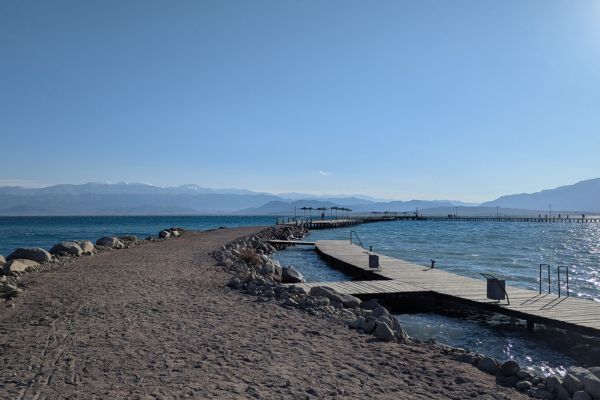
It’s also somewhere Kyrgyz families actually go to relax, not just a foreign tourist stop. If you take this one day tour from Bishkek, then it goes to the very locally focused resort of Balykchy. We went with Nur Ali and explored there – here’s what we thought of it.
The Geography of Issyk-Kul Lake
Issyk-Kul covers approximately 6,240 square kilometers (2,409 square miles), stretching up to 60 kilometers (37 miles) at its widest.
It has a maximum depth of 668 meters (2,192 feet), meaning that it’s the eighth-deepest lake in the world, behind giants like Lake Baikal in Siberia, Russia. Its name translates to “warm lake” in Kyrgyz, which makes more sense once you understand that it never freezes, despite being at 1,607 meters (5,272 feet) in the middle of the Tian Shan mountains. This is attributed to a high mineral and salt content.
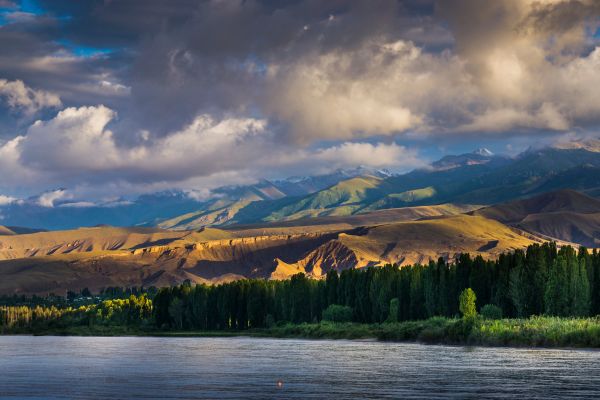
118 streams and rivers feed into Issyk-Kul, and remarkably, not one flows back out. A popular local theory holds there’s an underground outlet feeding the Chu River, although that’s folklore rather than any fact that I can find.
The lake and its surrounding basin have also been a UNESCO Biosphere Reserve since 2001.
Which Shore of Issyk-Kul Should You Pick?
Each part of Issyk-Kul’s shoreline has a completely different personality, and picking the right one will shape your experiences and trip there.
- Issyk-Kul North Shore (Cholpon-Ata): This is the most developed part of the lake, a former Soviet resort town lined with B&Bs and holiday homes, sandy beaches, and the liveliest nightlife on Issyk-Kul. It’s the easiest shore to combine with a proper beach holiday. There are full directions on how to get here in my guide to Bishkek to Cholpon-Ata.
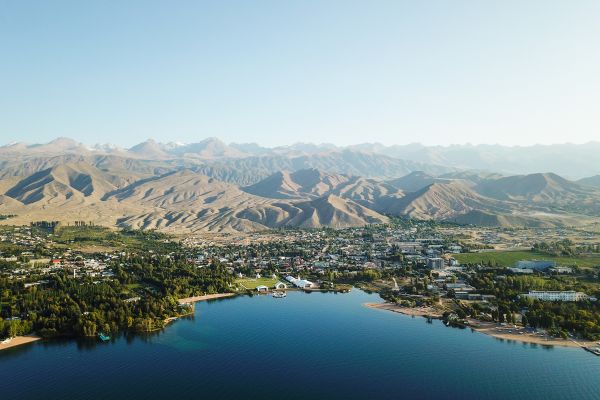
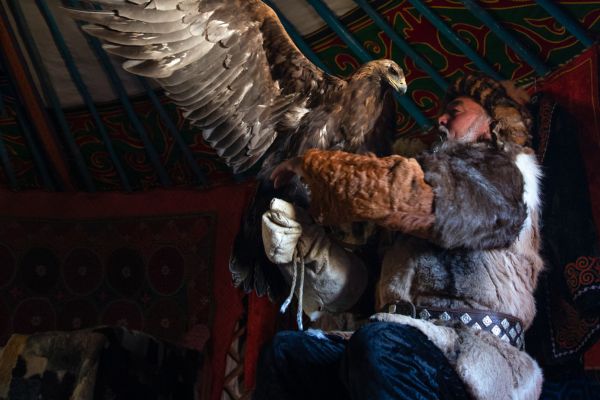
- Issyk-Kul South Shore: Here it’s much quieter and more traditionally Kyrgyz, with villages like Bokonbaevo, Tosor, and Kyzyl-Suu standing in for the resorts on the north side. Highlights of this area include the red-rock scenery at Skazka (Fairytale) Canyon near Tosor and traditional eagle-hunting demonstrations near Bokonbaevo.
- Karakol, Eastern End Issyk-Kul: This is the adventure base of the lake, and your gateway to Ala-Kul Lake and the Jyrgalan Valley for trekking. There are full directions on how to get here in my guide to Bishkek to Karakol.
- Balykchy, Western Tip Issyk-Kul: The closest and quickest gateway to the lake from Bishkek, and it’s the default base for day-trippers. It’s built more for local tourists than an international crowd; it’s windy, and it’s largely closed outside the main season. Even in mid-September, when the weather was blustery but still pleasant, it was empty.
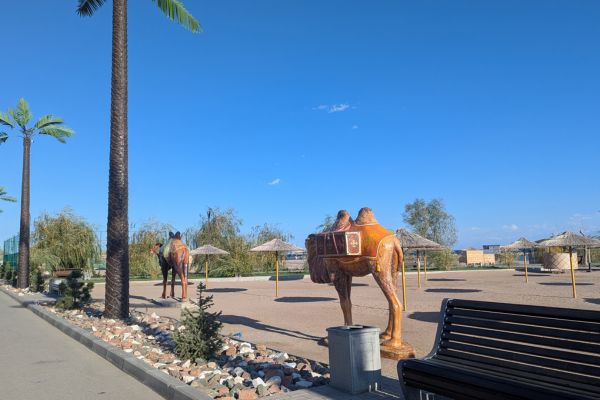
- However, it does have a couple of memorably weird sites: a decommissioned airliner being converted into a restaurant, and a row of concrete palm trees. It’s also home to the only seasonal train link to Bishkek (more on that below). There are full directions on how to get here in my guide to Bishkek to Balykchy.
So part of Issyk-Kul is right for you? If you’re short on time and just want to say you’ve seen Issyk-Kul, Balykchy is the quick, easy option. (this tour does that) If you want a proper beach holiday with some nightlife thrown in, head for Cholpon-Ata on the north shore. If mountains and trekking are what you’re after, base yourself in Karakol. And if you want the quieter, more traditional side of the country, the south shore is worth the extra effort.
If you’d rather see Issyk-Kul alongside Konorchek Canyon and Burana Tower in one guided day, rather than picking a shore and staying over, read my review of the combined day trip from Bishkek first, and you can book that same tour here.
How to Get to Issyk-Kul Lake
This isn’t a full step-by-step, since your exact route depends entirely on which shore you’re headed for, and I’ve got dedicated guides for that below. In general, you’re looking at two main routes out of Bishkek: the road north toward Balykchy and Cholpon-Ata, or the longer route east to Karakol. There’s also a seasonal summer train from Bishkek to Balykchy, running July and August only. It departs Bishkek just before 08:00, takes about 4 hours, and the return service leaves Balykchy at 19:00.
For full directions, head to my guides on
What to Do at Issyk-Kul Lake
Swimming is the big thing to do here, and Issyk-Kul is warm enough to swim in from June until September, especially near the shallower north shore. Around Cholpon-Ata you’ll find thermal springs, boat trips, and watersports if you want to get out on the water rather than just in it.
Karakol is your base for trekking, with routes heading up toward Ala-Kul Lake and the Jyrgalan Valley, and horse riding is easy to arrange almost anywhere around the lake.
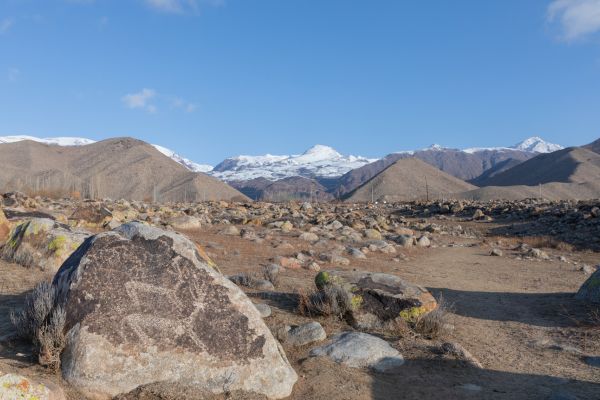
Just outside Cholpon-Ata, there’s also an open-air petroglyph museum that’s worth an hour or so if you’re already on the north shore. There are hundreds of boulders carved with mountain goats and hunting scenes dating back as far as the first millennium BCE.
The Best Time to Visit Issyk-Kul Lake
Summer, from June to September, is when Issyk-Kul is at its best, and it’s the only window for swimming and for that seasonal Balykchy train, which only runs in July and August.
The shoulder season, April-May or late September through October, gets you a quieter lake and thinner crowds, though it can still catch you out. We visited Issyk-Kul in late September, and it felt pretty closed, but we like things like that, so we were happy.
My guide to independent travel in Kyrgyzstan details the snow we experienced as early as mid-September on the Osh to Bishkek route, and Issyk-Kul isn’t immune to sudden weather shifts either.
Travel Tips for Visiting Issyk-Kul Lake
A few practical things worth knowing before you head to the lake.
- Weather: Summer days sit in the high 20s°C (upper 70s-80s°F) around Cholpon-Ata and Karakol, cooler once the sun drops. Balykchy is noticeably windier than the rest of the lake.
- Money: Cash is still king here around Issyk-Kul once you’re outside Cholpon-Ata’s resort strip. Card machines exist, but don’t rely on them. Stock up on som before you leave Bishkek or Karakol; my guide to ATM fees in Kyrgyzstan covers where to withdraw without getting stung.
- Time needed: A day trip from Bishkek is enough to say you’ve seen Issyk-Kul, especially to Balykchy. Give yourself 2 to 3 nights if you want to actually relax on a beach or base yourself in Karakol for trekking, and closer to a week if you want to see more than one shore.
- Connectivity: The signal is fine in Cholpon-Ata, Karakol, and Balykchy, although it’s patchier around the quieter south shore. My guide to the best SIM and eSIM for Kyrgyzstan covers what actually works out here.
FAQs on Issyk-Kul Lake
A few more questions and answers about Issyk-Kul and which part to visit – and how.
Can you swim in Issyk-Kul Lake?
Yes. It’s mildly saline, but perfectly swimmable, especially from June through September when the water’s at its warmest. I dipped my hand in when we visited in late September. It wasn’t that cold, and there were kids still jumping in the water then, even if it was very choppy.
Which shore of Issyk-Kul is better, north or south?
It depends on what you want. The north shore, around Cholpon-Ata, is better for beach time, resorts, and nightlife. The south shore is quieter and more traditional. If you just want to see the lake without picking a side, Balykchy is the easiest option from Bishkek.
How do you get to Issyk-Kul Lake from Bishkek?
It depends on which shore you’re headed for. Head to my dedicated guides on Bishkek to Cholpon-Ata, Bishkek to Karakol, and Bishkek to Balykchy for full directions.
Why doesn’t Issyk-Kul Lake freeze?
Some research attributes this to thermal springs and geothermal heat beneath the lake. Our guide, Nur Ali, told us this because of its high mineral and salt content.
PRACTICAL TRAVEL TIPS
- 🛡️ Get Travel Insurance: Civitatis includes medical expenses, repatriation, theft, luggage delays. No deductibles or upfront payments. Get a quote here.
- 🛏️ Sea view? Laundry? Private bath? Book a Room.
- 🔌 Be ready for the plug, socket & power situation.
- 📶 Get online EASILY & cheaply – One eSim for the world. Data never expires
Final words on visiting Issyk-Kul Lake
Issyk-Kul isn’t really a single destination; it’s four different ones cobbled together by 6,240 square kilometers (2,409 square miles) of water that refuses to freeze. Whichever shore you pick, and however long you stay, this is one of the real highlights of a Kyrgyzstan trip, a real break from mountain passes and yurt camps, with a beach thrown in alongside them. Give yourself more than a rushed day trip if you can, but even Balykchy on a quick afternoon from Bishkek is worth doing. However you visit, pick the shore that actually matches what you want from your trip, mountains, a beach, or somewhere quieter, and build real time in for it.
ASocialNomad is a participant in the Amazon Services LLC Associates Program, an affiliate advertising program designed to provide a means for sites to earn advertising fees by advertising and linking to amazon.com, amazon.co.uk, and amazon.ca. Amazon and the Amazon logo are trademarks of Amazon.com, Inc. or its affiliates. As an Amazon Associate, I earn from qualifying purchases.

