
Figuring out what power adapter you need for Iceland isn’t complicated, but it’s also not something you want to get wrong. The last thing you want after a long flight is to realize you can’t charge your phone, camera, or laptop, and the shops near your accommodation are already closed for the night (although there is an electronics store at Keflavik Airport arrivals). In this guide, I’ll walk you through exactly what kind of power adapter you need for Iceland, whether you’ll need a voltage converter too, and how to make sure all your devices work the moment you arrive.
THIS POST MAY CONTAIN COMPENSATED AND AFFILIATE LINKS MORE INFORMATION IN OUR DISCLAIMER
TOP PRODUCT PICK
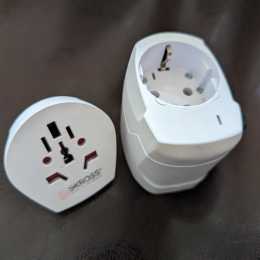
This fabulous adapter will cover you no matter where you’re from. And it’ll cover you wherever you’re going to.
What’s the Electricity Supply Like in Iceland?
Let’s start with the basics.
Iceland uses:
• Voltage: 230V
• Frequency: 50Hz
This is the same as the UK and the rest of Europe, but different from the US, Canada, and parts of Japan, where voltage runs lower.
What this means in practice is that most modern electronics, phones, laptops, and camera chargers will work without any issues. These devices are usually designed to handle a range of voltages automatically. You’ll just need the right plug adapter. This one.
What Plug Type Does Iceland Use?
Iceland keeps this simple compared to a lot of countries: it’s Type F, the two-round-pin European plug, sometimes called a Schuko plug, and that’s genuinely all you’ll find. No mix of styles from one hotel room to the next, no guessing which socket you’ll get.
Fun fact: Schuko is an abbreviation for “Schutzkontakt” (“protective contact” in German), and it refers to the plug system widely used in Germany, other European countries, and Iceland!
Type C plugs, the slimmer two-pin Europlug used across much of mainland Europe, also fit Icelandic sockets directly, since Type F sockets accept both.
Do You Need a Travel Adapter for Iceland?
For most travelers, the answer is yes.
• If you’re coming from mainland Europe (France, Germany, Spain, and similar) → No. You likely won’t need an adapter; your plug will fit directly.
• If you’re coming from the UK or Ireland → you’ll need an adapter; the rectangular three-pin plug doesn’t fit Iceland’s round-pin sockets.
• If you’re coming from the US, Canada, or Australia → you’ll definitely need an adapter.
Because Iceland only uses the one plug type, you don’t need anything fancy or universal; a straightforward Type F adapter will do, though a universal one is still worth having if you’re visiting other countries on the same trip.
If you’re at all unsure, then the simplest approach is to bring a universal travel adapter that covers all bases. We’ve used SK Ross for more than a decade now, and never had a problem.
Do You Need a Voltage Converter for Iceland?
In most cases, no.
If your device says something like:
Input: 100-240V, 50/60Hz
then it will work in Iceland without a converter. This applies to smartphones, laptops, cameras, and tablets.
You only need a voltage converter if you’re bringing devices that aren’t dual voltage, things like hair dryers, straighteners, or certain grooming tools. Even then, most hotels and guesthouses provide these, so it’s often easier not to bring your own at all.
Charging Devices in Hotels & Guesthouses in Iceland
Iceland’s tourism industry is well set up for international travelers, and most accommodation, hotels, guesthouses, even farm stays, will have standard Icelandic sockets in every room, and some of the newer Reykjavik hotels have USB ports built right into the bedside lamps or headboards.
Unlike some destinations, this doesn’t really vary much by region. A guesthouse in a small town in the Westfjords is just as likely to have reliable sockets as a hotel in Reykjavik; Iceland’s infrastructure is consistent nationwide. Read my guide to accommodation in Iceland for the full detail.
It’s still worth bringing your own adapter rather than assuming one will be provided, and a power bank is never a bad idea if you’re out for a full day of sightseeing and won’t be back near a socket for hours.
The easiest option is to bring a universal travel adapter. This one, from SK Ross, is our adapter of choice, and it’s been around the world with us since 2014.
Power Cuts and Electricity Reliability in Iceland
Electricity in Iceland is about as reliable as it gets anywhere in the world. The country runs almost entirely on renewable energy; hydroelectric and geothermal power make up the vast majority of the grid, and outages are genuinely rare, even in more remote areas.
Severe winter storms can occasionally cause a brief, localized outage, but this isn’t something to plan your trip around. If you’re relying heavily on your phone for photos, navigation, or checking road and weather conditions, a charged power bank is still a smart habit, just not because Iceland’s grid is unreliable.
Other essentials you need to know about traveling to Iceland:
What Travel Adapter Should You Bring for Iceland?
The easiest option is a straightforward Type F adapter, or a universal travel adapter if you’re combining Iceland with other destinations on the same trip.
Look for one that:
• Covers Type F (and ideally Type C, since it’s the same socket)
• Includes USB or USB-C ports for charging multiple devices at once
• Has surge protection if possible
This will work for the whole of your Iceland trip, and across most of Europe too if you’re continuing elsewhere.
Where to Buy a Power Adapter for Iceland
It’s best to buy a power adapter before you travel, especially if you want something reliable. SK Ross is the most reliable adapter that we’ve found, and we haven’t found a socket that hasn’t converted for us.

Quick Tips for Charging Devices in Iceland
• Bring a Type F adapter (or universal, if traveling elsewhere)
• Check your device voltage before you travel
• Don’t rely on hotel sockets alone for multiple devices at once
• Pack a power bank for long days out
• Charge devices overnight when possible
FAQs on Power Adapters for Iceland
Here are quick answers to the questions we hear most about charging devices in Iceland.
What voltage does Iceland use?
230V at 50Hz, the same as the UK and mainland Europe.
What plug type do I need for Iceland?
Type F, the two-round-pin European plug. Type C plugs fit the same sockets too.
Do I need a voltage converter for Iceland?
Only for non-dual-voltage devices like hair dryers or straighteners. Phones, laptops, and cameras almost always handle 100-240V automatically.
Will my UK plug work in Iceland?
No, the UK’s rectangular three-pin plug doesn’t fit Iceland’s round-pin sockets; you’ll need an adapter.
Are power cuts common in Iceland?
No, Iceland’s grid, powered almost entirely by hydroelectric and geothermal energy, is one of the most reliable in the world.
Can I buy an adapter in Iceland if I forget mine?
Yes, most supermarkets, gas stations, and electronics shops in Reykjavik carry them, though it’s easier to sort one out before you travel. There’s an electronics store at Keflavik Airport if you forget yours, you can read more about arriving at Keflavik in my guide here.
ICELAND TRAVEL RESOURCES
AIRPORT TRANSFERS
24/7 pickup & drop off. Trusted, local English speaking drivers. Prebook & prepay online with cards.
Book a Transfer
HOTELS AND APARTMENTS
See choices here
Rooms with a view? Budget rooms? Need a washing machine? The best choice of hotels & apartments.
TOURS & ATTRACTIONS
Most excursion choices, small group tours, skip-line tickets, free cancellation and top local guides.
Top options here.
CAR RENTAL OPTIONS
Choose cars here
Best choice of vehicles, automatics, large or small cars, child seats. Book early for more options.
Final Words on Power Adapters for Iceland
Power in Iceland is genuinely straightforward once you know what to expect. The voltage matches most modern devices without any fuss, and the plug type doesn’t change from one region to the next the way it does in some countries. Because of that, a simple Type F adapter is really all you need. Sort that before you travel, and you won’t have to think about it again once you land.
ASocialNomad is a participant in the Amazon Services LLC Associates Program, an affiliate advertising program designed to provide a means for sites to earn advertising fees by advertising and linking to amazon.com, amazon.co.uk, and amazon.ca. Amazon and the Amazon logo are trademarks of Amazon.com, Inc. or its affiliates. As an Amazon Associate, I earn from qualifying purchases.

