
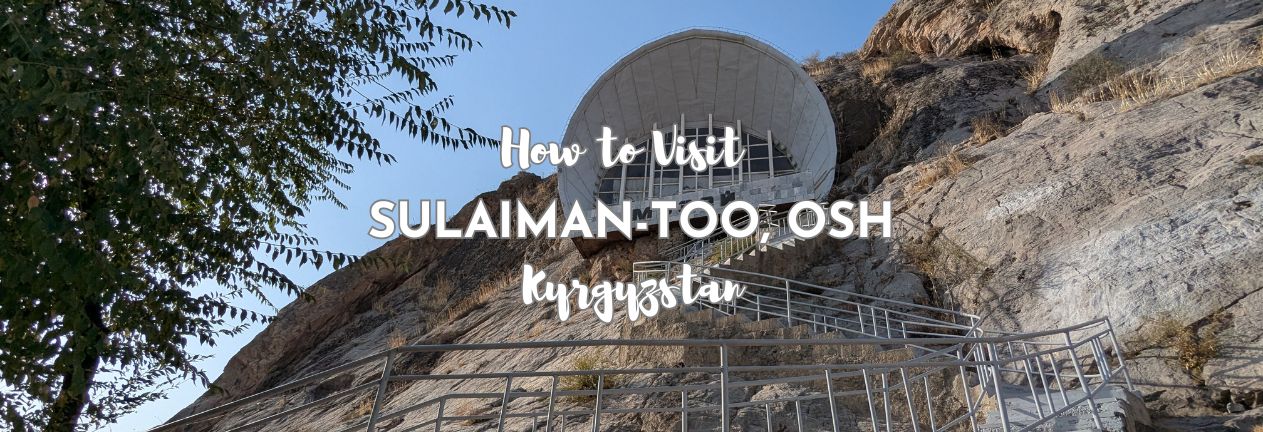
Sulaiman-Too has dominated Osh’s skyline since long before Osh itself existed in any form you’d recognize. Inscribed as a UNESCO World Heritage Site in 2009, and described by UNESCO as the most complete picture of a sacred mountain anywhere in Central Asia, it’s been a pilgrimage site for over 1,500 years, and it still is one today, not a preserved relic behind a rope line. It’s a real mix of ancient, Soviet era, and well, actually it’s a nice short hike too. This is exactly how to explore Sulaiman-Too.
THIS POST MAY CONTAIN COMPENSATED AND AFFILIATE LINKS MORE INFORMATION IN OUR DISCLAIMER
This guide to visiting Sulaiman-Too covers the mountain’s history and significance, how to get there from central Osh, what actually to see once you’re on it, and the practical details, entry fees, opening hours of the trail, the museums you can visit, best time of day that make or break a visit. It combines naturally with my guide to things to do in Osh for seeing the rest of the city.
Why Visit Sulaiman-Too
Sulaiman-Too is the only UNESCO-listed sacred mountain of its kind in Central Asia, and unlike most sacred mountains anywhere in the world, this one sits right in the middle of a city rather than requiring a trek to reach it. You can be climbing a 1,500-year-old pilgrimage route within ten minutes of finishing breakfast in central Osh, and from the top, the whole Fergana Valley opens out around you. After being cooped up in a vehicle on the Pamir Highway, aside from the glorious hike up the Jizeu Valley, this is the perfect place to stretch your legs away from Central Asian traffic. If you’re up there around the call to prayer, this spot is the one to be at; the calls bounce around the city below in a way that’s seriously worth timing your visit for.
Sulaiman-Too At-a-Glance
- Location: central Osh, southern Kyrgyzstan.
- UNESCO status: inscribed 2009 (criteria iii and vi).
- Time needed: From the entrance to the peak and back down the rest of the trail, including a visit to the cave museum, we spent about 90 minutes exploring.
- Entry fee: 70 KGS for the mountain and trails, plus a separate fee of 70 KGS for foreign visitors at the Cave Museum. Add another 70 KGS for the State Museum.
- Trail Opening hours:
- 08:00 – 22:00 May, June, July, August.
- 09:00 – 19:00 April, September, October
- 09:00 – 18:00 January, February, March, November, December
The History and Significance of Sulaiman-Too
Sulaiman-Too was inscribed as a UNESCO World Heritage Site in 2009, and it’s been revered for well over 1,500 years, a rare case of a single sacred site carrying pre-Islamic and Islamic worship traditions built directly on top of each other rather than one replacing the other. The mountain has 101 documented petroglyph sites, 17 active places of worship spread across its five peaks, and two reconstructed 16th-century mosques.
Local legend connects the name Sulaiman to the Islamic prophet Solomon, and the mountain is sometimes called the Throne of Solomon. Its legend, not confirmed history, archaeological evidence shows the mountain was a holy site since the Bronze Age, well before this particular story attached to it, but it’s a legend with a real, visitable spot – the a tiny 11th-century mausoleum at the mountain’s foot, dedicated to Asaf ibn Barkhiya, Solomon’s legendary vizier in Islamic tradition, credited with instantly transporting the Queen of Sheba’s throne to Solomon.
Getting to Sulaiman-Too from Central Osh
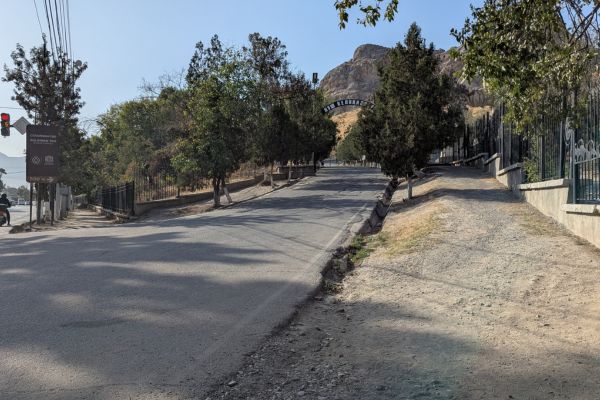
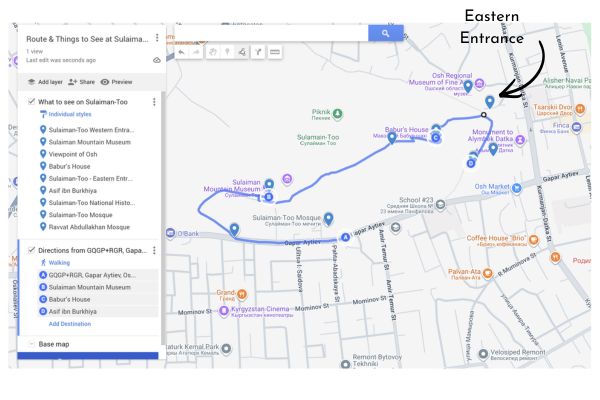
There are two entrances to the mountain. The eastern entrance, near the Archaeological Museum, is the steeper route (it’s step after step after step) and leads more directly to the summit shrine. The western entrance, near the mosque, is a gentler approach.
In my opinion, the best approach is to go up from the western entrance and come back down the steep eastern side into town, rather than the other way around; it makes for an easier climb and a more dramatic descent straight back into the city center.
I’ve marked both entrances on the map below.
Both entrances are walkable from central Osh, or a short Yandex ride away; ask for Gapar Aitiev 67 or the intersection of Aitiev and Rustaveli streets as a landmark if you need one.
What to See at Sulaiman-Too
Sulaiman-Too isn’t just a climb; it’s an active pilgrimage site for Kyrgyz visitors as much as it is a viewpoint for everyone else, and that’s worth keeping in mind as you move through it. Here’s what to see, in order from the western entrance.
You’ll get to the ticket office at the base of the western entrance; from there, walk up the road, and you’ll first find the cave museum.
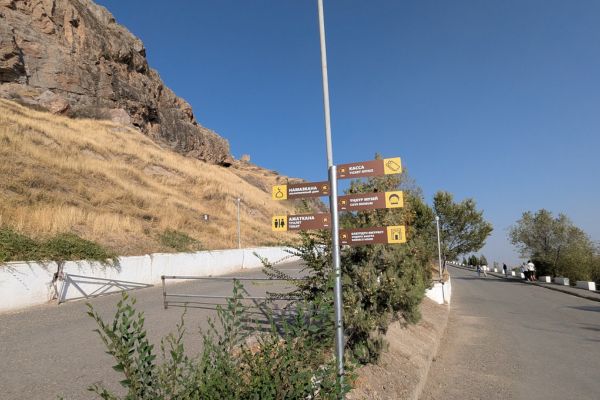
The Cave Museum (Rushan Cave) at Sulaiman-Too
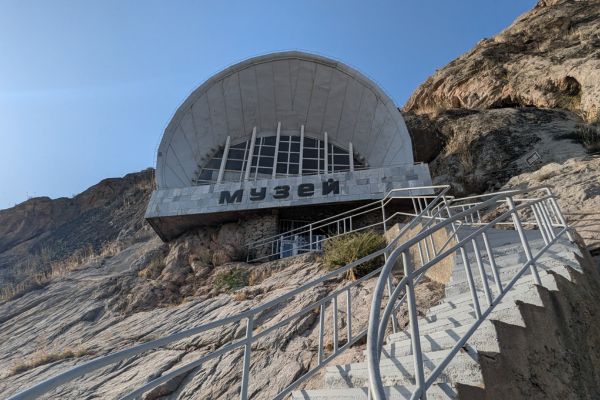
The Soviet-era museum itself (built in 1978), built into Rushan Cave and sometimes called the Gate of Fire, isn’t the main reason to come up here. And you can skip it if you’re here just for the hike. I think it’s worth the 70 KGS entrance fee, because it’s fascinating, both in terms of architecture and views. The contents inside? Not so much.
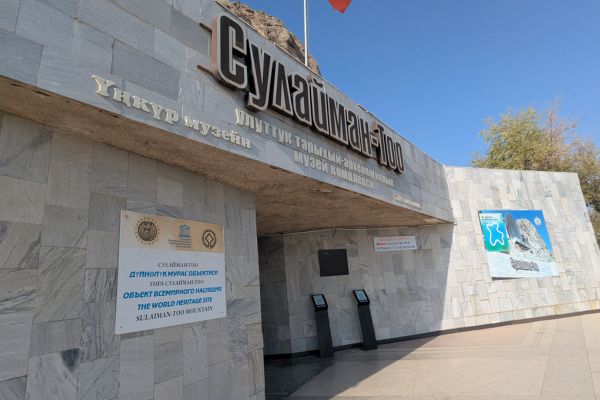
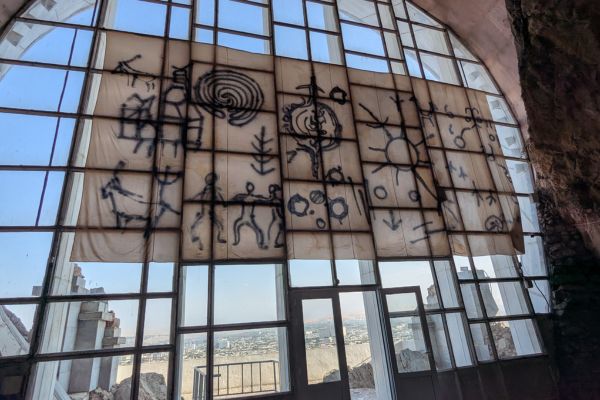
What is definitely worth it is the setting: The 13 interconnected caves, and the view out from the museum’s own Picture Window is genuinely incredible. The year-round temperature inside the Cave Museum is 14-15 Celsius.
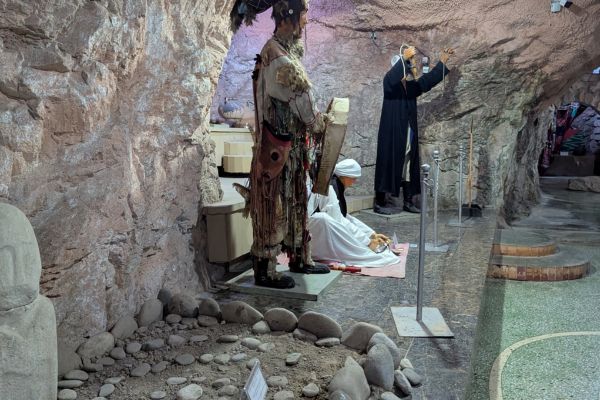
- How to get to the Cave Museum: up on Rushan Chokusu, the highest of the five peaks, reached via the marked trail from either entrance.
- How long to spend at the Cave Museum: We spent 20 minutes in here, including walking between the connected caves, and at the picture window.
- Entry fee for the Cave Museum: 70 KGS
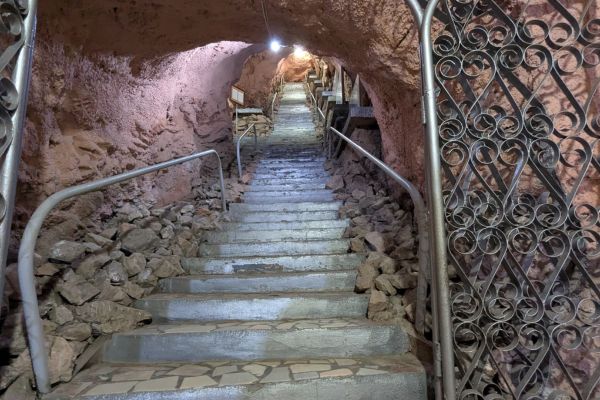
The Petroglyphs at Sulaiman-Too
Sulaiman-Too is home to 101 documented petroglyph sites scattered across the mountain, ancient rock carvings that predate the Islamic pilgrimage tradition by centuries. You don’t need to seek out all 101; a handful are visible right along the main paths as you climb.
Scientists believe that many of the petroglyphs date to the Neolithic period (the 8th-3rd millennium BC). You can find them on the rocks along the trail and also in the caves and grottoes on the mountain.
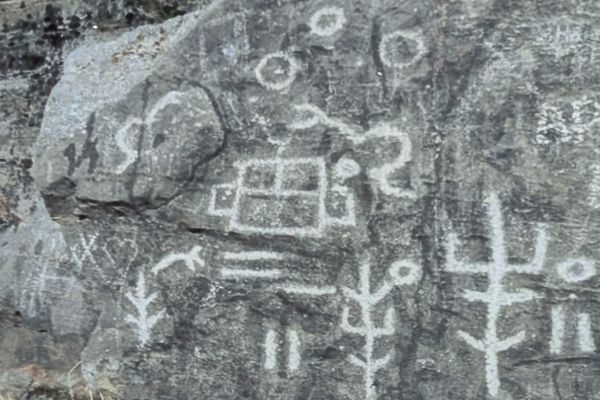
Most are images of solar signs (in the form of a circle with a point, with spokes and in the form of a circle with divergent rays), crosses, squares, arrows, commas, tree patterns, triple forks and web.
The Caves
Beyond the cave museum complex itself, Sulaiman-Too has caves worth knowing about even if you don’t go into all of them. Chaka-Tamaar, the dripping cave, is accessible only by crawling, not for everyone (we didn’t).
Tepe and Eshen caves sit on the slopes of Rushan Chokusu, near the museum. The Eshen cave is a place of pilgrimage for Muslims. Kiyik Eshen (according to legend) lived here when he prayed to the mountain; he is interred in a mausoleum at the base of the mountain.
The Five Peaks
Sulaiman-Too’s summit is really five separate peaks, not one, and knowing which is which makes sense of everything else on this list.
- Suleiman Chokusu (Buura): 1,162 meters (3,812 feet). Home to Emperor Babur’s hujra and the Bel-Tash and Kol-Tash (also called Beshik-Tash) healing stones, see below.
- Shor Choku: 1,141 meters (3,743 feet). Named for the salt deposits once found at its summit.
- Rushan Chokusu: 1,175 meters (3,855 feet), the highest of the five. Home to the Cave Museum and the Tepe and Eshen caves.
- Kattama-Tash: 1,145 meters (3,757 feet). Named for its layered rock formations, said to resemble kattama, a local layered bread.
- Kelinchek (Eer-Too) and Keklik Uchar: 1,119 meters (3,671 feet). Kelinchek means “daughter-in-law,” and Keklik Uchar means “the peak where partridges fly.” A saddle-shaped formation, effectively two peaks in one.
The Healing Ritual Stones
Also on Sulaiman-Too are several stones tied to local healing rituals, and they’re still actively used today. Here are the main ones (and the trail walks straight past them all)
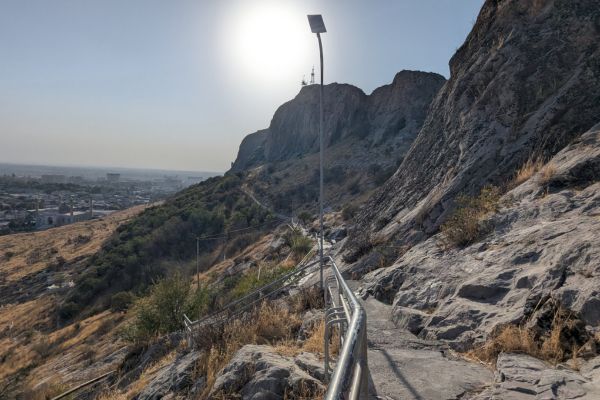
Beshikene
Suffering from infertility? Then you need to come to the beshik-ene stone. It’s for women only. Men, it doesn’t appear to apply to them.
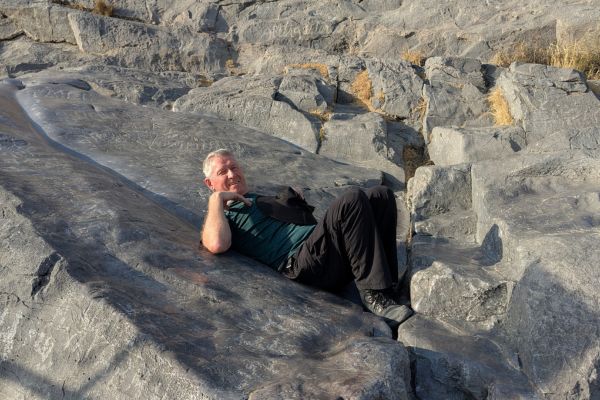
Beltash
This is an inclined plate stone about 3 meters long with a gutter, polished by use, I suppose. It is believed that anyone slipping on it 3 or 7 times can be cured of back pain, weak legs, or infertility. My thoughts are that slipping on it would more likely cause back pain!
Tamchy tamar
This is a cave on the southern slope of the first peak, where the entrance and floor are polished to shine. It has a length of about 8 meters. Near the entrance, there is a hole from which water drips, curing eye and headaches. I’m skeptically raising my eyebrows as I type this.
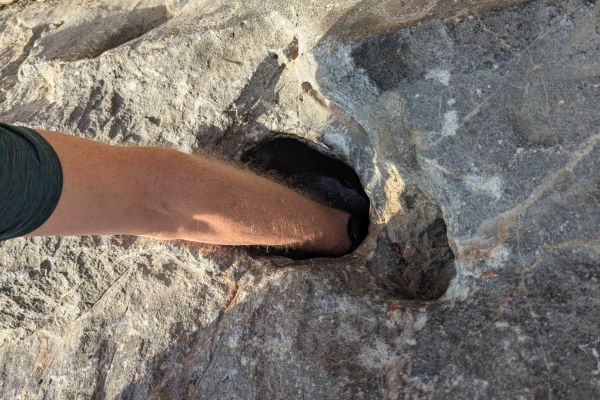
Kol tash
This is a hole in the karst formations; Pushing hands into it supposedly heals the pains in the joints. Me? I don’t like putting my hands into places where something might be alive (or dead), so I made Nigel do it.
Hujra of Babur aka the House of Babur
On Suleiman Chokusu sits the hujra, a small stone cell, associated with Babur, the founder of the Mughal Empire and a descendant of Tamerlane, who passed through Osh around 1496 to 1497 and built structures on the mountain during his time here.
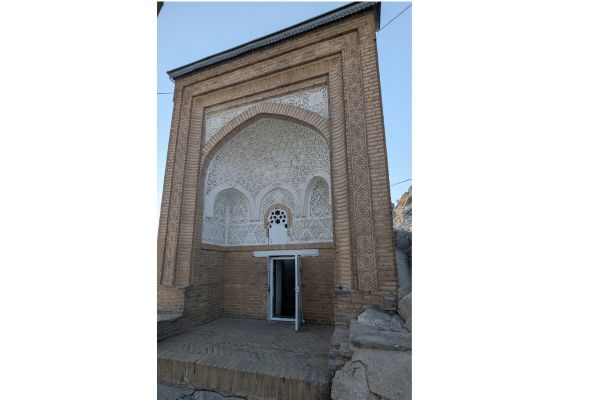
This is a one-chamber mosque and a place for reading prayer. According to legend, there are traces of the knees and fingers of the Prophet Solomon here from when he prayed.
This monument dates to the 16th century, was blown up, and was not restored until 1989.
The Asaf ibn Barkhiya Mausoleum
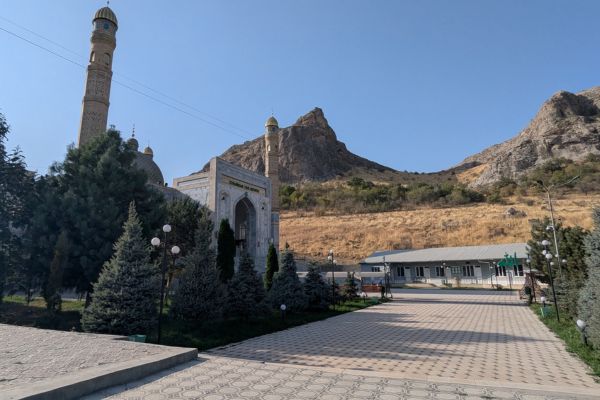
A tiny 11th-century mausoleum sits at the foot of the mountain, dedicated to Asaf ibn Barkhiya, the legendary vizier behind the Solomon legend covered above; it’s the physical site that ties that story to this specific mountain rather than it just being a legend. King Solomon agreed to bury him after death at the foot of this mountain. It’s been destroyed and replaced many times; the present building was constructed in the 17th century. The last restoration of the monument was carried out in 1980–1982.
Practical Info for Visiting Sulaiman-Too
- Entry fee: There’s a 70 KGS entrance fee for the mountain and trails, plus 70 KGS at the Cave Museum.
- Trail Opening hours:
- 08:00 – 22:00 May, June, July, August.
- 09:00 – 19:00 April, September, October
- 09:00 – 18:00 January, February, March, November, December
- Best time of day: 09:00 right at opening, or after 16:00, to avoid both the heat and the busiest crowds.
Map of Sulaiman-Too and Walking Route
Here’s the map of things to see along the way and the walking route across Sulaiman-Too. You can click the map here too.
FAQs on Sulaiman-Too
Here are the answers to the questions about Sulaiman-Too that you never knew you had.
What does Sulaiman-Too mean?
The name refers to an Arabic legend that the prophet Suleiman / Sulaiman (Solomon) stayed on this mountain, formerly called Kara-Bukh until the 16th century, when it became associated with his name as Islam spread through the region. A tiny 11th-century mausoleum at the mountain’s foot is dedicated to Asaf ibn Barkhiya, Solomon’s legendary vizier in Islamic tradition, tying the legend to a specific, real site. This is legend, not confirmed history; archaeological evidence shows the mountain was a holy site since the Bronze Age, well before this particular story attached to it. Too? It’s a Turkic word meaning mountain or mountain range.
Is Sulaiman-Too worth visiting?
Yes. It won’t take you long to walk the trail; the museums are interesting, rather than spectacular.
How long does the Sulaiman-Too climb take?
From the moment we entered the Western Entrance to Sulaiman-Too to the exit at the east took us just over an hour. We spent 20 minutes in the Cave museum on the way and stopped to observe the “healing stones”
Is there an entry fee for Sulaiman-Too?
Yes, it will cost you 70 KGS for the mountain, plus a separate fee of 70 KGS for the Cave Museum. I suggest you also visit the 3-Storey Yurt and the State and Archeological Museum too; I’ve covered those in my guide to visiting Osh here.
PRACTICAL TRAVEL TIPS
- 🛡️ Get Travel Insurance: Civitatis includes medical expenses, repatriation, theft, luggage delays. No deductibles or upfront payments. Get a quote here.
- 🛏️ Sea view? Laundry? Private bath? Book a Room.
- 🔌 Be ready for the plug, socket & power situation.
- 📶 Get online EASILY & cheaply – One eSim for the world. Data never expires
Final Words on Exploring Sulaiman-Too
Sulaiman-Too is the rare sacred mountain you can climb before lunch and be back at your guesthouse for an afternoon nap. There are five peaks, over a hundred petroglyph sites, working shrines, and a legend running underneath all of it that people are still actively Go up from the western entrance, take your time with the Picture Window view over the eastern side coming down, and if you can time it around the call to prayer, do. It’s easily the single best half-day in Osh, and it’s sitting right in the middle of the city the whole time.
ASocialNomad is a participant in the Amazon Services LLC Associates Program, an affiliate advertising program designed to provide a means for sites to earn advertising fees by advertising and linking to amazon.com, amazon.co.uk, and amazon.ca. Amazon and the Amazon logo are trademarks of Amazon.com, Inc. or its affiliates. As an Amazon Associate, I earn from qualifying purchases.

