
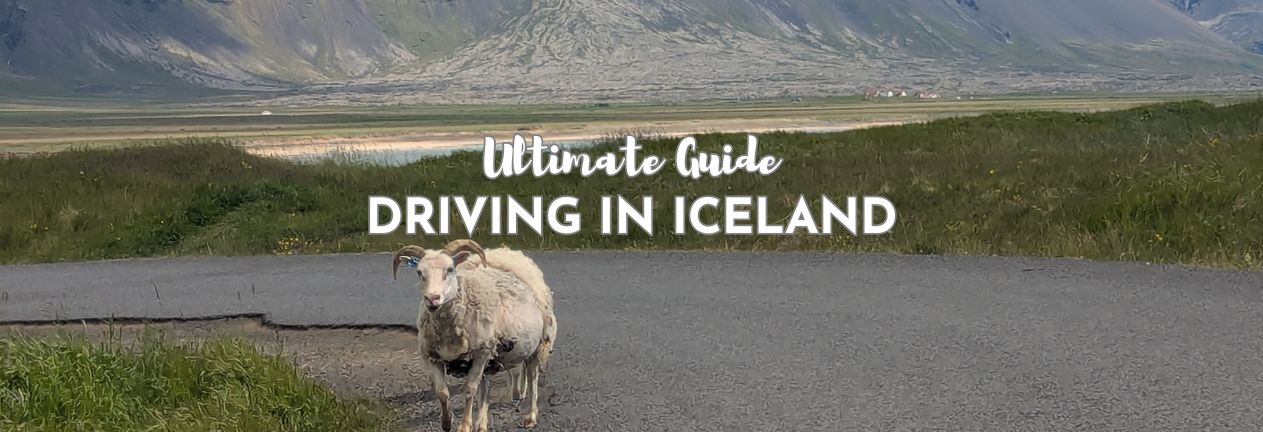
Driving in Iceland certainly isn’t difficult, but some things catch people off guard. And when I’m talking driving, I’m talking the regular roads, not the F roads in the highlands; that’s a whole other ballgame, and I’ll share where to find guidance on driving those. The regular roads in Iceland are well-marked, and traffic is generally light. It is the accumulation of small things: the requirement to always have headlights on (if you’re not used to it), single-lane bridges, roundabouts that work differently from home, and weather that changes in the 5 minutes that you’ve taken to stop for a photo. None of it is hard once you know what’s coming, but nobody warns you about all of it at once before you land. Here’s our guide to driving in Iceland.
THIS POST MAY CONTAIN COMPENSATED AND AFFILIATE LINKS MORE INFORMATION IN OUR DISCLAIMER
If you’re looking up Iceland driving rules before your trip, or just want a solid list of things to know before driving in Iceland so you’re not caught out on day one, I’ll walk through it in order: the basic rules, what the roads themselves are actually like, how fast the weather can change your plans, what F-roads require, the things that surprise even confident drivers, and a few safety habits worth building in from the start.
PRACTICAL TRAVEL TIPS
- 🛡️ Get Travel Insurance: Civitatis includes medical expenses, repatriation, theft, luggage delays. No deductibles or upfront payments. Get a quote here.
- 🛏️ Sea view? Laundry? Private bath? Book a Room.
- 🔌 Be ready for the plug, socket & power situation.
- 📶 Get online EASILY & cheaply – One eSim for the world. Data never expires
Basic Driving Rules in Iceland
A few rules apply everywhere in Iceland, and they’re worth knowing before you even set off in your rental car.
- Your headlights stay on at all times, even in the 24-hour daylight of summer; it’s the law, NOT a suggestion.
- Seatbelts are mandatory for everyone in the car, front and back.
- There’s no right turn on red anywhere in the country, so don’t even look for the option.
- Speed limits are lower than a lot of people expect: 50 kilometers/h in urban areas unless posted otherwise, 90 kilometers/h on paved roads outside town, sometimes 80 kilometers/h on gravel stretches, and as low as 30 kilometers/h in some residential zones. This might feel really slow on empty, open roads, but the limits are enforced; speed cameras and police checks both carry real and potentially hefty fines. If you end up having to pay fines after you’ve left Iceland, then there is ALWAYS a surcharge from your rental car company to pay as well.
- Single-lane bridges are common in the countryside; whichever car reaches the bridge first has the right of way, and everyone else waits. Approach slowly enough to actually see who got there first.
- Roundabouts can be confusing too. Even to us Brits who created the modern roundabout. (Fun Fact: it was a Frenchman, Eugène Hénard, who invented the first roundabout in 1906). Iceland’s two-lane roundabouts give priority to the inside (left) lane when exiting; that means that the outside lane is really only for cars leaving at the very next exit. If you’re going more than a short way around, get into the inside lane before you enter, and don’t change lanes once you’re inside the roundabout.

And if you’re used to four-way stops back home, Iceland runs on the European priority-to-the-right rule at uncontrolled intersections: if there’s no sign and no clear priority, traffic coming from your right has the right of way, regardless of who arrived first. It catches a lot of people from North America off guard.
Road Signs You’ll See in Iceland
A handful of signs show up constantly once you’re outside Reykjavik, and it’s worth knowing what they mean before you’re reading them at speed.
Gravel Road/Pavement Ends/Malbik Endar
Malbik Endar, literally “pavement ends,” marks the point where tarmac turns to gravel. Ease off the accelerator as soon as you see it, as there’s often a difference in height of the road and the bumps can be significant.

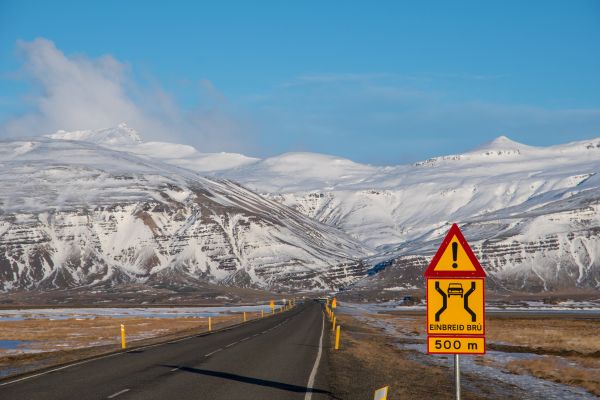
Single Lane Bridge Approaching
A narrowing rectangle on a yellow background marks a single-lane bridge ahead; the first car there has the right of way, as covered above.
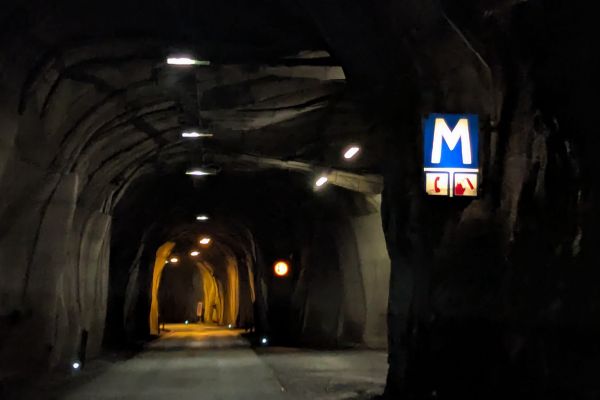
Single Lane Tunnel Pull Outs
Single-lane tunnels work the same way but are rarer, and usually have marked pull-outs; whichever car is closest to a pull-out gives way to the one that isn’t. The “M” is an indicator that YOU have to pull in and wait until the light turns green if you’re in a tunnel. Or there’s no traffic if you’re on a single track road. This is the tunnel on the Trollaskagi Peninsula. (read more about it here)
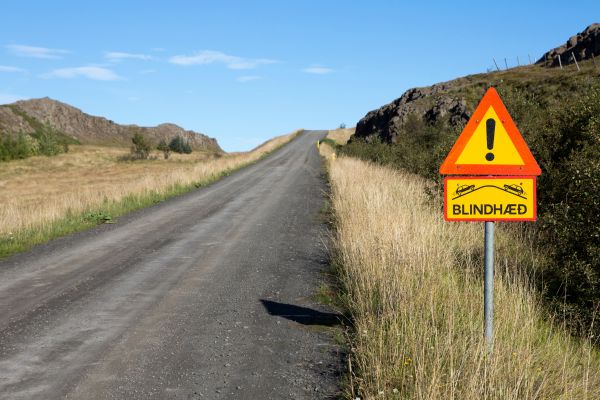
Blind Hill Sign
A blind hill sign (an arrow bent sharply upward) means exactly what it sounds like: you can’t see what’s coming on the other side. Slow down, stay right, and don’t overtake anywhere near one.
Illfaer Vegur: Difficult Road
This “difficult road” sign means specifically that 2wd drive vehicles are NOT allowed.

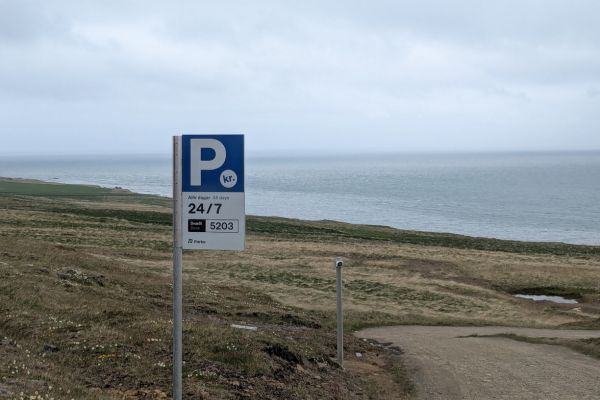
Parking signs in Iceland
Paying for parking is a big thing in Iceland. Most of the natural attractions are free to visit, but you must pay for the parking – read my guide about it here. If you see a sign – or a camera, it means you need to pay. Claimed ignorance is no defence.
Road Conditions to Expect in Iceland
The Ring Road itself is fully paved and, outside of winter, an easy drive. Yes, even on the gravel parts of it. Once you get off the Ring Road, then you get a lot more gravel/aka dirt roads, and it tends to be looser, so you don’t want to be stuck behind a vehicle throwing up a lot of dust and stones.
Gravel roads aren’t dangerous, but they do require a change of driving habit: You should slow down, leave more space than you think you need, and expect the odd stone kicked up by a passing car (this is exactly why gravel protection insurance exists; see our guide to renting a car in Iceland for that).
The interior, the Highlands, is a different category entirely. These are the unpaved F-roads, unbridged river crossings, and no services for long stretches. That’s covered properly in its own section below.
The Weather & How It Changes Everything in Iceland
Weather is the primary difficulty of driving in Iceland, not the roads themselves. Bright clear skies can turn to zero visibility quickly, or the wind gets strong enough to make your car door a dangerous weapon, all in the time it takes to drive between two towns.
Check road.is for road conditions and vedur.is for weather warnings before you set off. And do this every single day, not just once at the start of the trip. Warnings are color-coded: yellow means conditions could get difficult, and it’s worth reconsidering your plans; orange means bad weather is likely, avoid travel in the affected area; red means don’t travel, full stop.
The wind is the one people, including me, underestimate the most. And yes, it was a shock to find the wind so strong, even in the middle of June.
One practical habit that is worth getting used to is to park facing into the wind where you can, and hold onto the door as you open it. We lost count of the number of creased doors we saw that looked as though they’d been bent. Check live road conditions here.

F-Roads in Iceland: What You Need to Know
F-roads lead into the Highlands, and they’re a completely different driving experience from anything else in Iceland. The “F” in front of the road number, like F208 or F35, stands for Fjallvegur, Icelandic for “mountain road.” They’re legally restricted to 4×4 vehicles; a standard 2WD isn’t just ill-advised, it’s not allowed, and driving one there voids your rental insurance entirely. Even when you’re in the Highlands, there is still no off-roading allowed. It is punishable by very strict laws, as these idiot French drivers found out recently. It’s not just about the fine either; driving off the marked track damages moss that can take decades, if not longer, to grow back. This is fragile ground.
On the F Roads, you can expect rough gravel, steep sections, and river crossings with no bridge, and that means that you drive straight through the water. If you haven’t done this before, I would get some serious advice and perhaps a guide before your first crossing, as the depth of the river and the currents change by the day.
If you are crossing, walk it first if you can to check the depth and how fast it’s moving; don’t attempt it if it looks too deep for your vehicle. Enter at an angle, roughly 45 degrees, heading slightly downstream; this keeps water away from the engine. Then keep a slow, steady pace, 5-10 kilometers/h, and don’t change gears partway across; stopping mid-river is how people end up stuck.
Cellphone signal disappears once you’re into the Highlands, so it’s worth registering your travel plan at safetravel.is before you set off, and calling 112 if something does go wrong. Download and bring an offline map; a paper map is not a bad backup, since you can’t count on a signal to bail you out.
Fuel planning matters more on F-roads than anywhere else in Iceland; some routes run 200-250 kilometers (125-155 miles) with zero fuel stations, so a jerry can of extra fuel is worth having if you’re doing one of the longer ones.
F-roads only open once the snow clears, typically mid-June, and close again by mid-September. You need to check their status before you plan around any of them; opening dates shift year to year depending on the season.
F-roads are slower going than the rest of the country, so you should plan for more like 50-100 kilometers (30-60 miles) a day at 20-30 kilometers/h rather than the distances you’d cover on paved roads.
I used “plan” a lot in those last few sentences. And planning for Iceland is important. Here’s my guide on how to plan a trip to Iceland.
What Surprises First-Time Drivers in Iceland
Sheep roam freely and cross roads or just walk down the middle of them without warning, especially in summer. You need to slow down well before you reach one. Do NOT swerve onto the verge to avoid it, as that’s deemed off-road, which is illegal in Iceland, and that’s how you’ll end up with a large fine or in a ditch or both. If a lamb’s on one side of the road and its mother’s on the other, assume it’s about to cross.

Your driving distance will look shorter on a map than it feels in the car, and that’s likely because you’ll have a host of stops along the way. I’d add about 40% more time than Google Maps tells you, and plan for no more than 200-250 kilometers (125-155 miles) of actual driving in a day if you want time to stop for the places you’re driving past. The good news, of course, if you’re visiting Iceland in late spring or summer, is that you’ve got near 24-hour daylight; so long as sleep isn’t much of a consideration, then you’ll be fine.
Safety Tips for Driving in Iceland
Don’t stop on the road for photos, ever, however good the view. Iceland’s roads are narrow, with nonexistent shoulders. You’re likely to cause an accident. You’ll need to wait for a proper pull-off area.
You should always fuel up before heading into anywhere remote; the Highlands especially have zero fuel stations once you’re in. All the fuel stations, whether they are manned or automatic, can be found on Google Maps. Read our guide to renting a car in Iceland for typical fuel prices and where to check them before you go.
There’s exactly one toll road in the whole country, the Vaðlaheiðargöng tunnel near Akureyri in the north. It shortens the Ring Road by about 16 kilometers (10 miles) on the way toward Goðafoss, Húsavík, and Mývatn. If you skip it for the older mountain pass on Route 83/84 instead, that’s a genuinely beautiful drive in its own right, just weather-dependent in a way the tunnel isn’t. We drove this as part of our explorations in North Iceland, and it makes for a glorious drive on the Arctic Coast Way too. It’s 2,216 ISK for cars under 3.5 tons, charged in each direction, though there’s a small discount if you pay for the round trip in one go, 4,304 ISK versus 4,432 ISK for two separate one-ways, and you can prepay through the app, or pay within 24 hours either side of driving through. If you miss that payment window, then you’ll get a bill via your rental car company, who will also add their surcharge. The Hvalfjörður Tunnel used to be a toll tunnel, but has been free since September 2018.
Fun Fact: When the tunnel was being built, the construction team hit a “hot geothermal river,” a natural source of geothermal water. That water now feeds the Forest Lagoon nearby, with the overspill running down into the fjord. You can apparently still feel the heat from it driving when you are driving through the tunnel, and you’ll feel this if you wind your windows down around the halfway point of the 7.5-kilometer (4.7-mile-long) tunnel.
Once you’ve found somewhere to stop for the night or the day, check our guide to parking in Iceland and make sure that you’re parking either where it’s free, or you’re paying for it where it isn’t.
FAQs on Driving in Iceland
Here are the questions that we had before driving in Iceland and the answers we identified and verified.
Do I need to keep my headlights on at all times in Iceland?
Yes, headlights are required day and night, all year round, including the 24-hour daylight of summer.
What is the driving speed limit in Iceland?
Generally it is 50 kilometers/h in urban areas, 90 kilometers/h on paved roads outside town, and around 80 kilometers/h on gravel roads. Many rental cars have GPS that identifies the speed limit and displays it on screen in your car, but I always defer to the posted signs since limits do vary.
Can tourists drive on F-roads in Iceland?
Yes, but only in a 4×4; a standard 2WD is legally barred from F-roads, and your insurance won’t cover you if you try anyway. You will be fined if you try to flout the law.
Is driving in Iceland dangerous in winter?
It can be more demanding; ice, snow, and reduced daylight all add difficulty, but it’s manageable if you check conditions daily and adjust your plans around them rather than pushing through. Make sure you have an appropriate vehicle.
What should I do if there’s a storm warning in Iceland?
You need to take all weather warnings in Iceland seriously. A yellow warning means you should reconsider your plans, orange warnings mean avoid travel in that area, and red warnings mean don’t travel at all until it’s lifted.
Are there tolls on Icelandic roads?
There is just one toll road in Iceland. The Vaðlaheiði tunnel near Akureyri, it costs 2,216 ISK for cars under 3.5 tons, payable in advance or within 24 hours of driving through, and charged separately in each direction.
ICELAND TRAVEL RESOURCES
AIRPORT TRANSFERS
24/7 pickup & drop off. Trusted, local English speaking drivers. Prebook & prepay online with cards.
Book a Transfer
HOTELS AND APARTMENTS
See choices here
Rooms with a view? Budget rooms? Need a washing machine? The best choice of hotels & apartments.
TOURS & ATTRACTIONS
Most excursion choices, small group tours, skip-line tickets, free cancellation and top local guides.
Top options here.
CAR RENTAL OPTIONS
Choose cars here
Best choice of vehicles, automatics, large or small cars, child seats. Book early for more options.
Final Words on Driving in Iceland
Driving in Iceland really comes down to respecting the rules. Keep your headlights on, watch your speed, give single-lane bridges and roundabouts the attention they need, and check the weather every single day, not just once. None of the driving here, for us, was complicated, but we’re glad we opted for an automatic transmission vehicle; it made it a lot less tiring on days that were very full-on and long. We’re used to driving long distances on not great roads, so Iceland wasn’t difficult once we understood the basics.
ASocialNomad is a participant in the Amazon Services LLC Associates Program, an affiliate advertising program designed to provide a means for sites to earn advertising fees by advertising and linking to amazon.com, amazon.co.uk, and amazon.ca. Amazon and the Amazon logo are trademarks of Amazon.com, Inc. or its affiliates. As an Amazon Associate, I earn from qualifying purchases.

