
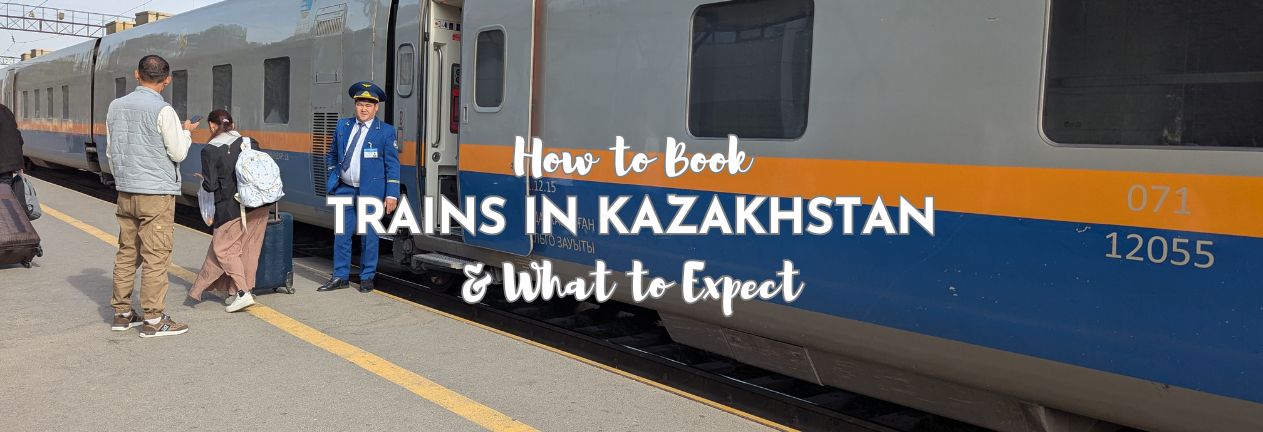
Kazakhstan is the world’s largest landlocked country, and the ninth largest overall, and once you look at a map, it might change how you think about getting around the country. Those distances that look short on paper can take a full day or more by rail, and trains are how a lot of Kazakhstan actually gets from city to city. And for us that is good news. They’re run by the national operator Kazakhstan Temir Zholy (KTZ), and there are two eras of trains running side by side here: older Soviet-era rolling stock and newer Talgo trains. The older Soviet era trains are slowly (and sadly) being phased out. Here’s how to book a Kazakhstan train ticket, and what to expect when traveling on trains in Kazakhstan.
THIS POST MAY CONTAIN COMPENSATED AND AFFILIATE LINKS MORE INFORMATION IN OUR DISCLAIMER
In this guide to traveling by train in Kazakhstan, I’ve covered the two eras of train you’ll find here, how the classes differ, and how to book a ticket, whether that’s online or at the station. I’ve included a sample of routes, what they cost and how long they take. Then I’ll go through what to expect once you’re on board, including safety considerations. For the full view on getting around Kazakhstan generally, including flights and marshrutkas, see my guide to how to get around Kazakhstan. Since most long-distance Kazakh trains are overnight by nature, this guide sticks to the basics: classes, booking, what’s provided. For the experience itself, whether a sleeper is actually worth it against flying, see my separate guide to overnight trains in Kazakhstan.
We used trains as our main mode of transport in our 10 day Kazakhstan Itinerary, you can see how that played out here.
Types of Trains in Kazakhstan
Kazakhstan trains fall into two distinct eras, and knowing which one you’re booking is important, as your journey is completely different.
Kazakhstan’s Soviet-Era Trains
These are the older trains in Kazakhstan. They average around 50 kilometers (31 miles) an hour, so the longest routes take days rather than hours. Stops are long, but scheduled; they tend not to hit delays, which is a good sign if you’re worried about reliability.
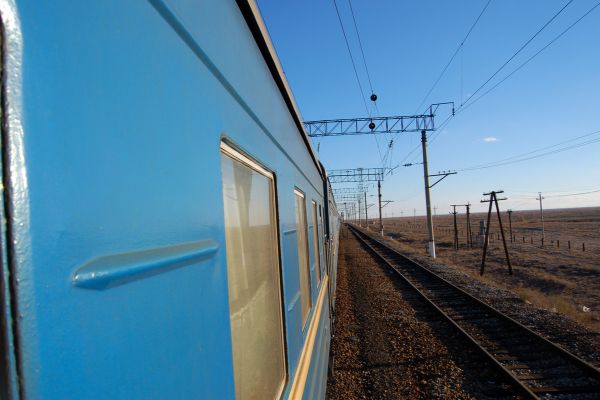
Of the two types of trains, this is the more social, more authentic option of the two, and it’s where you’ll find local vendors selling food on the platform at stops. The faster Talgo trains tend to make fewer, shorter stops. However, it’s not like it used to be on long-distance Soviet trains, where folks share food, drinks, and long stories, but it’s more like it than the newer Talgo trains.
Kazakhstan’s Talgo Trains
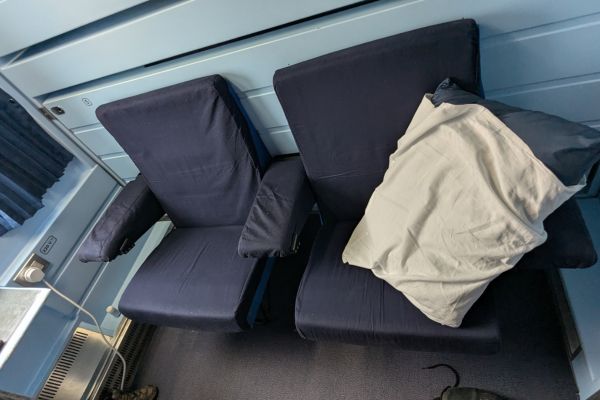
Kazakhstan’s Talgo trains are the modern, faster option, and you’ll find them especially on higher-demand routes like Almaty to Astana. There’s no Platzkart option on a Talgo train. Instead, you choose between three tiers, Tourist, Business and Grand, which I’ve covered in full below. Complimentary drinking water and in-train entertainment (by way of TV screens, not the entertainment we found on this special train service in Japan!) are standard, though WiFi is advertised and often doesn’t work in practice, so don’t count on it, and get yourself a Kazakh SIM card instead.
Kazakhstan Train Classes Explained
The class of carriage, seat and berth on Kazakhstan trains differs depending on whether you’re on a Soviet-era train or a Talgo, so here’s an explanation of both of them.
Kazakhstan’s Soviet-era trains:
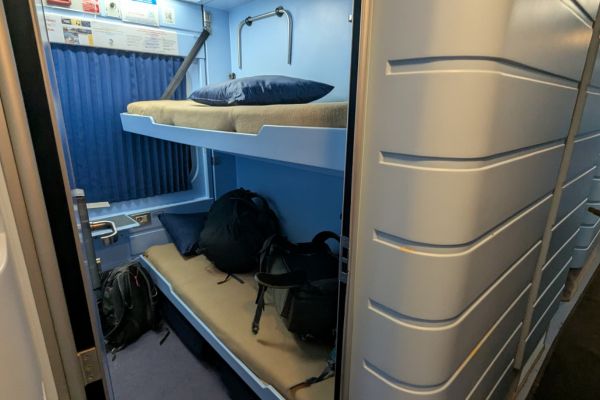
Lyux/Luxe: 2-bed compartments, the most private and most expensive option (we traveled on this between Almaty and Astana – I wrote about it here)
Kupe: 4-bed closed compartments, with a small table, individual lights and a few plug sockets (often not functional)
Platzkart: an open-plan carriage with around 40 bunks, no doors or compartments, noisier and more social, with the lower bunks doubling as daytime seating. They’re divided into sections with 6 bunk beds You’ll find this option on the Almaty to Shymkent train.
Obshy: seats only, no beds, the cheapest and least common option for visitors. It’s the cheapest option. And brutal for an overnight journey.
On Talgo trains:
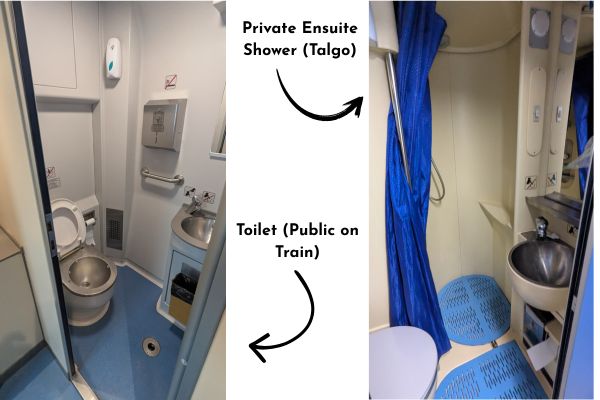
Grand: the most expensive tier, a 2-bed compartment with its own ensuite toilet and shower (we took this train from Astana to Shymkent, and I wrote about it here)
Business: a 2-bed compartment, the standard SV/Lyux equivalent, without the ensuite
Tourist: a 4-bed closed compartment, equivalent to Kupe on the older trains
How to Book Train Tickets in Kazakhstan
There are two options for booking, online or in person at the station, aside from using an agent to book tickets for you (and both in-person and online are easy enough, so here’s how both work. First, though, a little primer. Your ticket, if you buy with the KZ operator, will be printed in Cyrillic.
Useful Cyrillic Words for Booking Trains in Kazakhstan
A handful of these come in useful whether you’re booking online or at the station counter.
Вокзал (Vokzal): train station
Билет (Bilet): ticket
Касса (Kassa): ticket window or booking office
Отправление (Otpravlenie): departure
Прибытие (Pribytie): arrival
Купе (Kupe): the 4-berth closed compartment class
Плацкарт (Platzkart): the open-plan bunk carriage class
Almaty: АЛМАТЫ
Astana: АCTAHA
Shymkent: ШЫМКEНT
You will specifically need the Cyrillic for the city names if you’re using the KZ train booking website. And you’ll need to understand that using tickets.kz, Shymkent is Chymkent.
Booking Trains in Kazakhstan Online
12goAsia is, for us, the most reliable online booking engine for Kazakhstan train tickets.
Tickets.kz is another excellent recommended option, with an English interface, visible prices and timetables, and mobile apps for iOS and Android. Foreign cards generally work here, though not always flawlessly.
The official KTZ site (railways.kz / temirzholy.kz) also exists, but its English version is reported as less reliable and harder to use without a Cyrillic keyboard, and so I’m not even suggesting you go there.
Trains to and from China can only be booked through a travel agency, not online. The old direct Almaty to Urumqi service no longer runs either, so these days that route means booking a train to Khorgos, crossing the border on foot, and continuing by rail from Alashankou on the Chinese side. If you’re looking to go from Almaty to Urumqi, then just book the bus. We came overland, from Urumqi to Almaty, the last time we visited Kazakhstan (it’s NOT bookable online doing it that way around).
Booking Trains in Kazakhstan at the Station
It’s still possible to book tickets for Kazakh trains at the station, but English isn’t guaranteed at ticket counters, so bring your route and dates written down. And think about what your alternatives are before you get to the front of the line. It reminds me a lot of back in 2014 when we traveled across Russia by train, and had to buy tickets in scrambled Russian, all written down.
Booking Trains in Kazakhstan at a Qiwi Terminal
You’ll find Qiwi terminals in some shops. You can use these to book train tickets too. They have an English language option too. There’s more on the terminals (you’ll need to put translate on) here. You can pay cash at these machines as well. Read my guide to currency and how to pay in Kazakhstan here.
Kazakhstan Train Stations – What to Expect
Every city has a main station, called Vokzal in Russian/Kazakh, and larger cities, like Almaty and Astana, have TWO stations. Double-check which one your ticket departs from before booking a taxi there. Alternatively, use YandexGo, but for this you’ll need mobile data, so read my guide to SIMs in Kazakhstan. This station confusion is directly relevant if you’re planning on traveling the Almaty to Astana route.
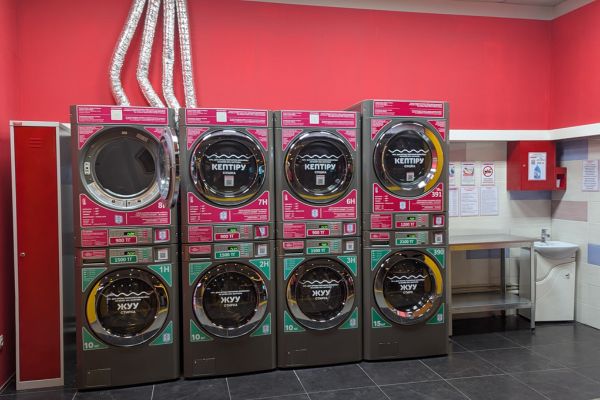
Train stations tend to be enormous. They have left luggage, but are usually so far out of the center that you probably won’t bother. The new Nurly Zhol station in Astana is more like an airport than a train station and (as of May 2026) has a metro connection to the city. There’s also, for those of you interested, a laundry here. So you can wash while you wait.
There is usually a big screen with departing and arriving trains on it. It’s easiest to match the number of your train, rather than look for the destination; after all, your train might be going on somewhere after you get off.
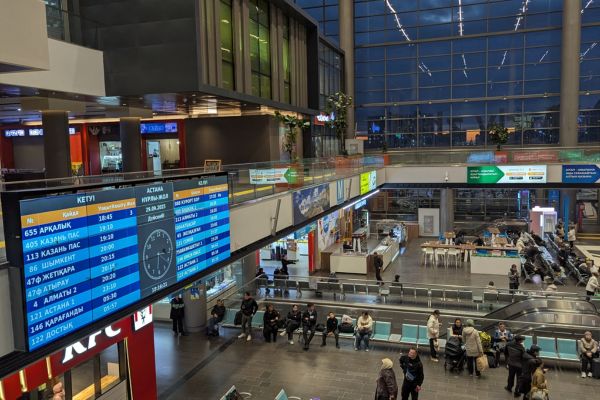
There may be announcements; they’re unlikely to be in English, but you’ll generally know that something is happening as crowds will disperse. If you have any problems with knowing where to go, have your ticket or e-ticket in hand and show it to someone. They’ll always help.
Why Travel by Train in Kazakhstan
Flying gets you there faster, and marshrutkas are cheaper for shorter hops, but neither shows you the country quite like a train does. Kazakhstan is enormous, and there’s something about watching the steppe roll past for hours, empty grassland stretching to the horizon in every direction, that no plane window can give you.
None of the views are particularly spectacular, but it’s slow travel in the truest sense, and that’s the point. You’ll either share a compartment with locals heading to visit family, or other travelers. Today, more than likely though, everyone will have headphones plugged in or be asleep.
On the overnight trains, you get the chance for an “ok” night’s sleep and on some trains a shower (in your la-di-da ensuite cabin). And yes. It’s worth it. There are dining cars with a small selection of options. There’s sometimes beer too. But all carriages – or at least every other one- have a hot and cold water dispenser, so you can resort to the good old pot of noodles.
What to Expect on Board Kazakh Trains
Every train has a dining car/restaurant serving Central Asian food, think plov and lagman, along with beer, wine or vodka. There’s a boiling water dispenser in every carriage too, so bring a mug, some decent coffee and instant noodles and you’re set.
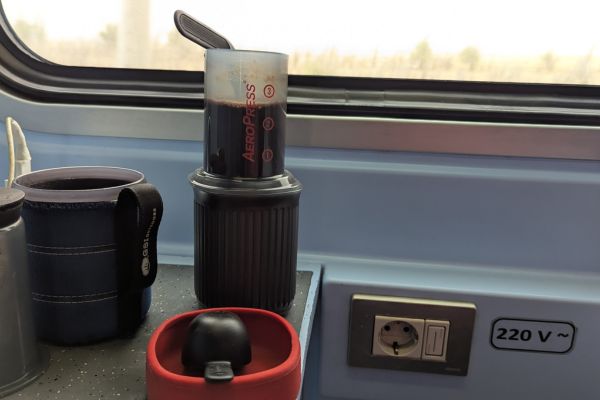
We always travel with an AeropressGo, which means we get great espresso coffee so long as we have hot water. (and yeah, we have a hot water boiler for when there isn’t hot water.)

AeroPress Go Extra Small Portable Coffee Maker Kit
Check price on AmazonAs an Amazon Associate I earn from qualifying purchases.
We use and love the AeroPress Go, small enough to pack easily and properly capable of a real cup rather than a compromise. Bring either the metal filter or a stash of paper ones, whichever you prefer, along with a couple of camping mugs.
AeroPress Go: buy it here.
GSI Outdoors Infinity Backpacker Mug: buy it here. – these are the BEST travel mugs ever, light, easy to clean, and perfect for all sorts of things.
Clean bed linen is provided regardless of class, so long as there’s a berth and not just a seat. Plug sockets exist in Kupe and Luxe compartments, and on Talgo trains, so make sure you bring along a power adapter.
Toilets are basic and can run out of paper, so bring your own. Local vendors still sell food and drink on the platform during stops, so you don’t need to stock up entirely in advance, although when you’re taking an overnight train, they’re unlikely to be there at the 04:00 stops. I would bring what you want to eat if you’re not planning on using the dining car service. There’s more on food and drink in Kazakhstan in my guide here.
Is Train Travel in Kazakhstan Safe?
Train travel here is widely safe, including for solo travelers, with fellow passengers generally looking out for tourists. The standard advice still applies: keep valuables close overnight, especially in open Platzkart carriages, and use a Kupe compartment if you want the option to lock the door.
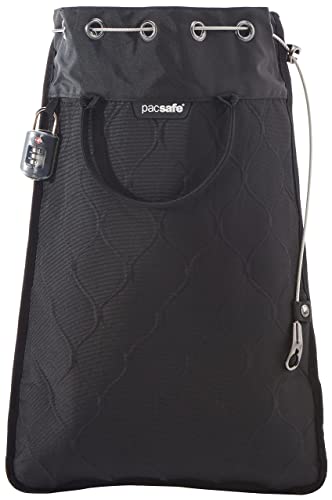
We always travel with a portable travel safe, and lock our valuables to something immovable. If that’s not possible, then I put them under my pillow when I sleep.
What to Pack for the Train
Extra layers, carriages can be cold, especially in winter
A sleeping bag liner (optional, on top of the provided linen). We did this years ago in Russia, but haven’t used them on any of the Kazakh trains.
Snacks; onboard and station food is available but pricier than bringing your own
A power bank and a power adapter for the sockets in the train.
A travel mug, coffee, or tea and instant noodles; the water dispenser makes this easy
Toilet paper
You MUST arrive at the train station at least half an hour before your train is due to depart. There are ALWAYS security checks these days, and it could take a while to find your carriage. You won’t be allowed to enter the train unless you have your ticket and passport.
The doors on the Talgo trains close 5 minutes before departure, so if you’re on time you’re essentially late and won’t get on the train.
PRACTICAL TRAVEL TIPS
- 🛡️ Get Travel Insurance: Civitatis includes medical expenses, repatriation, theft, luggage delays. No deductibles or upfront payments. Get a quote here.
- 🛏️ Sea view? Laundry? Private bath? Book a Room.
- 🔌 Be ready for the plug, socket & power situation.
- 📶 Get online EASILY & cheaply – One eSim for the world. Data never expires
FAQs on Trains in Kazakhstan
Here are the questions that I wish we’d have answered before we explored trains in Kazakhstan.
Can I book Kazakhstan train tickets with a foreign card?
Generally yes, via Tickets.kz, though occasional payment failures are reported. It’s worth having a backup card or payment method just in case. Alternatively, use 12goAsia for a consistent service.
How many classes of tickets are there in Kazakhstan?
There are four different classes of seats/berths on Soviet-era trains: Lyux, Kupe, Platzkart and Obshy. Three on Talgo trains: Tourist, Business and Grand.
Is WiFi available on Kazakh trains?
Talgo trains advertise that there is WiFi, but it’s inconsistent in practice.
Final Words on Trains in Kazakhstan
Trains are a fabulous way to see the scale of Kazakhstan, and to travel around, even when they’re slower than flying, and once you know which platform to book through, getting a ticket is manageable. Go on the Talgo if you want speed and don’t mind paying a bit more. Go Soviet-era if you want the more social, more authentic experience, and don’t mind the extra hours. Either way, book ahead in summer, bring your own snacks and a power bank, and settle in for the steppe.
ASocialNomad is a participant in the Amazon Services LLC Associates Program, an affiliate advertising program designed to provide a means for sites to earn advertising fees by advertising and linking to amazon.com, amazon.co.uk, and amazon.ca. Amazon and the Amazon logo are trademarks of Amazon.com, Inc. or its affiliates. As an Amazon Associate, I earn from qualifying purchases.

