
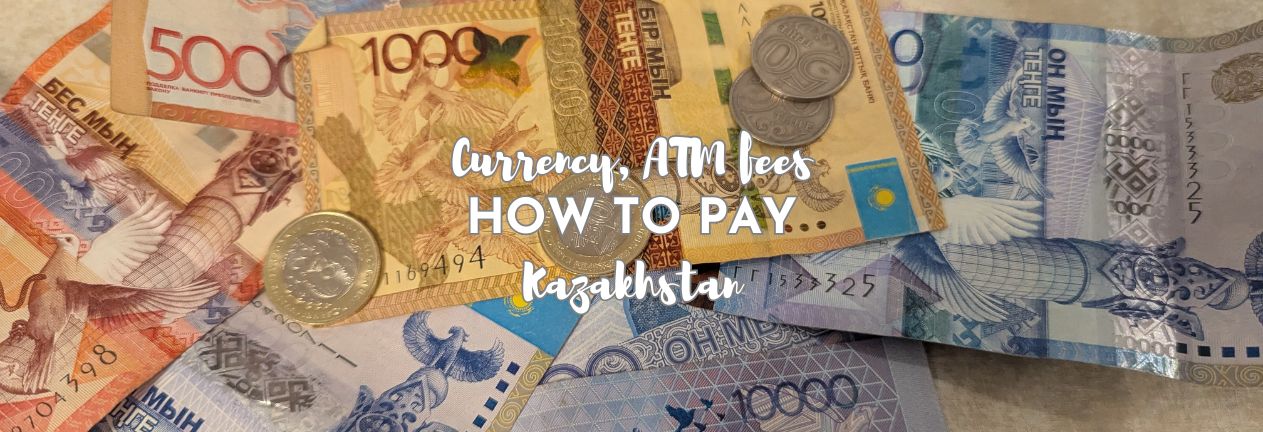
Kazakhstan is affordable and mostly straightforward when it comes to money, but as ever, this is on our list of things to figure out before we arrive. How cash, cards, and ATMs actually work in Kazakhstan. Locals increasingly pay via the Kaspi app, a QR code mobile wallet that’s convenient. For them at least. Kaspi is tied to a Kazakhstani bank account, so it’s not available to foreign visitors unless you’re staying around for quite some time, when you can organize it. Yes, it’s important to understand ATM withdrawals, bank fees, and when you need cash in your pocket. This guide walks through how to pay for things, what Kazakhstani tenge looks like, where cards work and where they don’t, and how to keep ATM and card fees to a minimum.
THIS POST MAY CONTAIN COMPENSATED AND AFFILIATE LINKS MORE INFORMATION IN OUR DISCLAIMER
Below you’ll find a breakdown of the banks’ and ATMs’ fees. There are withdrawal limits and what fees to expect, so you can pick sensibly once you land. Bank fees and limits do change over time, so if you’ve withdrawn cash in Kazakhstan more recently than the dates listed below, let us know in the comments or by email, and we’ll keep the table updated.
#1 TIP FOR CASH & CARDS

Get a WISE Card to take to on your travels. Two free ATM withdrawals per month, plus free to use to pay by card with zero foreign transaction fees.
Kazakhstan Money at a Glance
- Currency: Kazakhstani Tenge (KZT), 1 tenge = 100 tiyn
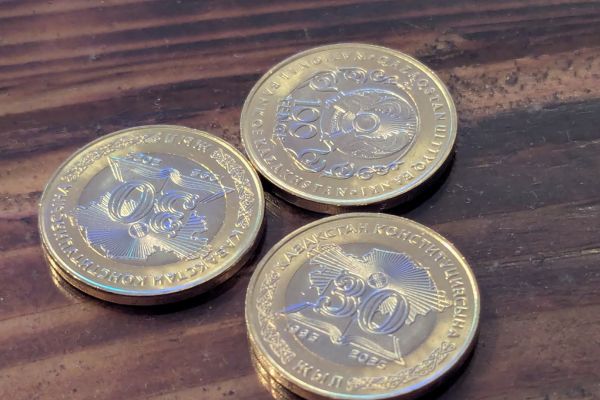
- Coins: ₸1, ₸2, ₸5, ₸10, ₸20, ₸50, ₸100, ₸200
- Notes: ₸500, ₸1,000, ₸2,000, ₸5,000, ₸10,000, ₸20,000
- Cash vs Cards: cards work almost everywhere in cities and towns; cash is essential in rural areas (yurts, guesthouses, gas stations, marshrutkas, small places to eat) and for emergencies.
- ATM Fees: Halyk Bank and Kaspi Bank both have no withdrawal fee on foreign cards, though any foreign transaction fee applied by YOUR bank still applies.
- Withdrawal Limits: typically 60,000–120,000 KZT (around US$125–250) per transaction, depending on the bank.
- Best Strategy: withdraw from Halyk Bank or Kaspi Bank ATMs with a no-foreign-fee card, and add your card to Yandex for taxis so you’re not caught needing cash for a ride.
- Currency Exchange: ATM withdrawals are cheaper than exchanging cash; although if you’re coming across a border with foreign currency you might as well change it. Do keep some tenge on hand for rural stops and emergencies.
Paying for Things in Kazakhstan
A lot of everyday spending in Kazakhstan has gone cashless, but it’s built around Kaspi, a QR-code mobile wallet that locals use for almost everything. And Kaspi is tied to a domestic bank account, so it’s not something you can sign up for as a visitor.
So yes. Cash still matters in Kazakhstan, but less than you might expect. A credit card gets you through almost everywhere except small local shops and marshrutkas. (More on transport and paying for it in my guide here) Add your credit card to Yandex, the ride-hailing app, and you can cover taxis without touching cash at all. We changed money twice when arriving in Kazakhstan. Most recently, crossing overland from China (traveling from Urumqi to Almaty), and earlier coming from Bishkek to Almaty, before ATMs became our default. A note of warning: if you are coming across from China, then you’ll want to get rid of your Chinese yuan in China and change to tenge. Yuan is hard to exchange in Kazakhstan.
Kazakhstani Currency – The Tenge (KZT)
Kazakhstan uses the tenge, written as KZT and denoted with the ₸ symbol. One tenge is made up of 100 tiyn, though tiyn coins are more or less obsolete in everyday use. Coins start at ₸1 and go up to ₸200. Notes go from ₸500 up to ₸20,000.
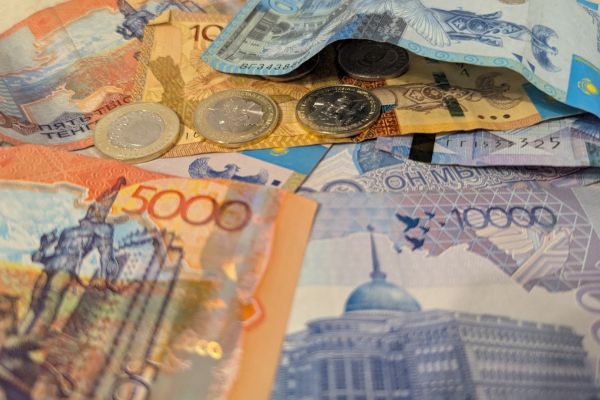
Kazakhstan has also been rolling out a redesigned “Saka” series of banknotes, smaller than the old notes and with upgraded security features. Both old and new versions are legal tender during the changeover.
You’ll pay EVERYWHERE in tenge. If you’re carrying US dollars as a backup, expect to change them before paying for anything.
Cash versus Cards in Kazakhstan
Cards should be your first option. In Almaty, and to a lesser extent the other big cities, cards are widely accepted: supermarkets, hotels, restaurants, and most shops will take a card without a second thought, and a credit card added to Yandex covers taxis too.
Once you get into rural Kazakhstan, in small local shops, rural guesthouses, yurt stays, and small cafes you’ll find that it’s cash-only far more often than not. For food and accommodation specifics, see our guides to Food and Drink in Kazakhstan and my suggestions on where to stay inside my Almaty Travel Guide
You’ll need cash to pay for extra, like horse rides if you visit Kolsai Lakes and Kaindy Lakes (read my guide here)
Tips for Minimizing ATM & Card Fees in Kazakhstan
Withdrawing cash in Kazakhstan is simple, and unlike a lot of countries, several of the major banks don’t charge an outright withdrawal fee on foreign cards. I’ve covered them in the table below. But that doesn’t mean that your cash withdrawal will be totally free, unless you follow a few key rules.
Keeping Cash costs low at the ATM in Kazakhstan
- Use a card with zero foreign transaction fees (Wise, Starling, Chase, or similar).
- Always choose to be charged in tenge, not your home currency. The “pay in your own currency” prompt is Dynamic Currency Conversion (DCC), and it always costs more.
- Add your card to Yandex so taxis and transfers don’t force you to carry extra cash.
- Prepay tours and transfers online where you can.
- Carry a backup card in case one gets declined or eaten by a machine.
- Keep your receipts, as some banks back home will reimburse foreign ATM fees if you can show the charge. We’ve successfully fought this with Santander in the past.
- If you start to withdraw cash from an ATM and it shows a withdrawal fee back out of the transaction, find another ATM.
#1 TIP FOR CASH & CARDS: Get a Wise card to take on your travels – free to use for card payments with zero foreign transaction fees, plus fee-free withdrawals up to a monthly limit.
Currency Exchange Options in Kazakhstan
You’ll find currency exchange kiosks in most Kazakhstani cities, and they’re straightforward enough if you need cash quickly, but they’re rarely your best option. You’ll also find them on both sides of the neighboring borders.
My tip? Always change any foreign currency you’re bringing in at the first major city you get to. It just becomes harder the further away you move from the border.
Withdrawing tenge directly from an ATM on a no-foreign-fee card ALWAYS exchanges cash, since you skip the exchange kiosk’s margin entirely. In Kazakhstan, banks like Halyk Bank and Kaspi do NOT have withdrawal fees.
If you do want to exchange cash, banks tend to offer better rates than standalone kiosks, and airport exchange desks are the worst value of the lot. If you need to change only enough there to cover a taxi or your first meal, and sort the rest once you’re in the city. USD and EUR are the easiest foreign currencies to exchange; as are currencies from Kazakhstan’s neighboring countries.
It’s also important to have good, new, uncreased and un-ripped notes. You’ll usually need your passport usualkly to change money at an exchange.
ATM Provider Table: Kazakhstan
The bank with the most ATMs in Kazakhstan is Kaspi.
All ATMs accept Visa and Mastercard. Some ATMs may also accept Maestro cards. You’ll have a tough time finding an ATM that accepts American Express. Sometimes you’ll find an ATM works one day and not the next. Just move on, or come back the next day.
| ATM Provider | Typical Withdrawal Limit | Withdrawal Fees | Date of Information |
| Halyk Bank | 60,000–100,000 KZT | No fees | Aug 2026 |
| Kaspi Bank | 100,000–120,000 KZT | No fees | January 2026 |
| ForteBank | Up to 60,000 KZT | Mixed – 400–700 KZT reported by two readers, none by others | September 2025 |
| Bereke Bank / Nurbank | 100,000 KZT | No fees | September 2025 |
These figures come from third-party ATM trackers and traveler reports, not our own bank statements for every entry – Halyk Bank’s “no fee” is confirmed from our own withdrawal at Almaty Airport, but treat the rest as a starting point rather than gospel, and expect some variation depending on your own bank’s foreign transaction fee.
Airport ATMs & Almaty Spending
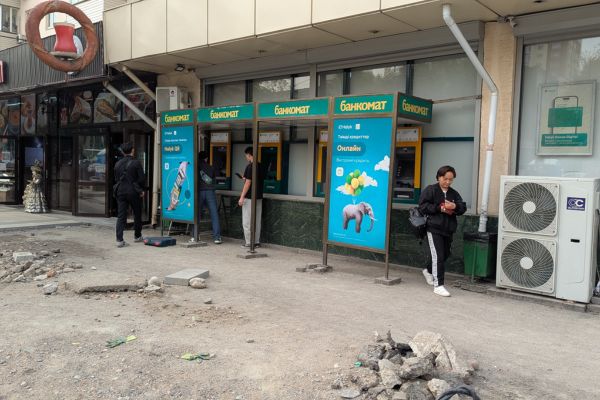
Almaty International Airport has ATMs right in the arrivals area, including Halyk Bank, where you can withdraw tenge on arrival with no fee charged on the Kazakhstani. Kaspi also has a presence at the airport, with English-language menus. (All the ATMs we found in Kazakhstan had English-language options. Withdrawal limits at the airport are the same as you’ll find elsewhere, generally in the 60,000–120,000 KZT range depending on the bank. There are currency exchange desks too, but as anywhere, expect worse rates than you’ll get in the city – just change enough to get you into Almaty. For more on the airport transfer itself, see our guide to Almaty Airport to the City.
FAQs on ATMs, Currency and How to Pay in Kazakhstan.
Oh yes, there’s more. Here are the questions (and answers) to everything that we haven’t covered so far.
What is the ATM withdrawal limit in Kazakhstan?
The ATM withdrawal limit is usually 100,000 KZT, although you may find a Kaspi or Halyk bank ATM that gives you 120,000 KZT. This limit is per withdrawal.
Can I pay in US Dollars in Kazakhstan?
No. Not usually. Unless you’re buying a house or a car. The currency in Kazakhstan is the tenge; use this to pay for things.
How do I find ATMs in Kazakhstan?
ATMS are known as bankomats in Kazakhstan. Search for them on your mapping tool, – 2GIS or Yandex Maps. They are NOT in short supply, and in the cities you’ll find one pretty much on every street!
PRACTICAL TRAVEL TIPS
- 🛡️ Get Travel Insurance: Civitatis includes medical expenses, repatriation, theft, luggage delays. No deductibles or upfront payments. Get a quote here.
- 🛏️ Sea view? Laundry? Private bath? Book a Room.
- 🔌 Be ready for the plug, socket & power situation.
- 📶 Get online EASILY & cheaply – One eSim for the world. Data never expires
Final Words on Currency and ATM Fees in Kazakhstan
Money in Kazakhstan is more straightforward than it might look on paper: cards will cover you almost everywhere in the cities, a no-fee card paired with a Halyk Bank or Kaspi ATM handles the rest, and cash is really only essential once you’re off the beaten path. Keep some tenge on you at all times once you leave Almaty, Astana, or the other big cities – for yurt stays, rural guesthouses, small eateries, and the worst-case scenario of a breakdown somewhere remote.
ASocialNomad is a participant in the Amazon Services LLC Associates Program, an affiliate advertising program designed to provide a means for sites to earn advertising fees by advertising and linking to amazon.com, amazon.co.uk, and amazon.ca. Amazon and the Amazon logo are trademarks of Amazon.com, Inc. or its affiliates. As an Amazon Associate, I earn from qualifying purchases.

