
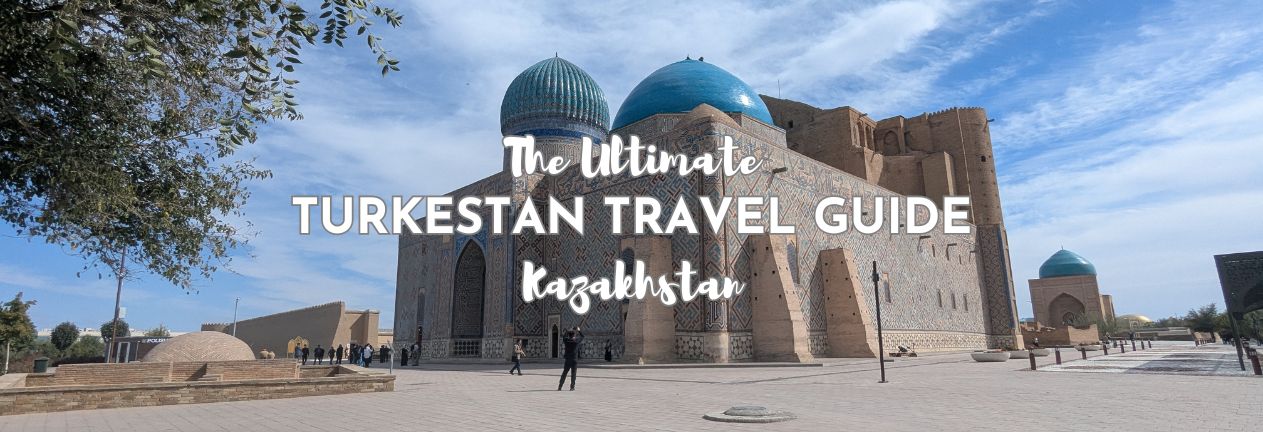
Turkestan is home to one of Kazakhstan’s six UNESCO World Heritage Sites – the Mausoleum of Khoja Ahmed Yasawi, an unfinished 14th-century masterpiece commissioned by Timur himself, and one of the best-preserved examples of Timurid architecture anywhere in Central Asia. It’s also a real pilgrimage site rather than just a museum piece. It’s said that three visits to Turkestan equals one hajj to Mecca. We came here on a day trip from Shymkent, and it turned out to be one of the most interesting parts of our route through Kazakhstan. Here’s our travel guide to Turkestan.
THIS POST MAY CONTAIN COMPENSATED AND AFFILIATE LINKS MORE INFORMATION IN OUR DISCLAIMER
If you’re putting together a Turkestan travel plan of your own, here’s what this one covers: how to get here from Shymkent, where to stay (whether that’s overnight here or a day trip from Shymkent), how long to spend in Turkestan, the top things to see inside and around the mausoleum complex, the history behind it all, a map to plan your visit, where to eat, and answers to the questions we get asked most about visiting.
How to Get to Turkestan
The easiest place to reach Turkestan from is Shymkent. It’s about 160 kilometers (100 miles), and you can travel here relatively easily by marshrutka, Yandex, trains, guided tour, or private transfer. We’ve written a complete breakdown of all five options, with prices and timings, in our guide on how to go from Shymkent to Turkestan.
Where to Stay to Explore Turkestan
Where is best to stay really depends on how much time you’re wanting to spend in Turkestan. If you want to be right by the mausoleum complex, which is useful for seeing it in the cooler (and quieter) early morning or evening light, or if you just don’t want to think about transport, then stay overnight at the Karavan Saray Turkistan Khaganate. It’s part of the Karavan Saray complex itself and about as close to the mausoleum as you can get, with facilities designed to support your visit to both the Karavan Saray and Mausoleum complex.
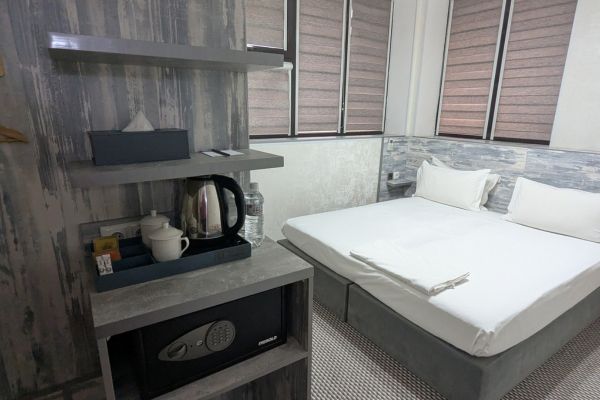
Otherwise, base yourself in Shymkent, and view Turkestan as a day trip, which is what most visitors, us included, end up doing. We stayed at the Express City Hotel in Shymkent. They do a great breakfast, we had a quiet but comfortable room, and an excellent location for exploring the city in between our trip to Turkestan. See our Shymkent Travel Guide for more on basing yourself there.
How Long to Visit Turkestan for
Half a day is enough time for Turkestan if the mausoleum complex is your main goal, and it’s an easy day trip from Shymkent. You’ll also have time to see the Karavan Saray complex and the gardens, but add an overnight stay at the complex itself if you want to slow down and not rush around.
Visiting Turkestan was a key stop on our 10 day Kazakhstan itinerary – you can see that here.
The Top Things to Do in Turkestan
Almost everything worth seeing in Turkestan is within, or right next to, the Azret Sultan complex around the Yasawi Mausoleum – here’s what to see.
This is an active pilgrimage site as well as a tourist attraction, so modest dress is expected throughout the complex. That means shoulders and knees should be covered for everyone, and women should bring a scarf to cover their hair before entering the mausoleum and mosques. Some sites can lend one at the door, but don’t count on it. I wore my scarf throughout the whole complex, inside and out.
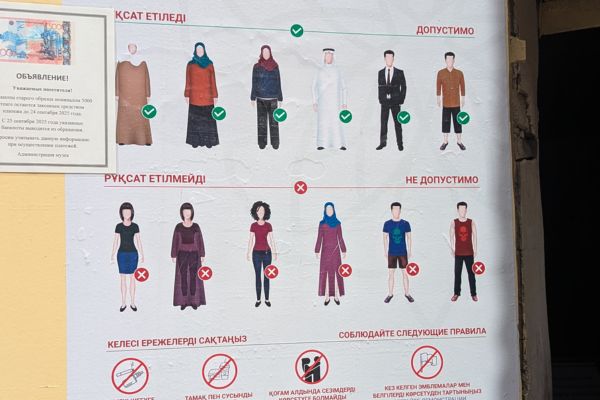
You’ll need to pay cash for the combined entrance ticket (the prices are below); read my guide to currency and paying for things in Kazakhstan here, but fear not, there are Halyk Bank ATMs on the mausoleum complex site.
The Khoja Ahmed Yasawi Mausoleum
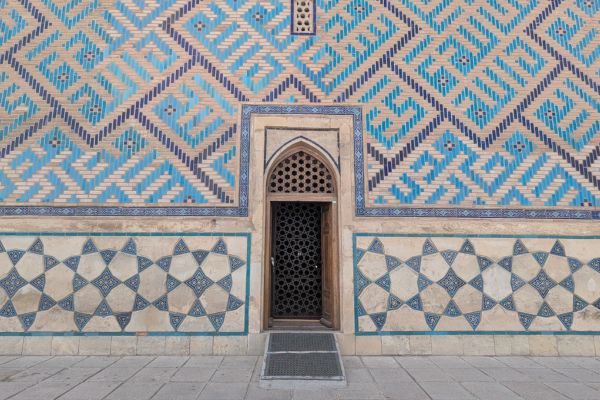
This is Kazakhstan’s most important historic monument, and one of the best-preserved examples of Timurid architecture anywhere in Central Asia. It was commissioned by Timur in 1389 to replace the original shrine over Sufi scholar Khoja Ahmed Yasawi’s tomb, but the mausoleum was never finished after Timur died in 1405.
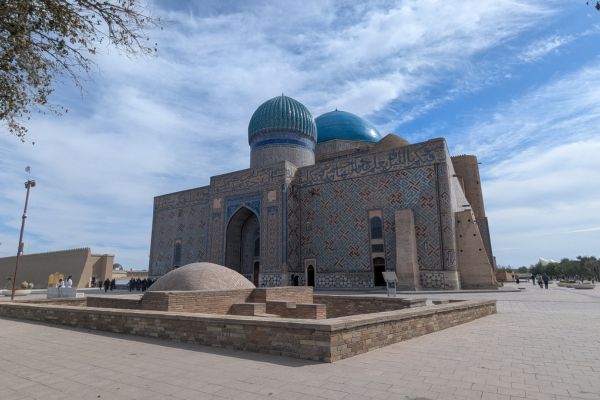
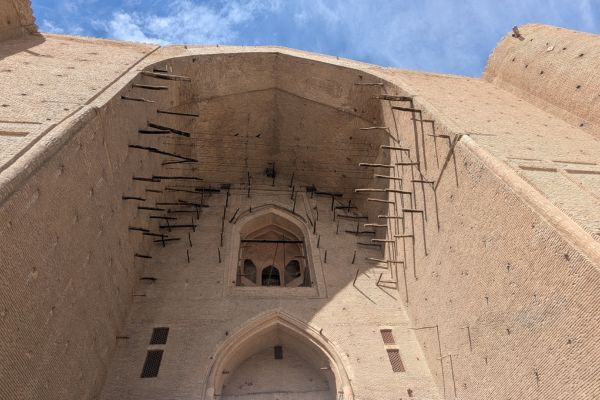
If you look closely, you can still see the unfinished brickwork and scaffolding holes on parts of the exterior. The 18.2-meter (60 feet) double dome and glazed blue tilework are extraordinary all the same.
There’s more on Yasawi and the history of Turkestan later in this article.
How to get to the Khoja Ahmed Yasawi Mausoleum: the center of Turkestan, at the heart of the Azret Sultan complex. It’s an easy walk from most hotels in town. If you’re taking a marshrutka from Shymkent, you can get dropped off by the entrance, rather than going all the way to the Alyn Orda bus station.
How long to spend at the Khoja Ahmed Yasawi Mausoleum: 45 minutes.
Entry Fees for the Khoja Ahmed Yasawi Mausoleum: 2000 KZT for foreigners (1000 KZT for Kazakh citizens, 1500 KZT for other regional citizens), which also covers the Rabia Sultan Begum mausoleum, Hilvet Underground Mosque, Juma Mosque and the Hammam within the same ticket.
Mausoleum of Rabia Sultan Begum
About 60 meters (200 feet) southeast of the main mausoleum, this smaller octagonal-domed structure honours Rabia Sultan Begum, Timur’s great-granddaughter and a notable figure in her own right in Central Asian history.
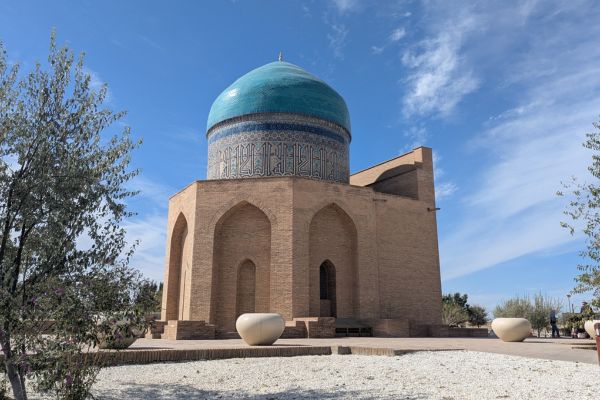
Its five interconnected rooms and turquoise dome are worth the short detour, and it’s included in the same ticket as the main complex.
How to get to the Mausoleum of Rabia Sultan Begum: within the Azret Sultan complex, about 60 metres southeast of the main mausoleum.
How long to spend at the Mausoleum of Rabia Sultan Begum: 20 minutes.
Entry Fees for the Mausoleum of Rabia Sultan Begum: included in the Azret Sultan complex ticket.
Hilvet Underground Mosque
Further on, around 150 meters (500 feet) from the main mausoleum, this semi-subterranean mosque dates back to the 12th-15th centuries and is said to be where Yasawi spent his final years in seclusion. If you’re here when there are few people (but that’s unlikely), it’s an atmospheric space; there are around 18 small rooms and seven doors, wooden columns, skylights, and a copper cauldron that’s been there since the mosque was built – and it’s still used by pilgrims for prayer today.
How to get to the Hilvet Underground Mosque: within the Azret Sultan complex, about 150 meters (500 feet) from the main mausoleum.
How long to spend at the Hilvet Underground Mosque: 20 minutes.
Entry Fees for the Hilvet Underground Mosque: included in the Azret Sultan complex ticket.
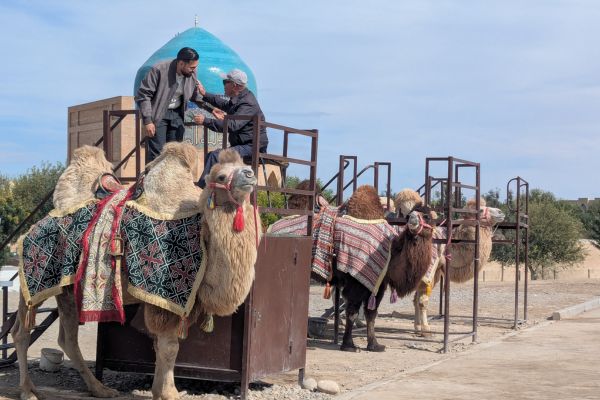
Near the mosque you’ll find another stalwart of Central Asian sites – the camel rides. And the statues of camels referring to this area’s position on the Silk Road.
The Hammam
This 16th-century bathhouse is no longer functional, but you can still walk through the connected domed chambers that were once used for hot, warm and cold bathing, and see the underfloor heating system that kept them running.
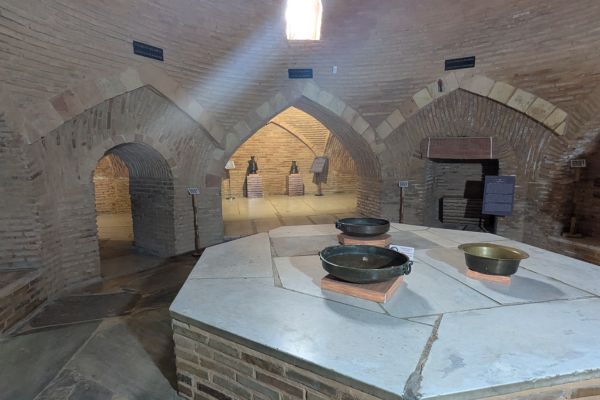
There’s a lot of informative signage, and it’s included on the free audio guide that you can use as you walk around the site. This complex wasn’t just a religious site; bathhouses were as much social hubs as hygiene stops in Central Asian cities.
How to get to the Hammam: within the Azret Sultan complex, just behind the main mausoleum.
How long to spend at the Hammam: 20 minutes.
Entry Fees for the Hammam: included in the Azret Sultan complex ticket.
Juma Mosque
This 19th-century addition to the complex, the Juma Mosque (Friday Mosque) is simpler and less ornate than the main mausoleum, but it’s still an active congregational mosque used by locals for Friday prayers. Traditional wooden columns and a central dome make it worth a quick look on your way between the other sites.
How to get to Juma Mosque: within the Azret Sultan complex, steps from the main mausoleum.
How long to spend at Juma Mosque: 20-30 minutes.
Turkestan City Fortress and Ancient City Ruins
Turkestan’s mud-brick city walls date back as far as the 5th century, reinforced repeatedly through the medieval period, with partially reconstructed sections now sitting near the Azret Sultan complex. It’s an active archaeological site, so what’s open to walk through does change.
How to get to the Turkestan City Fortress: near the Azret Sultan complex, walkable from the main mausoleum.
How long to spend at the Turkestan City Fortress: 30-45 minutes.
Entry Fees for the Turkestan City Fortress: free to explore.
Gardens Outside the City Walls and Musical Fountains
Beyond the walls of the mausoleum complex, there’s a stretch of neatly pruned gardens and fountains that gives you somewhere shaded and really rather delightful to wander around. There are cultivated gardens, musical fountains and seating areas too. There are also lovely views of the complex from here.
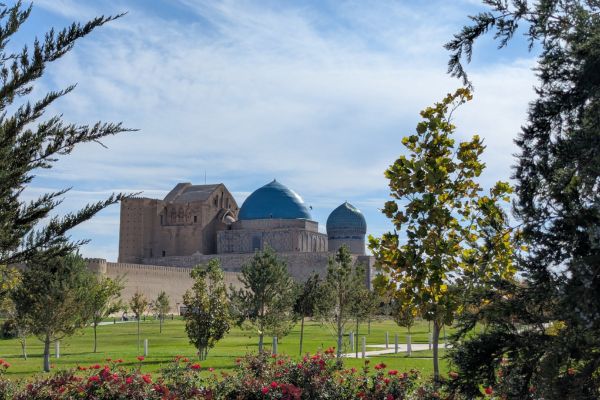
How to get to the gardens and musical fountains: just outside the old city walls, near the Azret Sultan complex and Karavan Saray.
How long to spend at the gardens and musical fountains: 30-45 minutes.
Entry Fees for the gardens and musical fountains: free.
Masjid Khoja Ahmed Yasawi
Not to be confused with the historic mausoleum, this modern mosque is a short walk from the main complex, built in a turquoise-domed style that reads almost like a contemporary reinterpretation of classical Timurid architecture. It’s a working mosque rather than a museum piece, so dress and behave accordingly if you go inside.
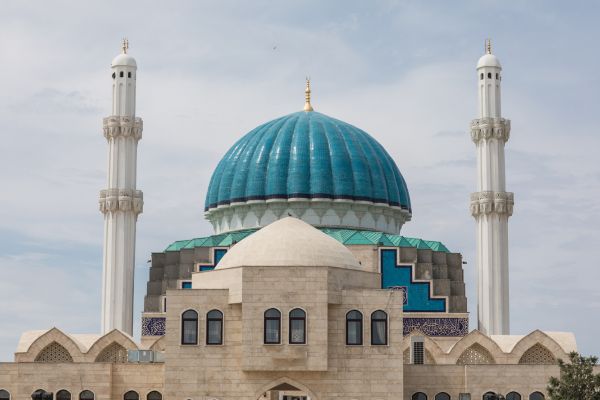
How to get to Masjid Khoja Ahmed Yasawi: a short walk from the main Azret Sultan complex.
How long to spend at Masjid Khoja Ahmed Yasawi: 15-20 minutes.
Karavan Saray Entertainment Complex
Opened in 2021, Karavan Saray bills itself as the largest tourist entertainment complex in Central Asia, and it’s a weird, odd contrast to the historic site next door.
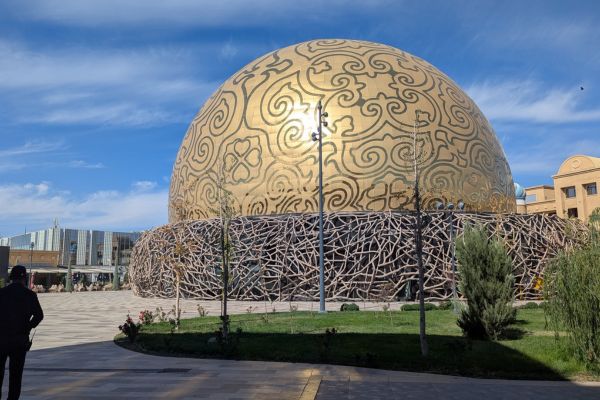
There’s a flying theatre, cinema, library, canals with gondola rides, craft shops and restaurants, all built around the same Silk Road theming. It’s aimed at domestic and Central Asian tourists rather than history-focused travellers, but it’s worth a stop for lunch and a wander around.
How to get to the Karavan Saray Entertainment Complex: next to the Azret Sultan complex, walkable from the mausoleum.
How long to spend at the Karavan Saray Entertainment Complex: 1-2 hours.
Entry Fees for the Karavan Saray Entertainment Complex: free to browse; individual attractions and vendors charge separately.
The History of Turkestan
Khoja Ahmed Yasawi was born near Shymkent in 1093 and became one of the most influential Sufi scholars and mystics in Central Asian history. Sufism is a dimension of Islamic practice built around a direct, personal relationship with God, with sincerity, purity, community and discipline at its centre – if you’ve heard of the Whirling Dervishes of Turkey, you’ve already encountered a branch of the same tradition. Yasawi died in 1166, and his tomb quickly became one of the most important pilgrimage sites for Sufi Muslims across the region.
The mausoleum you see in Turkestan today isn’t the original. It was commissioned in 1389 by Timur, Tamerlane, to replace an earlier, smaller structure over Yasawi’s tomb. Timur was a Turco-Mongol conqueror from what’s now Uzbekistan, and although not a direct descendant of Genghis Khan, he shared common ancestors and characteristics with him. At the height of his power, he’d conquered the Islamic armies of Egypt, Syria, Turkey and Delhi, despite lacking Khan’s physical prowess. A 1941 Soviet exhumation of his tomb found he’d actually been lame, with a withered left arm. Timur died in 1405, and the mausoleum he commissioned in Turkestan was never finished; the unfinished brickwork and scaffolding marks are still visible on parts of the structure today.
Timur had built himself a modest tomb in Shahrisabz near his Ak-Saray Palace, in today’s Uzbekistan; however, when he died in 1405 the passes to Shahrisabz were blocked with snow, and so he was buried in Samarkhand. (We visited both sites, and you can read about them here)
Turkestan itself has been an important city for far longer than the mausoleum. It was a major stop on the Silk Road, and in the 16th century became the centre of the Kazakh Khanate, before the Russians eventually took control of the region. Inscribed as a UNESCO World Heritage Site in 2003, the mausoleum complex remains one of Kazakhstan’s six UNESCO sites, and one of the best-preserved examples of Timurid-era architecture in Central Asia. The wider complex also includes the mausoleum of Rabia Sultan Begum, Timur’s great-granddaughter, and a prominent woman in her own right in Central Asian history, along with an underground mosque and a bathhouse that Yasawi himself is said to have used.
Map of Things to Do in Turkestan
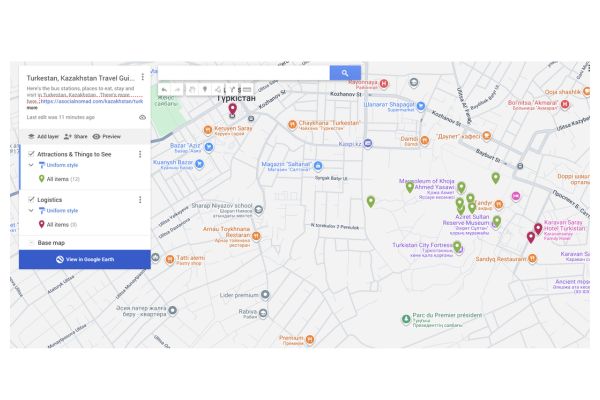
Here’s everything in this guide plotted on one map, so you can see how it all fits together and plan your own visit. You can also see the map here.
Shymkent from Turkestan
It’s easy to visit Turkestan as a day trip because Shymkent is close by, and most of what you’ll need before or after your visit, like accommodation, food, and onward transport, is easiest to arrange there. If you haven’t already, see our guide on how to go from Shymkent to Turkestan for the full transport breakdown, and our Shymkent Travel Guide for what to see and do in the city itself.
Where to Eat in Turkestan
Turkestan is small and for us, day-trip-focused enough, that we haven’t built out a full restaurant roundup here – see our Food and Drink in Kazakhstan guide for the country-wide picture. But for a quick, good meal without leaving the complex:
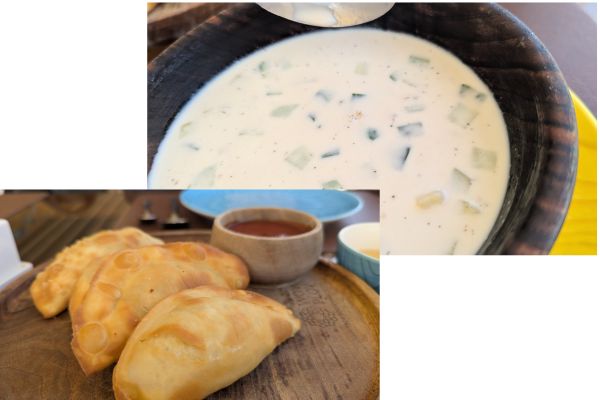
Head to the restaurants within the Karavan Saray complex. Wow Plov doesn’t just do plov; even if their plov is excellent, for something quick, try the okroshka (a cold yoghurt-based soup) and chebureks (fried savoury pastries). This is a great, fast option for lunching between the sights.
FAQs on Visiting Turkestan
A few quick answers to the questions we get asked most about visiting Turkestan.
How many days do you need in Turkestan?
You can easily explore the mausoleum complex in half a day, if that’s your priority; three-quarters of a day lets you add the Karavan Saray complex and the gardens without rushing. An overnight only really makes sense if you’re also exploring further sites nearby.
Is Turkestan walkable?
Yes. The Azret Sultan complex and Karavan Saray sit close enough together to walk between easily, and the historic centre is compact. You won’t need transport once you’re there, just to get in and out of town. If you don’t want to walk between the mausoleum sites and Karavan Saray, then there are electric golf carts for hire.
Can you visit Turkestan as a day trip from Shymkent?
Yes, easily. It’s about 160 kilometers (100 miles) and two to three hours each way by marshrutka or taxi, which leaves you enough time to explore the complex. See our guide on how to go from Shymkent to Turkestan for the details.
Do I need a car to explore Turkestan itself?
No, what you want to see is within the same walkable area around the Azret Sultan complex and Karavan Saray. If you don’t want to walk, there are electric golf carts that will ferry you around.
Is Turkestan worth the detour?
Yes. The Yasawi Mausoleum alone is one of the most significant historic sites in Kazakhstan, and it’s an easy add-on if you’re already in Shymkent rather than a major detour.
Final Words on Visiting Turkestan
Turkestan has a huge amount of history in a single, walkable complex. There’s an unfinished 14th-century mausoleum built by one of history’s great conquerors, a still-active pilgrimage site, and now, one of Central Asia’s biggest entertainment complexes sitting right next to it. Whether you come for half a day from Shymkent or stay overnight to take it slower, it’s a fascinating look at Kazakhstan’s pre-Soviet history.
PRACTICAL TRAVEL TIPS
- 🛡️ Get Travel Insurance: Civitatis includes medical expenses, repatriation, theft, luggage delays. No deductibles or upfront payments. Get a quote here.
- 🛏️ Sea view? Laundry? Private bath? Book a Room.
- 🔌 Be ready for the plug, socket & power situation.
- 📶 Get online EASILY & cheaply – One eSim for the world. Data never expires
ASocialNomad is a participant in the Amazon Services LLC Associates Program, an affiliate advertising program designed to provide a means for sites to earn advertising fees by advertising and linking to amazon.com, amazon.co.uk, and amazon.ca. Amazon and the Amazon logo are trademarks of Amazon.com, Inc. or its affiliates. As an Amazon Associate, I earn from qualifying purchases.

