
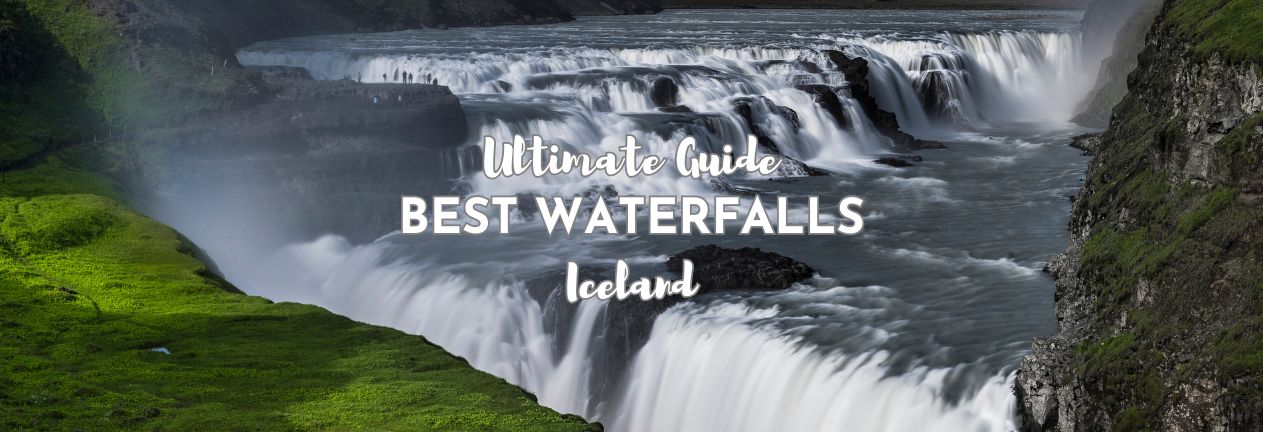
Iceland has more than 10,000 waterfalls, and fewer than 200 of them even have official names. You will not see them all, and you shouldn’t try. Here’s our guide to the waterfalls in Iceland, narrowed down to the ones worth planning your trip around: Iceland’s famous waterfalls and a handful of quiet waterfalls in Iceland that most drive straight past without knowing they’re there.
THIS POST MAY CONTAIN COMPENSATED AND AFFILIATE LINKS MORE INFORMATION IN OUR DISCLAIMER
If you’re trying to work out which waterfalls in Iceland deserve a stop, here’s the rundown: why the country has so many in the first place, then region by region, the Golden Circle, South Iceland, East Iceland, North Iceland, the Westfjords, and Snaefellsnes, the falls you’ll want to visit, plus practical tips for visiting them properly. Before I start, though, here are the links to my specific guides on those areas
- Iceland’s Golden Circle
- South Iceland
- East Iceland (and a bonus – Skagafjordur and the Trollaskagi Peninsula )
- North Iceland
- the Westfjords
- Snaefellsnes
Why Iceland Has So Many Waterfalls
Iceland’s glaciers, heavy rainfall, and steep volcanic terrain mean water is constantly moving downhill, fast, and often over a cliff edge. Add centuries of lava flows creating countless natural shelves and canyons for that water to drop over, and you get a country where a waterfall shows up roughly every mile you drive, most too small to ever get an official name.
Top Waterfalls on the Golden Circle
The Golden Circle’s two most notable waterfalls sit close enough together to visit on the same day, one iconic, one still finding its way onto more itineraries each year.
Gullfoss
Gullfoss is arguably Iceland’s most famous waterfall, a two-tiered giant on the Hvítá river, dropping first 11 meters (36 feet), then 20 meters (66 feet) into a rugged canyon carved out by glacial floodwaters, a combined drop of roughly 32 meters (105 feet). It’s the third stop on the classic Golden Circle loop, and one of the country’s most-visited natural sites for good reason; the sheer volume of water is hard to prepare for even after seeing photos.

A short, well-maintained path with some stairs leads down from the car park to the viewing platforms, barely a couple of minutes each way, so almost anyone can get close regardless of fitness or mobility. If you’re not self-driving in Iceland, you can visit Gullfoss on this Golden Circle trip.
- How to get to Gullfoss: continue past Strokkur Geyser on Route 35, in the Golden Circle area, about 90 minutes from Reykjavik.
- How long to spend at Gullfoss: 1-2 minutes down to the viewing platforms, longer if you’re taking photos; most people spend 30-45 minutes overall.
- Entry: free.
- Parking: free.
Bruarfoss
Bruarfoss is famous for having the bluest water of any waterfall in Iceland, glacial meltwater from Langjökull filtered through porous lava rock until it emerges a vivid turquoise. It’s a series of rapids rather than one tall drop; height really isn’t the point here, the color is, striking enough on an overcast day and reportedly dazzling in full sun. It’s not “officially” on the Golden Circle, but I include it as an optional extra in my 7 day Iceland Itinerary here.

Getting here used to mean a 7-kilometer (4.4-mile) round-trip walk, but a new parking lot opened in spring 2023 cut that down dramatically; now it’s a straightforward 5-minute walk in from the car park. Bruarfoss isn’t included in the “big three” of the Golden Circle, but this trip will take you there.
- How to get to Bruarfoss: on the Bruará River, roughly 15 minutes’ drive from Geysir, a natural detour on a Golden Circle route between Geysir and Gullfoss.
- How long to spend at Bruarfoss: about 5 minutes each way from the parking area, 30-45 minutes total including time at the falls.
- Entry: free.
- Parking: 750 ISK, pay via kiosk or the Parka app.
Top Waterfalls in South Iceland
South Iceland is where the country’s waterfall reputation really gets built; four stops here alone are worth a full day on the Ring Road.
Seljalandsfoss
Seljalandsfoss plunges 60 meters (197 feet) straight off a cliff, and it’s one of the few waterfalls in the country you can actually walk behind; a narrow path circles all the way around the back of the falls. That walk-behind path is exactly what makes it a favorite for photos, though be ready to get thoroughly wet doing it; waterproofs earn their keep here more than almost anywhere else on this list.

A further 9-10 minute walk brings you to Gljúfrabúi, a smaller falls tucked inside its own narrow gorge, with noticeably fewer visitors than its famous neighbor. Making waterfalls a feature of the day is what this trip along Iceland’s South Coast does, and Seljalandsfoss features on it.
- How to get to Seljalandsfoss: 90 kilometers (56 miles) east of Selfoss on Route 1, turn left onto Route 249 after crossing the Markarfljót river bridge.
- How long to spend at Seljalandsfoss: 45-60 minutes total including the walk-behind loop, longer if there’s a line.
- Entry: free.
- Parking: 900 ISK, pay via kiosk or Checkit.is.
Skógafoss
Skógafoss is one of Iceland’s largest waterfalls by volume, a wide, straight single drop of 60 meters (197 feet), right next to the Ring Road in the village of Skógar. Since it sits so close to Seljalandsfoss, the two get paired together in pretty much every South Coast itinerary, this one included.
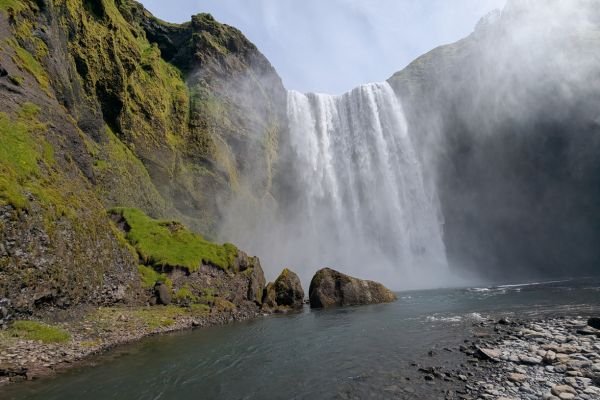
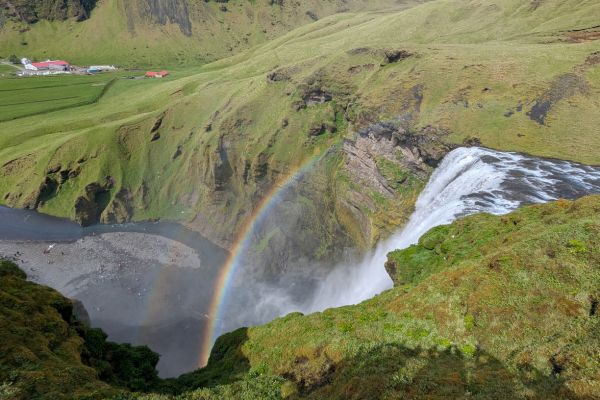
A staircase alongside the falls climbs to a viewing platform at the top, giving a proper sense of scale that’s easy to miss looking up from the base, and on a sunny day the spray regularly throws up a rainbow low across the pool. This is the perfect waterfall to visit on a South Coast trip, and its covered in this group tour.
- How to get to Skógafoss: just off Route 1, well signposted, about 2.5 hours’ drive from Reykjavik.
- How long to spend at Skógafoss: 35-45 minutes including walking up to the top viewing platform and down to the middle of the river.
- Entry: free.
- Parking: 1,000 ISK, pay via kiosk or the Parka app.
Kvernufoss
Kvernufoss is the quiet alternative to Skógafoss next door, a similar height and drop, tucked into its own gorge and missed entirely by most Ring Road drivers rushing between the bigger names. You can walk behind this one too, much like Seljalandsfoss, but with a fraction of the crowds, following the stream up alongside the falls before ducking around and behind the curtain of water.

Icelandic sheep tend to graze the field you cross to reach the trailhead, so shut the gate behind you on the way in and out. This is my favorite waterfall in Iceland, because it was glorious and so quiet. There were so few people there – here’s how you can get there.
- How to get to Kvernufoss: from Skógafoss, take a left and drive to the Skógar Museum; it’s signposted, and parking is outside there.
- How long to spend at Kvernufoss: 30-40 minutes including hiking to and from the parking area at the Skógar Museum.
- Entry: free.
- Parking: 750 ISK, pay via the Parka app only, no kiosk here.
Svartifoss
Svartifoss is famous for what surrounds it rather than its size, a modest 20-meter (65 feet) drop framed by a wall of dark hexagonal basalt columns that directly inspired the facade of Hallgrímskirkja church in Reykjavik. It’s inside Vatnajökull National Park, and getting there means a proper hike rather than a five-minute stroll, roughly 1.5 kilometers (1 mile) each way from the Skaftafell Visitor Center, moderate difficulty, passing three smaller waterfalls on the way up.
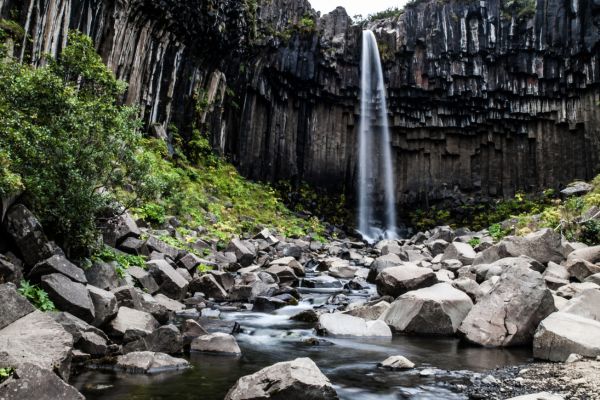
Budget 1-1.5 hours round trip if you want time to actually stand and take the columns in rather than just snap a photo and turn back. You can’t realistically get here and back to Reykjavik in a day, so you’ll need a few more. This 3 day trip gets you here and to a host of other amazing sites along the way.
- How to get to Svartifoss: inside Skaftafell, part of Vatnajökull National Park, on the South Coast route toward Jökulsárlón.
- How long to spend at Svartifoss: 1-1.5 hours round trip from the visitor center.
- Entry: free.
- Parking: 1,110 ISK, pay via the Parka app, 50% off if you’re visiting Jökulsárlón the same day.
Top Waterfalls in East Iceland
East Iceland’s waterfalls see far less traffic than the south, which is exactly the appeal for anyone willing to make the drive.
Hengifoss
Hengifoss is Iceland’s third-tallest waterfall, at 128 meters (420 feet), and one of its most distinctive; striped bands of red clay and dark basalt run through the canyon walls around it, a truly unusual sight even by Icelandic waterfall standards. Getting there takes a bit more of a hike, not a quick stop from a car park, roughly 2.5 kilometers (1.5 miles) each way with a real elevation gain; budget 2-3 hours round trip.
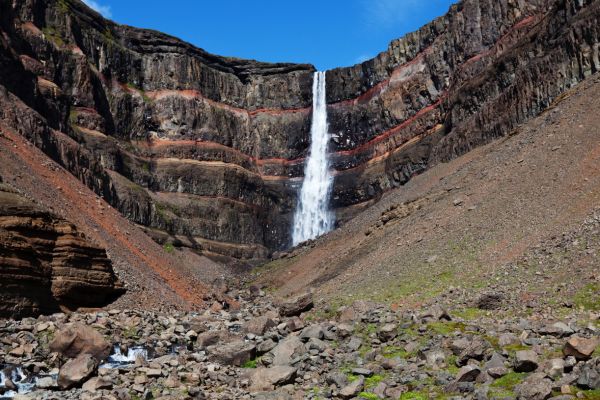
On the way up you’ll pass Litlanesfoss, a smaller but arguably more striking waterfall framed by some of the tallest, most symmetrical basalt columns in the country.
- How to get to Hengifoss: signposted off Route 931 in Fljótsdalur, south of Egilsstaðir.
- How long to spend at Hengifoss: 2-3 hours round trip, roughly 2.5 kilometers (1.5 miles) each way.
- Entry: free.
- Parking: 1,000 ISK, pay via Checkit.is.
Stuðlafoss
Stuðlafoss sits right at the start of the hike into Stuðlagil Canyon, and it’s one of the most overlooked waterfalls in the country for exactly that reason; most people walk straight past it, eyes already fixed on the canyon ahead. It’s a modest drop; sources put it anywhere from 15 to 25 meters (50-80 feet), which tells you it’s not really sold on height; the draw is the way the water falls into a dark bowl ringed by basalt columns rather than any single dramatic number.
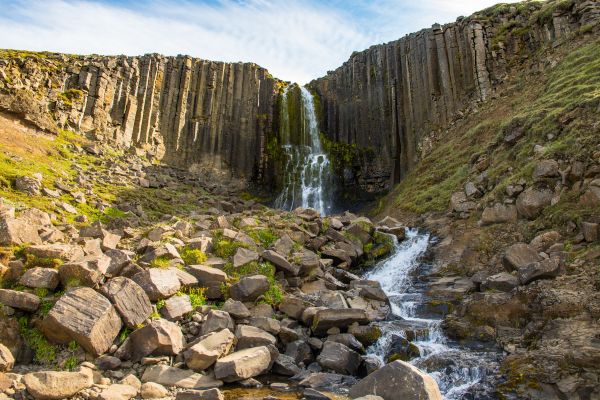
It sits right after the second parking area on the Stuðlagil trail, a couple of minutes’ detour at most. The canyon here is the most stunning part of things, and you can get here either by self-driving or on this tour from Seydisfjordur.
- How to get to Stuðlafoss: at the start of the Stuðlagil Canyon hike, inland from Egilsstaðir in Jökuldalur, right after the second parking area.
- How long to spend at Stuðlafoss: 10-15 minutes, a short detour right at the trailhead.
- Entry: free.
- Parking: 1,000 ISK, pay via the Parka app, shared with the Stuðlagil Canyon trailhead.
Gufufoss
Gufufoss sits right alongside the road into Seyðisfjörður, visible without needing to go looking for it, an easy stop on a route most people are already driving for the town itself. Sources vary slightly, but it’s generally put at around 27 meters (88 feet), dropping over a broad basalt ledge in a wide curtain that spreads out further during spring meltwater season. The name means “steam waterfall,” earned from the mist it throws up, and it’s said to be best viewed with the morning sun behind you given its east-facing position.
- How to get to Gufufoss: on Route 93, on the mountain pass between Egilsstaðir and Seyðisfjörður.
- How long to spend at Gufufoss: a few minutes from a small roadside pull-off.
- Entry: free.
- Parking: free, roadside.
Top Waterfalls in North Iceland
North Iceland’s waterfalls cluster around the same stretch of Route 1, easy to combine in a single day out from Akureyri or Mývatn.
Dettifoss
Dettifoss is one of Europe’s most powerful waterfalls by volume, a raw, largely unfenced wall of glacial water 44 meters (144 feet) high and about 100 meters (330 feet) wide, dropping into Jökulsárgljúfur canyon. There’s no barrier softening the scale here, and the roar reaches you well before the falls come into view. A short but rocky path leads from the car park down to the river, 45-60 minutes round trip, and each access road, Route 862 on the west side (paved) or Route 864 on the east (gravel), gives a noticeably different angle on the falls.
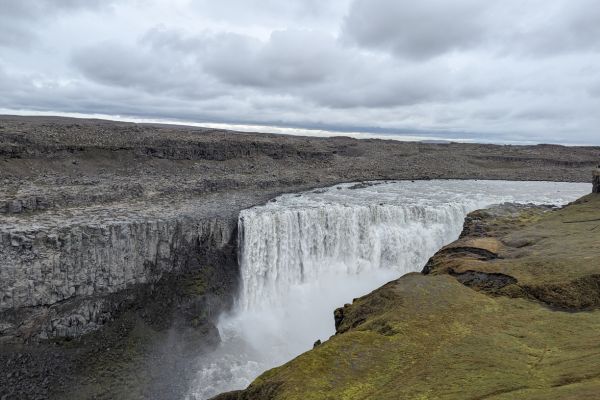
There are a variety of tours – from Akureyri – that will take you to Dettifoss, but this one also takes in Godafoss and other sites, so it’s a great way to maximize your time.
- How to get to Dettifoss: off Route 862 or Route 864, inside Vatnajökull National Park.
- How long to spend at Dettifoss: 45-60 minutes, a short but rocky path from the car park to the river.
- Entry: free.
- Parking: free at both access points.
Selfoss
Selfoss sits just upstream of Dettifoss on the same river, and worth being clear about upfront: this is the waterfall, not the town of the same name in South Iceland, two completely different places that share nothing but a name. At 11 meters (36 feet) tall and about 100 meters (330 feet) wide, it’s less powerful and much shorter than its famous neighbor, but it makes up for that in width, a series of narrow falls spread along a wide curve of canyon wall rather than one single drop.

It’s an easy add-on rather than a destination in its own right, 15-20 minutes from the Dettifoss parking area on the same stop.
- How to get to Selfoss: upstream from Dettifoss, inside Vatnajökull National Park, North Iceland.
- How long to spend at Selfoss: 15-20 minutes from the Dettifoss parking area, easily combined with a Dettifoss visit on the same stop.
- Entry: free.
- Parking: free, shared with Dettifoss.
Goðafoss
Goðafoss, the “Waterfall of the Gods,” is named for the legend that Iceland’s lawspeaker threw statues of the old Norse gods into it after the country officially converted to Christianity around 1000 AD. It’s a comparatively modest 12 meters (39 feet) tall but a wide 30 meters (98 feet) across, wide, symmetrical, and one of the more effortlessly photogenic stops on this whole list.
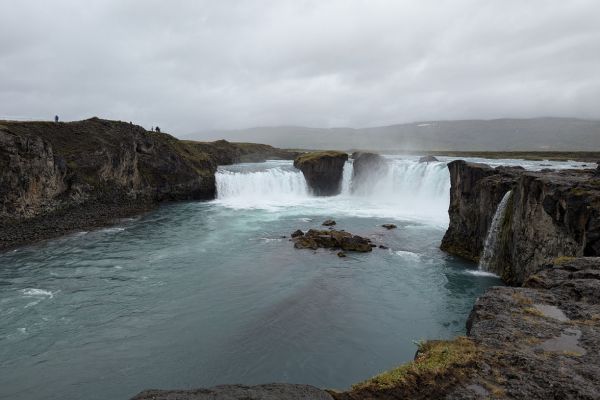
Wide, well-maintained paths run along both sides of the river, connected by a bridge, so you can view it from either bank without retracing your steps; a flat 30-45 minute walk covers both sides comfortably. Get yourself to Godafoss and Dettifoss on this combo tour from Akureyri.
- How to get to Goðafoss: right off Route 1, between Akureyri and Mývatn.
- How long to spend at Goðafoss: 30-45 minutes, wide, well-maintained paths on both sides of the river, connected by a bridge.
- Entry: free.
- Parking: free.
Top Waterfalls in the Westfjords
The Westfjords ask for more driving time than anywhere else on this list, but Dynjandi alone makes the detour worth it.
Dynjandi
Dynjandi is the largest waterfall in the Westfjords, also known as Fjallfoss, cascading 100 meters (328 feet) down a trapezoidal cliff that widens as it falls, from 30 meters (98 feet) at the top to 60 meters (196 feet) at the base. Its Icelandic name means “thunderous,” and the sound carries across the fjord below. Six smaller waterfalls drop beneath it on the same hillside, and a marked trail of about 15 minutes climbs past every one of them on the way up to the main cascade, easily the single best short hike in this entire region.
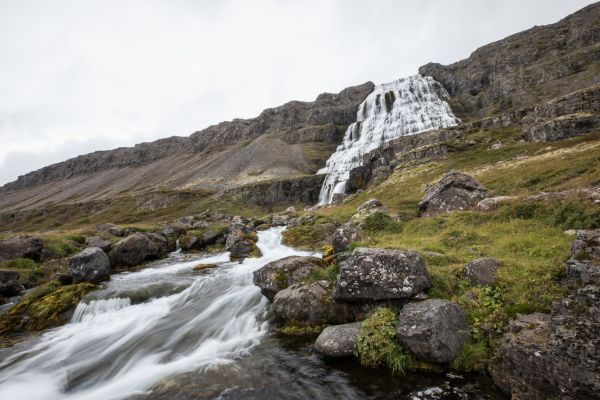
If you’re here in the Westfjords and not self-driving, the chances are that you’re on a cruise, so pick up this tour from Isafjordur and get to see Dynjandi.
- How to get to Dynjandi: on Road 60 in the Westfjords, about 3 hours from Ísafjörður, roughly 6 hours from Reykjavik.
- How long to spend at Dynjandi: about 15 minutes on a marked trail, passing the six smaller falls on the way up to the main cascade.
- Entry: free.
- Parking: 750 ISK, pay via the Parka app, toilets included, both close in winter when Westfjords roads become unreliable.
Valagil Falls
Valagil Falls stays hidden until the very last moment of the hike in, a multi-tiered waterfall that appears suddenly in a ravine once you cross a river bridge partway along the trail. Exact height isn’t well documented across sources, but it’s tall enough, and hidden enough, that most Westfjords visitors never make it out this far to see it. The hike itself runs to roughly 4 kilometers (2.5 miles) round trip, a moderate walk through meadow and across that river bridge, taking around 2 hours there and back at a comfortable pace.
- How to get to Valagil Falls: in the Westfjords, near Ísafjörður.
- How long to spend at Valagil Falls: around 2 hours round trip, roughly 4 kilometers (2.5 miles), through meadow, across a river bridge, then up toward the falls.
- Entry: free.
- Parking: free.
Top Waterfalls on Snaefellsnes
Snaefellsnes packs three worthwhile waterfalls into one compact peninsula, easy to see all three without much detour from the main loop.
Kirkjufellsfoss
Kirkjufellsfoss is the small, tiered waterfall that sits in the foreground of practically every photo of Kirkjufell mountain behind it, one of the most photographed compositions in the country. It’s a cascade rather than one tall drop; height really isn’t the draw here; the mountain behind it is, and the short boardwalk connecting the two main viewpoints takes barely a couple of minutes to walk.
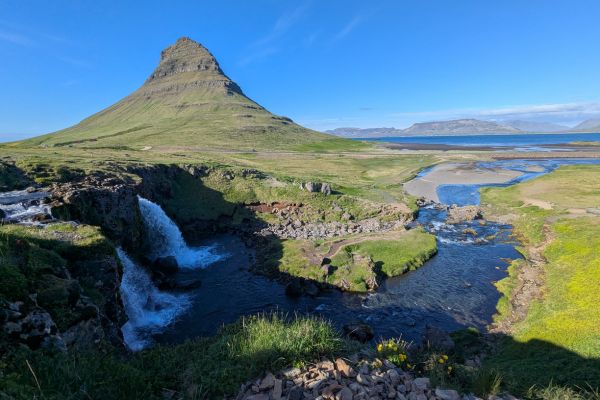
Budget extra time in summer specifically for waiting your turn behind other photographers rather than the walk itself; this is one of the most crowded few square meters on the whole peninsula. If you’re not self-driving, then small group tours are the way to go, especially on Snaefellsnes, where your stops are often. This is perfect to see Kirkjufellsfoss
- How to get to Kirkjufellsfoss: just outside Grundarfjörður, signposted off Route 54.
- How long to spend at Kirkjufellsfoss: 30-45 minutes at the viewpoint and waterfall, longer if you’re waiting out other photographers for a clear shot.
- Entry: free.
- Parking: 1,400 ISK, pay via the EasyPark app, shared with the Kirkjufell viewpoint car park.
Grundarfoss
Grundarfoss sits just outside its namesake town, one of the taller waterfalls on the peninsula at around 70 meters (230 feet), plunging over a dark basalt cliff face into a rocky basin below. It’s a straightforward family hike rather than anything technical, around 45 minutes round trip on a clear trail, with basalt columns behind the falls that surprise most first-time visitors expecting something smaller given how little attention it gets compared to Kirkjufellsfoss down the road.
- How to get to Grundarfoss: the trailhead starts right off Route 54.
- How long to spend at Grundarfoss: around 45 minutes round trip.
- Entry: free.
- Parking: free at the trailhead.
Map of Iceland’s Waterfalls
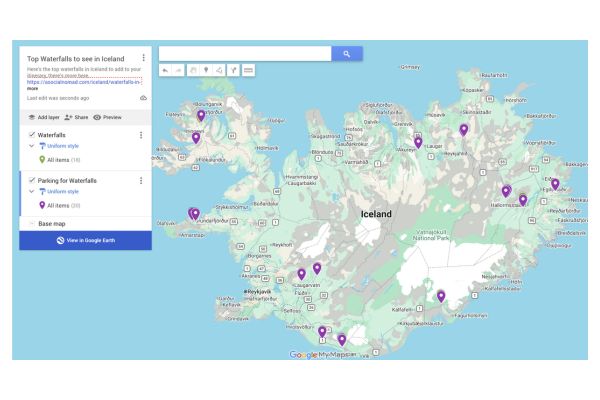
Here’s our map of every waterfall in this guide, region by region; you can also see the map here.
Tips for Visiting Waterfalls
A few practical habits make every stop on this list easier and safer.
Waterproof everything, even on a dry-looking day; spray from Skógafoss, Seljalandsfoss, and Dettifoss reaches you well before you expect it to, and it finds its way onto camera lenses within seconds. A proper rain shell and sturdy, waterproof boots cover most of what you need.
Walking behind Seljalandsfoss (or Kvernufoss) means getting wet; plan for it rather than being surprised by it, and know that the path behind Seljalandsfoss closes when ice builds up in winter; check signage at the car park rather than assuming it’s open.
Stay on marked paths at every single one of these. The ground near unfenced viewpoints, Dettifoss and Gullfoss especially, is wet, slippery, and often eroding at the edges, and rescue access is slow if something goes wrong. This isn’t so different from the sneaker wave caution that applies to Iceland’s black sand beaches, treat the water and the terrain around it with real respect, not just a photo opportunity.
FAQs on Waterfalls in Iceland
Got questions about Iceland’s waterfalls? Here are quick answers to what we’re asked most.
Can you walk behind Seljalandsfoss?
Yes, it’s one of the few waterfalls in the country where this is possible, and Kvernufoss offers the same experience with far fewer people around. Expect to get wet either way.
Which waterfall is the most powerful in Iceland?
Dettifoss, by volume, is regularly cited as one of the most powerful waterfalls in Europe, not just Iceland.
Are Iceland’s waterfalls free to visit?
The waterfalls themselves, yes, always. Parking is a different story; several of the most popular ones, Seljalandsfoss, Skógafoss, and Kvernufoss among them, charge a parking fee payable via kiosk or an app like Parka or Checkit.is. My guide to parking in Iceland (including all the charges and how to pay, is here)
What should I wear to visit waterfalls?
A waterproof jacket and pants, sturdy waterproof boots, and something to protect your camera or phone from spray. Layer up underneath your waterproofs; Icelandic weather can shift within twenty minutes, so a day pack to carry it all in is a good idea. There’s more in my guide on what to pack for Iceland here.
Which waterfalls are on the Golden Circle?
Gullfoss is the headline stop, with Bruarfoss a worthwhile detour nearby if you have the extra time.
Which waterfall is best for photography?
Kirkjufellsfoss, with Kirkjufell mountain framed behind it, is one of the most photographed compositions in the country. For raw power and scale instead, Dettifoss and Gullfoss both deliver.
Which is Iceland’s tallest waterfall?
Technically, Morsárfoss, at 228 meters, is the tallest, identified in 2007 as a retreating glacier exposed it. In practice, it’s remote and difficult to reach, so most visitors never see it. Glymur, at 198 meters, is the tallest waterfall most people can actually hike to, and it’s the one worth planning around if “tallest” is what you’re after. This amazing trip gets you within photo distance of Glymur, but that’s not the only highlight!
ICELAND TRAVEL RESOURCES
AIRPORT TRANSFERS
24/7 pickup & drop off. Trusted, local English speaking drivers. Prebook & prepay online with cards.
Book a Transfer
HOTELS AND APARTMENTS
See choices here
Rooms with a view? Budget rooms? Need a washing machine? The best choice of hotels & apartments.
TOURS & ATTRACTIONS
Most excursion choices, small group tours, skip-line tickets, free cancellation and top local guides.
Top options here.
CAR RENTAL OPTIONS
Choose cars here
Best choice of vehicles, automatics, large or small cars, child seats. Book early for more options.
Final Words on Waterfalls in Iceland
Iceland’s famous waterfalls earn the hype, Gullfoss and Dettifoss especially. But the quiet ones on this list, Kvernufoss, Stuðlafoss, and Valagil Falls, deserve just as much of your itinerary, mostly because almost nobody else stops for them. See both kinds, and you’ll come away with a fuller sense of what this country actually looks like.
ASocialNomad is a participant in the Amazon Services LLC Associates Program, an affiliate advertising program designed to provide a means for sites to earn advertising fees by advertising and linking to amazon.com, amazon.co.uk, and amazon.ca. Amazon and the Amazon logo are trademarks of Amazon.com, Inc. or its affiliates. As an Amazon Associate, I earn from qualifying purchases.

