
A metro station as a tourist attraction sounds on the unlikely side of quirky, but Almaty’s really is one. This single-line, 11-station system took 23 years to build, was started under Gorbachev in 1988, stalled completely when the Soviet Union collapsed, and finally opened in 2011. Each station along the way is a themed showcase of Kazakh history and culture: marble, mosaics, chandeliers, the works. And this, this blog post? It’s a self-guided walking and riding tour of the best stations, and yes, a paid guided version exists too if you’d rather have someone else do the talking. Here’s how to see Almaty’s most beautiful stations for the price of a metro ticket.
THIS POST MAY CONTAIN COMPENSATED AND AFFILIATE LINKS MORE INFORMATION IN OUR DISCLAIMER
A Quick History of the Almaty Metro
Construction of Almaty’s Metro system began in 1988 under Gorbachev, as a Soviet infrastructure project. It stalled almost immediately when the USSR collapsed and Moscow’s funding dried up with it. Kazakhstan restarted planning around 2005, using early-2000s oil-boom money to actually finish the job, and the metro finally opened on December 1, 2011, 23 years after groundbreaking, making it one of the longest metro construction projects in history.
Soviet Union Criteria at the time required that cities had to have one million residents before being approved for a rapid transit system. They met this in 1982. Almaty was the capital of Kazakhstan until 1991, when the capital was moved to Astana.
The original 7 stations of Almaty’s metro system were Raimbek Batyr, Zhibek Zholy, Almaly, Abay, Baikonur, Auezov Theatre and Alatau. Sayran and Moskva were added in 2015, and Saryarka and Bauyrzhan Momyshuli followed in May 2022, bringing the current total to 11 stations on one 11-kilometer line. Until May 2026, when the Astana light metro opened (more here), this was the only metro system in Kazakhstan. If you’re heading on to Astana next, see how to get there from Almaty.
Almaty very nearly built something far more futuristic than a conventional metro. Back in the Soviet era (1936 to 1991), planners considered Kazakhstan and Armenia as the first two Soviet republics to get a maglev line. That’s a magnetically levitating train that would have made Almaty, not Shanghai or Tokyo, the site of one of the world’s first maglev systems.
Almaty’s planners chose a conventional subway instead. Armenia’s Yerevan project pressed ahead until the devastating 1988 Spitak earthquake, and then the Soviet collapse killed it too. A second metro line has been talked about for years, but the city’s own planning documents now point toward light rail instead of a traditional second underground line.
Metro Tickets, Hours & Getting Around
A single ride costs 120 KZT, regardless of how far you’re going or how many stops you hop between.
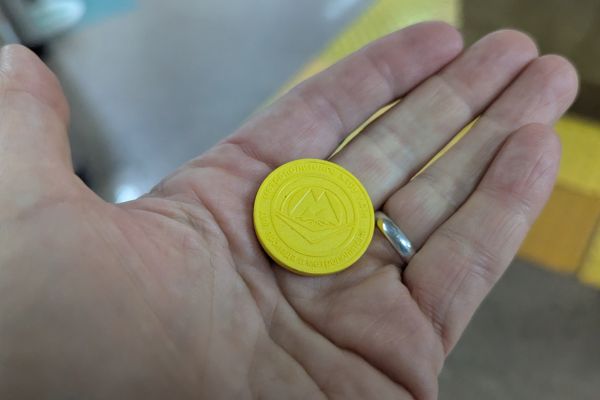
Buy a token at the staffed kassa window with cash, or use a reloadable Onay! card; most locals use this, and it’s valid for 3 years.
Some gates accept contactless bank cards and QR codes directly, though coverage isn’t complete across every station yet.
Children under 7 ride free. Ages 7-15 ride half price.
There’s a security and bag check at every station entrance before the ticket gates. It’s standard, not a hassle, but you’ll need an extra minute or two to get through this, more if it’s rush hour.
Scan your token, card or QR code to enter. There’s no need to tap or scan again on the way out. Your token goes into the slot on the way out.
Trains operate from 06:20 to 23:30, every 8 to 15 minutes; it tends to be more often during weekday rush hour, less often on weekends and holidays.
One ticket lets you jump between stations freely without exiting the system, and it’s ideal for a subway station tour like this one.
The metro is just one piece of getting around the country. See my complete guide to how to get around Kazakhstan for buses, trains and marshrutkas too.
The Best Stations to Visit
This route runs in a single line, so this works station by station in either direction. The order below starts at Zhibek Zholy, the same direction as the paid guided tour, and covers the most photogenic stops. We added this self-guided tour of Almaty’s subway into our Almaty travel plan, and also into our 10 day Kazaksthan Itinerary.
Zhibek Zholy (Silk Road) Metro Station
This is the most popular and most photographed of Almaty’s subway stations. It’s also a natural starting point. It’s named for the Kazakh word for the Silk Road. The walls resemble the lattice pattern inside a traditional yurt, with a mural of the shanyrak, the round roof-opening of a yurt and an important Kazakh symbol, at the end of the platform.
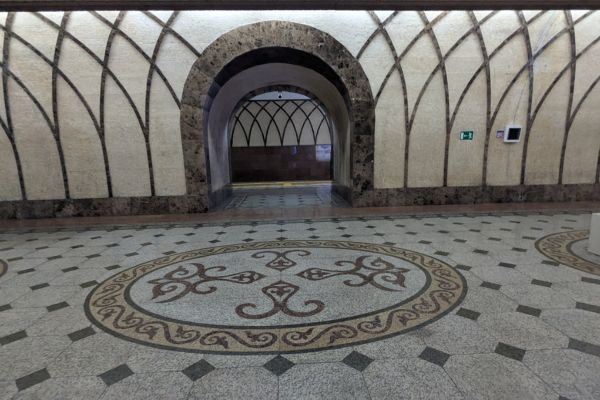
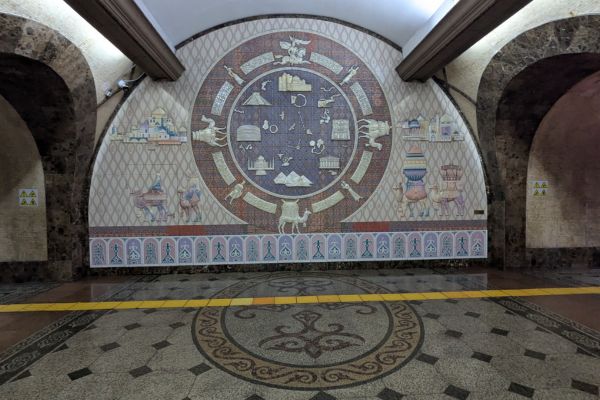
Circular abstract murals in gold mosaic add camel totems and merchant-route imagery to the theme, including, oddly enough, a bas-relief that features Mexican pyramids alongside the Silk Road scenes, presumably a nod to trade and civilization more broadly rather than anything literal.
Almaly (Apple) Station
This station is named after Almaty’s nickname, the City of Apples. There’s more on that in my guide to Almaty here. A glass mural of an apple tree welcomes you on the platform.
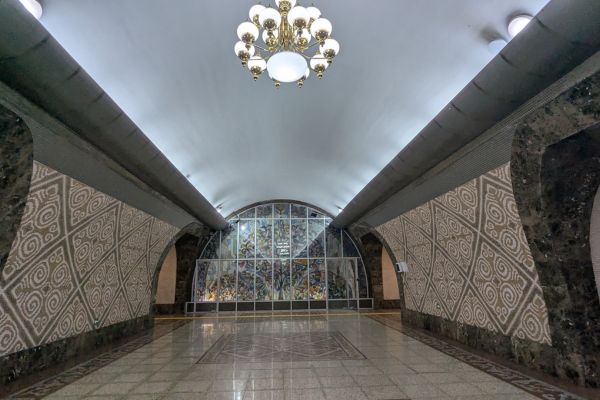
Alma is the Kazakh word for “Apples”. Almaty means “full of apples”. The foothills of the Tian Shan mountain foothills are the evolutionary birthplace of the modern domestic apple.
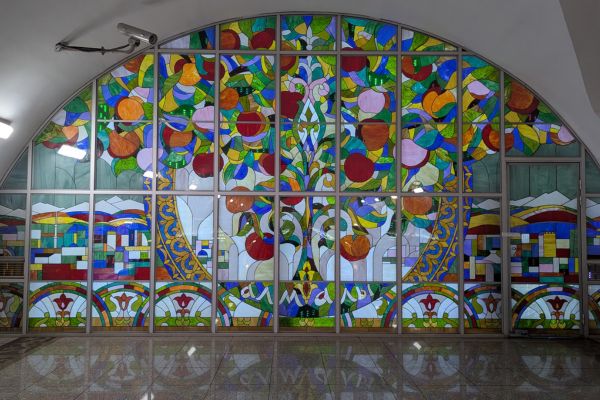
There are floor and wall patterns at this metro station echoing traditional Kazakh felt and carpet work.
Abay Station
This station is named for Abay Qunanbaiuli, Kazakhstan’s most celebrated poet, who can be equated roughly to the local equivalent of Rumi in Iran in terms of his cultural impact. There are Florentine-style mosaics lining the walls, with a bronze relief of the poet at either end.
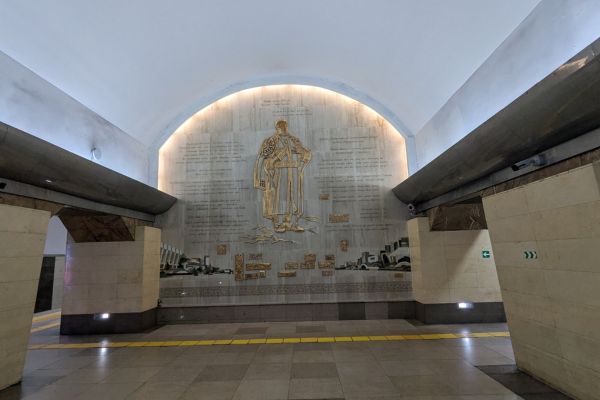
It’s also the system’s deepest station, at 78 meters, roughly a 3-minute escalator ride from street level, a legacy of the Soviet-era practice of building metros deep enough to double as air-raid shelters. The Kok-Tobe cable car entrance is right outside.
Baikonur Station
This space-themed metro station in Almaty was built to honor the Baikonur Cosmodrome, the launch site of Sputnik-1, Yuri Gagarin and Valentina Tereshkova. Baikonur itself is much further north in leased territory administered by Russia, not in Almaty.
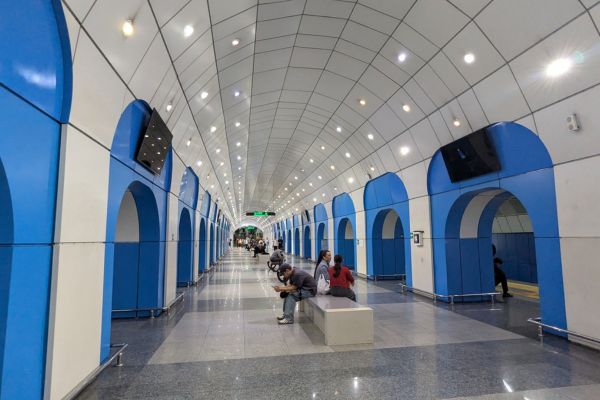
There are gleaming white and blue panels, star lights set into a blue dome, and launch footage playing on a screen at the platform’s end, making this the most visually striking station on the line.
Auezov Theatre Station
This station is named for Mukhtar Auezov, the Kazakh writer behind ‘The Path of Abay,’ and is located near the theatre that bears his name. The theater opened in 1926; it was originally established in the city of Kyzylorda, which was the then capital of the Kazakh SSR, and it moved here to Almaty in 1928, when Almaty was established as the then capital. The station opened on 1 December 2011.
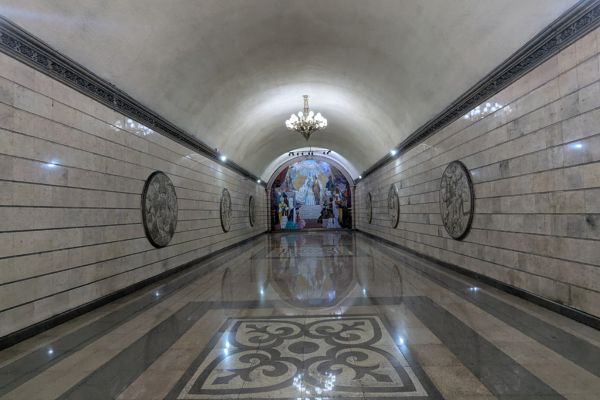
Circular stone carvings depict scenes of traditional Kazakh life, alongside a mural of a wedding scene, giving it a strong cultural, theatrical feel and making it one of the better photo stops on the line. There are white marble walls, polished granite, and elegant chandeliers.
Raimbek Batyr Station
This is the eastern terminus of the Almaty metro. A large statue of the 18th-century Kazakh military hero Raimbek Batyr greets you on the way out. The historic warrior was born in 1705, and his mausoleum is here in Almaty too, although it only dates to 1992, as his original tomb was destroyed in the Russian Civil War (1918 – 1922). This is the closest metro station to the train station here in Almaty, you should read my guide to traveling by train in Kazakhstan here.
Alatau Station
In this, one of Almaty’s newest metro stations (it was opened in 2015), mosaics depict Kazakhstan’s mountain ranges, including the Ile-Alatau range that borders Almaty itself.
Moskva Station
“Moscow Station” commemorates Russia-Kazakhstan relations, renamed from a planned ‘Molodyozhnaya’ as a diplomatic gesture. Aside from anything else, it’s very, well, red.
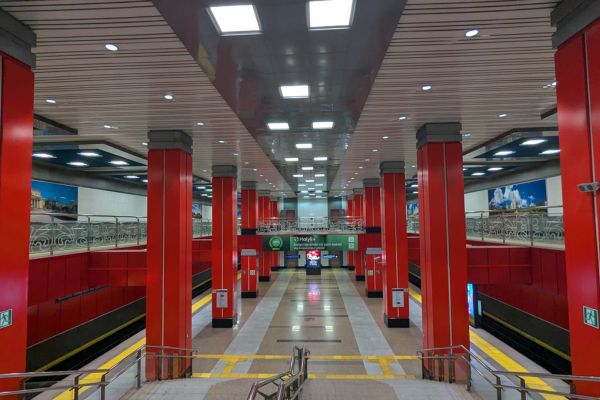
It’s the closest station to Sayran bus station, useful if you’re heading onward from Almaty to Bishkek.
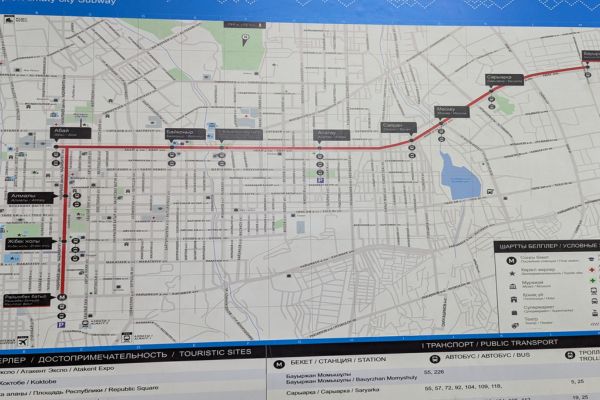
Map of Almaty’s Metro Stations
Here’s the map of Almary’s metro stations.
How Long Do You Need to tour Almaty’s metro stations?
We took around 2 hours for our tour of Almaty’s metro. You get one ticket, or token, and it covers unlimited station-hopping without exiting, so there’s no rush. We waited sometimes for more than one train to stop, so we could take photos and have a proper look around the stations.
Guided Tour vs Self-Guided – Which Should You Do
Walking Almaty runs a paid, 1.5 to 2.5-hour guided walking tour, starting from US$50 per person, starting at Zhibek Zholy and ending at Almaly. It’s worth it if you want the deeper stories and behind-the-scenes trivia rather than just reading station plaques. For most people, us included though, this is an easy, cheap DIY outing. The metro itself costs pennies, and the stations are self-explanatory enough to enjoy without a guide.
FAQs about touring the Almaty Metro
Here are the questions that you’re likely to have that I haven’t answered yet.
Is the Almaty metro worth visiting as a tourist attraction, not just transport?
Yes. It’s regularly compared favorably to far more famous metros, and while it doesn’t compare to St Petersburg, I’m guessing it’s unlikely that you’re traveling there at the moment.
How many stations does the Almaty metro have?
There are 11 metro stations on Almaty’s metro, on a single line, as of the 2022 additions.
How much does a ride cost?
A single ride costs 120 KZT (read my guide to currency, cash and paying in Kazakhstan here). It’s a flat rate no matter how far you’re going.
Do I need a guide for the Almaty metro?
No, it’s easy to do self-guided, though a paid guided option exists for anyone who wants more depth.
How did Almaty almost build the first maglev monorail in the world?
Soviet planners once considered Kazakhstan and Armenia as the first two Soviet republics to get a maglev line. Almaty went with a conventional subway instead, and Armenia’s own maglev project was derailed by the 1988 Spitak earthquake and then the Soviet collapse, so neither ever happened.
Why are Mexican pyramids depicted on a bas-relief of the Silk Road?
Mexican pyramids are part of the ceramic bas-relief at Zhibek Zholy station depicting global trade and civilization more broadly, alongside the Silk Road imagery you’d expect. Nobody I found has a definitive explanation for the specific choice; it just is.
Which station’s artwork was covered up for more than a decade by a portrait of Kazakhstan’s former president?
This is Almaly metro station. The original artwork, you know that glorious panel of stained glass depicting apples? Just before this metro station opened in 2010, a portrait of Kazakhstan’s president, Nursultan Nazarbayev, was put on top of the original artwork. It’s no longer there.
PRACTICAL TRAVEL TIPS
- 🛡️ Get Travel Insurance: Civitatis includes medical expenses, repatriation, theft, luggage delays. No deductibles or upfront payments. Get a quote here.
- 🛏️ Sea view? Laundry? Private bath? Book a Room.
- 🔌 Be ready for the plug, socket & power situation.
- 📶 Get online EASILY & cheaply – One eSim for the world. Data never expires
Final Words on Touring Almaty’s Metro
Almaty’s metro is a lovely oddity; it’s a very functional transport system that doubles as one of the city’s better free, or nearly free, attractions. It’s worth riding the whole line once for the novelty, then come back and see the stations you want to on the way back. It’s cheap, it’s air-conditioned, and it’s a much better use of an hour than you’d expect from a subway. Still got time in Almaty beyond the metro? Check out the best day trips from Almaty for more ideas.
ASocialNomad is a participant in the Amazon Services LLC Associates Program, an affiliate advertising program designed to provide a means for sites to earn advertising fees by advertising and linking to amazon.com, amazon.co.uk, and amazon.ca. Amazon and the Amazon logo are trademarks of Amazon.com, Inc. or its affiliates. As an Amazon Associate, I earn from qualifying purchases.

